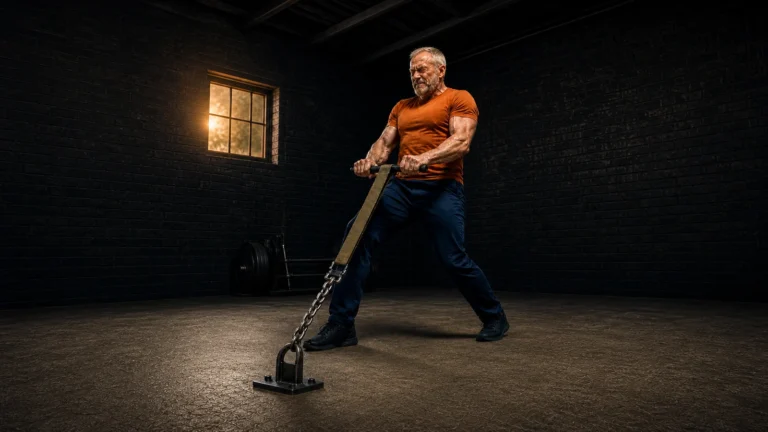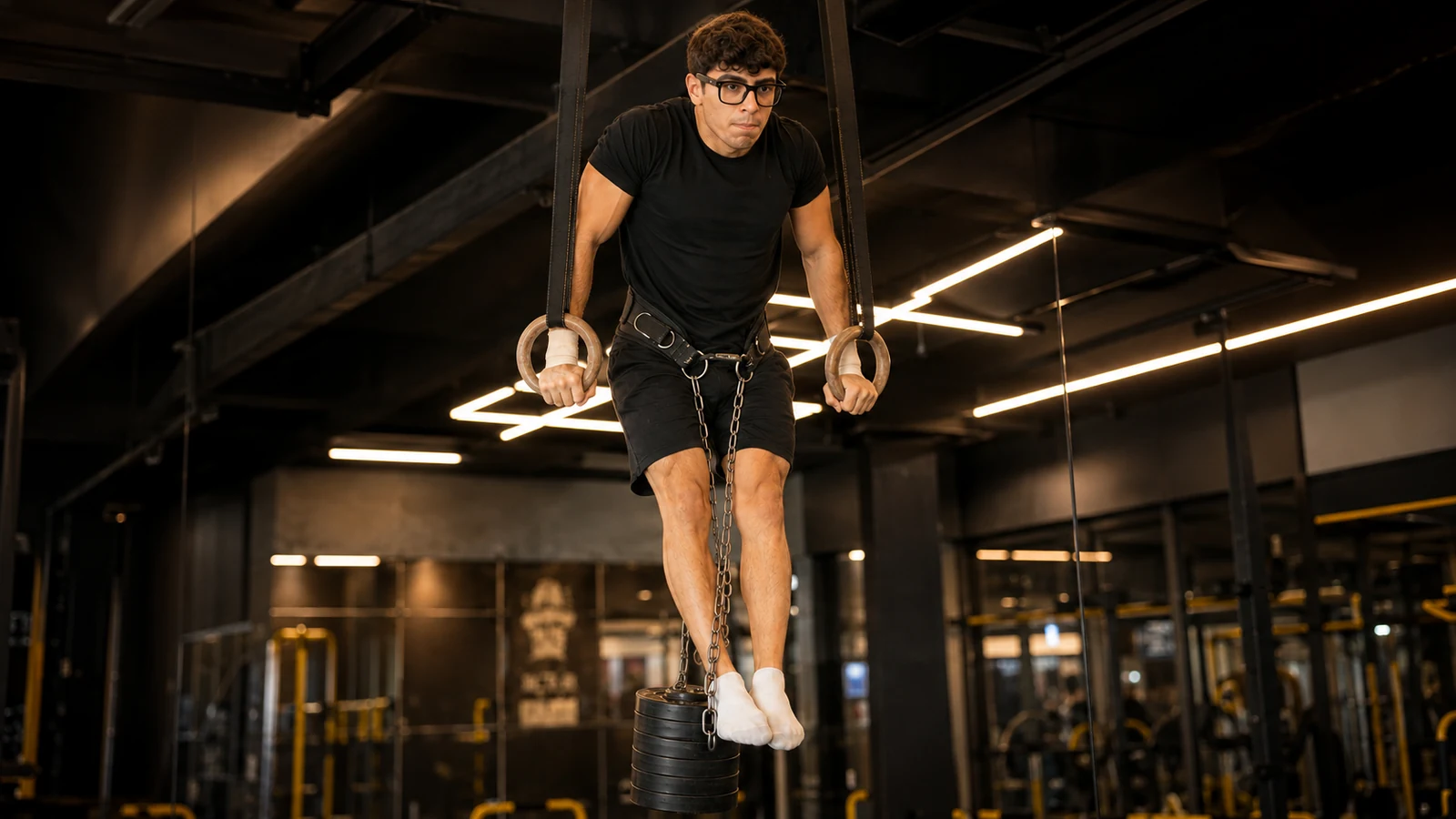

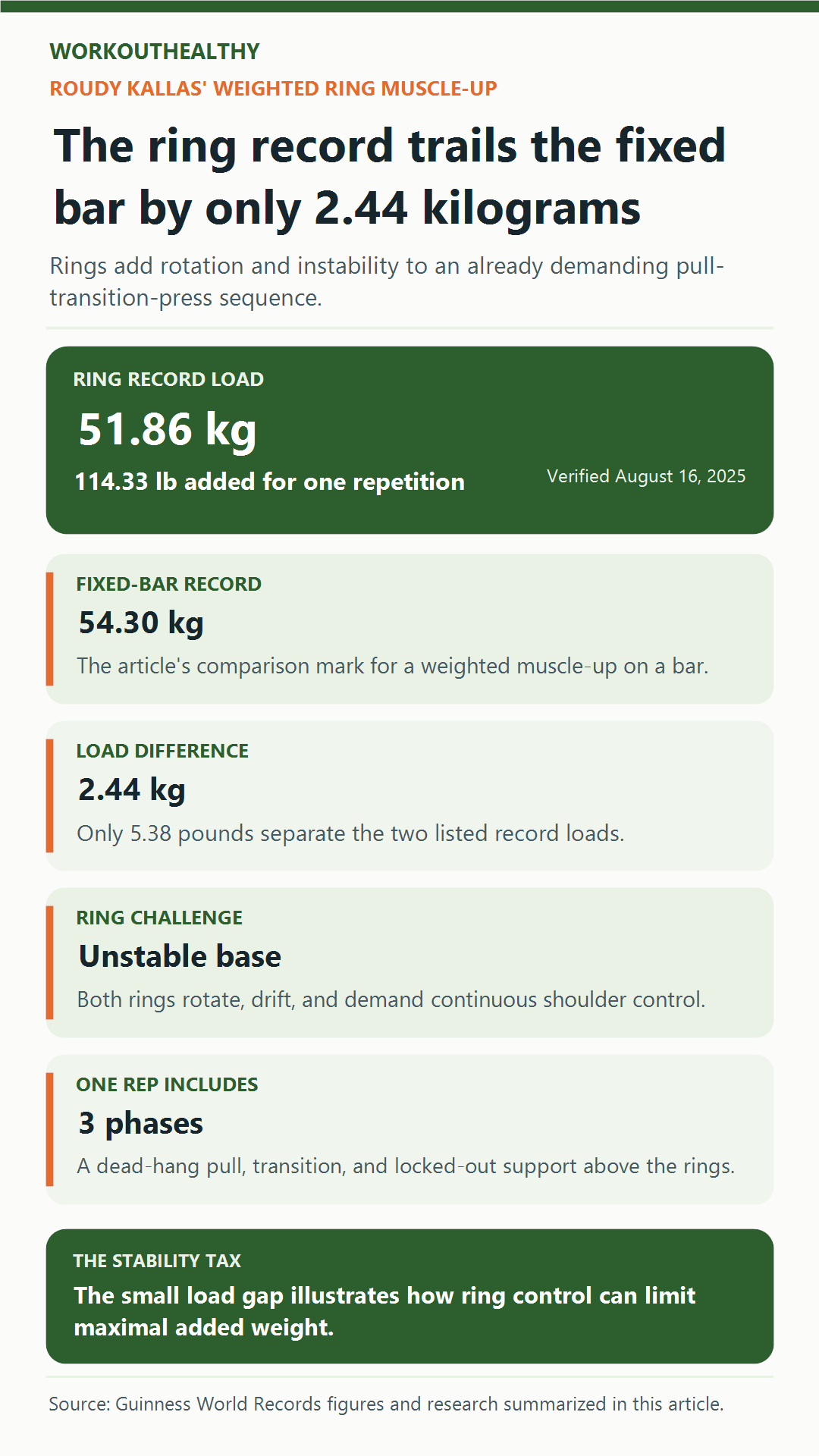
Roudy Kallas performed a ring muscle-up with 51.86 kilograms of extra weight strapped to his body.
Guinness World Records recognized it as the heaviest weighted ring muscle-up ever completed by a man.
He set the record on August 16, 2025, at a gym in Dbayeh, Lebanon.
Fifty one point eight six kilograms works out to about 114 pounds, roughly the weight of a fully loaded barbell, except this weight hung from his body instead of resting in his hands.
A ring muscle-up starts from a dead hang below two gymnastics rings and ends with the athlete’s arms locked out above them, in a support position, in one continuous motion.
Add over 100 pounds to that movement and you are no longer looking at a gym exercise.
You are looking at one of the more extreme single-rep strength displays in calisthenics, and it raises a real question: what does a human shoulder, elbow, and grip actually have to do to survive that load, even once.
What We Could Confirm, and What We Could Not
Guinness World Records lists this exact record on its own website, under record ID 15-724540.
The name, weight, date, and location on that official page match what circulated on social media.
That listing is the strongest confirmation available for a Guinness claim, since Guinness itself is the organization that decides whether an attempt counts.
Independent Lebanese press coverage, from the outlet IM Lebanon, also reported the achievement.
That report added a detail Guinness’s own page does not include: Kallas reportedly trained on a bar his father built for him at home, rather than in a professional gymnastics facility.
What we cannot verify from the outside is Guinness’s internal adjudication process for this specific attempt, since that review happens privately between the athlete and the organization.
The video tied to this record in our source material is an Instagram reel Kallas posted himself, not official Guinness broadcast footage, though its content lines up with what Guinness lists as the record.
So here is the honest summary: this is a real, currently listed Guinness World Record, backed by an official record page and independent press coverage, and the underlying video is athlete-posted footage rather than a third party broadcast.
That is a different, and stronger, evidence picture than a lot of viral fitness claims get, which is worth saying plainly rather than assuming.
Why a Ring Muscle-Up Is Harder Than a Bar Version
Most people who can do a muscle-up learned it on a fixed bar first.
Rings change the exercise because they are not fixed to anything.
They rotate, drift, and swing under load, which means your shoulders, wrists, and core have to actively fight instability on top of pulling and pressing your body weight.
A 2017 study presented at the International Journal of Exercise Science conference measured muscle activity during ring muscle-ups versus bar muscle-ups using surface electromyography (Walker et al., 2017).
The ring version produced significantly more activation in the upper trapezius, biceps brachii, and forearm flexors during the pulling phase, and more activation in the triceps and biceps during the pressing phase.
The researchers attributed this to instability, noting that an unstable base forces smaller stabilizer muscles to work harder to keep the rings, and the body, under control.
They also recommended a specific training order: build strength and confidence on a bar muscle-up first, then move to rings once those smaller stabilizing muscles are conditioned.
That progression matters even more once you add external weight, since a heavier load amplifies whatever the rings are already doing to your joints.
What Happens to Your Joints When You Load a Muscle-Up
Adding weight to a muscle-up does not just make the exercise harder in a general sense.
It changes the physics at specific joints, especially the shoulder.
A 2020 biomechanical study in the Scandinavian Journal of Medicine and Science in Sports modeled muscle forces across different pull-up hand positions and found that grip and arm position change how much force individual rotator cuff muscles have to produce to control the shoulder (Urbanczyk et al., 2020).
In plain terms, technique is not a minor detail here.
It is one of the main variables that decides whether a heavy pulling movement stresses the rotator cuff in a low risk way or a high risk way.
Now add over 50 kilograms to that same joint chain.
The transition point of a muscle-up, where the body moves from pulling to pressing, already asks a lot of the shoulder because the joint has to change its role mid-rep.
Under heavy added load, that transition happens with far more force running through the same tendons and cartilage.
“You are the reason, and you are the strength that taught me never to surrender.”
For comparison, a controlled pressing movement like the floor press deliberately shortens the range of motion and removes leg drive to limit joint stress.
You can read more about how that changes the load on your shoulders and elbows compared with a standard bench press.
A weighted ring muscle-up is close to the opposite approach.
It keeps a long, complex range of motion, an unstable base, and adds heavy load on top of all of it.
How Strong You Have to Be Before Weight Even Enters the Picture
You do not add 114 pounds to a muscle-up as a beginner move.
A 2021 study published in the journal Sports measured the raw strength required for advanced static ring positions in elite male gymnasts (Schärer et al., 2021).
The researchers tested 19 elite athletes on three difficult ring holds and expressed the force required as a percentage of each athlete’s own body weight.
The support scale position required concentric strength equal to roughly 60 percent of body weight, and eccentric strength closer to 87 percent of body weight.
Even among elite gymnasts, several athletes in the study could not perform some of these positions using body weight alone and needed assistance just to complete the testing protocol.
That is the baseline population a record like this comes out of: athletes who already produce forces close to their entire body weight through their shoulders and arms before anyone talks about adding a single extra kilogram.
For scale, Guinness also lists a separate record for the heaviest weighted muscle-up on a fixed bar, held by Liu Weiqiang at 54.30 kilograms, slightly above the ring version.
That gap is a small, real data point in favor of what the EMG research above suggests: rings add a stability tax that a fixed bar does not.
What This Record Does Not Prove
A single verified world record answers a narrow question: can this one person move this exact load, one time, on this specific day.
It does not prove that heavily weighted muscle-ups are a safe or necessary training method for anyone else.
It does not tell us how many failed attempts came before the successful one, or what Kallas’s shoulder health looks like five or ten years from now.
It also does not prove that maximal single-rep loading builds more usable strength than moderate, higher-rep weighted calisthenics work.
A separate 2017 study in Isokinetics and Exercise Science tracked untrained men through eight weeks of bodyweight calisthenics training, with no added external load at all (Thomas et al., 2017).
Pull-up performance improved by 39.2 percent and push-up performance improved by 16.4 percent in that group, alongside measurable fat loss, using nothing but bodyweight progressions.
That result says something important: you do not need a record-setting external load to build real, meaningful pulling strength.
A single extreme feat and a sustainable strength program are two different questions, even when they involve the same exercise family.
Common Mistakes and Injury Risks in Weighted Calisthenics
The most common mistake is skipping straight to added weight before bodyweight technique is genuinely solid.
A 2024 biomechanical study in Sport Sciences for Health tracked pull-up form across repeated repetitions and found that movement quality and safety scores dropped significantly as fatigue set in (Garavaglia et al., 2024).
Fatigued reps showed more compensation, including extra hip and knee swing used to generate momentum instead of pulling strength.
That same pattern shows up in weighted muscle-ups, where a tired athlete starts kipping or jerking to move the extra load instead of controlling it.
Kipping under a heavy external load multiplies the force spike at the shoulder compared with a strict, controlled rep.
Another common error is adding weight to the whole movement at once, instead of building weighted strength separately in the pull and the dip first.
People also frequently underestimate the elbow, focusing all their caution on the shoulder while the elbow absorbs real stress during the transition and lockout.
Rushing load progression, meaning adding more weight every session instead of every few weeks, is one of the fastest routes to a tendon overuse injury in this kind of training.
Who Should Be Extra Cautious
Anyone with a history of shoulder impingement, labrum tears, or rotator cuff strain should treat weighted ring work as advanced territory, not a near-term goal.
People still building basic pulling strength, meaning anyone who cannot yet do 8 to 10 strict, controlled bodyweight muscle-ups, should not be adding external load to the movement at all.
Adolescents whose growth plates have not fully closed carry extra risk from heavy loaded overhead and pulling work, and should train under qualified supervision if at all.
Anyone with elbow tendon pain, including golfer’s or tennis elbow symptoms, should resolve that issue before loading a movement that stresses the elbow this directly.
People with uncontrolled high blood pressure should also be cautious, since near-maximal strength efforts like this involve a real spike in blood pressure during the hardest part of the rep.
None of this means weighted calisthenics is inherently dangerous for a well-prepared athlete.
It means the preparation has to come first, measured in years for most people, not weeks.
How to Actually Start Progressing Toward This
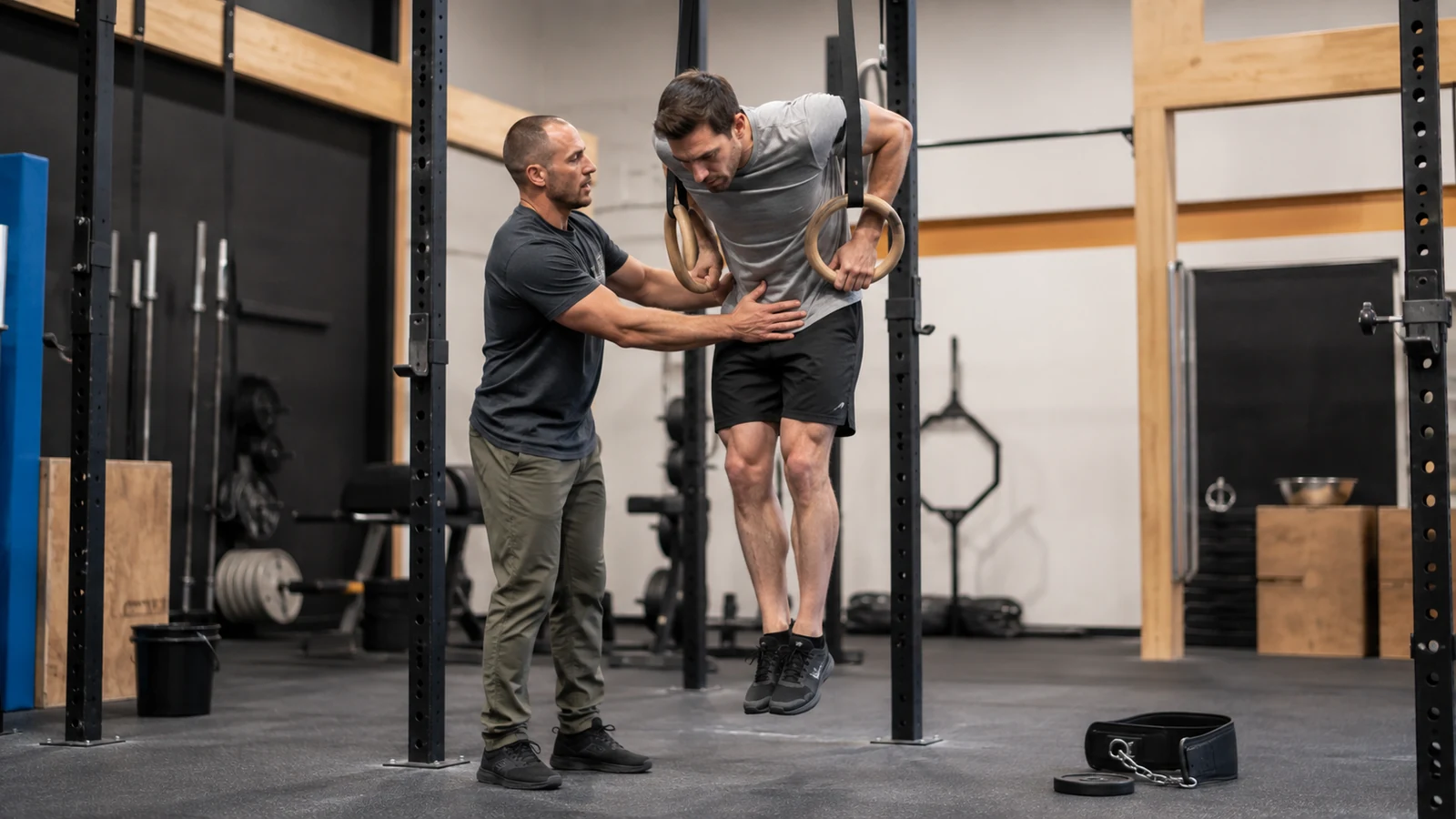
Step one is boring on purpose: build strict, dead-hang pull-ups until you can do sets of 10 or more with clean form and no swinging.
Step two is the dip side of the movement: build strict ring or bar dips to a similar standard, locking out fully at the top every rep.
Step three is the unweighted muscle-up itself, ideally on a fixed bar before rings, practiced until it is consistent and controlled, not just occasionally possible.
Step four moves that same unweighted muscle-up onto rings, since the instability alone is a meaningful new demand before any weight gets involved.
Step five is where external load finally enters, and it should start on the individual pieces, not the combined movement.
Add a light weighted vest or dip belt to your pull-ups and dips separately, in small increments, and give each new load at least two to three weeks before adding more.
Step six is combining a small, manageable added load with the full muscle-up, only once the individual weighted pull and weighted dip both feel genuinely controlled.
Throughout this process, track load increases by the week or month, not the session, since tendons and cartilage adapt far slower than muscle does.
If you are new to structured strength training in general, this is exactly the kind of multi-year progression where working with a qualified coach can help you sequence the steps safely instead of guessing.
A coach or experienced training partner can also spot form breakdown before it becomes a habit, which matters most exactly when fatigue is highest.
This is not the first Guinness bodyweight record we have looked at closely on this site.
DonnaJean Wilde’s push-up world record required a similarly obsessive approach, just built around pacing and endurance instead of raw added load.
Records like Edith Connor’s Guinness bodybuilding record are a good reminder that official verification confirms a feat happened, without telling you everything about how it was trained for.
Watch the Video
The footage tied to this record is a reel Roudy Kallas posted to his own Instagram account.
You can also view the official Guinness World Records listing for the record itself, which independently confirms the athlete’s name, the weight, the date, and the location.
What is not independently visible to us is Guinness’s private adjudication footage or paperwork, which is normal for how the organization verifies records and is not unique to this claim.
Want more real feats explained with real science? Subscribe to WorkoutHealthy Insider for practical explanations behind popular fitness claims.
References
Garavaglia, L., Romanò, J., Lazzari, F., & Pittaccio, S. (2024). Biomechanical characterisation of the pull-up exercise. Sport Sciences for Health, 20(1), 221–234. https://doi.org/10.1007/s11332-023-01097-1
Schärer, C., Huber, S., Bucher, P., Capelli, C., & Hübner, K. (2021). Maximum strength benchmarks for difficult static elements on rings in male elite gymnastics. Sports, 9(6), 78. https://doi.org/10.3390/sports9060078
Thomas, E., Bianco, A., Mancuso, E. P., Patti, A., Tabacchi, G., Paoli, A., Messina, G., & Palma, A. (2017). The effects of a calisthenics training intervention on posture, strength and body composition. Isokinetics and Exercise Science, 25(3), 215–222. https://doi.org/10.3233/IES-170001
Urbanczyk, C. A., Prinold, J. A. I., Reilly, P., & Bull, A. M. J. (2020). Avoiding high-risk rotator cuff loading: Muscle force during three pull-up techniques. Scandinavian Journal of Medicine & Science in Sports, 30(11), 2205–2214. https://doi.org/10.1111/sms.13780
Walker, C. W., Brunger, A., Tucker, S., & Lee, R. (2017). Comparison of muscle activity during a ring muscle up and a bar muscle up. International Journal of Exercise Science: Conference Proceedings, 11(5), Article 28.
This article is for general information only and is not medical advice. If you have an injury, ongoing pain, or a medical condition, talk to a doctor or physical therapist before you change how you train or eat.