
Randall Park has spent years playing versions of ordinary people who end up in extraordinary situations.
In November 2024, he put himself in one of the more literal versions of that setup.
Park lined up at the start of the TCS New York City Marathon alongside roughly 55,000 other runners.
He is best known for starring as Louis Huang on ABC’s Fresh Off the Boat, and for playing FBI Agent Jimmy Woo across several Marvel projects, including WandaVision.
He also co-wrote and starred in the Netflix film Always Be My Maybe and made his feature directing debut with Shortcomings in 2023.
None of that experience helps much over 26.2 miles of pavement.
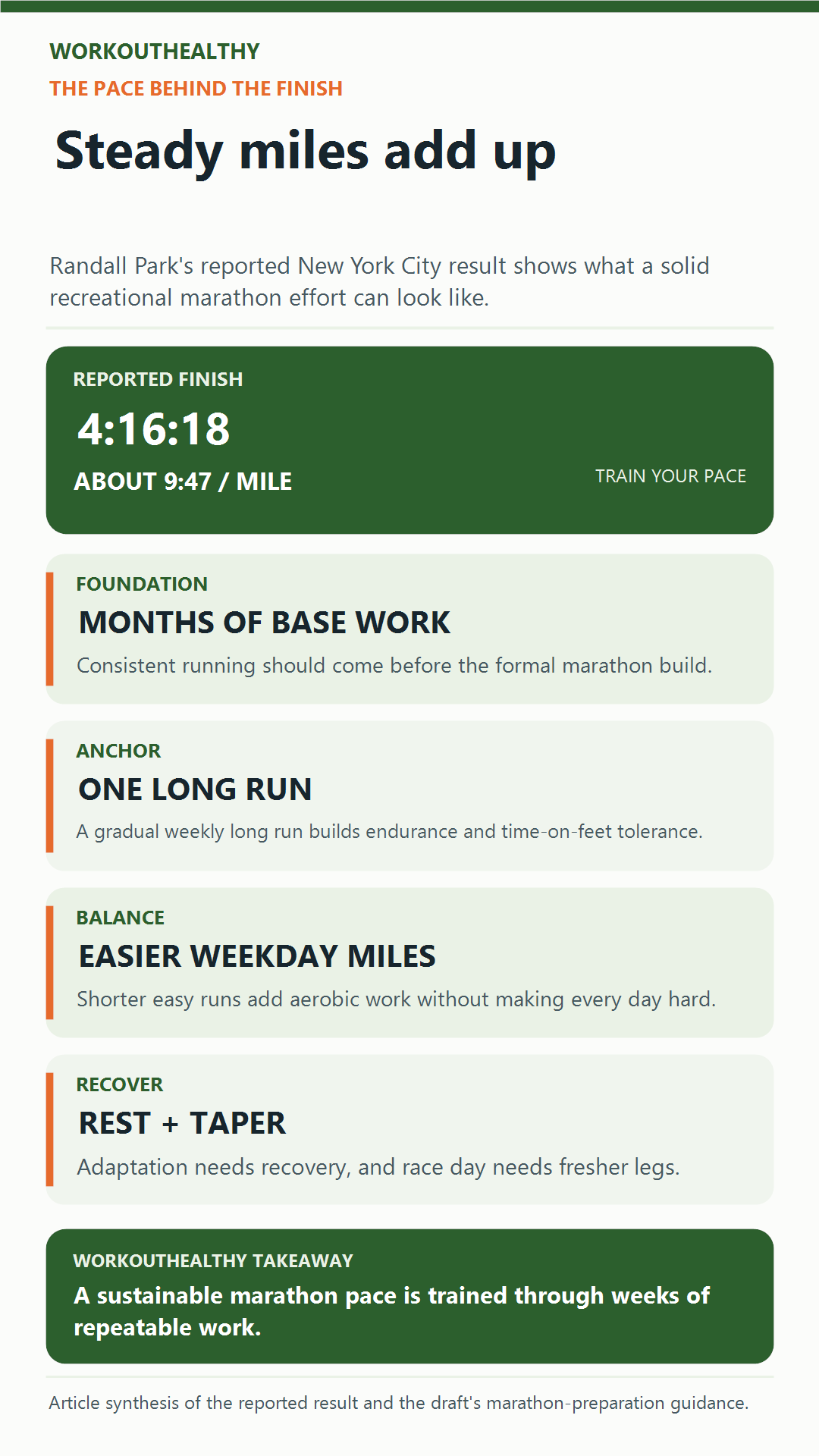
Park finished the race in 4 hours, 16 minutes, and 18 seconds. That works out to an average pace of roughly 9 minutes and 47 seconds per mile, a steady, sustainable effort rather than anything close to elite speed.
What a 9:47 Mile Pace Actually Means
Elite marathoners finish in a little over two hours, running close to a 4:40 mile pace for the full distance.
That is not the standard most runners, including most celebrities who take on a marathon, are working toward.
A roughly 4 hour 16 minute finish sits solidly in the range most race organizers describe as a typical recreational finishing time.
It is not a slow time by any meaningful definition, and it is not a fast one either.
That middle ground is worth naming directly, because it is the most common experience at almost every major marathon.
Most finishers are not competing for anything except finishing strong and staying healthy along the way.
A 9:47 per mile pace also reflects real training. Nobody walks into a marathon and holds that pace for over four hours without meaningful preparation beforehand, regardless of natural fitness level.
What Marathon Training Actually Requires
Marathon training is less about any single hard workout and more about accumulated weeks of consistent mileage.
Most structured programs run somewhere between 16 and 20 weeks before race day.
A long run, usually done once a week, builds up gradually over the training block.
This run teaches the body to burn fuel efficiently and gives the joints and connective tissue time to adapt to sustained impact.
Shorter runs during the week maintain aerobic fitness without adding as much cumulative stress. Many programs also include one day devoted to easier paced running, meant to build endurance without pushing intensity.
Rest days matter as much as training days in a well built plan. Muscles and connective tissue adapt during recovery, not during the run itself, which is a detail many new runners underestimate.
Cross training, such as cycling or swimming on non running days, is another common feature of established marathon programs.
It adds aerobic conditioning without stacking more impact on the same joints that absorb every mile of running.
For a working actor with an unpredictable schedule, cross training also offers flexibility that a strict running-only plan does not.
Sleep quality tends to get less attention than mileage in most marathon advice, even though it plays a direct role in recovery.
Poor sleep during a heavy training block can slow the exact adaptations a training plan is trying to build.
The Injury Risk Research Behind Marathon Prep
Marathon training carries a real injury risk, and researchers have spent years trying to identify what predicts it.
One study following runners as they began marathon training programs identified specific baseline factors linked to higher injury rates during preparation (Chorley et al., 2002).
Those factors included things like previous injury history and how quickly training volume increased early in a program.
This lines up with something coaches have said for years without always having research behind it.
A separate randomized trial, known as the GRONORUN study, tested whether a gradual, structured training program could reduce running related injuries in novice runners compared to less structured approaches (Bredeweg, 2012).
The core idea behind that kind of research is simple. Increasing training volume too quickly is one of the more reliably identified risk factors for overuse injury in new runners, regardless of a person’s overall fitness level going in.
Common marathon training injuries include shin splints, runner’s knee, and stress fractures in the foot or lower leg.
Most of these fall under the umbrella of overuse injuries, meaning they build gradually from repeated stress rather than from a single sudden event.
That makes them harder to notice early, since the first warning signs are often mild and easy to run through.

Does Age Change What a Good Marathon Time Looks Like
Park was 50 years old when he ran the 2024 New York City Marathon. Age is a real factor in marathon performance, though not always in the direction people assume.
A long term study tracking marathon finishing times among amateur male runners over several decades found finishing times do change with age, but the pattern is gradual rather than a sharp cliff at any single birthday (Lehto, 2016).
Performance decline tends to accelerate more noticeably after the 50s and 60s in that research, rather than showing up suddenly at an earlier age.
Many runners in their 40s and 50s post some of the strongest times of their running lives, particularly if they came to the sport later.
This matters for how a story like Park’s gets read. A sub 4:30 marathon at 50 is a genuinely solid athletic effort, not primarily a story about beating the odds of age.
How This Compares to General Marathon Guidance
Running organizations and coaches generally agree on a few core principles for a first marathon, and Park’s public numbers line up with that standard advice rather than contradicting it.
A common guideline suggests increasing weekly mileage by no more than about 10 percent from one week to the next, giving the body time to adapt without accumulating overuse injury risk.
Most coaches also recommend at least one prior half marathon or similar distance race before attempting a full marathon, both for physical preparation and for learning how a runner’s own body handles race day conditions.
A 9:47 per mile finishing pace for a full marathon generally reflects a training base built over months, not a single burst of late preparation.
It is consistent with a runner who respected the buildup rather than rushing it.
Common Mistakes First-Time Marathoners Make
One of the most common mistakes is increasing mileage too quickly in the excitement of early training.
A new runner feels good after a few weeks and adds distance faster than tissue can adapt.
Another frequent mistake is skipping the long run when life gets busy, then trying to make it up later with a much longer run than the plan called for.
That kind of compensation increases injury risk instead of fixing the missed week.
Starting the race itself too fast is another classic error. Adrenaline and a crowded starting corral make an easy pace feel too slow in the first mile, which often leads to a much harder second half of the race.
Ignoring nutrition and hydration training is another common gap. Race day is the wrong time to test a new gel or sports drink for the first time, since digestive reactions during a long run are hard to predict in advance.
Finally, many new marathoners neglect strength training entirely, treating running volume as the only variable that matters.
Some baseline strength work, especially for the hips and core, helps runners hold form as fatigue builds late in a race.
A related mistake is buying new shoes right before race day instead of breaking them in over several weeks of training runs.
Even a well fitted shoe can cause blisters or irritation if a runner’s feet have not adapted to it, and race day is a bad time to discover that problem for the first time.
Overtraining in the final two weeks before the race is another common trap. A taper period, where mileage drops noticeably before race day, lets the body arrive rested rather than fatigued from the training block itself.
A Practical Guide to Training for a First Marathon
Anyone considering a first marathon should start with an honest assessment of current running fitness rather than jumping straight into a generic 16 week plan.
A simple baseline check, like the four flights of stairs test, can offer a rough starting point before formal training begins.
Build a consistent running base of at least a few months before starting formal marathon training, ideally including a 10K or half marathon along the way.
Increase weekly mileage gradually, following something close to the 10 percent guideline rather than chasing quick jumps in distance.
Prioritize the weekly long run as the cornerstone workout, and protect it from being skipped or rescheduled whenever possible.
Add one or two easier, shorter runs during the week to build aerobic fitness without adding excessive fatigue.
Include rest days deliberately, treating them as part of training rather than as time off from it.
Practice race day nutrition and hydration during long training runs, not for the first time on race morning.
Anyone considering caffeine as a race day performance aid should test it during training first, since individual tolerance and timing vary widely.
Add basic strength training two times a week, focusing on hips, glutes, and core stability to support running form under fatigue.
Start the race itself deliberately slower than goal pace for the first mile or two, letting the body settle before pushing toward target pace.
Break in new running shoes over several weeks of training runs, never on race day itself.
Plan a taper in the final two to three weeks before the race, gradually reducing mileage so the body arrives at the starting line rested rather than worn down.
Pay attention to sleep and stress during the heaviest training weeks, since recovery outside of running has a real effect on how well the body adapts to the work being put in.
References
Chorley, J. N., Cianca, J. C., Divine, J. G., & Hew, T. D. (2002). Baseline injury risk factors for runners starting a marathon training program. Clinical Journal of Sport Medicine, 12(1), 18-23.
Bredeweg, S. W. (2012). GRONORUN: Does a graded training program for novice runners prevent injury? A randomized controlled trial protocol. ISRCTN registry.
Lehto, N. (2016). Effects of age on marathon finishing time among male amateur runners in Stockholm Marathon, 1979-2014. Journal of Sport and Health Science, 5(3), 349-354.
This article is for general educational purposes and is not a substitute for personalized medical or coaching advice. Anyone starting marathon training, especially after a period of inactivity or with an existing health condition, should consult a physician before significantly increasing exercise volume or intensity.