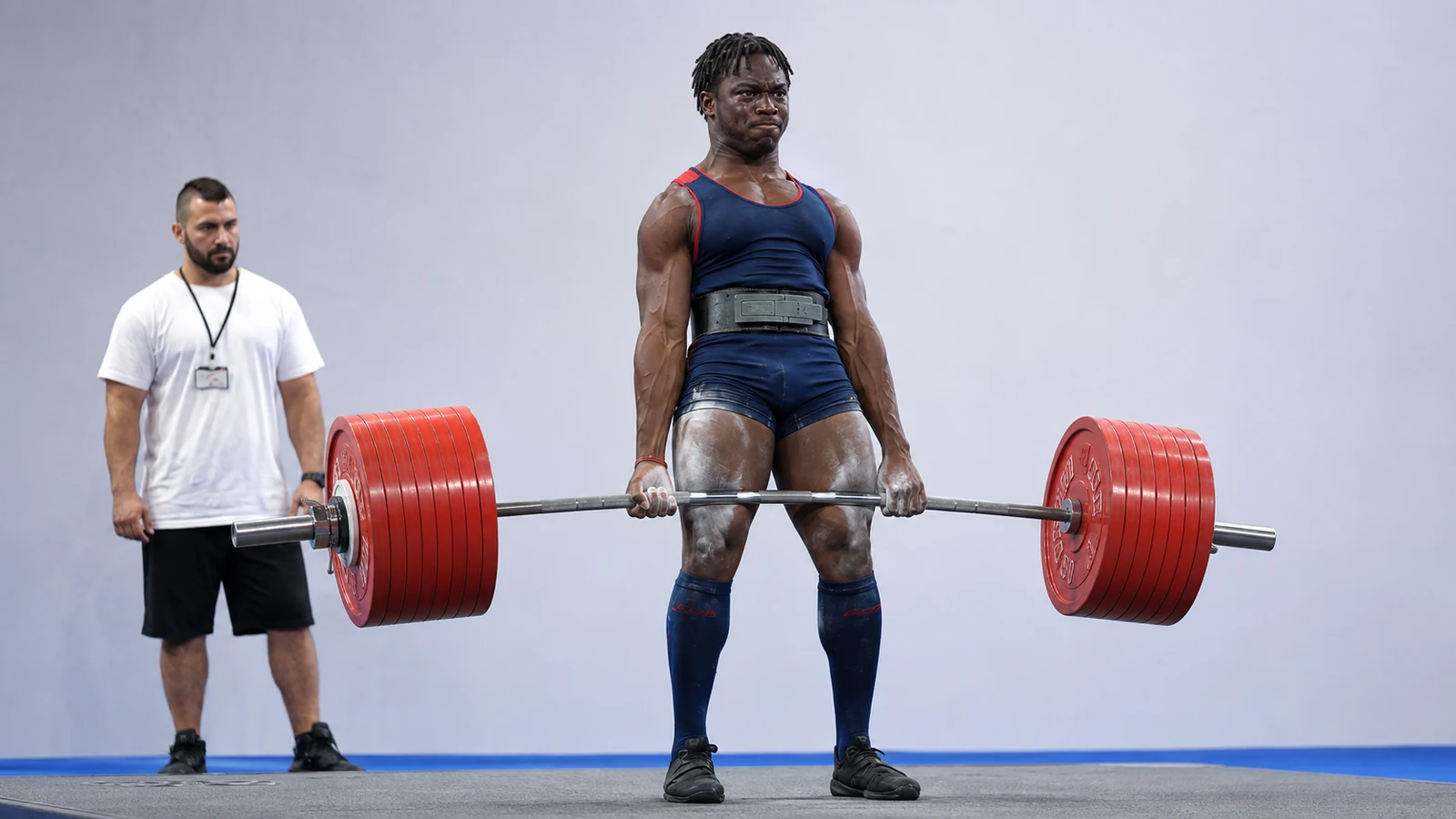

Nonso Chinye’s name did not mean much outside British junior powerlifting circles until August 2022.
He was seventeen years old that month, competing in the sub-junior 105 kilogram class at the IPF World Junior Classic Powerlifting Championships, held that year in Türkiye.
He walked off that platform holding a genuine International Powerlifting Federation world record.
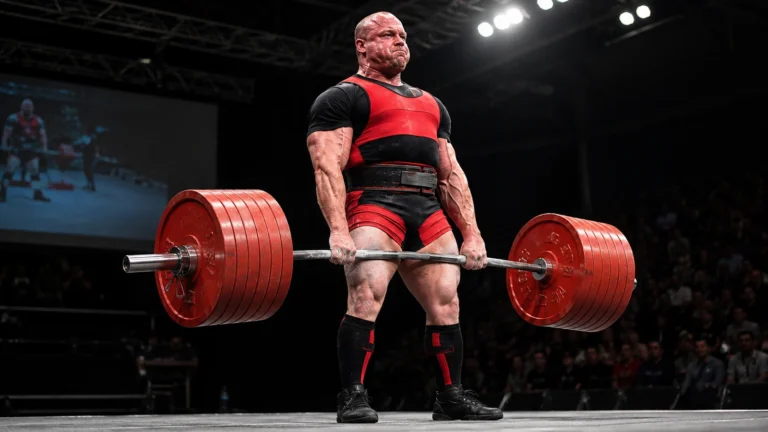
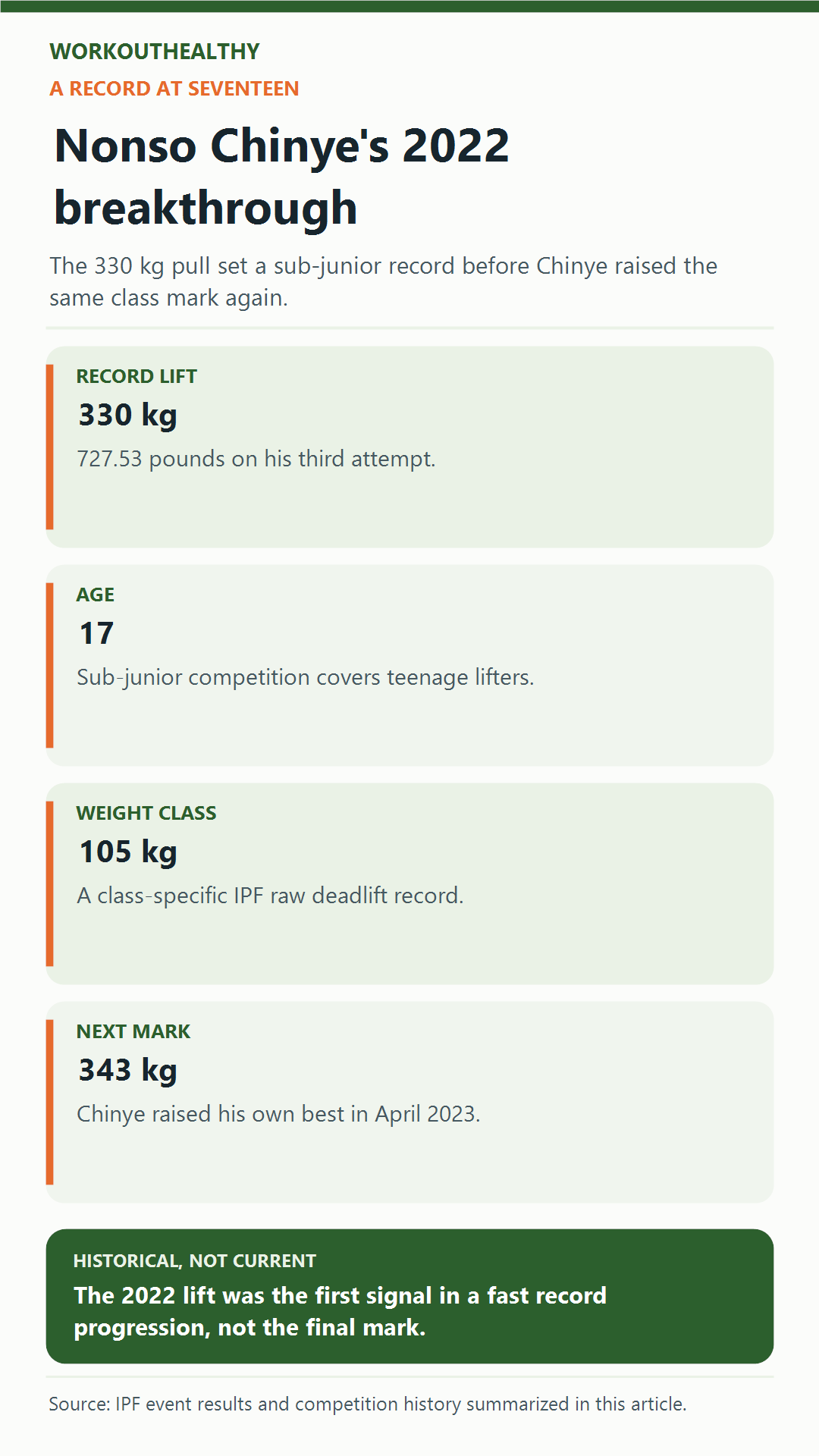
The lift was a 330 kilogram deadlift, which converts to 727.53 pounds.
It came on his third and final attempt, after he had already opened with 300 kilograms and moved to 325 on his second.
Two years before most fans outside the sport had heard his name connected to a junior world championship in Malta, this was the lift that put Chinye on the record books for the first time.
This article covers that 2022 record on its own terms.
What actually happened on the platform, what “sub-junior” means as a classification, how the number compared to grown competitors, and what happened to the record in the months that followed.
What Actually Happened at the 2022 World Junior Championships
The meet was the IPF World Junior Classic Powerlifting Championships, held in Türkiye in the final days of August 2022.
Chinye competed for Great Britain in the men’s 105 kilogram sub-junior division.
He weighed in at 101.9 kilograms on the day, according to competition results published on OpenPowerlifting, the sport’s public results database.
His squat opened at 230 kilograms, moved up to a made 245 on his second attempt, then missed a third attempt at 250.
His bench press went 145, then a made 150, then a made 155 kilograms on his final attempt.
The deadlift is where the record lived.
He opened at 300 kilograms, moved to 325 on his second attempt, and finished with a made third attempt at 330 kilograms.
That final pull is what earned the “World Sub-Junior Record” label, confirmed by the exact title the International Powerlifting Federation’s own YouTube channel gave the footage: “World Sub-Junior Record Deadlift with 330 kg by Nonso Chinye GBR in 105 kg class.”
His total for the day came to 730 kilograms, or 1,609.1 pounds, across all three lifts.
That was enough to win his weight class outright at a genuine IPF World Championship, not a smaller domestic or regional meet.
What “Sub-Junior” Actually Means
The International Powerlifting Federation splits competitors into age divisions, and sub-junior is the youngest bracket that competes at full international championships.
Sub-junior covers lifters age 14 through 18.
Junior is the next bracket up, covering ages 19 through 23.
Open has no age ceiling at all, and it is the division where the sport’s outright world records are set.
Chinye was 17 when he set the 330 kilogram deadlift record, squarely inside the sub-junior window with a year of eligibility still ahead of him.
A sub-junior world record is not a scaled-down or symbolic title.
It is tracked and ratified by the same federation that oversees junior and open world records, just within its own age-restricted division.
That distinction matters for reading the rest of Chinye’s career.
The 330 kilogram sub-junior mark is a separate number, in a separate competitive category, from the junior and open records he would go on to chase in later years.
Why the Deadlift’s Sticking Point Makes a Number Like This So Hard
A 330 kilogram deadlift does not succeed or fail on raw strength alone.
Most near-maximal deadlifts live or die at one specific point: the moment the bar passes the knees.
A 2020 systematic review of deadlift electromyography research, published in PLOS ONE, mapped exactly how muscle activity shifts through that range (Martín-Fuentes, Oliva-Lozano, & Muyor, 2020).
Below the knee, the lift depends heavily on the quadriceps and the muscles around the ankle and hip to break the bar off the floor.
Above the knee, the glutes, hamstrings, and lower back take over to finish driving the hips through.
That handoff between muscle groups is exactly where a near-maximal pull tends to stall.
Chinye’s third attempt at 330 kilograms had to clear that handoff cleanly, with no attempts left in reserve if it failed.
A missed lockout on that attempt would have meant leaving Türkiye with a strong total instead of a world record.
Similar joint-angle tradeoffs show up across other barbell lifts.
That is part of why small setup changes can shift how much weight a lifter is able to move, the kind of technical difference this site’s comparison of the floor press and bench press lays out for the upper body.
Is It Safe for a 17-Year-Old to Pull 330 Kilograms?
A number like 330 kilograms from a 17-year-old raises an obvious question for parents, coaches, and readers who do not follow competitive powerlifting: is this actually safe?
The research on supervised youth resistance training is more reassuring than the instinctive reaction to that question.
The National Strength and Conditioning Association’s position statement on youth resistance training concluded that a properly designed, supervised program does not damage growth plates or stunt growth, and can meaningfully lower injury risk in youth sports when it includes progressive overload and qualified coaching (Faigenbaum et al., 2009).
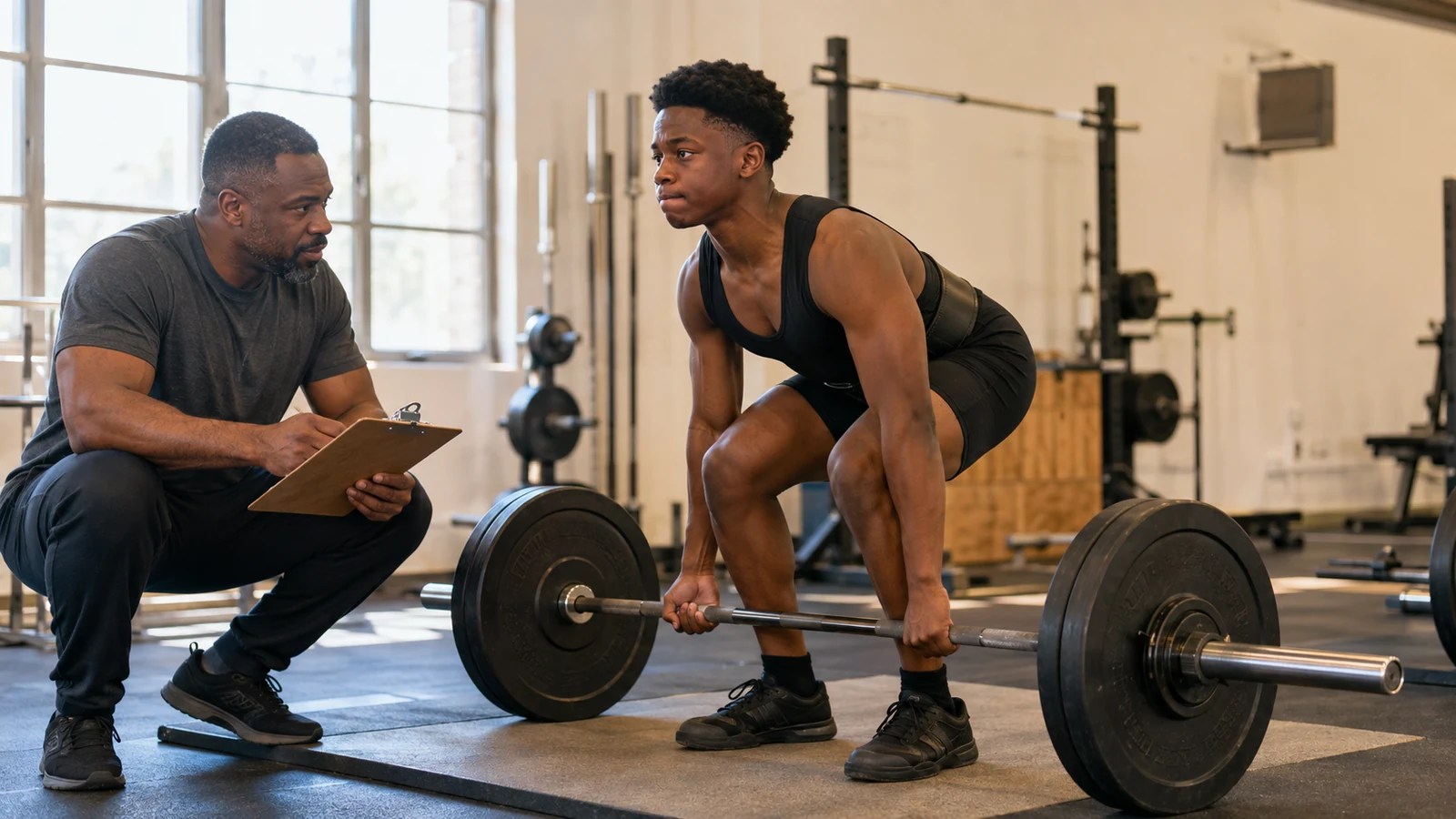
A separate review in the British Journal of Sports Medicine reached a similar conclusion about resistance training among young athletes.
That review found the real risk factors in youth strength sports are poor supervision, unrealistic jumps in load, and weak technique instruction, not the presence of heavy lifting itself (Faigenbaum & Myer, 2010).
Chinye’s own results support that framing rather than contradicting it.
OpenPowerlifting’s records show him competing as early as February 2022, at age 16, in a regional British meet with a 640 kilogram total, months before his 730 kilogram total in Türkiye.
That is a gradual, multi-meet build inside a federation’s drug-tested and technically judged system, not a single unsupervised max attempt.
A sub-junior world record is not luck on one good day. It is the visible result of a training program built years before anyone outside the sport was watching.
The Record Did Not Stay in the Same Weight Class
The Facebook caption connected to this record describes Chinye raising his own sub-junior best from 330 kilograms to 343 kilograms by April 2023.
That number checks out.
Competition results confirm Chinye deadlifted 343 kilograms, or 756.19 pounds, at the Gymshark British Junior Championships on April 26, 2023, in the same 105 kilogram weight class.
That meet was a British Powerlifting national championship, not an IPF World or European championship, which is worth flagging plainly.
IPF world records are most reliably ratified at IPF-sanctioned international competitions.
A British domestic meet does not automatically carry the same record status as Türkiye did, even when the number on the bar is heavier.
What is not in question is that Chinye kept improving inside the same weight class within eight months of his first world record.
Four months after that April meet, in August 2023, he competed again at a genuine IPF World Championship, this time the World Junior and Sub-Junior Classic Championships in Romania.
By then he had moved up to the 120 kilogram class, weighing in at 117.2 kilograms, a significant jump in bodyweight from the 101.9 kilograms he carried in Türkiye a year earlier.
In that new, heavier class, still competing as a sub-junior, he deadlifted 360.5 kilograms, or 794.77 pounds.
So the honest version of the 2022 to 2023 story spans two different weight classes, not one continuous climb inside the 105 kilogram division.
What This Record Does Not Prove
It is worth being precise about what a single youth world record does and does not establish.
One dominant meet at 17 does not guarantee a lifter becomes an elite senior competitor.
Plenty of promising junior lifters plateau, get injured, or simply move on from the sport before their twenties.
It is also worth being upfront about what could not be independently confirmed here.
IPF’s published records archive was not accessible for direct verification while researching this article, so whether Chinye’s 330 kilogram sub-junior mark in the 105 kilogram class has since been broken by another lifter could not be confirmed either way.
Sub-junior world records, especially in less heavily contested weight classes, do get broken as new cohorts of teenagers move through the sport.
Readers who want today’s exact standing should check the IPF’s own results archive rather than assume any single web source, including this one, reflects the current record.
What is verifiable, and does not change with time, is that Chinye set a genuine, IPF-recognized sub-junior world record on that specific day in Türkiye.
How a Sub-Junior Record Predicts What Comes Next
A strong sub-junior record is not just a single number.
It is also a data point in how a young athlete’s strength develops over years, not months.
The Youth Physical Development Model, an athlete-development framework published in Strength & Conditioning Journal, describes long-term athletic progress as a staged process, where early strength gains in the teenage years build the physical foundation for the power and technical refinement that follow later in a career (Lloyd & Oliver, 2012).
Chinye’s own career maps onto that model closely.
He did not stop competing after Türkiye, or after his 343 kilogram follow-up in April 2023.
He kept moving up in age division and weight class, eventually becoming a full IPF junior world record holder in the 120 kilogram class, and later competing as an open lifter against grown men with no age bracket to soften the field.
The 330 kilogram deadlift from August 2022 was not his ceiling.
It reads more like a floor, the first confirmed data point in a multi-year climb through nearly every age division powerlifting has to offer.
Common Mistakes Young Lifters Make Chasing a Heavy Deadlift
Watching a 17-year-old pull 330 kilograms tends to make other young lifters want to test their own ceiling right away.
That instinct is where most training injuries in the sport actually come from.
The first common mistake is skipping a real warm-up progression.
Elite young lifters like Chinye work through a long sequence of increasing weights before ever touching a true near-maximal single, not a handful of loose warm-up reps.
The second mistake is losing a neutral spine under load, especially once the bar passes the knees.
A rounding lower back at heavy weight shifts stress onto the spine’s passive structures instead of the muscles built to handle that load.
The third mistake is chasing weight before technique is automatic.
Bar path, hip hinge sequencing, and grip all need to be second nature before a lifter adds meaningful load, not something worked out mid-attempt.
The fourth mistake is training near a one-rep max every single session.
Chinye’s own meet calendar shows planned peaks a handful of times a year, not maximal singles every week in the gym.
The fifth mistake is ignoring recovery between heavy pulling sessions.
A true maximal deadlift is demanding enough on the nervous system that most structured programs build in easier days immediately afterward.
Want more stories like this one? Subscribe to WorkoutHealthy Insider for practical explanations behind popular fitness claims.
What Everyday Lifters Can Take From This
Nobody reading this needs to pull 330 kilograms to benefit from how Chinye actually built that number.
The most transferable part of his story is the pacing, not the poundage.
He did not jump from a beginner total to a world record in one meet.
OpenPowerlifting’s results show him competing at 16, with a 640 kilogram total, then climbing meet by meet before reaching 730 kilograms and a world record eight months later.
That same principle, small verified increases stacked over real time, applies at any strength level, including a lifter’s very first year in a gym.
Progressive overload, adding small amounts of weight or volume once a lift is genuinely mastered, remains one of the most consistent findings in strength training research.
Verified numbers matter here the same way they matter with any impressive claim in fitness.
This site’s look at Edith Connor’s Guinness World Record for oldest female bodybuilder covers a similar case, a record that holds up specifically because it is backed by documented competition results, not just a compelling story.
The same is true of DonnaJean Wilde’s push-up world record, where the pacing behind the number turned out to matter as much as the total itself.
For most readers, the practical lesson from Chinye’s 2022 record is not to copy a 330 kilogram attempt.
It is to copy the two and a half years of documented, gradually loaded meets that made that attempt possible in the first place.
Watch the Original Video
References
Faigenbaum, A. D., & Myer, G. D. (2010). Resistance training among young athletes: Safety, efficacy and injury prevention effects. British Journal of Sports Medicine, 44(1), 56-63. https://doi.org/10.1136/bjsm.2009.068098
Faigenbaum, A. D., Kraemer, W. J., Blimkie, C. J. R., Jeffreys, I., Micheli, L. J., Nitka, M., & Rowland, T. W. (2009). Youth resistance training: Updated position statement paper from the national strength and conditioning association. Journal of Strength and Conditioning Research, 23(5 Suppl), S60-S79. https://doi.org/10.1519/JSC.0b013e31819df407
Lloyd, R. S., & Oliver, J. L. (2012). The youth physical development model: A new approach to long-term athletic development. Strength & Conditioning Journal, 34(3), 61-72. https://doi.org/10.1519/SSC.0b013e31825760ea
Martín-Fuentes, I., Oliva-Lozano, J. M., & Muyor, J. M. (2020). Electromyographic activity in deadlift exercise and its variants. A systematic review. PLOS ONE, 15(2), e0229507. https://doi.org/10.1371/journal.pone.0229507
This article is for general information only and is not medical advice. If you have an injury, ongoing pain, or a medical condition, talk to a doctor or physical therapist before you change how you train or eat.