

Lena Dunham built her career on being direct about things most people keep private. She did it again in 2019, when she told the public she lives with Ehlers-Danlos syndrome, a genetic connective tissue disorder most people have never heard of until someone they know is diagnosed with it.
Dunham is best known as the creator, writer, and star of HBO’s Girls, which ran from 2012 to 2017.
The show earned her multiple Emmy nominations and two Golden Globe Awards. She had already built a following with her 2010 indie film Tiny Furniture before Girls made her one of the most talked about voices of her generation.
The EDS reveal did not come with a press tour. It arrived the way most chronic illness news from Dunham has come over the years, woven into interviews and public statements about her health rather than announced as a single headline.
It followed an earlier and more widely covered health story. In February 2018, Dunham wrote an essay for Vogue about choosing to have a hysterectomy because of endometriosis. Endometriosis is a condition that causes tissue similar to the uterine lining to grow outside the uterus, and it can cause severe, chronic pain.
Ehlers-Danlos syndrome and endometriosis are different conditions. But they are not unrelated in her story. Doctors who treat connective tissue disorders increasingly recognize that patients with joint hypermobility conditions like EDS also report higher rates of pelvic pain and gynecological complications. Dunham’s health story, told across several years and several public statements, reflects that overlap.
What Ehlers-Danlos Syndrome Actually Is
Ehlers-Danlos syndrome is not one disease. It is a group of at least 13 inherited conditions that affect connective tissue, the material that holds skin, joints, blood vessels, and organs together (Malfait et al., 2017).
The most common form by far is hypermobile EDS, often shortened to hEDS. Researchers estimate it affects roughly 1 in 3,100 people. Many experts believe the real number is higher, since the condition is often missed or misdiagnosed for years (Tinkle et al., 2017).
People with hEDS have joints that move beyond a typical range of motion. That sounds harmless, even enviable, to people who think of flexibility as a party trick. In practice it means joints can partially or fully dislocate from small, ordinary movements. A doorknob turn. A hug. Standing up too quickly from a chair.
The skin is often affected too. It can bruise easily. It can stretch more than usual. It tends to heal slowly, sometimes leaving thin scars from cuts that would barely mark someone without the condition (Mayo Clinic, 2024).
Pain is the symptom that shapes daily life the most for many patients. Researchers describe EDS pain as often chronic and separate from any single injury. It is frequently neuropathic, meaning it involves the nerves themselves rather than just the joints. Patients often describe it as burning, electric, or tingling (Tinkle et al., 2017).
How Dunham Has Described Living With It
Dunham has talked about needing a cane on harder days. She has described the strange gap between how she looks in public, often for a few minutes at an event or on a red carpet, and how her body actually feels behind the scenes.
That gap is the core problem with a condition like EDS. It does not show up the way people expect illness to look. There is no cast in every case. There is no wheelchair in every case. There is no visible marker that tells strangers to make space or lower their expectations.
Dunham has also spoken more broadly over the years about a difficult relationship with her own body.
She has described struggles with body image. She has described periods where she felt she had little control over her physical health, particularly in her twenties.
Chronic illness rarely exists in a vacuum. It sits alongside everything else a person is already carrying, from career pressure to public scrutiny to ordinary life stress.
What Dunham has not done is present EDS as something she beat or fixed. She has described it as something she manages, on good days and bad ones. That is a more honest picture of most connective tissue disorders than a tidy recovery story would be.
Why EDS Rarely Travels Alone
One reason EDS is hard to live with is that it rarely shows up by itself.
A large share of people with hypermobile EDS also have postural orthostatic tachycardia syndrome, known as POTS.
POTS affects the autonomic nervous system’s control of heart rate and blood pressure. Doctors at Johns Hopkins Medicine describe a strong association between POTS and joint hypermobility disorders, including EDS. They also note growing recognition of overlap with mast cell disorders, a separate category of immune-related conditions.
People with POTS can feel lightheaded or faint when they stand up. They can struggle with brain fog and fatigue. Their symptoms often get worse in heat or after standing for a long stretch of time.
Gastrointestinal problems are also common in people with hEDS. So are sleep disruption and anxiety (Tinkle et al., 2017).
None of this means every person with hypermobile joints has all of these issues. It means EDS often arrives as a cluster of connected problems rather than one clean diagnosis. That cluster is part of why it can take patients years to get an accurate answer from doctors.
What the Research Does Not Prove
There is no blood test or genetic marker that confirms hypermobile EDS. Diagnosis relies on a clinical checklist published in 2017.
That checklist includes a hand and joint exam called the Beighton score, which measures how far certain joints bend.
It also includes a review of family history and related symptoms (Malfait et al., 2017).
Two people with very similar symptoms can get different answers from different doctors. This is especially true before a rheumatologist or geneticist familiar with EDS gets involved in the case.
Research on the condition is also still catching up. Scientists do not yet know the exact genetic cause of hypermobile EDS. That is unlike some of the rarer EDS subtypes, where a specific gene mutation has already been identified.
This research gap matters for a public reading a celebrity’s diagnosis story. EDS awareness helps people recognize symptoms and seek evaluation sooner. It is not the same as EDS having a cure, a single confirmed cause, or one standard treatment plan that works the same way for everyone.

How EDS Care Differs From General Fitness Advice
Most fitness content assumes a body that responds to load in a predictable way. Lift heavier, and joints and muscles adapt. Stretch more, and tissue gets more flexible over time.
EDS flips part of that logic. The tissue is already too flexible in a way that leaves joints unstable rather than strong.
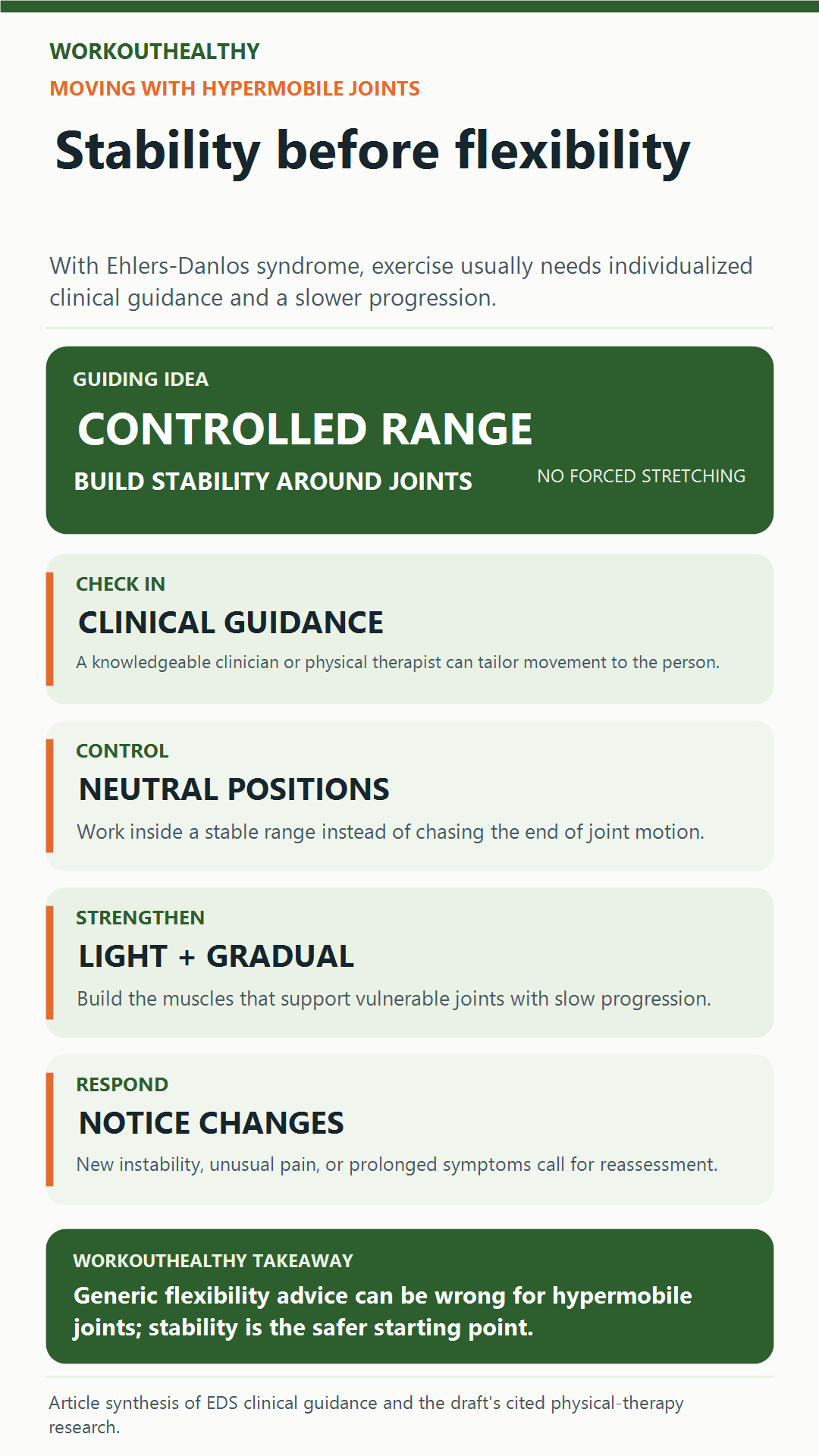
The goal for many patients is not more range of motion. It is building the muscle around a joint so it has some artificial stability the connective tissue cannot reliably provide on its own (Mayo Clinic, 2024).
Current guidance does not tell people with hEDS to avoid stretching or hyperextending joints altogether.
Some research suggests forcing joints to stay in a stricter, safer looking range can work against training goals compared to allowing a full but controlled range of motion, as long as the surrounding muscles are doing real work (Tinkle et al., 2017).
This is a case where a well meaning trainer applying standard advice without EDS-specific knowledge could genuinely make things worse instead of better.
Who Should Talk to a Doctor First
Anyone with a family history of unusually flexible joints has a real reason to ask a doctor about joint hypermobility conditions, including EDS.
The same goes for anyone with frequent unexplained dislocations, or skin that bruises and stretches more than seems normal for their age and activity level.
People already diagnosed with hEDS should loop in a physical therapist experienced with connective tissue disorders before starting a new exercise routine.
Waiting until after an injury forces the issue puts recovery further behind.
General strength coaches and personal trainers are not automatically trained in EDS-specific joint stabilization work.
It is fair to ask directly about their experience with the condition before starting.
Anyone with EDS who also experiences fainting, a racing heart on standing, severe digestive symptoms, or chest pain should be evaluated for POTS or related autonomic issues.
This evaluation should happen before ramping up exercise intensity, not after.
Starting activity horizontally, such as recumbent biking or swimming, is a common early step for people whose symptoms make upright exercise difficult at first.
Anyone considering surgery related to EDS complications should get input from a specialist familiar with connective tissue disorders specifically.
This includes procedures tied to joint instability or the gynecological issues some patients experience alongside it, since standard surgical assumptions about healing and tissue strength do not always apply the same way.
A Practical Guide to Moving Safely With Hypermobile Joints
People managing hEDS or suspected hypermobility can use a few general principles many physical therapists rely on.
These should always be adjusted to a person’s own diagnosis and symptoms.
Start with a proper evaluation. A physical therapist who understands connective tissue disorders can map out which joints are least stable and build a plan around protecting those first.
Prioritize controlled strength work over stretching. Building muscle around an unstable joint gives it support the ligaments cannot reliably provide on their own.
Resistance bands, light weights, and closed-chain exercises like wall pushes are common starting points for this kind of work.
Some patients also do well with a controlled, low-impact method like Pilates, which emphasizes core stability and slow, deliberate movement over range of motion.
Avoid locking joints into a fully extended position under load. A slightly bent knee or elbow during exercise keeps muscles, not ligaments, doing the work of stabilizing the joint.
Build core strength deliberately. A stronger trunk reduces how much individual joints have to compensate during daily movement, not just during workouts.
Watch for pain that lingers well past a session, not just soreness during it. That kind of pain is a signal to scale back and check in with a provider rather than push through.
Use supportive tools without embarrassment. Braces, kinesiology tape, or a cane on a harder day are not signs of failure.
They are tools that let someone stay active more consistently, which matters more over time than any single hard workout.
Pace activity across the week instead of concentrating it into one or two intense days.
Many people with EDS do better with frequent, moderate sessions than occasional maximal ones, since recovery and joint stability can be less predictable than in people without connective tissue disorders.
Track symptoms, not just workouts. A simple log of pain, dizziness, and fatigue alongside activity can help a patient and their care team spot patterns that a single appointment might miss.
References
Malfait, F., Francomano, C., Byers, P., Belmont, J., Berglund, B., Black, J., Bloom, L., et al. (2017). The 2017 international classification of the Ehlers-Danlos syndromes. American Journal of Medical Genetics Part C: Seminars in Medical Genetics, 175(1), 8-26.
Tinkle, B., Castori, M., Berglund, B., Cohen, H., Grahame, R., Kazkaz, H., & Levy, H. (2017). Hypermobile Ehlers-Danlos syndrome: Clinical description and natural history. American Journal of Medical Genetics Part C: Seminars in Medical Genetics, 175(1), 48-69.
Mayo Clinic. (2024). Ehlers-Danlos syndrome: Symptoms, causes, and treatment.
Johns Hopkins Medicine. Postural Orthostatic Tachycardia Syndrome (POTS).
This article is for general educational purposes and is not a substitute for personalized medical advice. Ehlers-Danlos syndrome and its related conditions vary widely from person to person, and anyone with symptoms of joint hypermobility, chronic pain, or autonomic dysfunction should consult a qualified physician or physical therapist before starting or changing an exercise program.