

Sia has written and sung some of the biggest pop songs of the last two decades.
Most of that time, she has also been living with chronic pain.
She has not hidden this fact.
She has spoken about it publicly, on her own terms, for years.
Her story is a useful reminder that chronic pain does not always look the way people expect it to.
A Career Built on More Than Vocals
Sia Furler built her career first as a songwriter, then as a performer in her own right.
She wrote or co-wrote hit songs for other major artists before her own single “Chandelier” became a global breakout moment.
Since then, she has released a string of platinum selling songs and albums.
She has also written music for films and stage productions, on top of her own touring and recording schedule.
That is a demanding pace by any measure.
It has continued for years alongside a set of chronic health conditions most audiences never see up close.
What Sia Has Disclosed About Her Health
In 2019, Sia shared that she lives with Ehlers-Danlos syndrome, a group of genetic conditions that affect the body’s connective tissue.
She has also spoken about living with Graves’ disease, an autoimmune condition that affects the thyroid.
Separately, she has talked about complex post traumatic stress disorder connected to childhood abuse, and about being diagnosed with autism.
Taken together, these are conditions she has managed while continuing to write, record, and perform at the highest level of her industry.
None of them have stopped her career.
They have shaped how she approaches it.
The Condition Behind Much of Her Chronic Pain
Ehlers-Danlos syndrome is not one single disease.
It is a group of about 13 related genetic conditions that all affect connective tissue, the material that supports skin, joints, blood vessels, and organs (Mayo Clinic, 2024).
The most common forms involve joint hypermobility, meaning joints move beyond a typical healthy range.
That flexibility can look impressive from the outside.
From the inside, it often means frequent joint pain, stiffness, and a higher risk of dislocations.
Skin changes are common too, including skin that stretches more than usual and heals slowly.
There is no cure for Ehlers-Danlos syndrome.
Management focuses on reducing symptoms and protecting the joints over the long term.
Why She Performs the Way She Does
Sia is known for performing with her face covered, often by an oversized wig, while dancer Maddie Ziegler performs as a visual stand in at the front of the stage.
She has explained that choice as a way to keep some control over her own image.
She has said she wants to avoid being picked apart for small changes in her appearance, the kind of scrutiny many public figures face.
That reasoning is about privacy and image, based on her own public statements, not a medical requirement tied to any single diagnosis.
It is a separate decision from how she manages her physical health day to day.
Both choices reflect the same instinct.
She has built a public career on her own terms, around her own needs.
Progress with a chronic condition often looks like adaptation, not a cure, and that is still real progress.

What Research Says About Exercise and Hypermobile Ehlers-Danlos Syndrome
People with hypermobile forms of Ehlers-Danlos syndrome often have a complicated relationship with exercise.
A study published in Disability and Rehabilitation surveyed people with joint hypermobility syndrome and hypermobile Ehlers-Danlos syndrome about their beliefs and behaviors around exercise (Simmonds et al., 2017).
It found that many people in this group avoid exercise out of fear that movement will cause more pain or joint damage.
That fear is understandable given how often movement does cause pain for this group.
But the same research points toward a different conclusion.
A companion paper laid out the evidence based case for physical therapy in this population, rather than avoidance (Engelbert et al., 2017).
It found that carefully guided movement, focused on building stability around unstable joints, tends to help more than strict rest.
The key word is guided.
Generic workout advice is not built for a body that moves differently than most.
The Psychology of Living With Ongoing Pain
Chronic pain is not only a physical experience.
A review in Current Pain and Headache Reports examined resilience as a framework for understanding how people adapt to long term pain (Sturgeon & Zautra, 2010).
It found that people who build effective coping strategies, strong social connections, and a sense of purpose tend to function better over time, even without a change in their actual pain level.
That does not mean mindset alone controls pain.
It means the psychological side of chronic illness is a real, measurable part of the picture, not a minor detail.
A demanding, creative career built around a chronic condition, the kind Sia has described, fits directly into that research.
Living With an Illness That Is Easy to Miss
Chronic pain from a condition like Ehlers-Danlos syndrome is often called an invisible illness.
A person can look completely healthy while dealing with real, ongoing pain underneath.
That gap between appearance and experience creates its own kind of pressure.
People with invisible conditions often describe having to explain or justify their pain to others, simply because it does not show on the outside.
A public figure who talks about it openly, the way Sia has, gives that experience some visibility.
It will not fix the underlying condition.
It can make it a little easier for someone with a similar diagnosis to feel less alone in it.
What This Evidence Does Not Prove
None of this research describes Sia’s specific case in detail.
Public figures rarely share every clinical detail of their diagnosis or treatment plan, and Sia is no exception.
Ehlers-Danlos syndrome also varies enormously from person to person, even within the same subtype.
What helps one person’s joints may not help another’s.
This research describes general patterns across groups, not a specific treatment plan for any one individual.
How This Compares to General Chronic Pain Guidance
General public health guidance often pushes people toward more movement for better long term health.
For someone managing a connective tissue disorder, that advice needs real adjustment.
The goal shifts from pushing through discomfort to building strength and stability without triggering flares.
That distinction matters for anyone living with an invisible chronic condition, not just those with Ehlers-Danlos syndrome specifically.
Pain that cannot be seen from the outside is still real, and it still deserves a thoughtful, individualized approach.
Who Should Talk to a Doctor First
Anyone with unexplained joint pain, frequent dislocations, or unusually flexible joints should bring it up with a doctor.
A rheumatologist or a genetics specialist can help confirm whether a connective tissue disorder like Ehlers-Danlos syndrome is present.
People already diagnosed with a form of Ehlers-Danlos syndrome should work with a physical therapist familiar with hypermobility before starting a new exercise routine.
That specific experience matters, since standard strength training advice can sometimes push joints in ways that cause harm rather than help.
Anyone managing chronic pain alongside mental health symptoms, including anxiety or depression, should also loop in a mental health provider.
Chronic pain and mental health are closely connected, and treating them separately often works less well than treating them together.
A primary care doctor is a reasonable first stop for anyone unsure where to begin.
They can order initial tests and refer to the right specialist based on the specific symptoms involved.
A Practical Starting Point for Gentle, Guided Movement
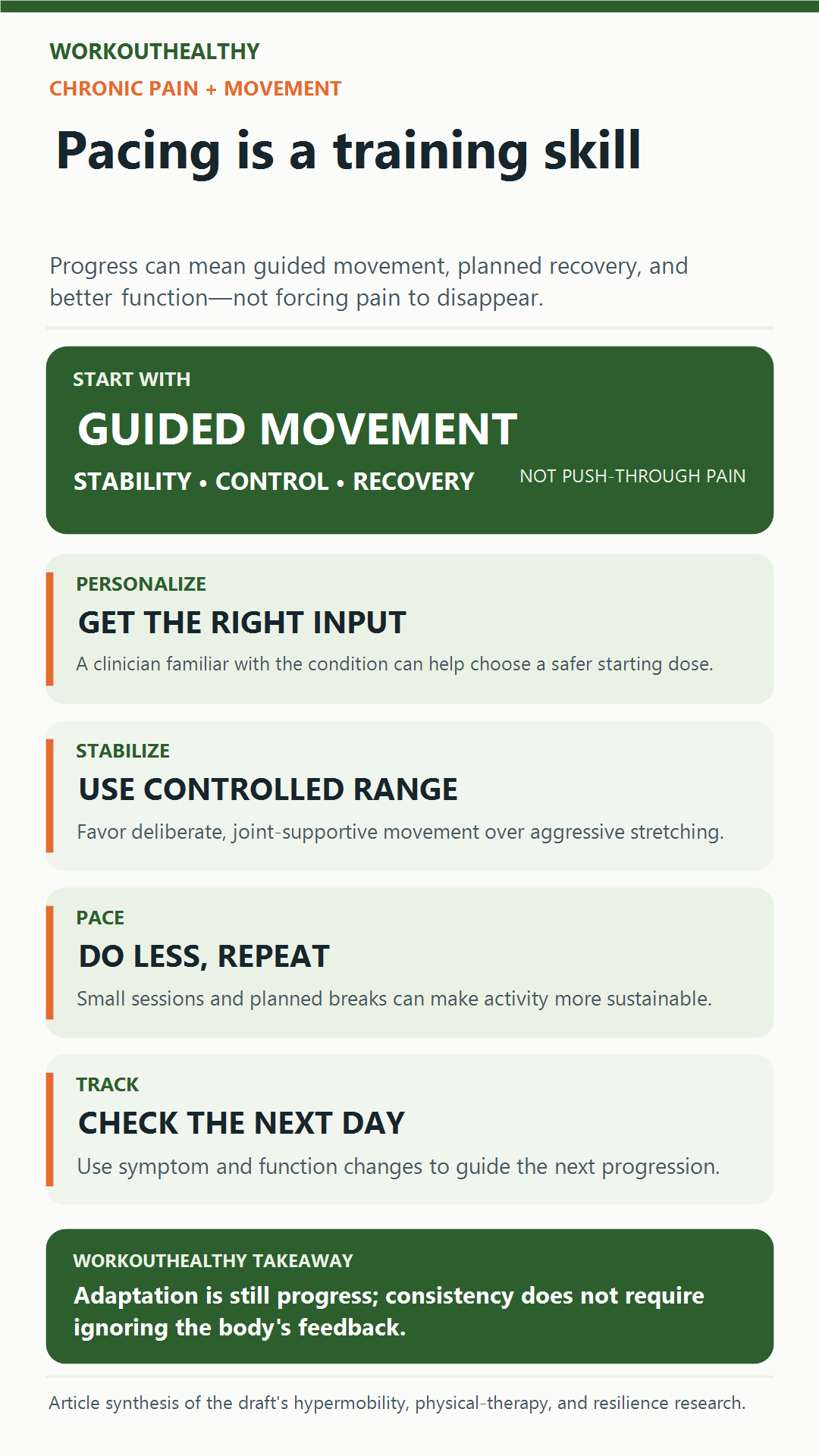
Start with a proper diagnosis before changing an exercise routine, rather than guessing.
Once a diagnosis is clear, look for a physical therapist with specific experience in hypermobility or connective tissue disorders.
Low impact strength work, focused on stabilizing muscles around loose joints, is usually a safer starting point than high impact cardio.
Resistance bands and controlled bodyweight movements are common early tools, since they allow careful control over range of motion.
Track pain and fatigue after each session, not just during it.
Symptoms from overdoing it can show up a day or two later.
Build in real rest days, and treat them as part of the plan, not a failure to push harder.
Progress slowly, and expect that pace to look different from a typical fitness program.
Warm up joints gently before any session, since cold, unstable joints are more prone to injury.
Supportive footwear and, in some cases, joint braces can help during specific movements.
A physical therapist can advise on when bracing genuinely helps versus when it becomes a crutch.
Keep a simple log of which movements feel fine and which ones cause pain afterward.
Over time, that log becomes a useful, personalized map of what a body can safely handle.
Chronic illness does not always end a demanding career.
Gentle, controlled movement has real research behind it for people managing pain.
References
- Mayo Clinic. (2024). Ehlers-Danlos syndrome: Symptoms and causes. Mayo Foundation for Medical Education and Research.
- Simmonds, J. V., Herbland, A., Hakim, A., Ninis, N., Lever, W., Aziz, Q., & Cairns, M. (2017). Exercise beliefs and behaviours of individuals with joint hypermobility syndrome/Ehlers-Danlos syndrome, hypermobility type. Disability and Rehabilitation, 41(4), 445-455. https://doi.org/10.1080/09638288.2017.1398278
- Engelbert, R. H. H., Juul-Kristensen, B., Pacey, V., de Wandele, I., Smeenk, S., Woinarosky, N., Sabo, S., Scheper, M. C., Russek, L., & Simmonds, J. V. (2017). The evidence-based rationale for physical therapy treatment of children, adolescents, and adults diagnosed with joint hypermobility syndrome/hypermobile Ehlers Danlos syndrome. American Journal of Medical Genetics Part C: Seminars in Medical Genetics, 175(1), 158-167. https://doi.org/10.1002/ajmg.c.31545
- Sturgeon, J. A., & Zautra, A. J. (2010). Resilience: A new paradigm for adaptation to chronic pain. Current Pain and Headache Reports, 14(2), 105-112. https://doi.org/10.1007/s11916-010-0095-9
This article is for general educational purposes only.
It is not a substitute for individualized medical advice or a professional diagnosis.
Anyone with symptoms of a connective tissue disorder, unexplained chronic pain, or joint instability should speak with a qualified doctor.