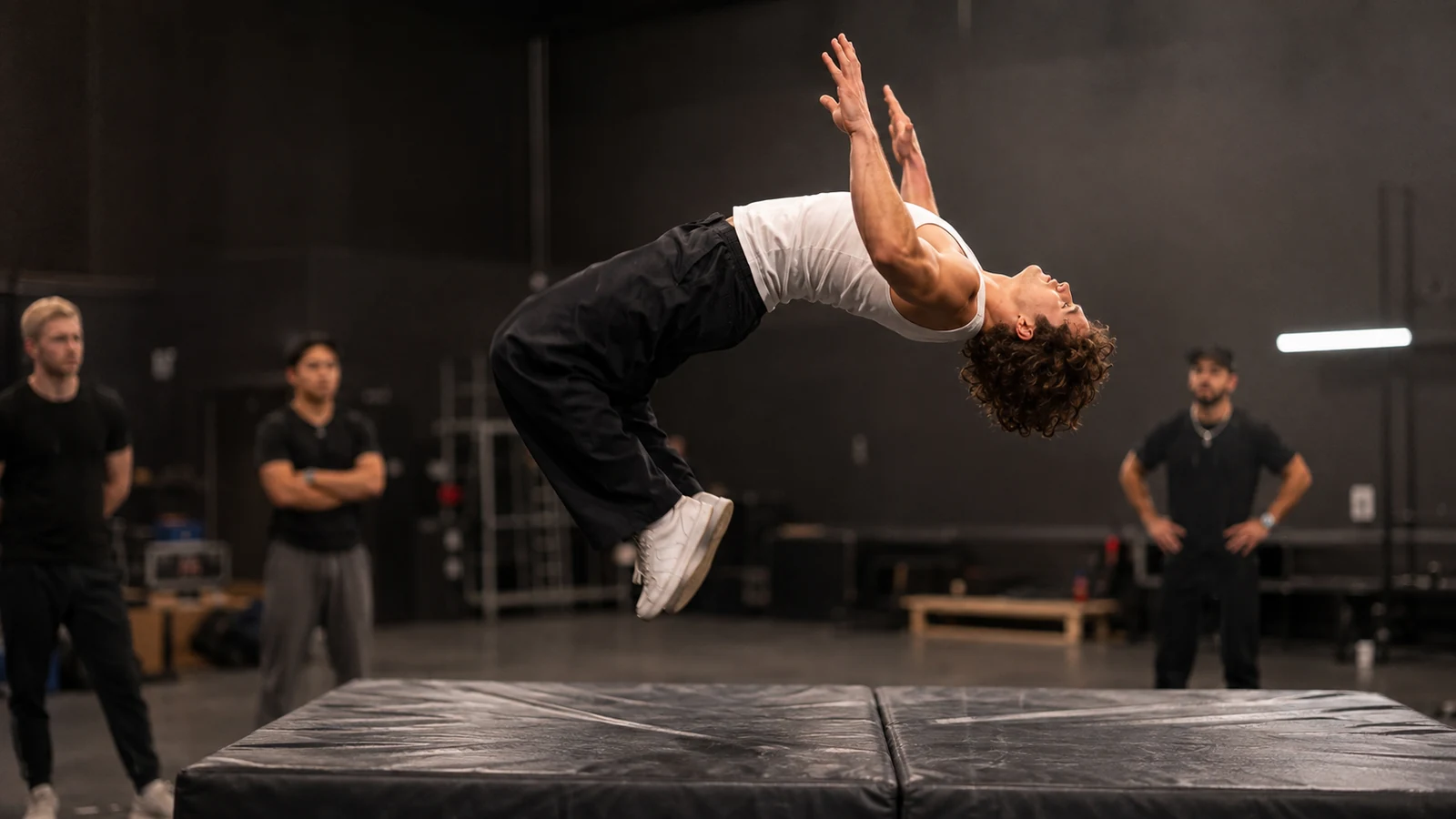

Benson Boone has built one of pop music’s most talked about live moments almost by accident.
Mid song, mid tour, he throws a backflip. Fans caught it on video early in his run of shows, and it spread fast online. It is now one of the moments people expect at a Boone concert, not just a surprise.
Boone is 23 years old and grew up in Monroe, Washington. He got his start posting singing videos online. He briefly competed on American Idol in 2021 before leaving the show to build his own path. His breakthrough single, “Beautiful Things,” hit number two on the Billboard Hot 100 in 2024. His debut album, Fireworks & Rollerblades, reached the top ten that same year.
He has kept climbing since. Boone opened for Taylor Swift’s Eras Tour at Wembley Stadium in 2024. He played Coachella in 2025 and released a second album, American Heart, that summer. He has been touring behind it through arenas and stadiums, where the backflip has become one of his most shared stage moments.
Boone had no formal music training before any of this started. A friend asked him to sing at a high school talent show during his junior year in Monroe, and that unplanned performance changed his path. He posted videos of himself singing on TikTok afterward, building an audience of roughly 1.7 million followers before he ever released a single song. Imagine Dragons frontman Dan Reynolds discovered his account and signed him to a new label, a partnership with Warner Records that turned one talent show moment into a full career.
What most fans do not see is the physical preparation behind it. Performing a full backflip while singing live, night after night, is not something most touring musicians ever plan for.
What Boone’s Training Reportedly Looks Like
Boone’s routine has been reported to lean on core and shoulder strength work. It is built specifically to help him land the move safely through a long tour schedule. That kind of training is different from a typical gym routine built around size or general fitness. It is built around control.
A backflip asks a lot of the body in a short window of time. The performer has to generate enough rotation to complete the flip, control that rotation in the air, then absorb the landing without losing balance. Doing that once is one thing. Doing it dozens of times across a touring schedule, often on a stage that was not built for gymnastics, raises the stakes considerably.
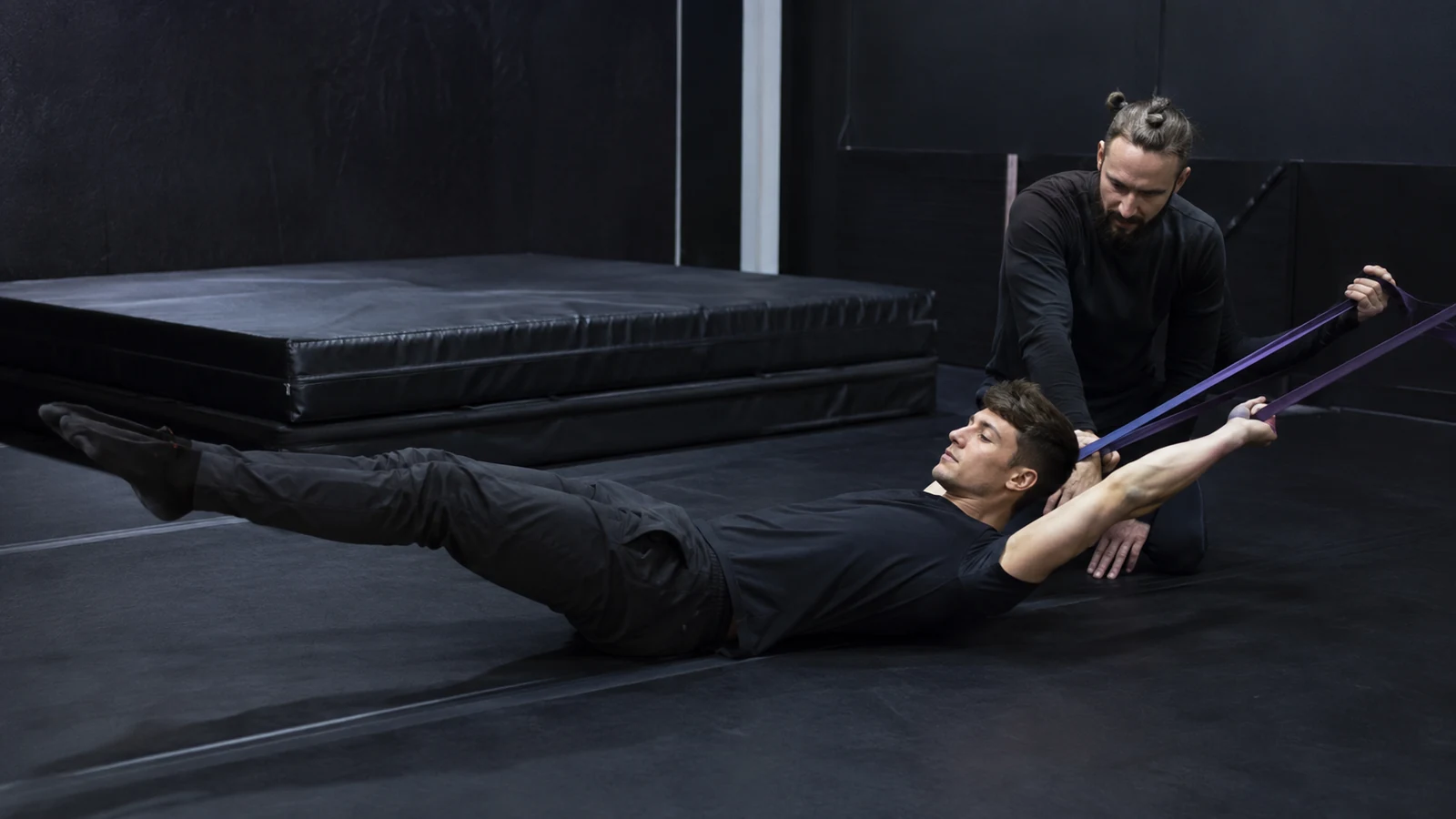
Core strength gives a performer control over rotation and body position in the air. Shoulder strength and stability help absorb impact and protect the joints during the landing. Neither shows up as visibly as bigger arms would. Both matter more for safety and consistency than for looks.
A single backflip is manageable in isolation. The bigger challenge is repeating it after a full set of songs, often with limited warmup time between cities and a schedule that leaves little room for extra rest. That is where structured strength training does its most important work. It is not really about the move itself. It is about how well the body holds up to doing it again after weeks of shows.
Why Stage Acrobatics Are a Different Kind of Athletic Demand
It is easy to think of touring musicians as performers first and athletes second, if athletes at all.
That undersells what a physical stage show actually asks of the body.
Research on acrobatic gymnastics, a related but more formal discipline, backs up why the physical preparation matters.
A study in Physical Therapy in Sport looked at injury patterns among acrobatic gymnasts. It found that training load and landing mechanics were significant risk factors for injury, particularly around the lower body and shoulders (Purnell et al., 2010). A large share of the injuries the researchers recorded centered on those same joints, the ones that absorb the most force on the way down from height. The specific numbers do not transfer directly from competitive gymnastics to a pop concert. The underlying point does. Repeated high impact landings put real stress on the joints, and the body needs to be conditioned for that stress specifically, not just generally fit.
That risk does not disappear just because the setting is a concert stage instead of a gym floor.
Anyone adding a real acrobatic element to a physical routine is taking on a version of the same demand, whether or not they think of themselves as an athlete.
Core stability plays a central role in that kind of conditioning. A widely cited review in Sports Medicine described core stability as the foundation that lets the arms and legs produce force efficiently and safely. That applies whether the movement is a golf swing, a tackle, or a landing from height (Kibler, Press, & Sciascia, 2006). A weak or poorly controlled core forces other joints, often the shoulders or lower back, to compensate. Over time, that compensation is where injuries tend to show up.
How This Compares to General Fitness Guidance
Most people are never going to attempt a backflip on a stage or anywhere else, and that is completely fine.
The training principle behind Boone’s routine still applies to ordinary fitness in a smaller way.
Core and shoulder stability work is not just for performers or athletes. It supports everyday movement. It protects the spine during lifting and helps prevent the shoulder strain that shows up from repetitive motion, whether that is throwing a ball or reaching overhead at work.
General fitness guidelines from groups like the American College of Sports Medicine recommend resistance training for all the major muscle groups at least twice a week.
Core and stabilizing muscles belong in that plan from the start, not as an afterthought.
Boone’s training takes that same foundation and applies it to an unusually specific and demanding skill.
The base principle is the same one that applies to a beginner doing planks at home: a strong, stable core supports safer movement everywhere else.
Common Mistakes People Make With Core and Shoulder Training
A few mistakes come up often when people try to build the kind of stability Boone’s training reportedly emphasizes.
The first is treating core training as only crunches or sit ups. Those exercises work the front of the core. They do little for the rotational control or deeper stabilizing muscles that matter most during real movement, including landings, twists, and lifts.
The second is skipping shoulder stability work entirely. Many people train the front of the shoulder through pressing movements. They neglect the muscles around the shoulder blade that keep the joint stable, and that imbalance is a common source of shoulder pain.
The third is progressing too fast toward anything explosive or acrobatic without building a base first.
Jump training and anything involving landing impact should be added gradually, after basic strength and control are already in place.
The fourth is ignoring recovery. Repeated high impact movement, even at a fraction of what a performer like Boone does on tour, needs real recovery time built in. Training the same stressed joints every single day without rest raises injury risk rather than building resilience.
The fifth is chasing the flashiest version of an exercise before mastering the basic one.
A wobbly, poorly controlled plank teaches the body bad habits that a harder variation only makes worse.
Getting the fundamentals right first, even if it feels slow, pays off later.
A Practical Way to Build Core and Shoulder Stability
Building this kind of foundation does not require a gymnastics background or a stage crew.
It starts with a few basic movement patterns done consistently.
Planks and side planks are a reasonable starting point for core endurance. Holding a plank for 20 to 40 seconds with good form builds the kind of steady core control that supports almost every other movement. Good form means a straight line from shoulders to heels with no sagging hips.
Dead bugs and bird dogs add a rotational and coordination element. These moves ask one limb to move while the rest of the body stays still and stable. That trains the core to resist unwanted movement rather than just hold a static position.
For the shoulders, band pull aparts and external rotation exercises with a light resistance band target the smaller stabilizing muscles around the shoulder blade.
These are not glamorous exercises. They build the kind of joint stability that protects against injury during anything more demanding.
Once that foundation is solid, basic plyometric work like step downs or small controlled jumps can be added slowly, always landing softly with bent knees.
Rest matters just as much as training here. Muscles and connective tissue need real recovery time to adapt to new stress, especially anything involving impact. Adding jumping or landing work every single day without rest is one of the more common ways a good plan turns into an overuse injury.
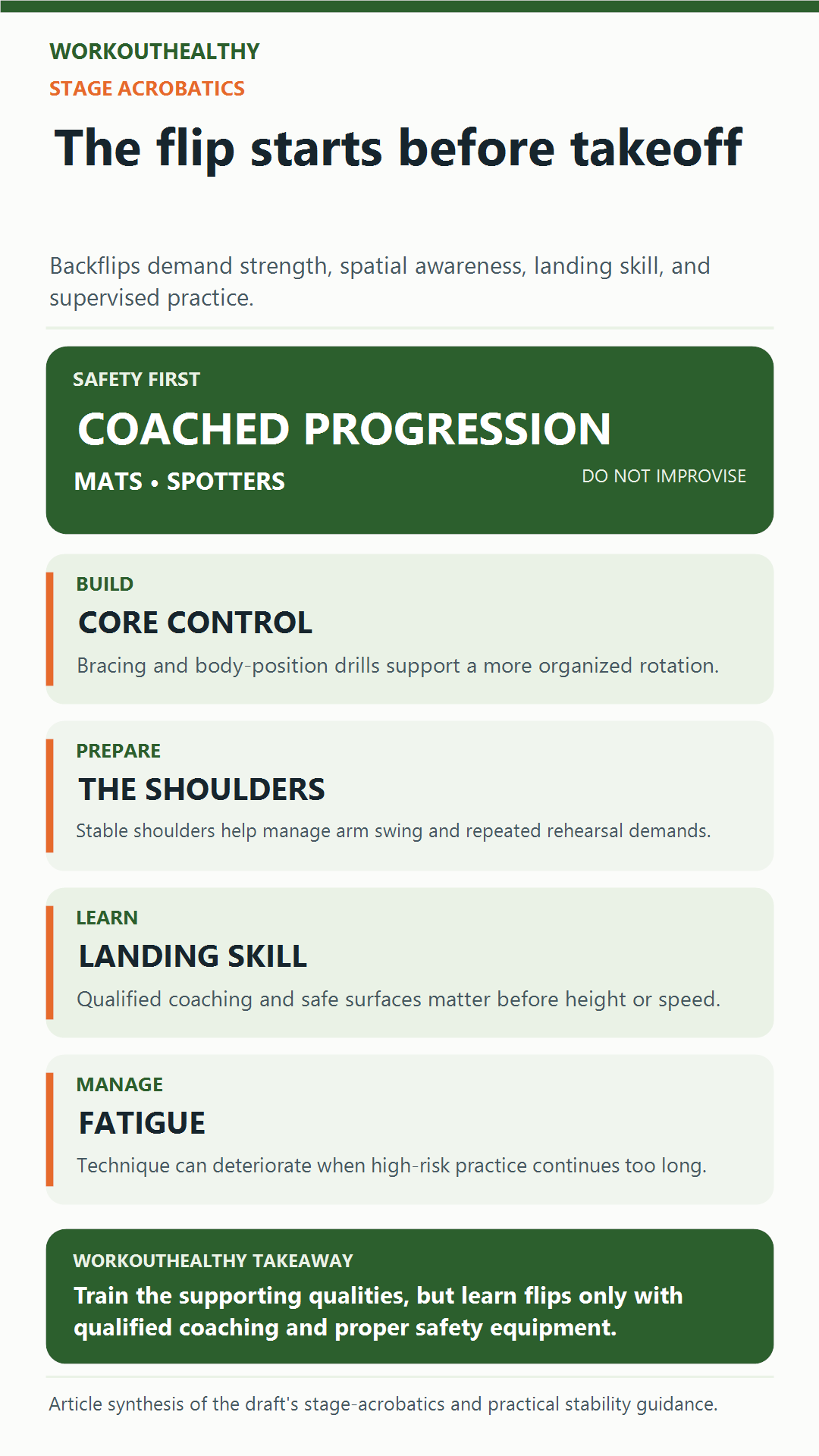
Anyone interested in more advanced movement, including anything resembling a flip or an aerial skill, should work with a qualified coach or gymnastics trainer rather than attempting it alone.
The risk of a bad landing is real, and it scales quickly with height and speed.
References
Kibler, W. B., Press, J., & Sciascia, A. (2006). The role of core stability in athletic function. Sports Medicine, 36(3), 189-198. https://doi.org/10.2165/00007256-200636030-00001
Purnell, M., Shirley, D., Nicholson, L., & Adams, R. (2010). Acrobatic gymnastics injury: Occurrence, site and training risk factors. Physical Therapy in Sport, 11(2), 40-46. https://doi.org/10.1016/j.ptsp.2010.01.002
This article is for general information and is not personalized medical or fitness advice. Acrobatic movements, including backflips and other aerial skills, carry a real risk of serious injury and should only be attempted with proper coaching, spotting, and progression. Talk to a doctor or a qualified trainer before starting any new exercise program, especially one involving jumping, landing, or inverted movement.