
A Bold Claim About Exercise Intensity
A short clip from FoundMyFitness has been spreading online.
Its title is direct: “Scientists Just Found How Hard You Should Exercise for Longevity.”
The clip argues that most exercise guidelines have been quietly wrong about something important.
They treat one minute of hard effort as worth about two minutes of easy effort.
New research suggests that ratio badly undersells what intensity actually does.
That is a big claim. It could change how a lot of people plan their workouts.
So we set the video aside and went looking for the actual studies behind it.
What the Video Claims About Exercise Intensity
The video centers on a large 2025 study that used wrist worn fitness trackers instead of survey answers.
Older physical activity research often relied on people remembering and reporting their own workouts.
Memory is not a great measuring tool, especially months after the fact.
Trackers do not have that problem, since they record actual movement as it happens.
The video argues that this more accurate data reveals vigorous exercise is far more powerful, minute for minute, than moderate exercise.
It suggests the standard advice, that a little vigorous activity equals a little more moderate activity, understates the real gap by a wide margin.
That is a specific, checkable claim, so it deserves a real look at the data behind it.
The core question is not whether exercise helps longevity. Nearly every major study agrees it does. The real question this video raises is whether intensity matters much more than most guidelines currently assume.
What the Real Research Actually Shows
The video’s central study is real, and it holds up well under a closer look.
Published in Nature Communications in 2025, the study followed more than 70,000 adults in the UK Biobank project who wore wrist accelerometers for about a week each (Biswas et al., 2025).
Researchers then tracked these adults for roughly eight years, watching for deaths, cardiovascular disease, type 2 diabetes, and cancer.
Instead of just comparing active people to inactive people, the team calculated something new.
They worked out exactly how many minutes of moderate activity would be needed to match the benefit of one minute of vigorous activity, for each health outcome separately.
The results were striking.
For all cause mortality, one minute of vigorous activity matched about 4.1 minutes of moderate activity.
For heart disease death specifically, the gap was even wider, with one vigorous minute matching roughly 7.8 moderate minutes.
Type 2 diabetes risk showed the largest gap of all, at about 9.4 moderate minutes for every vigorous one.
Cancer mortality showed a smaller but still meaningful gap, at about 3.5 moderate minutes per vigorous minute.
Every one of those ratios is well above the old 1 to 2 rule of thumb that most fitness guidelines still use.
This lines up with other, older research on fitness and survival.
A large 2018 study followed more than 120,000 adults who took a treadmill fitness test as part of routine medical care (Mandsager et al., 2018).
People with the highest fitness levels, sometimes called elite performers, had about an 80 percent lower risk of death compared with the least fit group.
Importantly, the study found no upper limit where more fitness stopped helping.
Even comparing the elite group to the next highest fitness group, the elite group still came out ahead.
An earlier, very large pooled analysis reached a similar conclusion from a different angle.
Researchers combined data from more than 660,000 adults and looked at leisure time physical activity levels compared with a standard minimum guideline (Arem et al., 2015).
People doing one to two times the recommended minimum had about 31 percent lower mortality risk than inactive people.
People doing three to five times the minimum saw the largest reduction in that study, around 39 percent.
Past that point, additional activity kept helping only slightly.
Even at ten times the recommended minimum, the study found no sign of increased mortality risk from too much exercise.
A separate 2022 study added a very practical piece to this puzzle.
Researchers tracked over 25,000 adults who did not exercise in any structured way, using wearable devices to catch brief bursts of vigorous effort during ordinary daily life (Stamatakis et al., 2022).
Things like rushing up a few flights of stairs or carrying heavy shopping bags quickly counted as this kind of activity, sometimes called vigorous intermittent lifestyle physical activity.
People who logged just three to four minutes of this kind of activity a day had roughly a 26 to 30 percent lower risk of dying during the study, and an even larger drop in cardiovascular death risk.
None of this requires a gym membership or a formal workout, which is part of why the finding got so much attention.
What This Evidence Does Not Prove
It is worth being precise about what these studies do and do not show.
These are observational studies, meaning researchers watched what people already did and tracked outcomes, rather than randomly assigning people to different exercise intensities for years.
That design can reveal strong, consistent patterns, but it cannot fully rule out other explanations.
People capable of vigorous exercise may also be healthier to begin with, for reasons unrelated to the exercise itself.
Researchers try to statistically adjust for factors like age, existing illness, and smoking, but no adjustment is perfect.
The health equivalence ratios from the 2025 study are also population averages, not a personal guarantee.
They describe what tends to happen across tens of thousands of people, not what will definitely happen for any one individual.
None of this research says moderate activity is worthless.
Moderate activity still lowers mortality risk substantially compared with no activity at all, in every one of these studies.
The finding is about relative efficiency between intensities, not a case against moderate exercise entirely.
This research also does not mean everyone should immediately switch to all out effort.
Vigorous activity is a real physical stressor, and a body that has not built up to it needs a gradual approach, not a sudden leap.
Common Mistakes People Make With This Information
The most common mistake is treating vigorous exercise as the only kind that counts.
These studies still show large benefits from moderate activity alone.
Vigorous effort adds efficiency, it does not erase the value of a daily walk or an easy bike ride.
A second mistake is jumping straight into hard intervals without any base fitness.
The safest path to more vigorous activity is a gradual build over weeks, not a first workout that goes all out.
A third mistake is ignoring how a person’s fitness relates to everyday tasks like climbing stairs, which is one reason a simple check like our four flights of stairs test can be a useful starting point before chasing more intense workouts.
A fourth mistake is assuming intensity is only about cardio.
Resistance training also carries real longevity related benefits beyond the mortality data covered here, including effects on the brain covered in our review of lifting weights and brain health.
A fifth mistake is thinking a single viral video captures the entire body of research on a topic.
This clip highlights one genuinely strong study, but the fuller picture includes multiple studies across different populations and methods, which is exactly why this article checked more than one source.
Who Should Check With a Doctor Before Adding Vigorous Exercise
Most healthy adults can safely add short bursts of vigorous activity without medical clearance first.
Some situations call for a conversation with a doctor before increasing intensity.
Anyone with a diagnosed heart condition, uncontrolled high blood pressure, or a history of chest pain during exertion should get clearance before adding vigorous effort.
People who have had a recent heart attack, stroke, or heart surgery need an individualized plan from their care team, not a general guideline from an article or video.
Anyone with uncontrolled diabetes, significant joint problems, or a recent injury should also check in first, since vigorous effort places more demand on the body than moderate movement does.
Pregnant women should talk to their doctor about safe intensity levels, since recommendations can shift throughout pregnancy.
Older adults who have been sedentary for a long stretch generally do best starting with moderate activity and adding brief vigorous bursts gradually, ideally after a check in with a doctor.
Anyone who feels chest pain, unusual shortness of breath, dizziness, or lightheadedness during exercise should stop immediately and seek medical attention rather than pushing through it.
How to Practically Add Intensity to Your Week
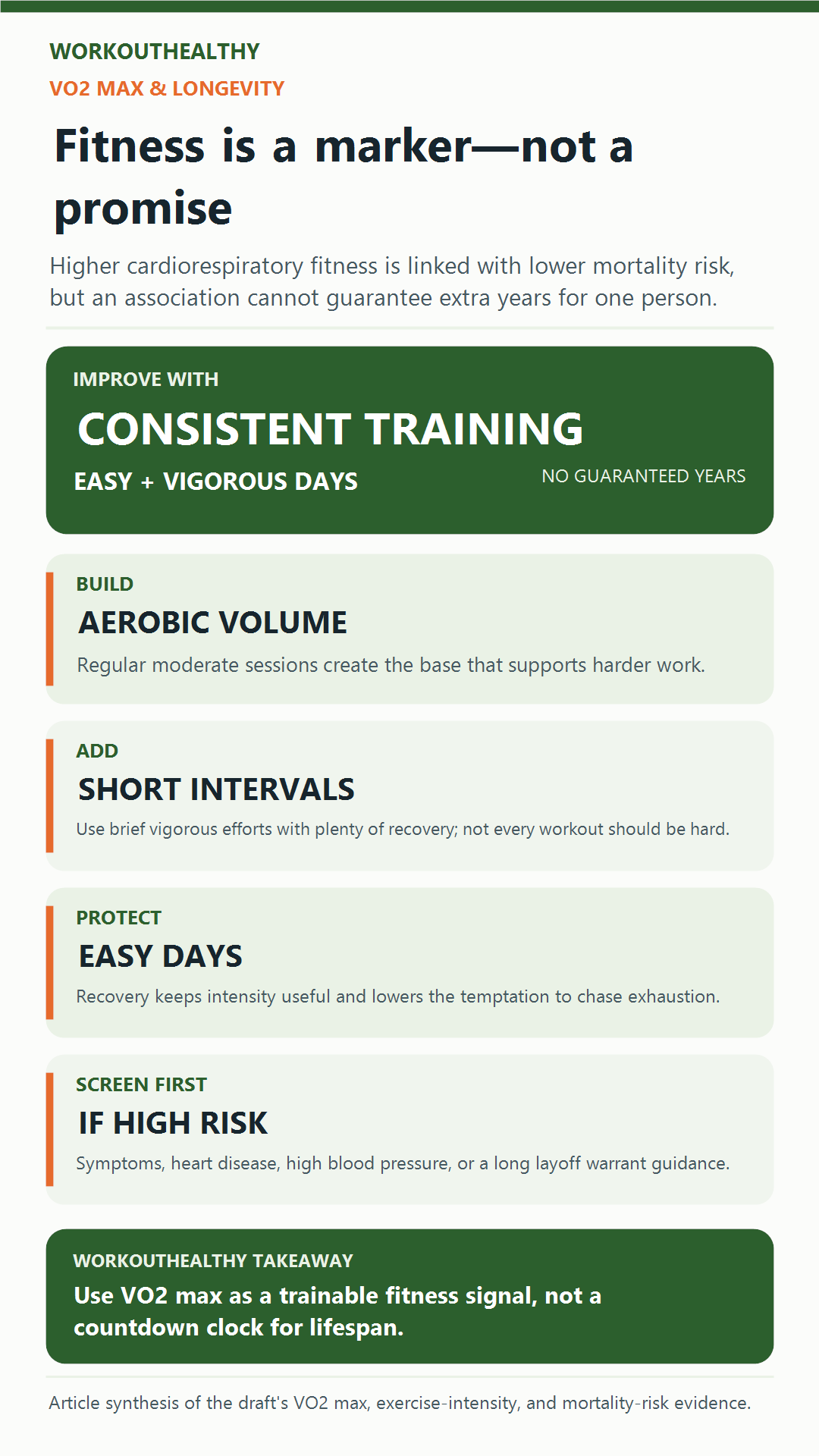
Based on the research above, a few practical, low risk moves can help most healthy adults capture some of this benefit.
Walking briskly enough that talking feels a little harder, rather than at a relaxed pace, is a simple starting point.
Our guide on how many miles you should walk a day is a reasonable place to check your current baseline before adding intensity on top of it.
Taking stairs at a faster pace instead of the elevator, when your body tolerates it well, is a realistic way to add short vigorous bouts without scheduling a separate workout.
Carrying groceries quickly from the car, or picking up the pace for the last minute of a walk, are exactly the kind of everyday vigorous bursts the 2022 study measured.
For structured workouts, simple interval formats work well, such as alternating one minute of faster effort with two or three minutes of easier movement, repeated several times.
Building up gradually over several weeks, rather than starting with long hard sessions, lowers injury risk while still adding real intensity to your routine.
Three to four short vigorous bouts a day, each lasting somewhere around a minute, matches roughly what the wearable device research found meaningfully useful.
None of this requires special equipment, a gym, or a large block of extra time.
What the research keeps pointing to is that a small amount of real effort, added consistently, appears to matter more than most guidelines have given it credit for.
Watch the Original Video
Want more like this? Subscribe to WorkoutHealthy Insider for practical explanations behind popular fitness claims.
References
Arem, H., Moore, S. C., Patel, A., Hartge, P., Berrington de Gonzalez, A., Visvanathan, K., Campbell, P. T., Freedman, M., Weiderpass, E., Adami, H. O., Linet, M. S., Lee, I. M., & Matthews, C. E. (2015). Leisure time physical activity and mortality: A detailed pooled analysis of the dose-response relationship. JAMA Internal Medicine, 175(6), 959 to 967. https://doi.org/10.1001/jamainternmed.2015.0533
Biswas, R. K., Ahmadi, M. N., Bauman, A., Milton, K., Koemel, N. A., & Stamatakis, E. (2025). Wearable device-based health equivalence of different physical activity intensities against mortality, cardiometabolic disease, and cancer. Nature Communications, 16(1), Article 8315. https://doi.org/10.1038/s41467-025-63475-2
Mandsager, K., Harb, S., Cremer, P., Phelan, D., Nissen, S. E., & Jaber, W. (2018). Association of cardiorespiratory fitness with long-term mortality among adults undergoing exercise treadmill testing. JAMA Network Open, 1(6), e183605. https://doi.org/10.1001/jamanetworkopen.2018.3605
Stamatakis, E., Ahmadi, M. N., Gill, J. M. R., Thogersen-Ntoumani, C., Gibala, M. J., Doherty, A., & Hamer, M. (2022). Association of wearable device-measured vigorous intermittent lifestyle physical activity with mortality. Nature Medicine, 28(12), 2521 to 2529. https://doi.org/10.1038/s41591-022-02100-x
This article is for general information only and is not medical advice. If you have an injury, ongoing pain, or a medical condition, talk to a doctor or physical therapist before you change how you train or eat.