

The classic bodybuilding split gives every muscle its own day and its own hour of glory.
Chest on Monday, back on Tuesday, shoulders on Wednesday, and so on until the week runs out.
It is simple, it feels productive, and for a lot of lifters it quietly leaves results on the table.
Here are six reasons the once weekly approach may be costing you, and how to fix it without booking a single extra gym day.
What the Bro Split Actually Is
A bro split trains each muscle group hard on one day and then leaves it alone for the rest of the week.
A typical version runs chest, back, shoulders, arms and legs across five separate sessions.
Each muscle therefore gets trained once every seven days, and all of its weekly work lands in a single block.
The format became closely associated with bodybuilding culture, where a lifter may devote an entire session to one body part.
6 Reasons the Bro Split Might Be Wasting Your Gym Time
- 1. Twice a week beat once a week in the frequency research. A meta-analysis of frequency studies found that training a muscle group twice per week produced greater growth than training it once per week (Schoenfeld et al., 2016).
- 2. Strength gains showed the same pattern until volume was matched. A separate meta-analysis reported greater strength improvements at higher frequencies, but the difference disappeared in studies where weekly volume was equal (Grgic et al., 2018).
- 3. Long sessions can reduce set quality. Piling every weekly set for a muscle into one session means the later sets may be limited by local fatigue.
- 4. It caps how much quality volume you can fit. Weekly volume drives growth within a broad range, and one session per muscle puts a low ceiling on how many good sets you can actually complete (Schoenfeld et al., 2017).
- 5. A missed session costs you a whole week. If leg day falls on the one Thursday you have to work late, your legs get nothing for seven days.
- 6. It usually demands more gym days than people have. A true five day split needs five reliable slots, and most people do not have five reliable slots.
What the Frequency Research Actually Found
The headline result is straightforward but the detail matters.
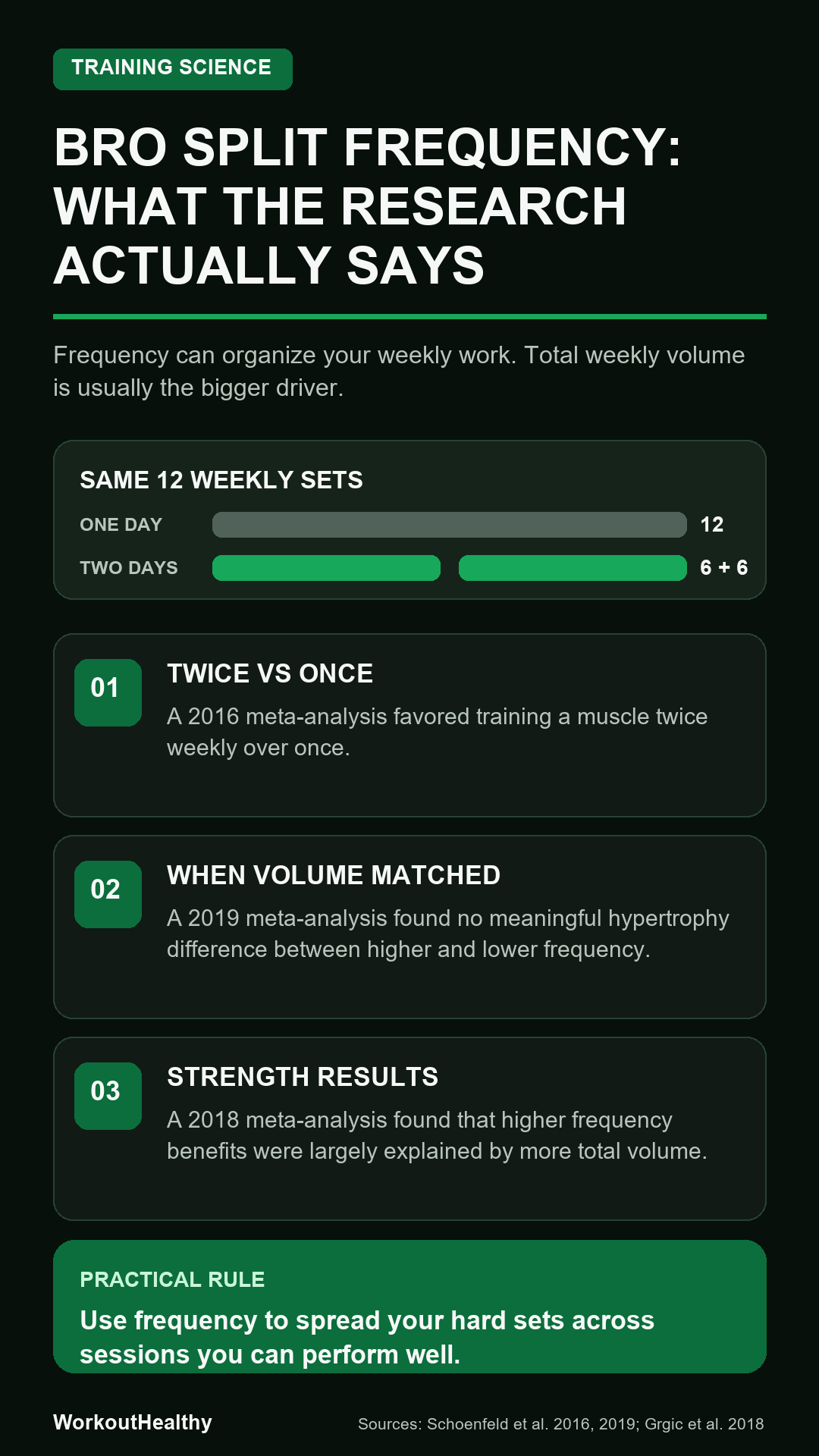
Schoenfeld and colleagues pooled studies comparing training frequencies and found that muscle groups trained twice per week grew more than the same muscle groups trained once per week (Schoenfeld et al., 2016).
A later and more careful analysis by the same group asked what happens when weekly volume is held identical between the two schedules (Schoenfeld et al., 2019).
Under those equated conditions, frequency by itself stopped looking like the deciding factor.
The strength literature lands in a similar place, with a meta-analysis reporting an advantage for higher frequency that appears to run largely through the extra volume it allows (Grgic et al., 2018).
The Part Most People Get Backwards
Frequency is not magic, and it is not the ingredient that builds muscle.
Frequency is a delivery system for volume, and volume is what does the work.
Weekly set totals show a dose-response relationship with muscle growth across a broad range, which means the number of hard sets you complete each week matters a great deal (Schoenfeld et al., 2017).
Spreading those sets over two sessions simply makes them easier to complete well, because you arrive fresh twice instead of grinding through set number eighteen once.
Training a muscle twice a week does not add a second helping of magic. It just gives your weekly sets somewhere better to live.
What This Evidence Does Not Prove
None of this proves a bro split does not work, because it plainly does work for plenty of people.
The frequency studies mostly ran between six and twelve weeks, which is short compared with a training career.
Many of them used untrained or lightly trained participants, and results in that group do not always carry over to someone with a decade under the bar.
Once weekly volume is matched, the research does not show that two sessions beat one by any large margin (Schoenfeld et al., 2019).
No study here says five is worse than three, and none of them measured whether you will actually enjoy the change enough to keep doing it.
How to Fix Your Split Without Adding Gym Days
This is the whole trick, and it is a reorganization rather than an expansion.
Keep the same number of gym days you already have, and change what each day contains.
Start by counting your current weekly hard sets per muscle group, because that number is what you are protecting.
Then split each muscle’s weekly sets across two of your existing sessions instead of one.
Chest, for example, moves from twelve sets on Monday to six sets on Monday and six sets on Thursday.
Pair muscles that share sessions sensibly, so a push group and a pull group can both appear twice a week without anyone getting a third session.
Cut the set count per session before you cut exercises, since three good exercises beat six rushed ones.
Keep your training log honest about weight and reps through the changeover, because that record is the only way to see whether the new layout helped.
Three Rewrites Using the Days You Already Have
- Three days a week. Run three full body sessions, with one or two exercises per major muscle group each time, which gives every muscle three exposures without a fourth gym trip.
- Four days a week. Run upper, lower, upper, lower, which lands every muscle group twice a week inside the four days you already attend.
- Five days a week. Run push, pull, legs, upper, lower, which keeps your five days and still hits everything roughly twice.
In all three cases the gym days stay the same and only the contents move.
If you want a fuller template rather than a rearrangement, a complete training program gives you the whole structure at once.

Common Mistakes When People Switch
- Doubling the volume instead of splitting it. Doing your full Monday chest session twice a week is a volume jump, not a frequency change, and it usually ends in a stall.
- Adding a sixth day to make it fit. The entire point is to reorganize the days you have, and adding days is the thing you were trying to avoid.
- Dropping the heavy work. Splitting sessions is not a reason to abandon your main lifts, and both sessions should still include something genuinely hard.
- Judging it in two weeks. The studies behind this ran for months, so give the new layout at least eight weeks of logged sessions.
- Ignoring recovery between the two sessions. Placing your two chest days back to back on Monday and Tuesday defeats the purpose, so separate them by at least two days.
- Forgetting that rest days are part of the program. More frequent muscle exposure does not mean fewer days off.
How to Count a Hard Set So the Math Works
Every instruction above depends on counting weekly sets correctly, and most people count them generously.
A hard set is a working set taken close enough to failure that you could not have added more than a couple of clean reps.
Warm up sets do not count, and neither do the light sets you use to feel out a movement.
Count sets per muscle group rather than per exercise, since a barbell row and a lat pulldown both deposit work into your back.
Give partial credit where a movement only assists, so a heavy bench press adds a full set to chest and roughly half a set to triceps.
Once you have an honest weekly number for each muscle, splitting it in half across two days becomes simple arithmetic rather than guesswork.
When a Bro Split Is Actually Fine
If you genuinely train five or six days a week and enjoy the structure, the research does not tell you to stop.
Once weekly volume is matched, the measured gap between frequencies is small (Schoenfeld et al., 2019).
Lifters with long training histories often use a body part split successfully because they can tolerate and complete high volume in one sitting.
The split that you look forward to and repeat for two years will beat the theoretically better one you quit in six weeks.
Who Should Check With a Doctor Before Changing Their Training
Ask a doctor first if you have heart disease, uncontrolled high blood pressure, or any condition that makes heavy exertion risky.
The same applies if you are recovering from surgery or managing a joint problem that a change in weekly loading could aggravate.
Anyone returning from a shoulder, back or knee injury should check with a physical therapist before increasing how often that area gets loaded.
If you are pregnant or recently postpartum, get individual guidance before you restructure your training week.
Stop and seek medical advice if a new layout brings on sharp joint pain, numbness, or pain that does not settle within a few days.
The Short Version
The bro split is not broken, but for most ordinary lifters it is an inefficient container for their weekly sets.
Research found an advantage for training muscles twice a week, and the most likely reason is that the schedule makes weekly volume easier to complete well (Schoenfeld et al., 2016; Grgic et al., 2018).
You do not need extra gym days to capture that, since the same weekly sets simply move across the sessions you already attend.
Count your sets, split them across two days, keep your log, and judge the result in eight weeks rather than eight days.
Wondering what else the research quietly overturned? Subscribe to WorkoutHealthy Insider for practical explanations behind popular fitness claims.
References
Grgic, J., Schoenfeld, B. J., Davies, T. B., Lazinica, B., Krieger, J. W., & Pedisic, Z. (2018). Effect of resistance training frequency on gains in muscular strength: A systematic review and meta-analysis. Sports Medicine, 48(5), 1207 to 1220. https://doi.org/10.1007/s40279-018-0872-x
Schoenfeld, B. J., Grgic, J., & Krieger, J. (2019). How many times per week should a muscle be trained to maximize muscle hypertrophy? A systematic review and meta-analysis of studies examining the effects of resistance training frequency. Journal of Sports Sciences, 37(11), 1286 to 1295. https://doi.org/10.1080/02640414.2018.1555906
Schoenfeld, B. J., Ogborn, D., & Krieger, J. W. (2016). Effects of resistance training frequency on measures of muscle hypertrophy: A systematic review and meta-analysis. Sports Medicine, 46(11), 1689 to 1697. https://doi.org/10.1007/s40279-016-0543-8
Schoenfeld, B. J., Ogborn, D., & Krieger, J. W. (2017). Dose-response relationship between weekly resistance training volume and increases in muscle mass: A systematic review and meta-analysis. Journal of Sports Sciences, 35(11), 1073 to 1082. https://doi.org/10.1080/02640414.2016.1210197
This article is for general information only and is not medical advice. If you have an injury, ongoing pain, or a medical condition, talk to a doctor or physical therapist before you change how you train or eat.