

Halsey, born Ashley Nicolette Frangipane, built a career on turning personal struggle into direct, specific songwriting.
That pattern held true again in June 2024, when the singer shared serious health news with fans.
Halsey revealed diagnoses of lupus and a rare T cell lymphoproliferative disorder, a condition affecting the blood and immune system.
Both conditions can bring unpredictable symptoms and require ongoing, individualized medical care.
Rather than stepping away from music, Halsey continued writing and released the album “The Great Impersonator” later that year, an album that directly addresses the health battle.
The singer also went on to announce the Back to Badlands Tour, continuing to perform while managing both conditions.
Public reaction to the announcement was significant, in part because lupus remains widely misunderstood despite affecting a large number of people.
An artist with a large platform naming a specific, rare combination of conditions gave many fans language for symptoms they had never been able to explain, and it echoes how chronic stress and immune function are connected in ways many people underestimate.
What Lupus and T Cell Disorders Actually Involve
Lupus is an autoimmune disease, meaning the immune system mistakenly attacks the body’s own healthy tissue.
It can affect joints, skin, kidneys, blood cells, the heart, and the lungs, and symptoms often come and go in flares.
Fatigue is one of the most consistently reported symptoms across people living with lupus, and it can be severe enough to limit daily activity.
A T cell lymphoproliferative disorder involves an abnormal growth of a type of white blood cell called T cells.
These disorders are rare, and their severity and treatment path vary enormously depending on the specific subtype.
Having both an autoimmune condition and a blood cell disorder at the same time adds real complexity to treatment planning, since medications for one condition can sometimes affect the other.
Lupus itself is not rare in the way the T cell disorder is.
The Lupus Foundation of America estimates that at least 1.5 million Americans are living with some form of the disease, the large majority of them women diagnosed between the ages of fifteen and forty four.
Despite that prevalence, lupus is often called an invisible illness, since many of its most disruptive symptoms, including fatigue and joint pain, do not show up in a way others can see.
In Halsey’s Own Words
Halsey has described managing the health news as something that shaped the songwriting and themes running through “The Great Impersonator.”
The singer has talked publicly about wanting to be honest with fans rather than disappearing quietly to deal with the diagnoses in private.
Halsey has framed continuing to create music as a way of staying connected to identity and purpose during a difficult stretch, rather than treating illness and creative work as separate, competing forces.
That framing has resonated with fans managing their own chronic health conditions, many of whom have described feeling seen by an artist choosing visibility over silence.
Halsey has also been careful to describe the situation as personal, not a template for how anyone else’s illness should look or be handled.

What the Research Says About Exercise and Lupus
For a long time, doctors were cautious about recommending exercise for lupus patients, worried that exertion might trigger flares.
That caution has softened considerably as more research has been done.
A 2017 systematic review with meta analyses published in Seminars in Arthritis and Rheumatism examined multiple randomized controlled trials of exercise in lupus patients.
The review found that structured exercise programs improved fatigue, aerobic capacity, and quality of life without increasing disease activity or triggering flares in the studied populations (O’Dwyer et al., 2017).
That last point matters enormously, since fear of triggering a flare has historically kept many lupus patients away from exercise entirely.
The exercise programs studied were generally moderate, supervised, and built around each participant’s current symptom level, not high intensity or one size fits all.
Improvements showed up most consistently in cardiovascular fitness and self reported fatigue scores, two areas that matter enormously for day to day quality of life.
The review’s authors were careful to note that study quality varied and sample sizes were often small, which is common in research on less common conditions.
Even with those limits, the overall pattern across the included trials pointed in the same direction: appropriately dosed exercise appears safe and helpful rather than risky for most stable lupus patients.
Why Fatigue Management Looks Different With a Chronic Illness
Fatigue tied to an autoimmune or blood disorder behaves differently than ordinary tiredness from a hard workout or a late night.
It does not always respond to a good night’s sleep, and it can fluctuate for reasons that have nothing to do with activity level the day before.
Many clinicians who treat chronic illness use a pacing approach, where activity is spread out and adjusted around symptom flares instead of pushed through on a fixed schedule.
This is a meaningfully different mindset than typical fitness advice, which often emphasizes consistency and pushing slightly past comfort.
For someone managing lupus or a blood disorder, listening to the body’s signal on a given day carries more weight than following a rigid plan.
How This Compares to General Health Guidance
For someone without a chronic illness, general guidelines suggest roughly 150 minutes of moderate activity a week.
For someone managing lupus or a similar condition, the numeric target matters far less than how the activity is structured and monitored.
Exercise oncology and chronic disease researchers, working from broader consensus guidance on exercise for people managing serious illness, generally recommend building activity gradually, with regular check ins on symptoms and lab markers (Campbell et al., 2019).
Low impact options like walking, swimming, and gentle resistance training tend to appear most often in the research specific to autoimmune and blood conditions.
The overall message from current research is not “exercise less because you are sick.”
It is “exercise differently, and expect the plan to change over time as symptoms change.”
Who Should Talk to a Doctor First
Anyone with a new lupus or blood disorder diagnosis should build an exercise plan together with their treating physician, not independently.
Certain lupus medications, including corticosteroids and immunosuppressants, can affect bone density, muscle strength, and infection risk during exercise.
People with active inflammation, unexplained new pain, or a recent flare should check with their doctor before starting or resuming a workout routine.
Blood disorders in particular can affect clotting risk, red blood cell counts, and energy levels in ways that are not always visible from the outside.
A rheumatologist or hematologist can help identify which specific symptoms are safe to train through and which ones signal it is time to rest instead.
Family members and friends supporting someone with these conditions should avoid pushing a loved one to “just push through” fatigue, since that instinct can conflict directly with real medical guidance, the same lesson dancer Misty Copeland’s own recovery from major surgery made clear about respecting a body’s actual timeline.
What This Evidence Does Not Prove
None of this research proves that exercise can treat lupus or a T cell disorder on its own.
The 2017 review found real benefits for fatigue and quality of life, but it did not find that exercise altered the underlying disease course.
Research specific to T cell lymphoproliferative disorders and exercise is limited, since these disorders are rare and vary widely between subtypes.
Broader guidance built for cancer and chronic illness patients is a reasonable starting point, but it is not a substitute for individualized medical advice.
The honest picture is that movement can meaningfully support quality of life alongside medical treatment, not replace it.
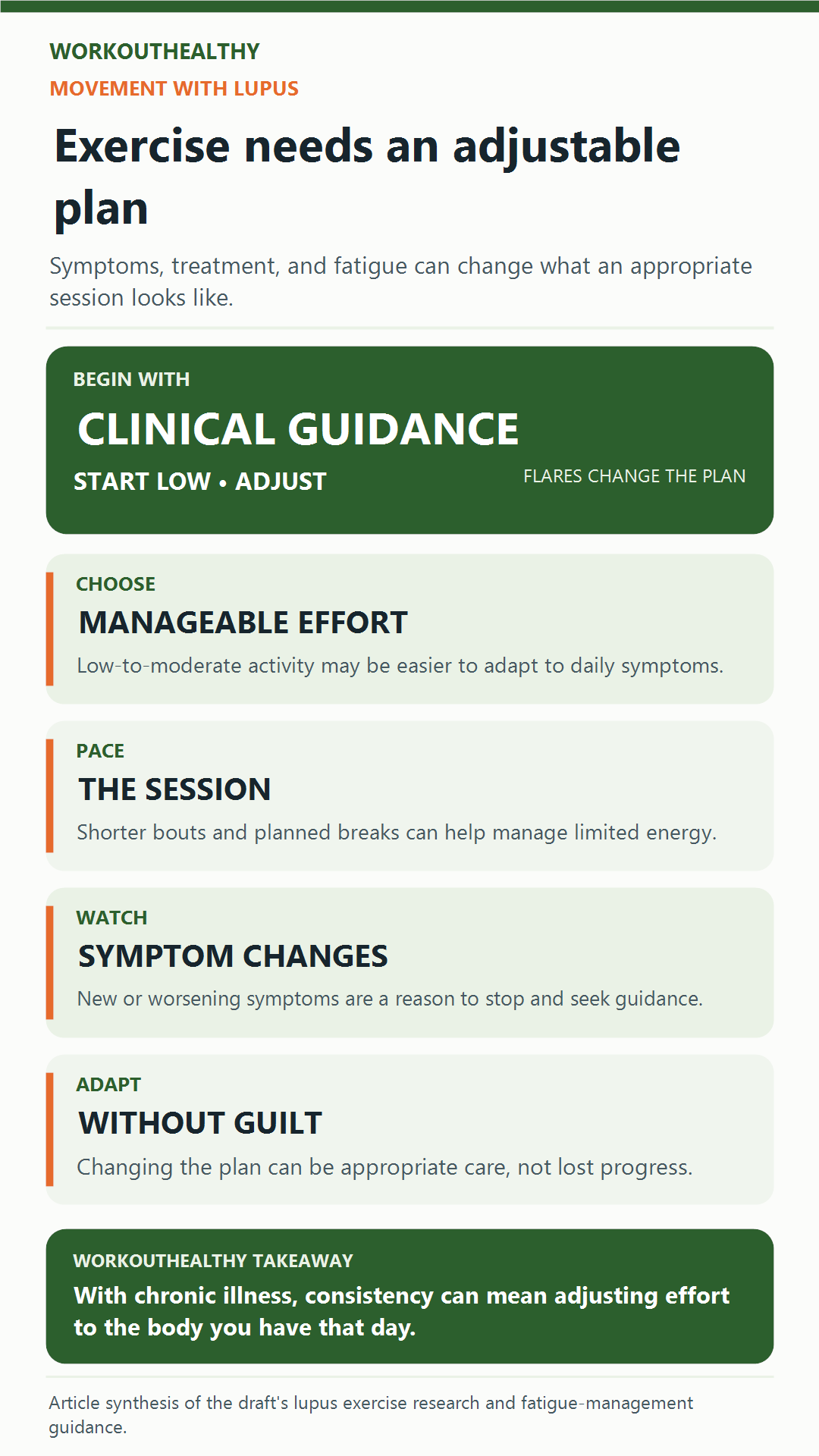
A Practical Starting Point
Start with a conversation with the treating physician about current symptom severity and any activity restrictions.
Begin with short sessions, ten to fifteen minutes of gentle movement like walking or stretching, rather than a full workout on day one.
Track energy levels and any new symptoms after each session, since that record helps a doctor adjust the plan over time.
Prioritize consistency at a low intensity over occasional high intensity efforts that risk triggering a flare.
Build in extra rest days around known stressors, including travel, poor sleep, or illness, since these can lower the body’s tolerance for exercise temporarily.
Consider working with a physical therapist experienced in autoimmune or chronic illness rehabilitation, since they can design a plan specific to current symptoms.
Above all, treat any plan as flexible, since a good day and a hard day can call for very different activity levels within the same week.
Keep a simple written or app based symptom log, noting sleep, joint pain, and energy on a one to ten scale alongside whatever activity happened that day.
Over a few months, that log can reveal patterns a single week of data never would, including specific activities or amounts that reliably precede a harder day.
Share that log with the treating physician at regular checkups, since it gives them information they cannot get from a lab test alone.
Building a support system, whether that is a physical therapist, a support group, or simply an honest friend who understands the diagnosis, tends to matter as much as the exercise plan itself over the long run.
References
Campbell, K. L., Winters-Stone, K. M., Wiskemann, J., May, A. M., Schwartz, A. L., Courneya, K. S., Zucker, D. S., Matthews, C. E., Ligibel, J. A., Gerber, L. H., Morris, G. S., Patel, A. V., Hue, T. F., Perna, F. M., & Schmitz, K. H. (2019). Exercise guidelines for cancer survivors: Consensus statement from International Multidisciplinary Roundtable. Medicine & Science in Sports & Exercise, 51(11), 2375 to 2390. https://doi.org/10.1249/MSS.0000000000002116
O’Dwyer, T., Durcan, L., & Wilson, F. (2017). Exercise and physical activity in systemic lupus erythematosus: A systematic review with meta analyses. Seminars in Arthritis and Rheumatism, 47(2), 204 to 215. https://doi.org/10.1016/j.semarthrit.2017.04.003
This article is for general informational purposes only and is not medical advice.
Talk with a rheumatologist, hematologist, or other treating physician before starting or changing an exercise routine if you are managing lupus, a blood disorder, or any other chronic autoimmune condition.