
A social post says that adding 0.54 grams of protein per kilogram of body weight built real muscle in older men. The number comes from published research, but it is not a new daily protein recommendation.
It describes an increase above habitual intake in one secondary analysis of a small, specific group. Understanding that difference changes the headline from a prescription into a useful study-reading lesson.
Quick answer: among undernourished, frail older Korean adults in a 12-week feeding trial, an increase greater than 0.54 g/kg/day was positively associated with several relative muscle-mass measures in men. It did not improve gait speed, did not establish the same result in women, and still requires confirmation in a clinical trial designed to test that threshold.
A threshold found inside one analysis is evidence to investigate, not a dose to prescribe to everyone.
What the 2020 study analyzed
Kim and Park published the analysis in Nutrients in 2020. It used data from a previous 12-week, double-blind randomized controlled feeding trial.
Participants were undernourished, prefrail or frail older Korean adults. They had been assigned to diets providing about 0.8, 1.2, or 1.5 grams of protein per kilogram of body weight per day.
The newer analysis asked a different question from the original trial. Instead of simply comparing the three assigned groups, it examined how the change from each person’s habitual protein intake related to changes in muscle mass and gait speed.
That makes it a secondary analysis. The underlying feeding trial was controlled, but the 0.54 threshold itself was not the original randomized assignment.
Researchers measured body composition with dual-energy X-ray absorptiometry, commonly called DXA. They evaluated appendicular skeletal muscle, which summarizes lean tissue in the arms and legs.
The study did not include a resistance-training program. That detail matters because protein and training solve related but different problems.
The sample was also not a cross-section of all older adults. Frailty, undernutrition, country, baseline diet, health, and body size affect how widely the result can be generalized.
What 0.54 g/kg/day means
The number is the increase above habitual protein intake, not the person’s total daily intake. That is the most important correction to the viral wording.
For a 70-kilogram person, 0.54 g/kg/day equals about 38 additional grams of protein. A person already eating 0.9 g/kg/day would therefore reach roughly 1.44 g/kg/day after that increase.
For a 90-kilogram person, the same calculation equals about 49 additional grams. That example shows why copying a body-weight formula can create a large dietary change.
The study authors grouped men by the amount their intake changed, then identified a positive relationship above 0.54 g/kg/day for several relative muscle measures.
This is not the same as proving that 0.53 fails and 0.55 succeeds. Biological responses rarely flip at one hundredth of a gram per kilogram.
The value is better understood as a result from the distribution and statistical model used in this sample. It helps describe what happened in the data.
It does not replace dietary assessment, clinical judgment, or the broader evidence on protein needs in aging.
What changed and what did not
In older men, an increase above 0.54 g/kg/day was positively associated with changes in appendicular muscle relative to body weight, body mass index, and fat mass.
The same change was not significantly associated with absolute appendicular muscle indexed to height. Different ways of expressing muscle mass can produce different results.
The analysis did not find an association between the protein increase and gait speed in either men or women.
That gap matters because more lean mass is not automatically more strength, mobility, or independence. Muscle quantity, muscle quality, nervous-system function, balance, confidence, and practice all influence performance.
The study authors noted that participants already walked faster than one meter per second on average. A ceiling effect may have made gait improvement harder to detect.
It is also possible for a nutritional intervention to affect one body-composition measure without producing a noticeable change in daily function during 12 weeks.
A headline that says the added protein “built real muscle” is therefore incomplete. The more accurate statement is that a larger increase was associated with improvement in selected relative muscle-mass measures among the men studied.
Why the sex difference is uncertain
The analysis did not find the same association in older women. The authors discussed possible sex differences in anabolic response, but the study was not large enough to write a new sex-specific protein rule.
Baseline muscle mass and habitual protein intake differed between the men and women. The same absolute increase can represent a different dietary and physiological change across those starting points.
The amount added may also have been insufficient for some women in this undernourished, frail sample. That possibility is not proof that women universally need more than men.
Men and women were analyzed in smaller subgroups, which increases uncertainty. The authors explicitly called for further study in women and a clinical trial to confirm the threshold in men.
Later observational research has also reported sex-specific patterns, but observational associations remain vulnerable to differences in activity, total calories, disease, body composition, and food choice.
The safest conclusion is that sex may modify the relationship between protein and muscle in some older populations. The practical dose still needs to be individualized.
Do not interpret the result as evidence that protein is unimportant for older women. Protein remains essential tissue material for every sex.
The four-question dose check
WorkoutHealthy’s four-question dose check helps readers decide whether a striking nutrition number can travel from a study into real life.
Who was studied? Here, the participants were undernourished, frail or prefrail, older, and Korean. A healthy recreational lifter in the United States is not the same population.
What does the number describe? It describes protein added above habitual intake. It is not total intake and not the Recommended Dietary Allowance.
What outcome changed? Several relative muscle-mass measures improved in men. Gait speed did not, and the association did not appear in women.
How was it tested? The threshold came from a secondary analysis. Participants were randomized to total protein groups, but not to a specific 0.54 g/kg/day increase.
This filter is an original WorkoutHealthy study-reading tool. It can be used for supplement doses, training frequencies, and risk statistics, not only protein.
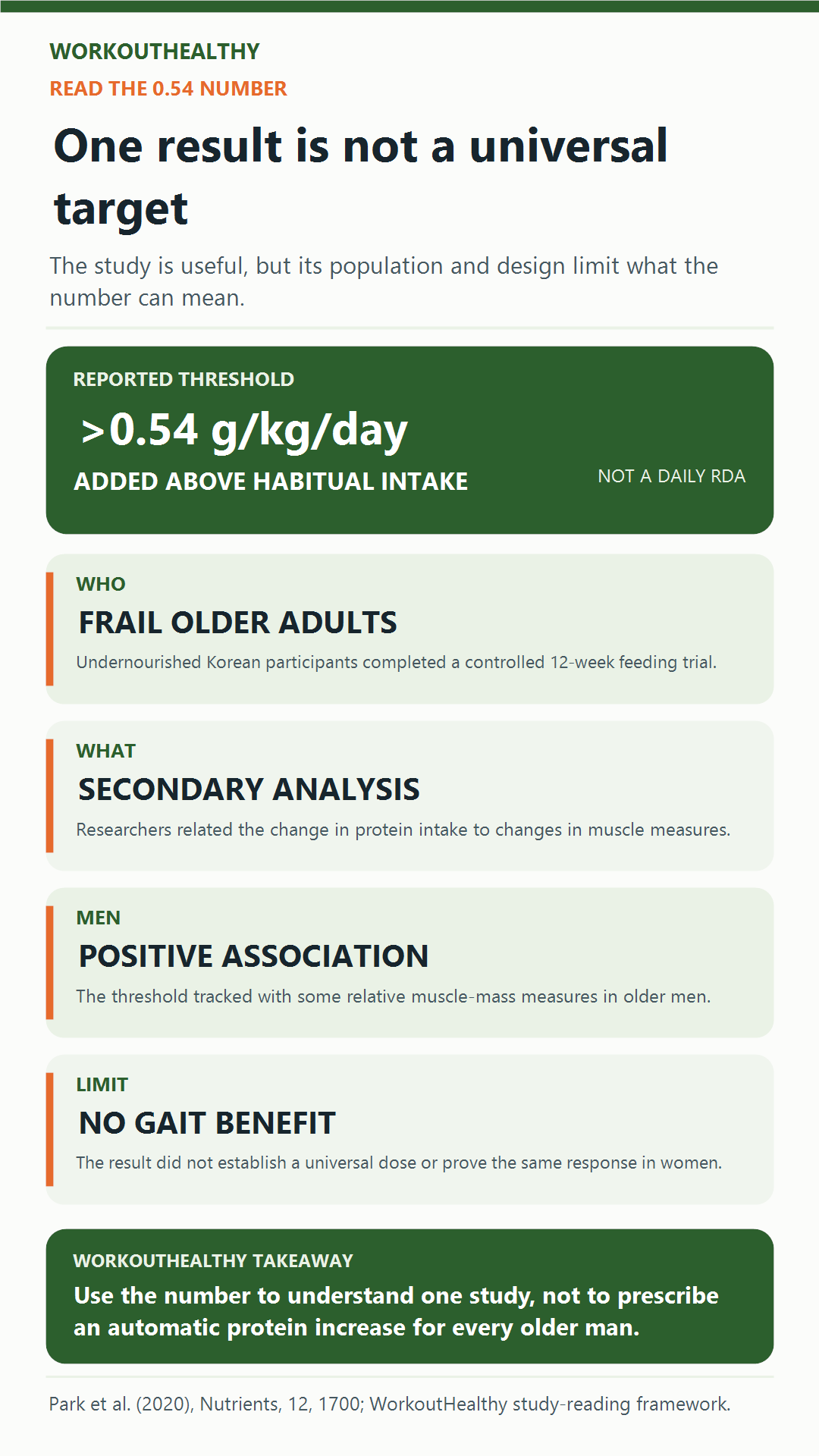
The useful question is not “Can I copy the number?” It is “Does this study describe someone like me and an outcome I care about?”
Why resistance training still matters
Protein provides amino acids, but resistance training provides the mechanical reason for muscle to adapt. Treating the two as interchangeable misses the strongest practical combination.
The 0.54 analysis intentionally examined protein without an exercise intervention. It cannot tell us that adding the same amount to a well-designed training program produces the same response.
Other research generally supports pairing adequate protein with progressive resistance exercise for muscle and strength in older adults.
Training also practices the function people want to preserve. Squats or sit-to-stands, hinges, pushes, pulls, carries, and calf raises challenge force, control, and balance in ways food cannot.
That does not mean every older adult should begin with heavy weights. Bands, machines, bodyweight variations, and supervised free-weight work can all be progressed.
Our five-exercise strength plan for your 40s shows how to organize a compact routine. Older or frail beginners may need an easier entry point and professional supervision.
Recovery belongs beside training. Our guide to rest days and adaptation explains why the signal needs time and resources to produce change.
A safer practical approach
Start by estimating current intake for several ordinary days instead of immediately adding a large calculated amount.
Record meals, beverages, and supplements. Divide daily protein grams by body weight in kilograms to understand the current pattern.
Look for missed meals and long low-protein stretches. Adding a familiar protein food to breakfast or lunch may be easier than forcing one very large shake.
Pair the nutrition plan with two or more weekly strength sessions when medically appropriate. Track exercises, loads, repetitions, walking speed, chair rises, and how daily tasks feel.
Body weight and consumer body-composition scales can fluctuate with hydration. Treat trends over several weeks as more informative than one reading.
The legacy WorkoutHealthy guide to unexplained weight and muscle loss covers reasons to look beyond protein alone.
Sudden weight loss, weakness, poor appetite, swallowing problems, or declining function deserves clinical evaluation. These signs can reflect illness, medication effects, dental problems, depression, or other barriers that a protein target will not solve.
People with kidney disease or another condition requiring dietary management should ask a clinician or registered dietitian before making a large protein increase.
A practical plan should make eating easier, preserve food variety, and support the training the person can safely perform.
The bottom line
The 0.54 g/kg/day figure is real, but its meaning is narrower than the social headline. It was an increase above habitual intake associated with selected muscle measures in older men from a small, frail, undernourished Korean sample.
It was not a universal daily requirement, did not improve gait speed, and did not establish the same association in women. The authors called for confirmatory clinical research.
Start here: assess current intake, spread familiar protein foods across meals, and pair nutrition with progressive resistance training. Use the 0.54 result to read the study, not to self-prescribe a large increase.
References
Medical disclaimer: This article is general product information, not medical advice. The equipment described here is not a treatment for any condition. If you have an injury, ongoing pain, or a medical condition, talk to a doctor or physical therapist before using any of it.