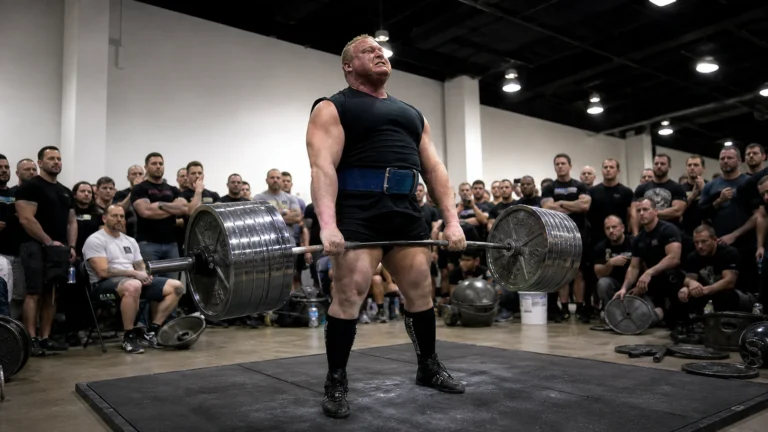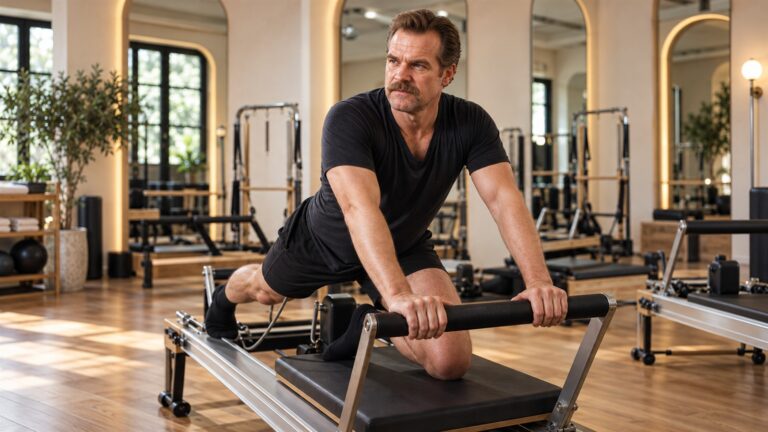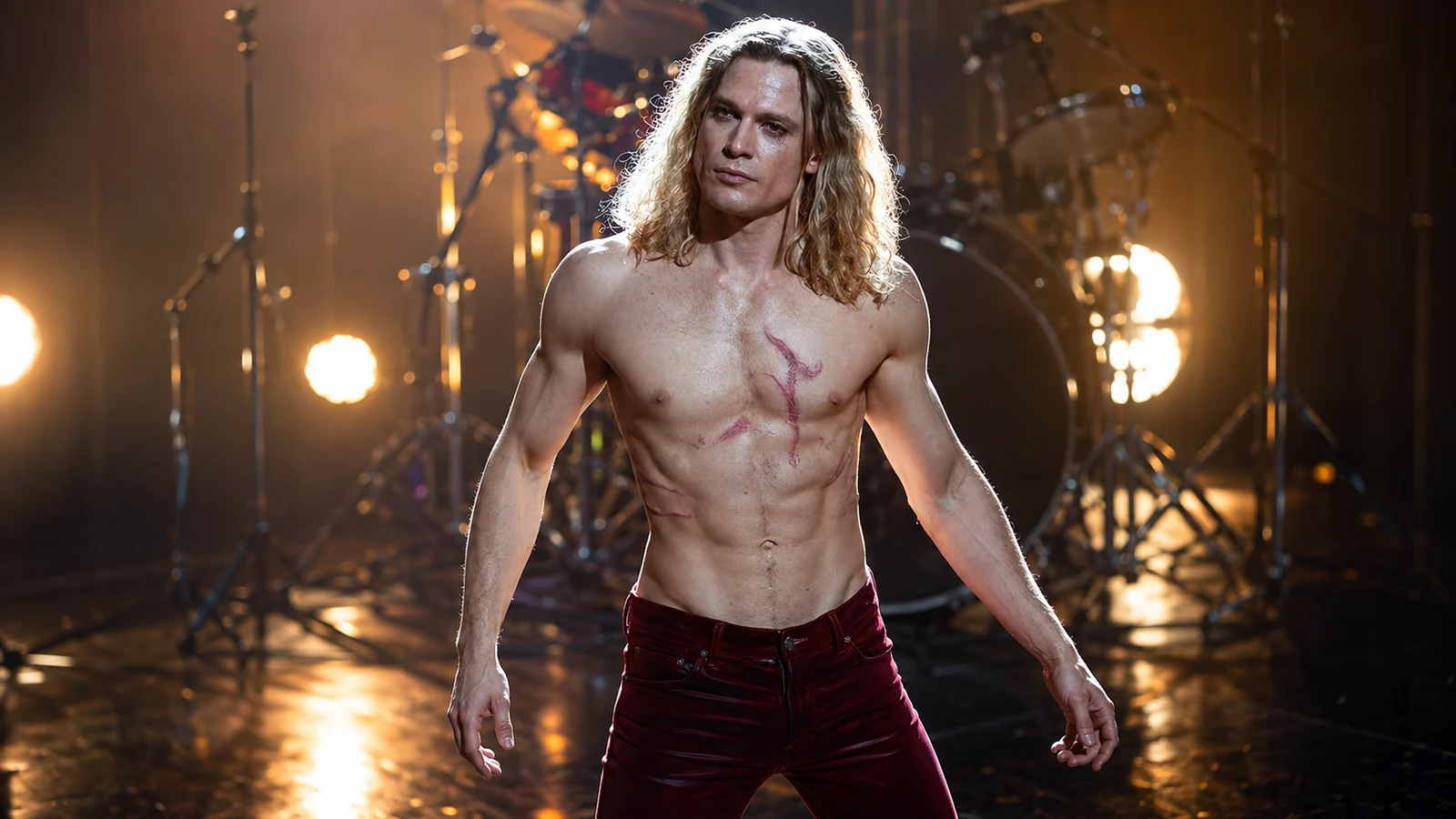

Sam Reid spent two seasons playing Lestat de Lioncourt as a seductive, dangerous vampire in AMC’s Interview with the Vampire.
Then season three asked him to become something different. The story shifts to follow Anne Rice’s novel The Vampire Lestat, and Lestat trades his old identity for a new one. He becomes a rock star.
That shift is not just a costume change. A rock star who commands a stage needs a different physical presence than a vampire who lurks in the shadows of old New Orleans. Reports on the production describe Reid leaning into a training plan built around his shoulders, back, and arms, the muscle groups that shape how a person reads on a stage or a screen the moment they walk into frame.
This is a common but underexplained part of screen acting. Actors do not train the way most gym members do. They train for a specific look tied to a specific character. Here is what the science says about that kind of targeted training, and what an everyday lifter can actually take from it.
Who Is Sam Reid
Sam Reid is a 39 year old Australian actor from New South Wales.
He trained at the London Academy of Music and Dramatic Art, one of the country’s best known drama schools.
He graduated in 2010. Before Interview with the Vampire, he built a steady career in film and television. He played John Davinier in the 2013 film Belle. He played Father Ignatius Jones in the 2019 series Lambs of God, which earned him his first AACTA nomination, the Australian equivalent of an Emmy.
He also spent several years playing Dale Jennings in the Australian newsroom drama The Newsreader, earning three more AACTA nominations for that role.
None of that prepared audiences for what came next.
The Role That Changed His Training
Reid took over the role of Lestat de Lioncourt in 2022, when AMC’s Interview with the Vampire reimagined Anne Rice’s classic vampire story for television.
Critics singled him out immediately. One review called his performance a master class in manipulation. Another said he could convincingly command every room he entered. That command is part of what made season three’s rock star arc work as a natural next step for the character, rather than a strange detour.
In the show’s timeline, Lestat releases a rock album called The Vampire Lestat.
He tours the country performing it. The tour also serves as cover for a documentary being filmed around him.
Reid recorded original songs for the role, including tracks titled Long Face and All Fall Down, along with a cover of a Billy Idol song, all credited to the in universe band.
A vampire who spent two seasons moving through shadowy interiors now needed to hold a stage in front of a crowd.
That is a different physical job. It calls for a build that reads as powerful from a distance, under lights, while an actor also has to move, sing, and perform.
Why Actors Train for a Look, Not Just Fitness
Most people who lift weights are training for general health, strength, or how they feel day to day.
Actors preparing for a physical role are usually solving a narrower problem. They need a specific silhouette by a specific date, one that supports a costume, a lighting setup, and a character’s presence on screen. For Lestat’s rock star era, that likely meant building noticeable size and definition through the shoulders, back, and arms, the upper body regions that show up most clearly in a fitted stage costume or a bare chested performance shot.
This kind of targeted training is not a new idea in exercise science. It has a name: regional hypertrophy, the idea that different training choices can build more size in some muscle groups than others, even within the same overall program.
What the Research Says About Targeted Training
Building noticeable size in specific areas is not just a matter of doing a few extra exercises.
A 2017 systematic review and meta-analysis published in the Journal of Sports Sciences looked at the relationship between weekly training volume and muscle growth.
Researchers Brad Schoenfeld, Dan Ogborn, and James Krieger pooled data across many studies. They found a clear pattern. More weekly sets for a muscle group, up to a point, produced more muscle growth than fewer sets, as long as recovery kept pace with the added work.
That finding matters for anyone trying to build a specific look. Simply adding a few sets of curls will not transform a physique. The muscle group that gets the most focused volume over time is the muscle group most likely to grow the most.
Growth tends to follow the muscle groups that get the most focused, well recovered training volume over time, not the muscle groups a person merely thinks about the most.
A separate 2022 study published in PeerJ by Daniel Plotkin and colleagues, including Schoenfeld again as a senior author, tested something related.
The researchers compared two groups of lifters over eight weeks. One group kept adding more weight to the bar. The other kept the same weight but added more reps instead. Both groups built meaningful muscle and strength. The takeaway was that consistent progressive overload, in either form, drives growth more reliably than any single trick or shortcut.
Neither study was designed around actors or screen roles. Both help explain why a focused, months long training block, not a crash routine, is what tends to produce a noticeably different upper body.
Building a Program Around Shoulders, Back, and Arms
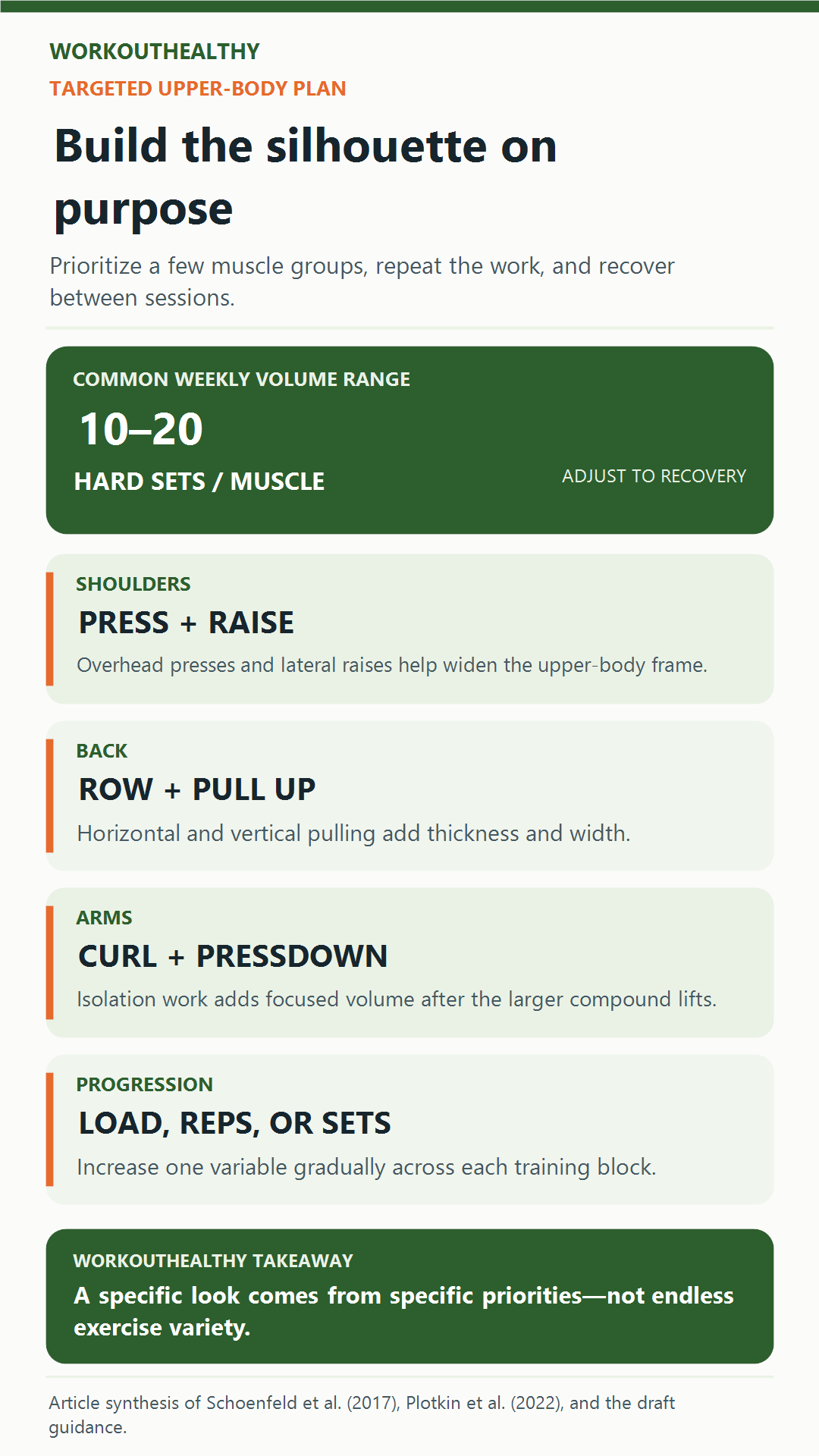
A training block built around Lestat’s rock star silhouette would likely emphasize a handful of proven movement patterns.
Overhead pressing and lateral raises build the shoulders, which widen the frame and create the look of a broader upper body under a shirt or jacket.
Rows and pull ups build the back. That adds thickness that shows up from behind and helps the torso look more substantial in three dimensions, not just from the front.
Curls and pressdowns finish the arms, since visible arm size is often what a camera picks up first in a close or medium shot.
None of that is exotic. It is a fairly standard upper body split, run consistently, with enough total volume to drive growth in those specific areas over several months. Pressing variation choice matters here too. A floor press or bench press both work the chest, shoulders, and triceps, just with slightly different joint demands worth knowing before building a program around one or the other.
What This Evidence Does Not Prove
It is worth being honest about the limits here.
No public source has confirmed the exact program Reid followed, his specific sets and reps, or how long he trained before filming began.
The general shape of “targeted upper body training for a rock star physique” is a reasonable read.
It fits the character shift. It also fits how film and television productions typically prepare actors for physical roles. It is not a confirmed workout log.
Visible muscle size also depends on more than training volume alone. Diet, body fat levels, and genetics all play a role. Lighting and costume choices affect how a physique reads on screen too.
The research above explains the training side of the equation. It does not explain the full picture of how any single actor achieves a specific look for a specific role.
Common Mistakes People Make Copying This Kind of Plan
Trying to copy a celebrity’s rumored training plan is a common trap, and a few mistakes show up again and again.
The first mistake is chasing variety instead of volume. Jumping between many different exercises each week feels productive, but it usually means no single muscle group gets enough focused, repeated work to grow.
The second mistake is skipping progressive overload. Doing the same weight and reps every session for months will maintain a physique, not build a new one. Some form of steady progression, more weight, more reps, or more sets over time, is what the research above consistently points to.
The third mistake is underestimating the timeline. Meaningful, visible muscle growth in specific areas usually takes several months of consistent training, not a few weeks. Productions that need an actor camera ready for a role often start the process well before filming begins.
The fourth mistake is ignoring recovery. More sets only help if a person can recover from them. Training the same muscle group without enough rest between sessions can stall progress instead of speeding it up.
How to Try a Role Specific Training Block
Anyone can borrow this style of focused training without a film contract. Working with a coach can help, especially for anyone new to structured programming. Here is how to decide whether a personal trainer is worth it and how to pick a good one.

Start by picking two or three muscle groups to prioritize, rather than trying to change everything at once.
For an upper body focus like this one, that usually means shoulders, back, and arms.
Train each priority muscle group two times a week. Research on training frequency generally favors hitting a muscle group more than once weekly for people trying to maximize growth.
Build each session around a few compound lifts first, like overhead presses and rows, then add isolation work like lateral raises and curls afterward.
Compound lifts allow heavier loading and broader stimulus. Isolation work fills in detail once the bigger movements are done.
Track total sets per muscle group each week and add to that number gradually over four to six week blocks.
A common, well supported range for most lifters trying to grow a muscle group is somewhere between ten and twenty hard sets per week, adjusted based on how well a person recovers.
Give the plan real time. Four to six months is a realistic window to see a meaningfully different upper body, not four to six weeks.
Finally, eat enough to support the work. Building new muscle tissue requires enough total calories and enough protein, generally in the range most sports nutrition guidelines recommend for muscle building, which is roughly 1.6 to 2.2 grams of protein per kilogram of body weight per day for people actively training for growth.
The Takeaway
Sam Reid’s shift from a shadowy vampire to a stage commanding rock star is a useful reminder that physiques do not happen by accident, on screen or off.
A focused plan, built around a small number of priority muscle groups and run consistently with rising effort over months, is what the research on hypertrophy and progressive overload actually supports.
That is true whether the goal is playing a rock star vampire or simply filling out a shirt a little differently by next spring.
References
Schoenfeld, B. J., Ogborn, D., & Krieger, J. W. (2017). Dose-response relationship between weekly resistance training volume and increases in muscle mass: A systematic review and meta-analysis. Journal of Sports Sciences, 35(11), 1073 to 1082. https://doi.org/10.1080/02640414.2016.1210197
Plotkin, D., Coleman, M., Van Every, D., Maldonado, J., Oberlin, D., Israetel, M., Feather, J., Alto, A., Vigotsky, A. D., & Schoenfeld, B. J. (2022). Progressive overload without progressing load? The effects of load or repetition progression on muscular adaptations. PeerJ, 10, e14142. https://doi.org/10.7717/peerj.14142
Wikipedia. Sam Reid (actor). Retrieved September 2026.
Wikipedia. Interview with the Vampire (TV series). Retrieved September 2026.
This article is for general information and is not medical or fitness advice. Talk with a doctor before starting a new exercise program, especially if you have an existing health condition or injury. Individual results from any training plan will vary.