
A Role That Demanded More Than Muscle
Oscar Isaac took on the lead role of Marc Spector in Marvel’s Moon Knight, a Disney+ series released in 2022.
Marc Spector is a man with dissociative identity disorder who becomes an avatar for the Egyptian moon god Khonshu.
Isaac was reportedly hesitant to join another big franchise after Star Wars.
He only signed on after several conversations with Marvel Studios president Kevin Feige about the character.
To prepare for the role’s psychological complexity, Isaac read Robert B. Oxnam’s book A Fractured Mind to research dissociative identity disorder.
He gave the character’s different personas distinct accents and mannerisms to help tell them apart on screen.
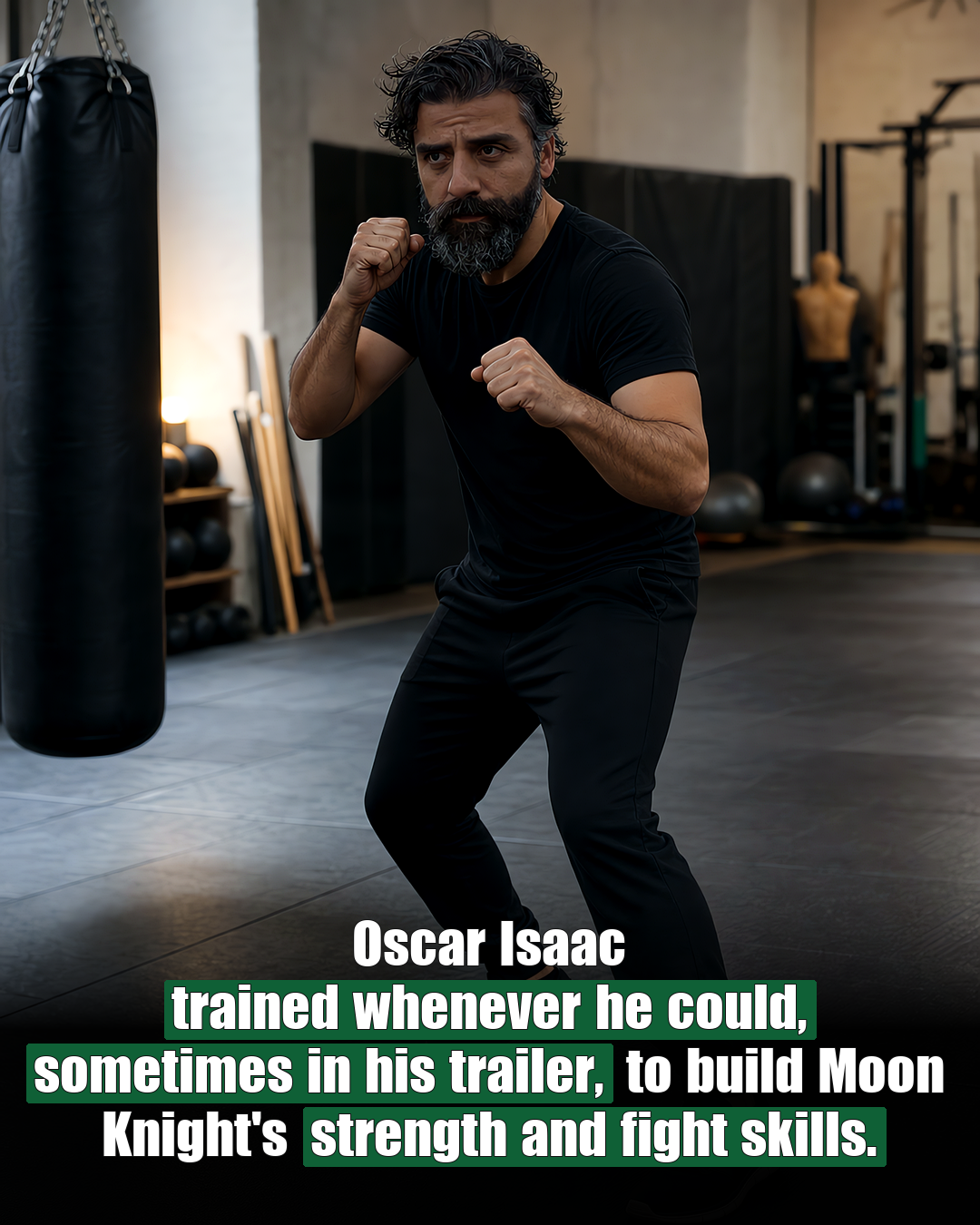
The physical side of the role mattered just as much, since Moon Knight required extended fight choreography.
It also required a lean, capable look that read as believable for hours at a time on camera.
Isaac had already built a reputation for taking on demanding, physically varied roles before Moon Knight, from Poe Dameron in the Star Wars sequel trilogy to Duke Leto Atreides in Dune.
Those roles required very different physical presentations, from a battle worn pilot to a composed, aristocratic ruler.
Moon Knight asked for something different again: a character who convincingly shifts between several distinct personas, each carrying itself differently in the body as well as the voice.
That meant Isaac’s physical preparation had to support not just one look, but a body that could read as several different men depending on the scene.
Isaac assigned each of the character’s main personas its own accent and physicality, drawing partly on comedians Karl Pilkington and Peter Sellers for the English spoken Steven Grant alter, and incorporating his own Guatemalan and Cuban heritage into the Spanish speaking Jake Lockley alter.
That character work was separate from the physical training, but it reflects the same underlying approach: building something layered and specific rather than reaching for a single generic action look.
Why Fight Choreography Adds Its Own Demands
Beyond general conditioning, Moon Knight required extended fight choreography, which is its own distinct physical skill.
Learning choreographed sequences well enough to perform them safely and convincingly on camera takes repeated rehearsal, often for weeks before a single fight scene is filmed.
That rehearsal itself functions as a form of training, building muscular endurance and movement memory in the exact patterns the role requires.
Boxing training likely supported this work directly, since many of the coordination and reaction skills boxing builds transfer well into learning and executing choreographed fight sequences.
Stunt performers and fight coordinators often describe this overlap directly, noting that actors with some background in a real combat sport tend to pick up choreography faster and move more convincingly on camera than those without any combat sport experience.
Why Boxing Became Part of the Plan
Reports describe Isaac’s preparation as centered on a training block built around boxing, general strength work, and disciplined eating.
That preparation reportedly began months before filming started.
The goal, as described, was building lean, functional muscle rather than simply adding size.
That distinction matters for how a body actually performs on screen during fight scenes.
Boxing in particular is often used by actors preparing for physical roles because it develops several qualities at once.
Cardiovascular conditioning, coordination, reaction speed, and full body strength all show up within the same training session.
That efficiency is likely part of why boxing shows up again and again in actor prep for physically demanding characters, not just for Isaac, and it is the same reason boxing keeps showing up in real athletic comeback stories, including George Foreman’s own well documented return to the sport in his 40s.
Chasing a specific look tends to be less sustainable than training for how your body actually needs to perform.
What Boxing Training Actually Builds, According to Research
A 2015 review by Chaabène and colleagues, published in Sports Medicine, examined the physical and physiological demands of amateur boxing across multiple studies.
The review found that boxing training and competition place heavy demands on both the aerobic and anaerobic energy systems.
That means boxers need long duration cardiovascular fitness and the ability to produce short, powerful bursts of effort.
It also found that boxing training develops upper body power, core rotational strength, and reactive coordination.
Punches rely on hip and trunk rotation transferring force through the arms, not arm strength alone.
That combination explains why boxing style training can build a lean, athletic look relatively efficiently.
It works nearly the entire body while also burning a significant number of calories per session.
The Muscle Building Side of the Equation
Boxing conditioning alone does not fully explain how someone builds visible muscle for a role.
Punching and pad work is not primarily a muscle building stimulus in the way structured resistance training is.
A widely cited 2010 review by Schoenfeld in the Journal of Strength and Conditioning Research explained the biological mechanisms behind muscle growth.
The review identified mechanical tension, the force placed on a muscle during resistance exercise, as the primary driver of hypertrophy.
That means the strength work reportedly paired with Isaac’s boxing training was likely doing much of the muscle building work.
The boxing itself likely built conditioning, coordination, and leanness instead.
Combining both makes sense from a training science standpoint.
Resistance training builds and shapes muscle, and boxing builds the cardio and athleticism a fight heavy role requires.
What This Evidence Does Not Prove
No published research describes Oscar Isaac’s individual program in detail.
Reports about any actor’s training regimen are second hand accounts, not verified training logs.
The research on boxing’s physical demands describes general patterns across boxers.
It does not guarantee the same results for an actor training for a limited number of months.
It also does not mean boxing is required to get lean or build functional muscle.
Many other combined training approaches can produce similar outcomes.
What the science does support is the underlying logic reportedly behind Isaac’s prep.
Combining resistance training with boxing style conditioning is a well supported way to build both muscle and cardiovascular fitness at once.
How This Compares to General Training Guidance
Most strength and conditioning professionals recommend combining resistance training with some form of cardiovascular conditioning for general fitness.
That advice applies to everyday people, not just actors preparing for a role.
Boxing specifically is increasingly used in mainstream gyms as a form of conditioning.
It delivers cardio, coordination, and some strength benefits in a single session.
General exercise guidance recommends at least 150 minutes of moderate aerobic activity weekly alongside resistance training.
Boxing style conditioning is one of many ways to meet that aerobic target while adding real variety.
Common Mistakes People Make Trying This Approach
A common mistake is treating boxing purely as cardio and skipping the strength training side entirely.
That limits how much visible muscle actually develops over time.
Another mistake is jumping into intense pad work or sparring without first learning proper technique.
That raises injury risk in the wrists, shoulders, and lower back.
People also often underestimate how demanding boxing conditioning is.
They try to combine it with a heavy lifting schedule without enough recovery between sessions.
Nutrition gets overlooked too. Building lean muscle while staying conditioned requires enough protein and enough total calories.
That is different from the calorie deficit some people assume is needed to look lean.
Finally, many people quit boxing style training within a few weeks.
The coordination demands feel awkward at first, before the skill has had time to develop.
Another mistake is training only the punching motion and neglecting footwork and defense drills, which are actually where much of boxing’s coordination and conditioning benefit comes from.
People also often skip hand and wrist conditioning, like proper wrapping and gradual load progression on the bag, which raises the risk of a wrist or knuckle injury early on.
A Practical Way to Combine Boxing and Strength Training
Start with two structured strength sessions a week built around compound lifts such as squats, pressing movements, rows, and deadlifts.
Those lifts build the muscle foundation everything else relies on, the same brief, high effort philosophy behind approaches like Mike Mentzer’s Heavy Duty training system, even though the two methods differ in other ways.
Add two to three boxing focused sessions weekly, starting with basic technique work on a heavy bag or with a coach.
Hold off on pad work or any sparring until your fundamentals feel solid.
Keep boxing sessions to 30 to 45 minutes when starting out.
The coordination and conditioning demands are higher than they look at first.
Schedule strength and boxing sessions on separate days when possible.
If you combine both in one session, do strength work first, since fatigue from boxing can compromise lifting form.
Eat enough protein, generally around 0.7 to 1 gram per pound of body weight daily, to support the muscle building side of this approach.
Track technique progress with video, not just how tired a session felt.
Proper form protects the wrists and shoulders as intensity increases.
Work with a boxing coach for at least your first several sessions.
They can teach proper hand wrapping, stance, and punching mechanics before you increase pace or power.
Rotate in footwork and defense drills, not just punching combinations, since balance and head movement are just as central to boxing’s conditioning benefit as throwing punches.
Reassess after six to eight weeks and check whether your cardio, coordination, and strength have all genuinely improved, adjusting the split between boxing and lifting if one area is lagging behind the others.
References
- Chaabène, H., Tabben, M., Mkaouer, B., Franchini, E., Negra, Y., Hammami, M., Amara, S., Chaabène, R. B., & Hachana, Y. (2015). Amateur boxing: Physical and physiological attributes. Sports Medicine, 45(3), 337 to 352. https://doi.org/10.1007/s40279-014-0274-7
- Schoenfeld, B. J. (2010). The mechanisms of muscle hypertrophy and their application to resistance training. Journal of Strength and Conditioning Research, 24(10), 2857 to 2872. https://doi.org/10.1519/JSC.0b013e3181e840f3
This article is for general educational purposes and is not medical advice. Talk with a qualified trainer or healthcare provider before starting a new combat sport or strength training program, especially if you have an existing injury.