

Lifelong endurance athletes are supposed to have the healthiest hearts in the room.
Decades of running, cycling, or swimming case a person as the model of cardiovascular fitness, the kind of resting heart rate and body composition a doctor points to as a goal.
So it surprises a lot of people when a viral clip points the other way, saying that veteran endurance athletes often show more calcified plaque in their coronary arteries than sedentary people the same age.
That claim is not a myth or a misreading of one small study.
It is a real, replicated finding in cardiology, and the field has a name for it: the exercise paradox.
The nuance that gets lost in a short video is what kind of plaque actually shows up, and what that specific kind of plaque means for a person’s real risk of a heart attack.
What Researchers Found in Veteran Marathon Runners’ Arteries
The clearest starting point is a 2008 study out of Germany, led by cardiologist Stefan Möhlenkamp, that scanned the hearts of 108 male marathon runners aged 50 and older (Möhlenkamp et al., 2008).
Every runner had finished at least five marathons in the previous three years.
Researchers compared the runners’ coronary artery calcium scores, a CT measurement of calcified plaque buildup, against two separate control groups drawn from a large German population study.
On paper, the runners looked like the healthier group by a wide margin.
Their average calculated ten-year heart attack risk, using the standard Framingham formula, was 7 percent, compared to 11 percent in the general-population control group.
Despite that lower calculated risk, the runners’ coronary calcium scores were not lower.
They were about the same as age-matched men from the general population, and higher than a separate group matched specifically for cardiovascular risk factors.
More than a third of the runners age 50 and older had a calcium score of 100 or higher, a level radiologists usually flag as clinically significant.
During roughly two years of follow-up, the runners who went on to need a coronary intervention all had calcium scores above that threshold, while none of the runners with lower scores had an event.
The Coronary Calcium Score, Explained
A coronary artery calcium score comes from a low-dose CT scan of the heart.
The scan measures how much calcium has built up inside the walls of the coronary arteries, the vessels that feed the heart muscle itself.
A score of zero means no detectable calcium.
Scores climb from there, and a score above 100 is generally treated as evidence of moderate plaque burden, with scores above 400 considered high.
Cardiologists use the score to help decide who needs more aggressive cholesterol treatment or closer monitoring, on top of standard risk calculators.
Calcium itself is not the dangerous part of a plaque.
It behaves more like a scar, the body’s way of stabilizing a plaque that formed earlier from cholesterol, immune cells, and inflammation.
A higher calcium score simply means more total plaque has accumulated in the artery walls over a person’s lifetime, whatever caused it to form in the first place.
Calcified vs. Non-Calcified Plaque: Why Composition Matters More Than the Number
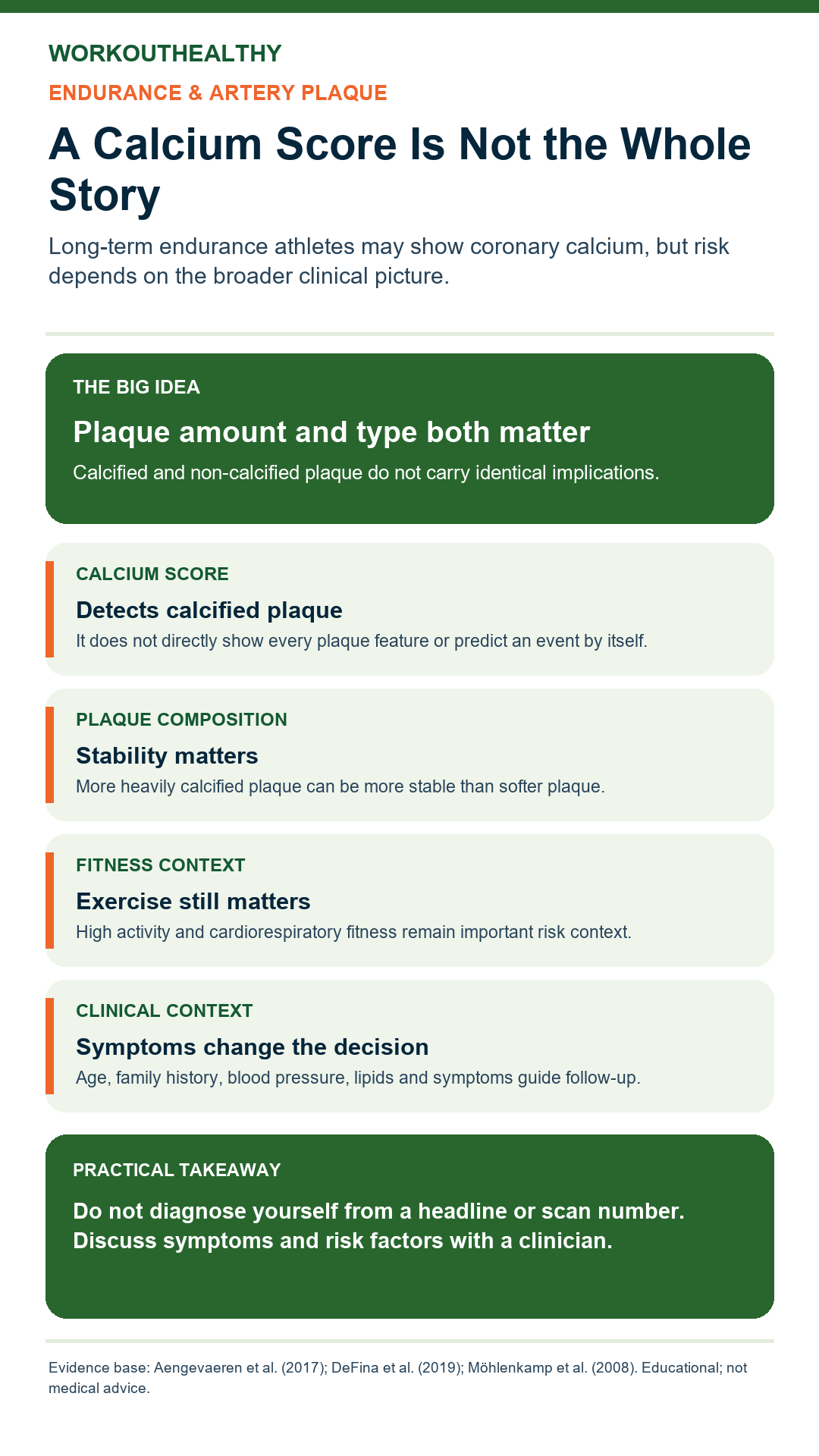
Not all plaque behaves the same way, and this is the part a short video’s headline compresses into one line.
A separate study, led by cardiologist Vincent Aengevaeren and published in Circulation in 2017, scanned 284 healthy middle-aged and older men and grouped them by lifetime exercise volume (Aengevaeren et al., 2017).
The men with the highest lifetime exercise volume did have a higher prevalence of detectable coronary calcium than the least active group.
But when the researchers looked at plaque composition rather than just the total score, the picture shifted.
Among men who had detectable plaque, the most active men were more likely to have plaque that was calcified only, with a smaller share of mixed or non-calcified plaque compared to less active men.
That distinction matters because calcified-only plaque is generally considered more stable.
Non-calcified and mixed plaques are the ones more associated with sudden rupture, the event that actually triggers most heart attacks.
A high calcium score built mostly from stable, calcified plaque is not automatically the same clinical picture as the same score built from soft, unstable plaque.
A coronary calcium score built mostly from stable, calcified plaque is a different clinical picture than the same score built from soft, unstable plaque, even though both can show up as the same number on a scan.
The Largest Mortality Study on Exercise and Calcium Scores
The plaque composition angle explains a mechanism, but the number most readers actually care about is mortality.
The most direct answer comes from a 2019 study in JAMA Cardiology, led by Laura DeFina, that followed 21,758 men for an average of 10.4 years (DeFina et al., 2019).
Every man in the study had both a baseline physical activity level and a baseline coronary calcium score on file.
Men who reported at least 3,000 MET-minutes of physical activity per week, well above general public health guidelines, were about half as likely to die during follow-up as the least active men with a similar calcium score.
Highly active men did show a higher prevalence of detectable coronary calcium than less active men.
That part lines up with the marathon runner data.
But across a decade of follow-up, high physical activity was not associated with higher all-cause or cardiovascular mortality, even among men with clinically significant calcium scores.
In plain terms, the most active men in this study built up more plaque, and still tended to die less often than less active men carrying the same amount of plaque.
What This Research Does Not Prove
None of these studies prove that hard endurance exercise is risk-free for the heart.
All three are observational, which means they can show a pattern without proving that exercise itself caused the calcium buildup or protected against death.
The marathon runner study followed its participants for only about two years, a short window for tracking heart attacks and cardiac deaths.
The men in these studies were also overwhelmingly white, middle-aged to older, and drawn from populations with access to advanced cardiac imaging, so the findings may not generalize cleanly to women, younger athletes, or more diverse populations.
The coronary events in the marathon study, though few in number, still landed disproportionately in runners with the highest calcium scores.
That detail is a real caveat, not a footnote to explain away.
A stable plaque today is not a guarantee against a coronary event years later, and calcium scores tend to climb with age regardless of activity level.
Common Mistakes People Make Interpreting This Research
The most common mistake is reading “the plaque is more stable” as “the plaque does not matter.”
A calcium score of 400 in a lifelong runner is still a calcium score of 400, and most cardiology guidelines treat that number the same way regardless of a patient’s exercise history.
A second mistake is assuming any amount of endurance training produces this pattern.
The runners and athletes in these studies were unusually high-volume: multiple marathons a year, or decades of serious training, not a few weekly jogs or the activity level most casual exercisers reach.
A third mistake is treating “more exercise, more plaque” as a reason to stop moving altogether.
The DeFina study’s headline result was that inactive men with similar calcium scores did worse, not better, than the highly active men.
Moderate, consistent activity remains one of the best-supported tools for lowering cardiovascular risk in the general population, a point this site has covered in the context of daily step counts and mortality risk and in a practical look at how many miles most adults should walk each day.
Who Should Talk to a Doctor Before Ramping Up Endurance Training
Anyone starting or significantly increasing endurance training in midlife or later should talk to a doctor first, not after symptoms show up.
That conversation matters most for people over 40 who are new to sustained cardio, since this is exactly the population these calcium studies were drawn from.
A family history of early heart disease, high blood pressure, high cholesterol, or diabetes all raise the value of a baseline cardiac workup before training volume increases sharply.
Anyone who has already noticed chest tightness, unusual shortness of breath, or a racing heart during exercise should get evaluated before continuing that training pattern.
A coronary calcium scan itself is a reasonable question to raise with a doctor for someone in this exact profile: male, over 50, training at a genuinely high volume for years.
It is a low-dose scan, not something ordered routinely, and a doctor can weigh whether it makes sense for a specific person’s risk profile.
People recovering from a cardiac event, or managing an existing heart diagnosis, need individualized guidance rather than general research to set training limits.
Why Intense Endurance Training Might Raise Calcium Scores in the First Place
Researchers do not have one confirmed mechanism, but a few candidates come up repeatedly.
Years of repeated high cardiac output, the kind marathon and endurance training produces, put mechanical stress on artery walls that may accelerate the same repair-and-calcify process seen with age and other risk factors.
Endurance athletes tend to develop higher blood volume and larger heart chambers, adaptations that are generally healthy, but that also change the physical forces moving through the coronary arteries over time.
Some researchers point to repeated cycles of exercise-induced inflammation followed by long-term repair as a plausible driver of calcification specifically, distinct from the softer plaque more associated with poor diet and metabolic risk factors.
None of these explanations are settled, and the field has openly called this an unresolved paradox rather than a closed question.

How to Approach Long-Term Endurance Training Sensibly
None of this research argues for abandoning endurance training.
It argues for treating heart health monitoring as part of a serious training plan, the same way a runner tracks mileage or a lifter tracks load.
A useful starting point is a baseline checkup before significantly increasing training volume, especially past age 40 or 45.
Standard blood work, including a lipid panel, a blood pressure check, and a conversation about family history, catches more risk factors than most people expect.
This site has covered how a simple stair-climbing test can offer a rough, informal read on cardiovascular fitness between formal checkups, though it is not a diagnostic tool on its own.
Tracking symptoms honestly matters more than tracking splits.
New chest discomfort, unusual fatigue during a normally easy effort, or a change in resting heart rate over several weeks are worth mentioning to a doctor rather than pushing through.
For most people, the actual cardiac risk from moderate cardio training, the kind covered in guidance about heat exposure and heart health, stays far lower than the risk of staying sedentary.
Watch the Original Video
Want the research behind the headline, every time? Subscribe to WorkoutHealthy Insider for practical explanations behind popular fitness claims.
References
Aengevaeren, V. L., Mosterd, A., Braber, T. L., Prakken, N. H. J., Doevendans, P. A., Grobbee, D. E., Thompson, P. D., Eijsvogels, T. M. H., & Velthuis, B. K. (2017). Relationship between lifelong exercise volume and coronary atherosclerosis in athletes. Circulation, 136(2), 138–148. https://doi.org/10.1161/CIRCULATIONAHA.117.027834
DeFina, L. F., Radford, N. B., Barlow, C. E., Willis, B. L., Leonard, D., Haskell, W. L., Farrell, S. W., Pavlovic, A., Abel, K., Berry, J. D., Khera, A., & Levine, B. D. (2019). Association of all-cause and cardiovascular mortality with high levels of physical activity and concurrent coronary artery calcification. JAMA Cardiology, 4(2), 174. https://doi.org/10.1001/jamacardio.2018.4628
Möhlenkamp, S., Lehmann, N., Breuckmann, F., Bröcker-Preuss, M., Nassenstein, K., Halle, M., Budde, T., Mann, K., Barkhausen, J., Heusch, G., Jöckel, K.-H., Erbel, R., & the Marathon Study Investigators. (2008). Running: the risk of coronary events: Prevalence and prognostic relevance of coronary atherosclerosis in marathon runners. European Heart Journal, 29(15), 1903–1910. https://doi.org/10.1093/eurheartj/ehn163
This article is for general information only and is not medical advice. If you have an injury, ongoing pain, or a medical condition, talk to a doctor or physical therapist before you change how you train or eat.