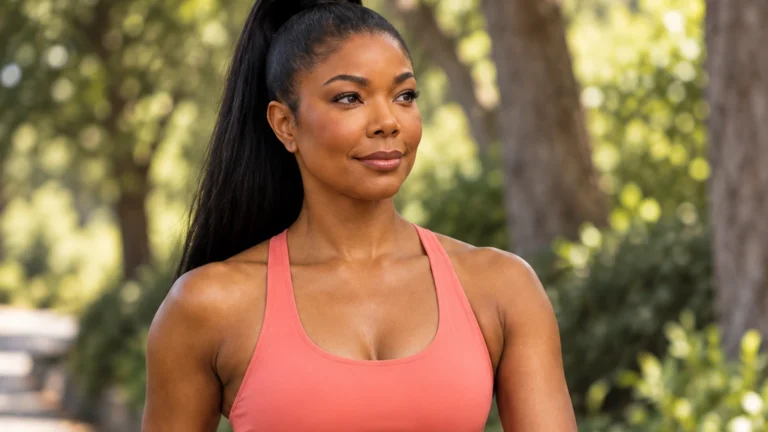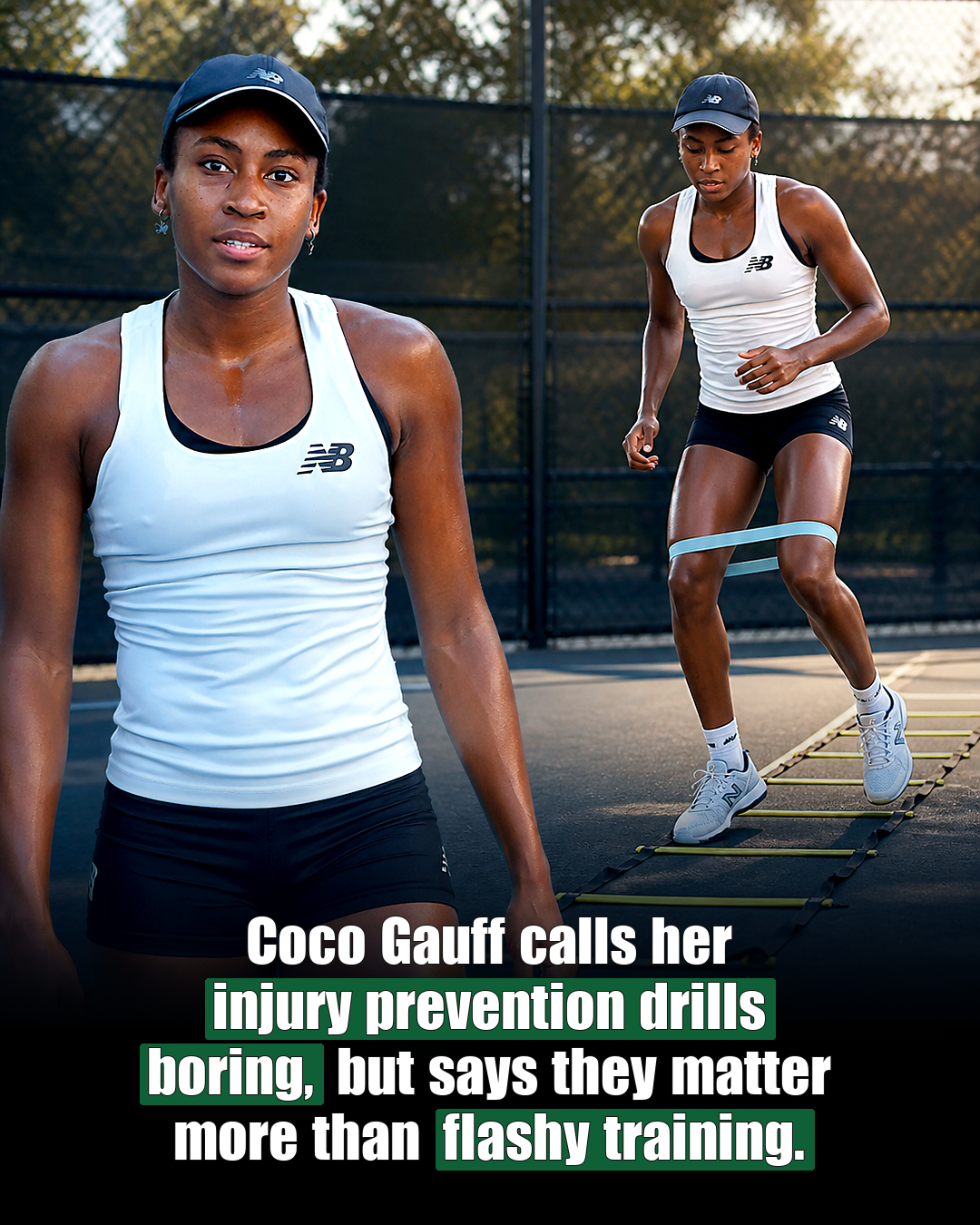

Coco Gauff has two Grand Slam singles titles before her 22nd birthday, a US Open win in 2023 and a French Open win in 2025.
Neither title came from raw talent alone.
Reports on her training describe a routine built around a category of work that rarely shows up in highlight reels: injury prevention drills that she herself has reportedly called the least exciting part of her preparation.
That kind of routine, unglamorous but deliberate, is a useful case study in what actually keeps a professional athlete’s body intact through a demanding schedule.
A Career Built on More Than Talent
Gauff turned professional as a teenager and reached a Grand Slam final at 15, a level of early exposure that puts unusual strain on a still developing body.
Competing at the top of professional tennis means an unusually long season, with tournaments spread across hard court, clay, and grass surfaces that each place different stress on the joints and connective tissue.
A player who reaches deep into events also plays far more matches than a player who loses early, which means the athletes with the most success also accumulate the most physical wear over a season.
That combination, a long season, multiple surfaces, and deep tournament runs, is exactly why injury prevention work matters more, not less, the more successful a player becomes.
She won her first major singles title at the 2023 US Open, beating Aryna Sabalenka in three sets and becoming the first American teenager to win the tournament since Serena Williams in 1999.
In 2025, she added a second major, defeating Sabalenka again, this time at the French Open, for the first French Open singles title by an American woman since Serena Williams in 2015.
She also won the WTA Finals in 2024 as its youngest champion since Maria Sharapova in 2004, and reached the world No. 2 ranking.
Staying near the top of a sport this physically demanding for this long, especially starting this young, depends heavily on staying healthy enough to keep training and competing at full intensity.
The Unglamorous Part of Her Routine
Reports describe her injury prevention work as including movement combinations like weighted squats paired with box jumps, along with banded monster walks and toe lifts that target smaller, stabilizing muscles.
Those exercises are not designed to build the kind of visible strength or explosive power that shows up during a match.
They target joints and smaller muscle groups that tennis relies on constantly but almost never trains directly through the sport itself.
Her approach to nutrition has been described in similarly simple terms, built around basics like fruit salad, eggs, and protein shakes rather than a rigid or complicated meal plan.
Reports describe her characterizing this injury prevention work as the least exciting part of her routine, a lot of unglamorous exercises that quietly do most of the work.
That framing, if accurate, points to something coaches see constantly: the parts of a program that get skipped first are often the parts protecting an athlete from the injuries that actually end careers.
Sometimes the least exciting part of a routine is the part doing the most work.
What the Research Says About Glute and Hip Activation Work
Exercises like banded monster walks are not a trend without evidence behind them.
They target the gluteal muscles specifically, which play a major role in stabilizing the hip and knee during rotational, start stop movement, exactly the kind of movement tennis demands constantly.
A study using surface electromyography, a method that measures electrical activity in working muscle, compared a range of common therapeutic exercises for how effectively they activate the gluteal muscles.
Banded side stepping and similar hip abduction movements, closely related to monster walks, produced strong, measurable activation of the gluteus medius, a muscle that plays a key role in controlling hip and knee alignment during single leg movement (Distefano et al., 2009).
That matters directly for a sport like tennis, where players are constantly cutting, stopping, and pushing off one leg to reach for a shot.
Weak hip stabilizers are a well recognized contributor to knee and ankle injuries in exactly that kind of movement pattern.
What the Broader Injury Prevention Research Shows
The bigger question is whether structured injury prevention work like this actually reduces injuries in a measurable way, not just in theory.
A large systematic review and meta-analysis pooled data from 25 randomized controlled trials covering more than 26,000 participants across multiple sports.
It found that structured strength training programs reduced overall sports injuries to less than a third of their baseline rate, and cut overuse injuries specifically by nearly half (Lauersen et al., 2014).
The same review found that stretching alone did not show the same protective effect, which is a useful distinction.
The benefit came specifically from strength and stability focused training, the category Gauff’s routine reportedly falls into, not from general flexibility work.
That is strong, well supported evidence that the unglamorous part of an athlete’s routine is doing real, measurable work, not just following tradition.
What This Evidence Does Not Prove
The glute activation research does not prove that any single exercise, including banded monster walks, prevents a specific injury on its own.
Distefano and colleagues measured muscle activation during exercises, a useful marker of how hard a muscle is working, but activation alone does not guarantee an injury will never happen, since injuries usually involve multiple factors beyond one muscle group.
The larger injury prevention meta-analysis has its own limits too.
Lauersen and colleagues pooled trials across a range of sports and training programs, not tennis specifically, so the exact size of the benefit for a professional tennis player’s particular movement demands is not something that research can pin down precisely.
Reports describing Gauff’s specific routine also come from secondary coverage rather than a published training log.
The general pattern, strength and stability work tied to lower injury rates, holds up well in the research, even though the precise details of any one athlete’s program are hard to verify from the outside.
How This Compares to General Guidance
Most people are not training for a Grand Slam, but the underlying principle holds up for recreational athletes and casual gym goers too.
General strength and conditioning guidance consistently recommends including hip and glute stabilization work, alongside more traditional strength training, for anyone doing regular sport or high impact activity.
The research supporting that guidance is the same body of evidence behind professional athletes’ prehab routines, just applied at a lower volume and intensity.
The bigger lesson from Gauff’s routine may be more about mindset than exercise selection.
Prioritizing unglamorous, protective work over flashier training is a pattern worth borrowing regardless of skill level or sport.
Common Mistakes People Make With Injury Prevention Work
Skipping it entirely once the exciting part of a workout is done is the most common mistake.
Injury prevention exercises are usually the first thing cut when time runs short, which defeats their purpose.
Doing the exercises with too little resistance or too little control to matter is another common error.
Banded work in particular needs real tension and controlled form to actually load the target muscles.
Treating injury prevention work as a warm up formality rather than genuine training is a third mistake.
The evidence suggests this work needs to be progressed over time, the same way strength training does, not just repeated at the same easy level indefinitely.
Ignoring the smaller stabilizing muscles in favor of only training the larger, more visible muscle groups is another gap.
Toe and foot stability work, similar to what Gauff’s routine reportedly includes, protects joints further up the chain, including the ankle and knee.
Assuming a lack of pain means a lack of risk is a final and important mistake.
Injury prevention work matters most before an injury happens, not after, which is exactly why it is easy to skip when everything currently feels fine.
A Practical Injury Prevention Routine to Start With
Add banded lateral walks two to three times a week.
Place a resistance band above the knees or around the ankles and take controlled side steps, keeping the knees tracking over the toes.
Include single leg work, not just two legged squats and lunges.
Split squats, single leg deadlifts, and step ups build the kind of stability that sports requiring quick direction changes actually depend on.
Add toe and foot strengthening drills.
Simple toe raises, short foot exercises, and single leg balance work strengthen the smaller stabilizing structures that larger exercises tend to skip entirely.
Pair explosive work with a stability foundation rather than doing it in isolation.
Combining a loaded movement like a goblet squat with a lighter plyometric movement like a box step down mirrors the kind of pairing described in Gauff’s routine, and research on plyometric training supports its role in building both power and muscle when it is programmed well.
Progress the work over time instead of repeating the same light version indefinitely.
Increase band resistance, add reps, or slow the tempo down every few weeks to keep the stabilizing muscles adapting.
Consider working with a qualified coach or physical therapist to build a program specific to a person’s own sport, movement pattern, and injury history, since a good coach or trainer can catch imbalances a person is unlikely to notice on their own.
References
Distefano, L. J., Blackburn, J. T., Marshall, S. W., & Padua, D. A. (2009). Gluteal muscle activation during common therapeutic exercises. Journal of Orthopaedic & Sports Physical Therapy, 39(7), 532-540.
Lauersen, J. B., Bertelsen, D. M., & Andersen, L. B. (2014). The effectiveness of exercise interventions to prevent sports injuries: A systematic review and meta-analysis of randomised controlled trials. British Journal of Sports Medicine, 48(11), 871-877.
This article is for general educational purposes and is not a substitute for personalized medical or coaching advice. Anyone starting a new training program, recovering from an injury, or managing ongoing joint pain should speak with a qualified doctor, physical therapist, or certified coach.