
Jennifer Connelly has spent more than three decades as one of Hollywood’s most respected actresses.
Her career stretches from childhood roles in the 1980s through an Academy Award win for “A Beautiful Mind,” and continuing work in major films today, including a starring role in “Top Gun: Maverick.”
In November 2024, she added something new to that resume. She crossed the finish line of the New York City Marathon, a 26.2 mile race through all five boroughs of the city.
She did not run it for a personal record. She ran it to raise money for cancer research.
Connelly, now in her mid-50s, is far from the only public figure to use the New York City Marathon this way.
The race has become one of the most visible charity fundraising platforms in the country.
Her participation is part of a much larger, less flashy story. That story is about how those fundraising programs actually work behind the scenes, week after week, long before race day arrives.
What Actually Happened
Connelly completed the 2024 TCS New York City Marathon in 3 hours and 45 minutes.
That is a strong, well executed time for a first marathon, especially on a notoriously hilly, five-borough course that challenges even experienced runners.
She ran as part of Fred’s Team, the official marathon fundraising program of Memorial Sloan Kettering Cancer Center, a major cancer treatment and research hospital based in New York City.
Fred’s Team has been running since 1995, with participants completing major marathons around the world specifically to fund research at the cancer center.
By November 2022, the program had passed 100 million dollars in total funds raised since its founding.
In the same fundraising cycle Connelly ran in, the program raised more than 8.5 million dollars.
That total was a record for the program at the time, according to figures released by Memorial Sloan Kettering.
That money goes directly toward the center’s research programs rather than general operating costs, which is part of what draws participants who want their training miles to translate into something concrete.
Her husband, actor Paul Bettany, was there to greet her at the finish line along with family and friends.
He shared the moment publicly afterward, celebrating both the achievement and the cause behind it.
In Her Own Words
While Connelly has largely let her actions speak for themselves around this race, the people closest to her captured the moment publicly.
Paul Bettany posted about her finish, celebrating what she had accomplished.
“Congratulations to my extraordinary Spartan wife! She realized her dream and raised a ton of money for cancer research. Thanks also to lovely family and friends who came out to cheer her on.”
He tagged the effort directly to Fred’s Team and Memorial Sloan Kettering in the post, making the connection between the race and the cause explicit rather than incidental.
That kind of framing, “she realized her dream,” points to something worth noticing. For many marathon finishers, especially first-timers, the race represents a long-held personal goal, not just a single day’s effort.
Fred’s Team runners typically commit to a fundraising minimum well before race day, often months in advance.
That commitment turns training into something with real stakes attached, long before mile one.
It changes how the entire process feels compared to training for a race with no cause attached at all.
The Science Behind Marathon Training and Purpose
Marathon training produces real, measurable changes in the body, even in people who have never run competitively before.
A 2020 study published in the Journal of the American College of Cardiology followed 138 first-time marathon runners training for the London Marathon over about 17 weeks.
Researchers measured blood pressure and the stiffness of participants’ aortas before and after training.
They found meaningful reductions in blood pressure after training.
They also found a notable improvement in aortic flexibility.
That improvement was roughly equal to reversing four years of natural arterial aging. None of the participants had serious existing heart disease going into the study.
Separately, researchers have studied why people choose to run in charity-affiliated events like Fred’s Team in the first place, and whether that motivation changes the experience.
A 2022 study published in the Journal of Amateur Sport surveyed runners in a cause-affiliated half marathon and found that charitable motives were the dominant factor driving participants’ commitment and continued support, ahead of their identity as runners or their connection to the specific event itself.
In plain terms, people who run for a cause tend to stay more engaged with that cause, not just the race, both before and after the event.
That combination, real physical benefit plus a strong psychological anchor in purpose, may help explain why charity-linked marathon programs like Fred’s Team have proven durable over decades.
Marathon training itself is demanding and time consuming for anyone juggling a full time career and family.
A program like this asks runners to fit long weekend runs on top of everything else in their week, sometimes for six months straight.
A strong underlying reason to keep showing up matters more than it might seem at first glance.
The Journal of Amateur Sport researchers found that charitable motivation was the strongest predictor of deeper commitment to the cause, more than a runner’s own identity as an athlete.
That is a useful distinction for anyone assuming a personal record is the only measure of a successful race.
What This Means for Everyday Readers
Most readers will never train for a marathon, and that is completely fine.
The broader lesson from Connelly’s race is less about the distance and more about the structure behind it.
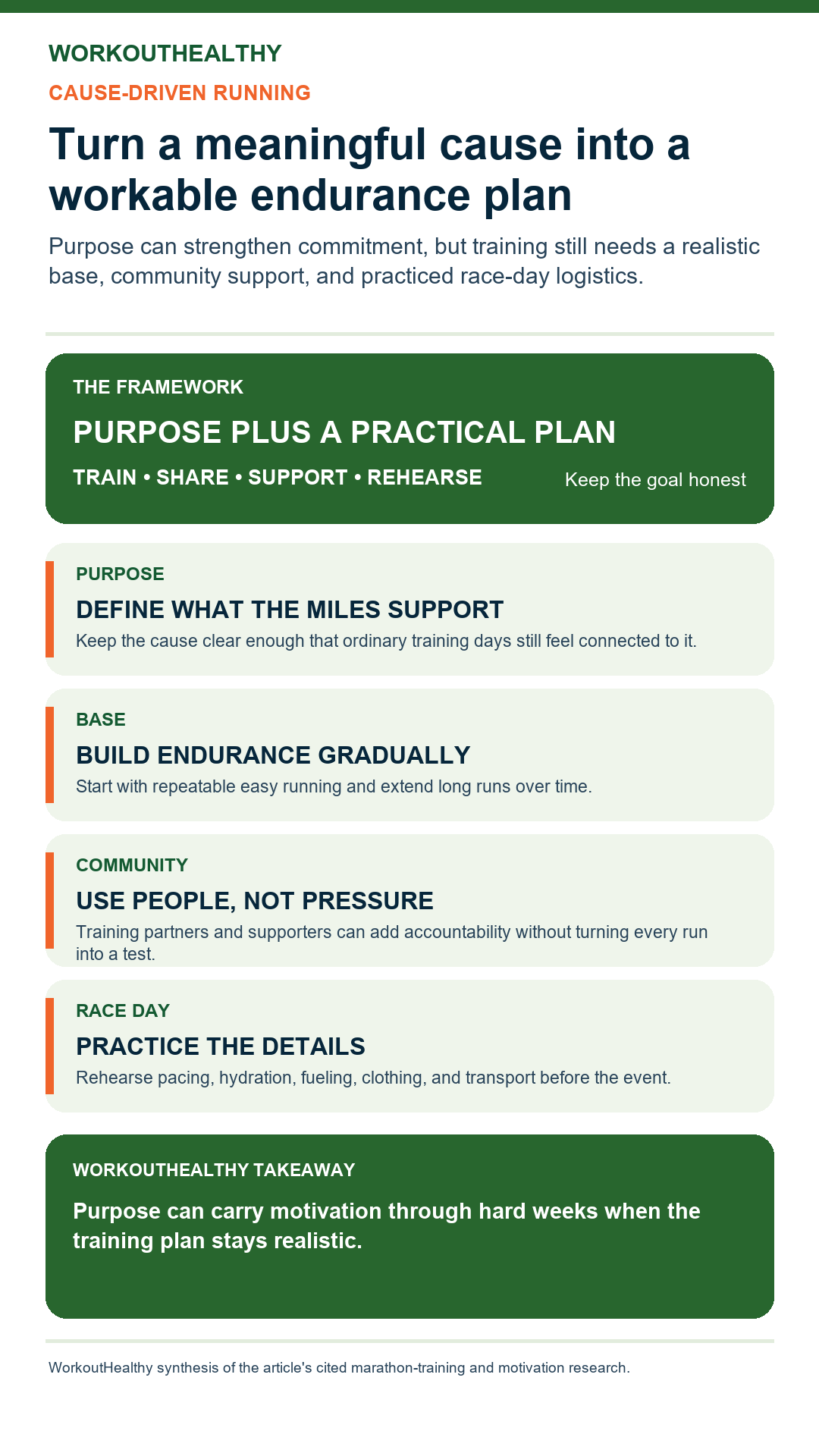
Training for a long-term physical goal works best with two things in place at once: a realistic, gradual plan, and a reason that matters beyond the workout itself.
The cardiovascular research shows the plan matters physiologically. Structured training, even for first-timers, produces real changes to blood pressure and vascular health in a matter of months.
The motivation research shows the reason matters psychologically. People who attach their training to something bigger than themselves, in this case cancer research funding, tend to stay more committed through the hardest parts of a long training block.
Fred’s Team specifically requires runners to commit to a fundraising minimum in exchange for a guaranteed race entry, which formalizes that purpose into the process itself rather than leaving it as an abstract feeling.
Common Mistakes People Make Training for a First Marathon
One common mistake is increasing weekly mileage too quickly in an attempt to catch up on lost time.
A widely used guideline caps weekly mileage increases at around 10 percent to reduce the risk of overuse injuries like stress fractures and tendinitis.
Another mistake is skipping strength training entirely and only running.
Runners who add basic strength work, particularly for the hips, glutes, and core, tend to report fewer injuries over a training cycle than runners who rely on running volume alone.
Some first-time marathoners also try a new shoe, new nutrition strategy, or new gear for the first time on race day itself.
Anything worn or consumed on race day should already be tested during training. Race day is not the time to discover a blister-prone sock or an energy gel that upsets your stomach.
Finally, people sometimes underestimate the taper, the planned reduction in training volume in the final two to three weeks before the race.
Cutting volume can feel counterproductive right before a big goal.
Still, it lets the body fully recover before the start line.
A simple stair climbing fitness check can also give beginners a rough sense of their baseline cardiovascular fitness before a plan even begins.

How to Train for a Cause-Driven Endurance Goal
1. Pick a cause that genuinely matters to you before you pick a specific race. The research suggests that connection drives commitment more than the event itself does.
2. Get medical clearance if you have any existing health conditions, are over 40 and new to running, or have a family history of heart disease. A basic checkup before a long training block is a small investment compared to the months of training ahead.
3. Follow a structured plan of 16 to 20 weeks rather than improvising your mileage week to week. Build the base gradually, since even daily walking volume on its own carries measurable health benefits long before running enters the picture.
4. Increase weekly distance gradually, staying close to the 10 percent rule to protect against overuse injury.
5. Add two short strength sessions a week focused on hips, glutes, and core stability.
6. Test every piece of gear, every shoe, and every fueling strategy during training runs, never for the first time on race day.
7. Build your long runs up gradually on weekends. The long run is what actually prepares the body for the specific demands of covering 26.2 miles in one session.
8. Build in a real taper during the final weeks so your body arrives at the start line recovered, not depleted.
9. Track your fundraising progress alongside your training mileage if you are running for a charity program. Both timelines matter, and many programs offer support and coaching for the fundraising side, not just the running.
References
- Time Out New York, “Who were the fastest celebrities in the 2024 NYC Marathon?”
- People, via Yahoo News, “Paul Bettany Kisses ‘Extraordinary’ Wife Jennifer Connelly After She Runs N.Y.C. Marathon”
- Memorial Sloan Kettering Cancer Center, “Fred’s Team Makes History by Raising $100 Million for Cancer Research”
- Memorial Sloan Kettering Cancer Center, “Fred’s Team Raises Over $8.5 Million for Cancer Research in Record-Breaking Year”
- Bhuva, A.N., et al. (2020). “Training for a First-Time Marathon Reverses Age-Related Aortic Stiffening.” Journal of the American College of Cardiology, 75(1), 60-71.
- Gomez, E., Hill, E., Ridinger, L., & Shipp, S. (2022). “An Examination of Motivations, Attitudes and Charitable Intentions for Running in a Charity Event.” Journal of Amateur Sport, 7(2).
This article is for general information only. It is not personal medical or fitness advice. Talk with a qualified healthcare provider before starting marathon training, especially if you have an existing health condition or are new to endurance exercise.