
Jonathan Roumie is best known for one role.
He plays Jesus in “The Chosen,” the crowdfunded television series that has grown into one of the most watched faith-based shows ever made.
Season 6, which will depict the crucifixion, is set to premiere on Prime Video in November 2026.
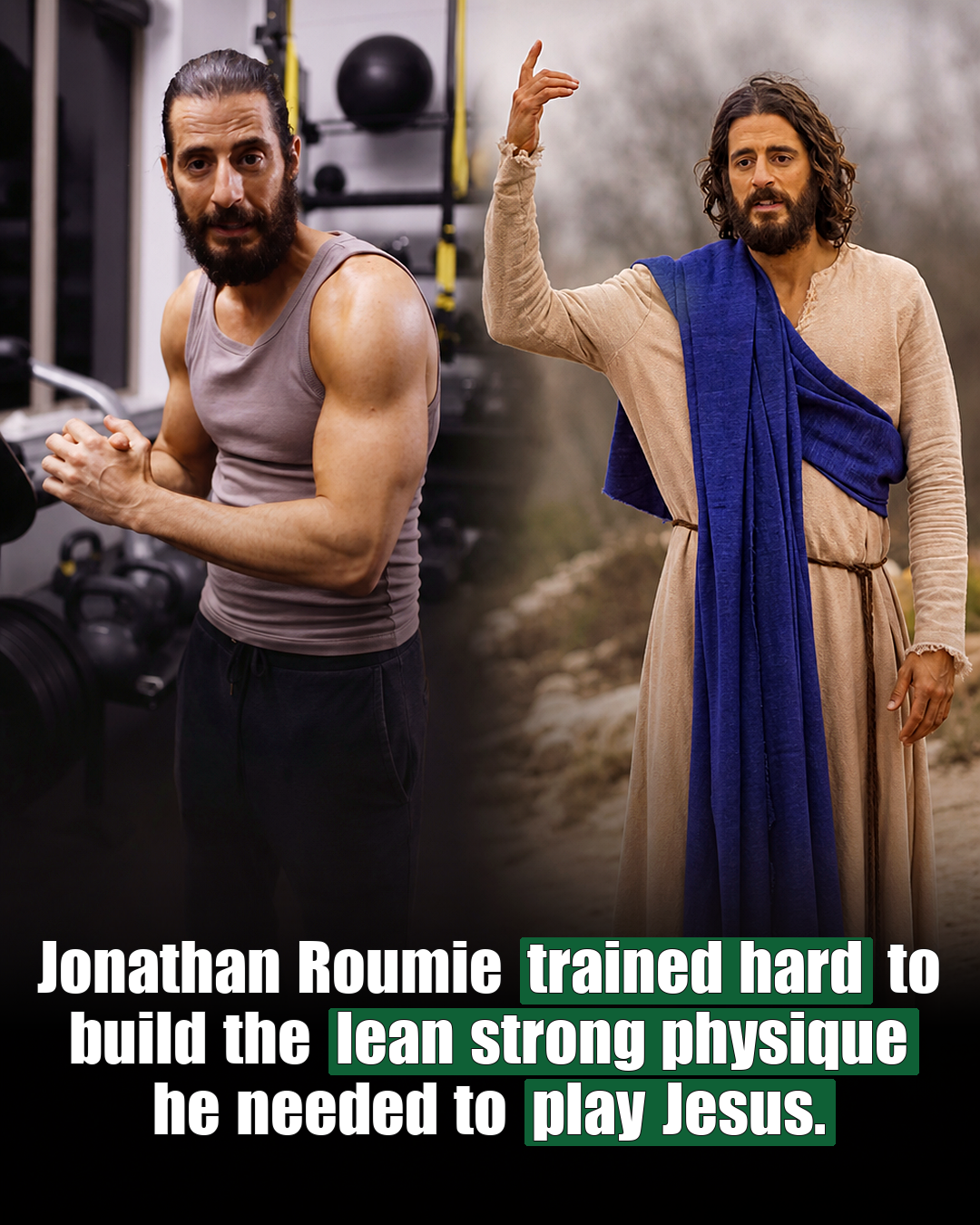
Ahead of that season, Roumie did not just rehearse lines and study scripture. He spent roughly a year deliberately training his body for the physical demands of the role.
His approach offers a useful case study in training with a specific purpose in mind, rather than training just to look a certain way.
Roumie is 52 years old, born July 1, 1974. Before landing the role of Jesus, he spent years working small parts in television and struggling financially in Los Angeles, a period he has described as one of the hardest stretches of his life before The Chosen changed everything.
What Actually Happened
Roumie began preparing for Season 6 well in advance of filming.
He worked with a trainer to build a program that could travel with him.
Much of “The Chosen” films on location. That meant the routine had to work in hotel gyms with limited equipment, not just a fully stocked studio facility back home.
Over the course of about a year, Roumie lost roughly 20 to 25 pounds while building visible muscular definition.
That combination, leaner and more defined rather than simply bigger, was intentional.
The goal was a grounded, capable-looking physique suited to walking, standing, and moving through long filming days in character.
It was never meant to be a bodybuilding stage look. The Chosen shoots long days on location, often outdoors and on foot, so a physique built purely for a photo shoot would not have held up to the actual physical demands of the shoot schedule.
His routine centered on two main pillars.
The first was daily walking, targeting at least 10,000 steps regardless of what else was on the schedule that day.
The second was structured resistance training built around functional, full body movements.
A sample session included wide grip pull ups, single arm cable pulls, dumbbell rows, chest supported rows, and curls, each done for multiple planned sets rather than random reps until tired.
In His Own Words
Roumie has talked about this training block as something bigger than a physical transformation for its own sake.
“I’ve been training specifically for this season and so there’s been a lot of self-sacrifice in order to bring my idea of how I want Jesus to feel and look for Season 6.”
He has described the process, both physical and emotional, as one of the hardest things he has ever taken on professionally.
“The hardest thing I’ve ever done in my life, both professionally and personally as a human being.”
He has also spoken about the importance of the smaller habits that support that kind of training over a full year, not just the workouts themselves.
“The details matter. The little things matter.”
That framing lines up with his overall philosophy toward the role.
Being physically prepared, he has said, helps him move and carry himself with more confidence in front of the camera, which then shapes the performance itself.
Roumie has connected some of that discipline to sleep specifically.
He has said recovery became a bigger priority for him as he got older, running alongside the training itself rather than separate from it.
The Science Behind Functional Training
Functional training is a broad label.
Broadly, it means training movement patterns the body actually uses in daily life.
Pulling, pushing, carrying, and walking are common examples. That is different from isolating single muscles the way traditional bodybuilding routines often do, one exercise and one muscle group at a time.
A 2021 systematic review published in Frontiers in Physiology looked at nine controlled studies involving 330 athletes to evaluate what functional training actually delivers.
The review was led by researcher Wangcheng Xiao.
It found strong evidence that functional training meaningfully improves speed, strength, power, balance, and agility.
It found more moderate evidence for improvements in flexibility and muscular endurance. Fewer studies had looked closely at those two specific outcomes, which is why the evidence there was rated lower.
Interestingly, the same review found no significant improvement in body composition measures.
That includes body weight, body fat percentage, and BMI, across the studies it analyzed.
That detail matters for interpreting Roumie’s own results.
His visible physique change likely came from several factors working together. Structured resistance training, sustained daily walking that added up to real caloric expenditure, and almost certainly some attention to nutrition all played a role, rather than functional training alone reshaping his body composition by itself.
Walking specifically deserves its own mention.
Hitting 10,000 steps daily is a well known target. The exact number is more of a popular benchmark than a hard scientific cutoff, but research on daily step counts and mortality risk confirms consistent walking remains one of the most well supported, lowest risk forms of physical activity for cardiovascular health available to almost anyone.
What This Means for Everyday Readers
Most people are not preparing to play a role on camera, but the underlying approach Roumie used translates well beyond acting.
He picked a specific, meaningful outcome first, how he wanted to look and move for a particular purpose.
He built a program around that goal.
That is different from chasing a generic idea of fitness. Purpose before program is an order of operations worth borrowing for almost any physical goal.
The research on functional training helps explain why this combination works.
Full body strength work paired with daily walking builds a strong foundation. Compound, multi joint movements build strength that transfers directly to everyday tasks like carrying groceries or climbing stairs, not just to how a muscle looks in isolation.
The equipment limitation part of his story is also worth noting.
His trainer built the program specifically to work in hotel gyms with minimal equipment.
That is a useful reminder about a common excuse.
A lack of a fully equipped gym is rarely the real barrier to consistent training.
A handful of dumbbells, a pull up bar, and a willingness to walk can carry a program a very long way, on the road or at home.
Common Mistakes People Make With Functional Training
One common mistake is assuming functional training means no structure or no progression, just random movement.
Roumie’s routine shows the opposite.
It included specific sets, rep ranges, and planned exercises for each muscle group. Effective functional programs still track volume and progressively add difficulty over time, the same way any structured strength program does.
Another mistake is neglecting walking or daily step count because it feels too basic to matter.
The research above suggests the opposite is true.
Consistent walking is one of the most reliable, sustainable habits in fitness.
Roumie built it into his routine as a daily non-negotiable, not an occasional bonus he fit in when he had extra time.
People sometimes also expect visible body composition change from functional training alone, without paying attention to nutrition or overall activity level.
The Frontiers in Physiology review found no significant body composition change from functional training by itself.
Real physique changes, like the one Roumie achieved, typically require several factors working together at once, not one single method doing all the work.
Finally, some people skip recovery entirely while ramping up training intensity, treating rest as optional.
Roumie has specifically pointed to sleep as something that mattered more to him as his training intensified.
Recovery is not the absence of training. It is part of what makes the training actually work.
How to Build a Purpose-Driven Training Program
1. Start with a specific, meaningful goal rather than a vague idea like “get in shape.” A clear target makes every other decision easier.
2. Build your routine around compound, full body movements like rows, pull ups, presses, and squats rather than isolating single muscles.
3. Set a daily walking target and treat it as seriously as your gym sessions. Ten thousand steps is a reasonable, well known benchmark, though any consistent daily target works.
4. Work with a trainer if you can, even briefly, to build a program that fits your actual schedule and available equipment, not an idealized version of a routine. If you are trying to decide whether that step is worth it, this guide to deciding whether you need a trainer and how to hire one walks through the decision.
5. Track your training with real sets and rep ranges rather than treating workouts as unstructured activity.
6. Pay attention to nutrition alongside training if body composition change is part of your goal, since exercise alone rarely drives that outcome by itself.
7. Prioritize sleep and recovery as training intensity increases, not as an afterthought once everything else is done.
8. Expect the process to take months, not weeks. Roumie’s transformation happened over roughly a year of consistent, purposeful work, not a crash program before a deadline.
9. Build in variety within the structure, rotating grip, angle, or equipment for the same movement pattern every few weeks. This keeps a functional program challenging without abandoning the plan entirely each time motivation dips.
References
- Movieguide, “THE CHOSEN’s Jonathan Roumie Shares His Workout Routine”
- Movieguide, “Jonathan Roumie: ‘I’ve Been Training Specifically For This Season'”
- Men’s Health, “The Chosen’s Jonathan Roumie Shows The Workout He Hits To Play Jesus,” Train Like series
- Forbes, “‘The Chosen’ Season 6 Release Date and Streaming Schedule Are Finally Here,” April 2026
- Xiao, W., Soh, K.G., Wazir, M.R.W.N., Talib, O., Bai, X., Bu, T., Sun, H., Popovic, S., Masanovic, B., & Gardasevic, J. (2021). “Effect of Functional Training on Physical Fitness Among Athletes: A Systematic Review.” Frontiers in Physiology, 12, 738878.
This article is for general information only. It is not personal fitness advice. Talk with a doctor or qualified trainer before starting a new exercise program, especially if you have an existing injury or health condition.