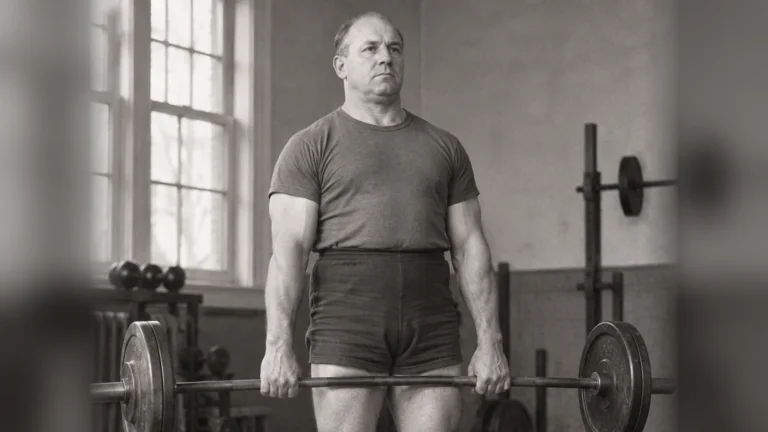

You finish a workout and the next day your legs barely bend on the stairs.
A lot of lifters take that as good news.
Sore muscles feel like proof that a workout worked.
That belief is everywhere in gym culture, and it shows up constantly on social media too.
A video from the BaseLift Lab YouTube channel asks the question directly: does DOMS mean hypertrophy?
DOMS stands for delayed onset muscle soreness, the stiff, achy feeling that shows up a day or two after a hard workout.
This article checks that question against the actual exercise science, not gym folklore.
The short answer is that soreness and muscle growth are related, but not in the simple way most people assume.
What the Video Claims
BaseLift Lab describes itself as a channel built around breaking down research on strength training, muscle growth, and recovery.
Its stated goal is explaining the science without hype or extreme claims.
The video title itself, “Does DOMS Mean Hypertrophy?”, frames soreness as an open question rather than a given fact.
That framing already puts it ahead of a lot of gym content on this topic.
The channel’s YouTube page does not name an individual host, credential, or degree.
Because of that, this article checks the underlying science directly rather than relying on the video’s authority.
What follows is what peer reviewed research actually shows about soreness, muscle damage, and growth.
What Real Research Shows About Muscle Damage and Soreness
DOMS comes from small scale damage inside muscle fibers.
This damage happens most from movements that lengthen a muscle under load, called eccentric contractions.
Lowering a heavy squat slowly creates more of this kind of damage than lifting it back up.
Priscilla Clarkson, a researcher who spent much of her career studying this exact process, laid out the biology in detail with a colleague (Clarkson & Hubal, 2002).
Their review describes torn structures inside the muscle cell, followed by inflammation and swelling.
That inflammation is part of what makes the area feel sore and stiff.
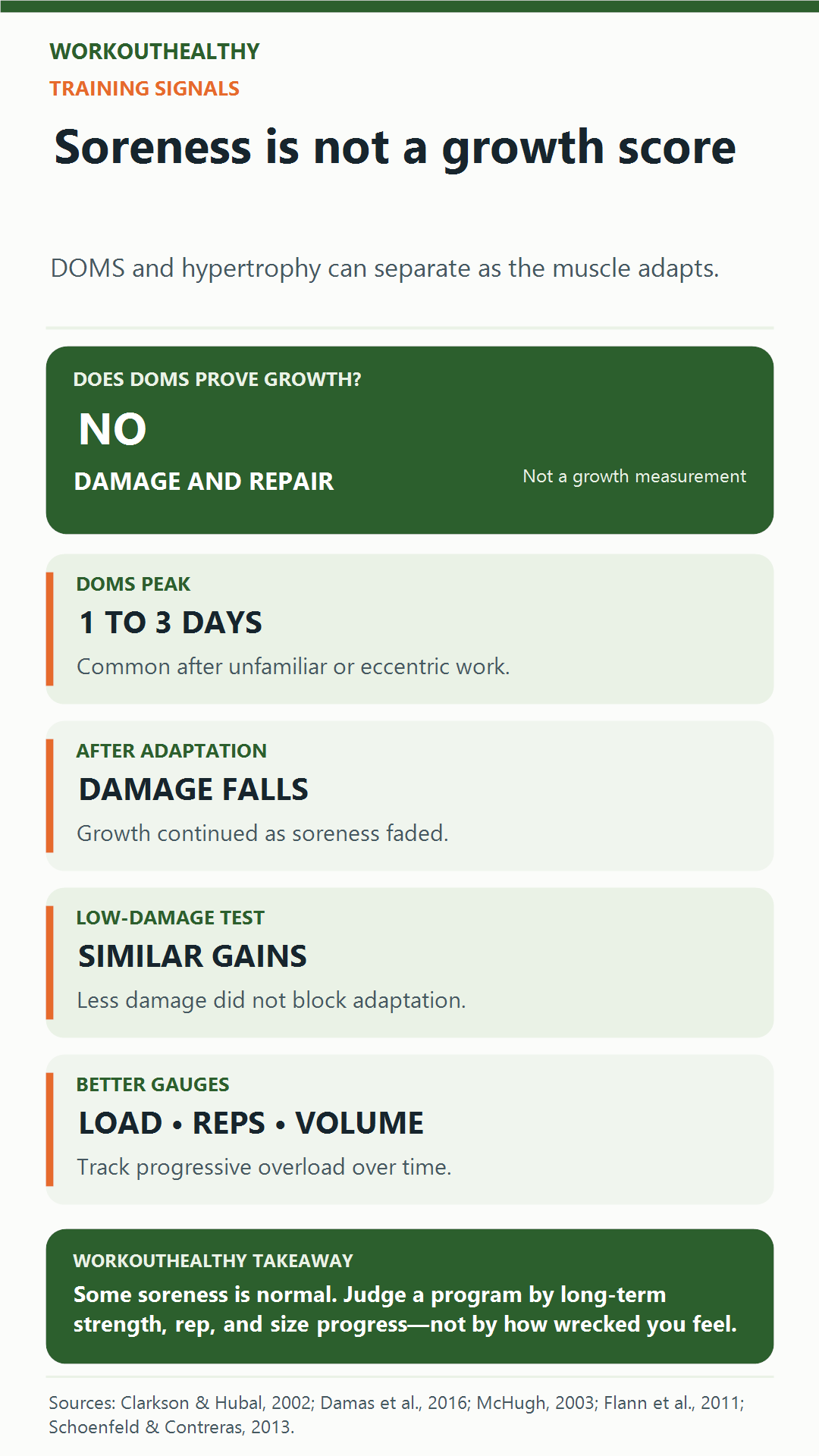
Soreness itself usually peaks around one to three days after the workout.
It is a real physical response, not something imagined.
But soreness is a marker of disruption inside the muscle, not a direct measurement of new muscle tissue.
What Real Research Shows About DOMS and Hypertrophy Outcomes
The more direct question is whether soreness predicts how much muscle actually grows.
A team led by Felipe Damas tested this in a carefully designed training study (Damas et al., 2016).
Young men trained their legs with resistance exercise over several weeks.
The researchers tracked muscle damage, protein synthesis, and eventual muscle growth in the same people over time.
Early in training, muscle damage was high and so was protein synthesis.
But that early protein synthesis was mostly going toward repair, not new growth.
As the weeks went on, muscle damage from the same workout dropped sharply.
Growth kept happening anyway, and it kept growing even as the damage response faded.
Once the researchers accounted for that repair related synthesis, protein synthesis became a much better predictor of real hypertrophy.
In other words, the soreness producing damage response and the actual growth process were not the same signal.
Soreness tracked the damage response early on, but muscle growth kept climbing even after that damage response had mostly faded.
What Real Research Shows About the Repeated Bout Effect
Anyone who trains consistently has noticed something odd.
The first time you do a new exercise, you are often crushed with soreness.
Do that same exercise again a week or two later, and the soreness is much milder.
This pattern is well documented and has a name, the repeated bout effect.
Malachy McHugh reviewed the evidence behind it in detail (McHugh, 2003).
A single bout of unfamiliar eccentric exercise appears to protect the muscle against damage from the next similar bout.
This protection can last for weeks and sometimes months.
Researchers believe several things contribute to it, including changes in how the muscle fibers absorb force.
The nervous system also seems to adjust how it recruits muscle fibers after that first exposure.
None of this means the muscle stops adapting.
Lifters keep getting stronger and keep building muscle long after the soreness from a given exercise has faded.
If soreness were the true driver of growth, this pattern would not make sense.
A muscle that stops getting sore from an exercise has not stopped needing to grow from it.
What Real Research Shows About Training Without Chasing Damage
A separate line of research asked an even more direct question.
Can a muscle adapt and grow without much damage at all?
A team led by Kyle Flann tested this using a specific eccentric cycling protocol (Flann et al., 2011).
One group started training with a very gradual ramp up in intensity, designed to limit muscle damage from the start.
A second group jumped in at a higher intensity right away, producing much more soreness and muscle damage.
Blood markers of muscle damage were far lower in the gradual group throughout the study.
Despite that, both groups ended up with similar strength and muscle adaptations by the end of the program.
The researchers concluded that muscle remodeling could happen without a large damage response driving it.
That finding directly challenges the idea that more soreness always means a more productive workout.
What Real Research Shows About Soreness as a Training Indicator
Brad Schoenfeld has published extensively on what actually drives muscle growth.
Along with Bret Contreras, he wrote a focused analysis of this exact soreness question (Schoenfeld & Contreras, 2013).
Their paper walks through why soreness makes an unreliable training gauge.
Soreness varies a lot between people doing the identical workout.
It also varies a lot across different muscle groups in the same person.
Some exercises reliably produce more soreness simply because of their mechanics, not because they build more muscle.
The authors point out that using soreness to judge a program can lead lifters toward exercises that feel productive but are not necessarily the most effective ones.
Their conclusion lines up with the training studies above.
Soreness can happen alongside growth, but it does not reliably measure it.
The Mechanism
Muscle growth mostly comes down to mechanical tension.
Mechanical tension is the force a muscle fiber experiences during a hard, demanding contraction.
That tension activates a cell signaling pathway that tells the muscle to build more contractile protein.
Muscle damage is a separate process that can happen alongside tension, especially with unfamiliar movements.
Damage triggers inflammation and brings in repair cells called satellite cells.
Those repair processes can contribute some material to the growth process, but they are not the main engine of it.
Soreness itself comes largely from that inflammation and repair activity, not from the tension signal driving new growth.
That is the core reason soreness and hypertrophy can separate from each other over time.
Early in a new program, both processes are elevated together, so soreness and growth line up loosely.
As the muscle adapts through the repeated bout effect, the damage and soreness side fades faster than the tension driven growth side.
The result is a trained lifter who keeps growing muscle while barely getting sore at all.
Mechanical tension appears to be the main engine behind muscle growth, while soreness comes mostly from a separate damage and repair process that fades with experience.
What This Evidence Does Not Prove
These studies do not prove that soreness is meaningless or should be avoided entirely.
Some soreness is a normal part of starting a new program or trying a new exercise.
The research also does not prove that eccentric focused training is worthless for building muscle.
Eccentric work still builds real strength and size, just not because of the soreness it happens to cause.
Most of these key studies involve relatively short training blocks, often just a few weeks to a few months.
Many also enroll younger, previously untrained men, which limits how far the findings generalize.
Results in older adults, in women specifically, or in already well trained lifters could look somewhat different.
These studies also report group averages, and individual responses can vary a good deal.
None of this research claims that pain during a workout is a good sign either.
Sharp or joint related pain is a different category entirely from general post workout muscle soreness.
Common Mistakes
One common mistake is picking exercises purely because they leave you sore.
That approach can steer someone away from more effective movements that just happen to feel less brutal the next day.
Another mistake is assuming a lack of soreness means a workout failed.
Experienced lifters can have excellent, productive sessions with almost no soreness afterward.
That is true even when comparing pressing patterns like the floor press and the bench press.
Some lifters chase soreness by adding random new exercises every week just to feel wrecked again.
That habit can get in the way of the consistent progressive overload that actually drives long term growth.
Other people train through genuinely concerning pain because they assume any discomfort is a growth signal.
That is a risky mindset that can turn a manageable strain into a real injury.
It also helps to remember that building visible muscle takes sustained effort over months, not a single brutal session.
That same pattern shows up in athletes who trained for decades to reach elite muscular condition.
A Practical Takeaway
Use effort and progressive overload as your main training gauges, not soreness.
Track whether your weights, reps, or total volume are trending upward over time.
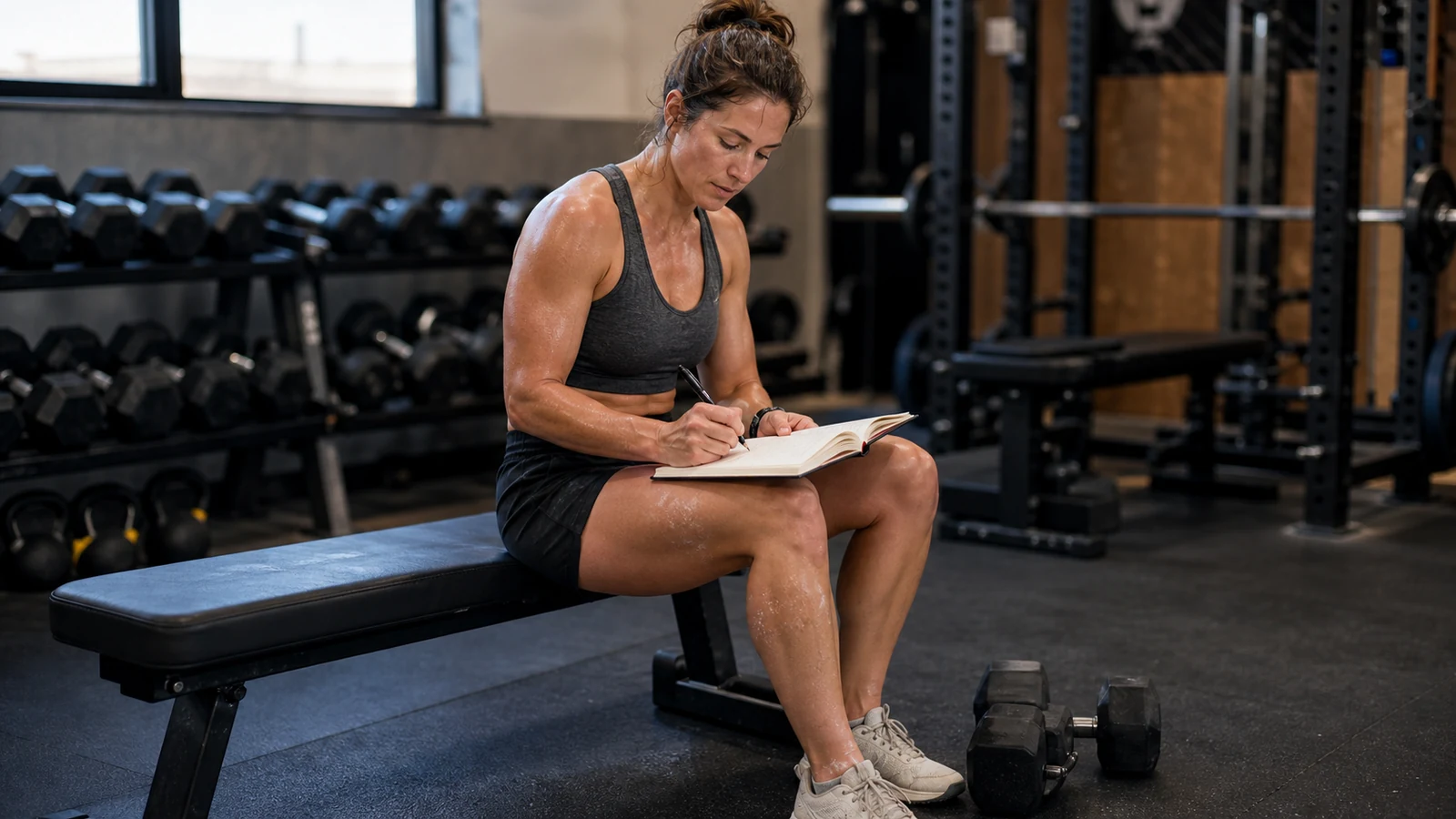
That trend is a far more reliable sign of a working program than how sore you feel the next day.
It is fine to expect some soreness when you start something new or change your routine.
Do not be alarmed if that soreness fades even though you keep training hard, since that fading is the expected repeated bout effect.
Give muscles real recovery time between hard sessions for the same movement pattern.
Eat enough total calories and protein to support genuine repair and growth.
That nutritional side matters just as much as training itself, a tradeoff explored further in this piece on losing weight without losing muscle mass.
If a specific workout style like box jumps for building muscle interests you, judge it by strength and size progress over months, not by next day soreness.
Sharp or lingering joint pain is always a different signal than normal muscle soreness, and it deserves its own attention rather than being pushed through.
Over time, consistency and effort near failure will tell you far more about your progress than any ache ever will.
Watch the video
Want more like this? Subscribe to WorkoutHealthy Insider for practical explanations behind popular fitness claims.
References
Clarkson, P. M., & Hubal, M. J. (2002). Exercise-induced muscle damage in humans. American Journal of Physical Medicine & Rehabilitation, 81(Suppl), S52 to S69. https://doi.org/10.1097/00002060-200211001-00007
Damas, F., Phillips, S. M., Libardi, C. A., Vechin, F. C., Lixandrão, M. E., Jannig, P. R., Costa, L. A. R., Bacurau, A. V., Snijders, T., Parise, G., Tricoli, V., Roschel, H., & Ugrinowitsch, C. (2016). Resistance training induced changes in integrated myofibrillar protein synthesis are related to hypertrophy only after attenuation of muscle damage. The Journal of Physiology, 594(18), 5209 to 5222. https://doi.org/10.1113/jp272472
Flann, K. L., LaStayo, P. C., McClain, D. A., Hazel, M., & Lindstedt, S. L. (2011). Muscle damage and muscle remodeling: no pain, no gain? Journal of Experimental Biology, 214(4), 674 to 679. https://doi.org/10.1242/jeb.050112
McHugh, M. P. (2003). Recent advances in the understanding of the repeated bout effect: the protective effect against muscle damage from a single bout of eccentric exercise. Scandinavian Journal of Medicine & Science in Sports, 13(2), 88 to 97. https://doi.org/10.1034/j.1600-0838.2003.02477.x
Schoenfeld, B. J., & Contreras, B. (2013). Is postexercise muscle soreness a valid indicator of muscular adaptations? Strength & Conditioning Journal, 35(5), 16 to 21. https://doi.org/10.1519/ssc.0b013e3182a61820
This article is for general information only and is not medical advice. If you have an injury, ongoing pain, or a medical condition, talk to a doctor or physical therapist before you change how you train or eat.