
Soreness cannot quantify muscle growth. Use this guide to inspect the measurements, comparisons and explanations behind a DOMS claim.
Start a methods note before reading the conclusion: “The researchers measured ____ in ____ at ____.” Fill each blank from the paper, leaving it unanswered when the paper does not supply the information.
Image context: The featured image illustrates a person touching his shoulder after exercise, not a study participant or a diagnosis of DOMS. A photograph cannot establish the cause of pain or show that muscle growth occurred.
Three Questions That Often Get Blended Together
Asking what causes soreness is different from asking whether soreness predicts growth. Asking whether deliberately producing more soreness improves growth is a third question, requiring a suitable comparison rather than an appealing biological explanation.
- Mechanism: Which tissues and sensory processes might contribute to post-exercise pain?
- Association: Do people with a larger soreness response subsequently gain more muscle?
- Causal effect: Does a program that deliberately increases soreness produce better growth than an appropriate comparison?
A study can contribute to one question without settling the other two. Finding a plausible source of pain does not establish that the pain drives hypertrophy or that pursuing it improves a training program.
Build a Methods Note
Make a separate line for each outcome. Record the test, sampling location, timing and unit, then check whether the conclusion concerns that outcome or introduces a different one.
For your conclusion note, write “observed ____” and “suggested explanation ____” on separate lines. This is a reading aid, not a clinical test or a way to calculate personal muscle gain.
Study Design and Measurements
Damas’s 2016 study followed ten healthy young men, previously trained but at least six months without leg training, through 19 sessions over ten weeks.
Workouts 1/5/19: weeks 1/3/10.
Chair-movement visual analogue scale: 0 (none) to 100 (very high) millimeters.
Check how the pain question was asked before comparing the scores. Record the procedure in your methods note.
| Training phase | Soreness 48 hours after the sampled workout | Fiber-size assessment |
|---|---|---|
| Week one | 61 mm, SEM 8 | Initial comparison measurement. |
| Week three | 8 mm, SEM 2 | No statistically significant increase from the initial assessment. |
| Week ten | 8 mm, SEM 3 | Significantly larger than at weeks one and three. |
Group means and standard errors of the mean (SEM), not individual ranges or targets, are shown. Fiber area was preexercise.
Indirect damage-growth correlations, including soreness, were nonsignificant.
Small samples cannot establish universal zero.
Interpreting the Pattern
Initial myofibrillar synthesis peaked, unrelated to later hypertrophy; later associations varied by phase and size measure.
Rough Z-band-area normalization suggested repair, without tracing protein allocation.
Visits cannot locate growth onset.
What a Lower-Damage Comparison Can Add
Flann et al. (2011) compared gradual preparation with an initially damaging exposure before eight weeks of matched-work, high-force eccentric cycling.
Despite greater initial soreness and creatine kinase (CK) in the unprepared group, muscle-size and strength gains did not differ significantly.
The result challenges a requirement for discernible damage in that protocol, not all microscopic damage or every gym program. Neither study assigned precise soreness targets or tested an optimum.
Ask what the comparison can establish before accepting an explanation. A description of the design should remain separate from a recommendation.
A Pain Mechanism Is Not a Growth Result
Wilke and Behringer’s 2021 review proposes a contribution from muscle-associated connective tissue, including fascia, to post-exercise discomfort.
It combines animal, experimentally stimulated tissue and human exercise evidence; these do not all directly test a lifter’s symptoms.
This is a pain-mechanism hypothesis, not an established exclusive cause or a trial showing that fascial pain increases hypertrophy.
A mechanism also does not validate a recovery product: pain relief, marker changes and later growth require their own comparisons.
A Five-Question Check for a Soreness Claim
Use these questions when a headline turns a short-term response into a promise of bigger muscles. They are an editorial reading aid, not a diagnostic score or a training prescription.
- What was measured? Find the actual outcome: reported pain, blood enzyme, sampled tissue, protein synthesis, strength or later size.
- When was it measured? Keep hours after one workout separate from changes over a training block.
- What was compared? A before-and-after change, a correlation and a comparison between assigned groups answer different questions.
- Who and what were studied? Check training experience, population and exercise before applying a small specialized experiment broadly.
- What was inferred? Identify the step between the observed result and a proposed explanation or personal recommendation.
For example, “soreness rose after an unfamiliar workout” reports a symptom change. Adding “therefore this person will gain more muscle” introduces a prediction that the soreness observation alone cannot support.
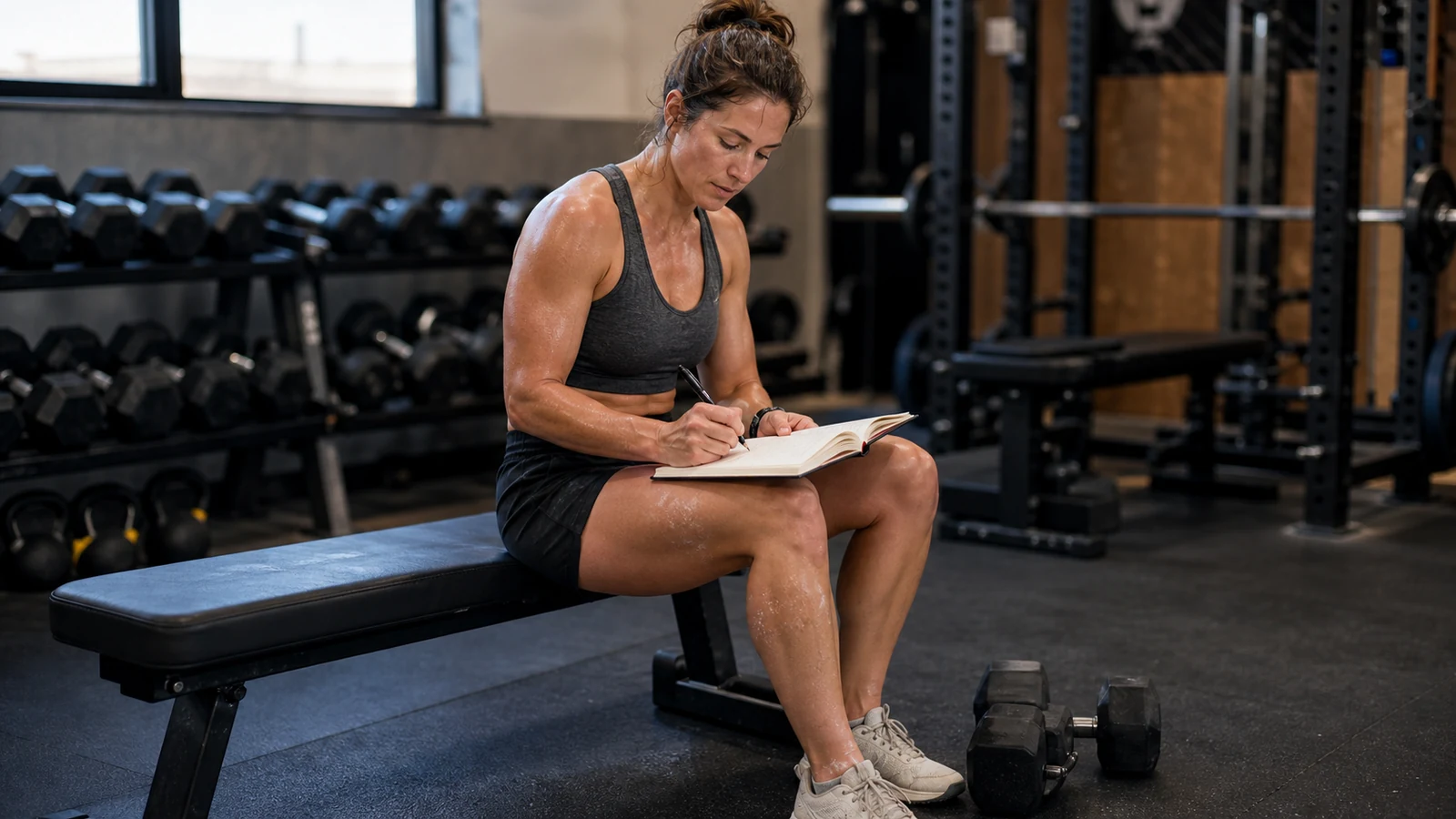
For the separate practical question of what to track during training, see our soreness and training-progress guide. The focus here is interpreting the research, rather than duplicating its tracking example.
Keep Pain and Research Conclusions in Their Proper Place
A study-reading framework cannot identify the cause of your pain. Cleveland Clinic advises seeking medical attention for concerning symptoms such as severe swelling, sharp persistent pain or unusually dark urine, and for soreness that does not improve.
Do not use the absence of a growth-predicting relationship as permission to ignore symptoms or push through them. Decisions about an injury or medical condition need appropriate healthcare advice.
Keep your note’s observation, proposed explanation and recommendation in separate fields. Link each statement to the measurement or comparison offered to support it.
Get the next evidence check.
Five practical fitness stories worth your time, every Friday.
One email a week. No product pitches. Unsubscribe in one click.
References
Damas, F., et al. (2016). [Measurements]. The Journal of Physiology, 594(18), 5209 to 5222. Paper.
Flann, K. L., LaStayo, P. C., McClain, D. A., Hazel, M., & Lindstedt, S. L. (2011). [Preparation and eccentric-training adaptation]. Journal of Experimental Biology, 214(4), 674 to 679. Original indexed abstract.
Wilke, J., & Behringer, M. (2021). [Connective-tissue pain hypothesis]. International Journal of Molecular Sciences, 22(17), 9482. Original review.
Cleveland Clinic. (2025). Delayed onset muscle soreness (DOMS). Reviewed December 19, 2025. Clinical information and warning signs.
Fitness disclaimer: This article provides general exercise-science information, not medical advice or a personal training or rehabilitation plan. Consult a qualified healthcare professional about concerning pain, symptoms or a medical condition.