
Does physical therapy work? Exercise therapy has evidence of benefit for some adults with chronic nonspecific low back pain or knee osteoarthritis.
For a new episode of rotator cuff-related shoulder pain, one trial found that several extra physiotherapy visits were no better than one assessment and advice session.
A useful plan should have a clear functional goal, a way to measure progress, and a reason to change course when it is not helping. More visits are not automatically better, and an exercise handout is not automatically ineffective.
The studies below mainly test exercise-based care, not every treatment offered under the name physical therapy. Their average results cannot predict whether a specific person’s plan will help.
What the evidence actually compares
| Condition and population | Intervention and comparator | What changed | What the result cannot prove |
|---|---|---|---|
| Chronic nonspecific low back pain | Exercise therapy versus no treatment, usual care, or placebo in a large Cochrane review | Average pain was about 15 points better on a 100-point scale at the earliest follow-up, with moderate-certainty evidence | It does not show every exercise plan or every supervised visit beats a tailored home program |
| Knee osteoarthritis | Land-based exercise versus usual care, no treatment, or limited education in a 2024 Cochrane review | Average pain was about 13 points better and function about 12.5 points better on 100-point scales immediately after treatment | Clinical importance for an individual is uncertain; the review does not establish a universally best delivery setting |
| Knee osteoarthritis, supervision question | Two smaller reviews compared supervised or center-based plans with home exercise | A 2025 review favored supervised care for pain and disability; a 2024 review found home care similarly effective in the short term on limited evidence | The reviews do not justify a blanket claim that paying for more visits always improves outcomes |
| New rotator cuff-related shoulder pain | GRASP randomized 708 people to up to six physiotherapy sessions with progressive exercise or one best-practice advice session with a home plan, with or without an injection | Over 12 months, extra progressive-exercise visits were not superior for shoulder pain and function | The result does not mean advice-only care fits every shoulder problem or that assessment has no value |
The low-back result comes from the 2021 Cochrane review, and the knee result from the 2024 Cochrane review. The shoulder comparison is the GRASP randomized trial; none of these studies tested the particular clinic shown later in this article.
These figures are group averages under the studies’ criteria. A therapist still has to consider a person’s diagnosis, symptoms, medical history, goals, and response before choosing or changing a plan.
Does supervision work better than home exercise?
Sometimes supervision may help with assessment, access, feedback, or adjusting a plan, but the trials do not support treating it as a universal ingredient. The 2025 knee-osteoarthritis review pooled 10 randomized trials with 917 participants and favored supervised exercise for pain and disability, while acknowledging the small evidence base (Mapinduzi et al., 2025).
A 2024 review of home versus center-based knee exercise concluded that home programs were as effective on short-term pain, disability, walking ability, and lower-limb strength, also on limited evidence (Zhang et al., 2024). The differing reviews use different included comparisons and outcomes, so neither is a promise about one person’s result.
The 2024 Cochrane knee review found no clear relationship between benefit and the ratio of real-time clinician consultations across its trials. For shoulder pain, GRASP directly challenges the assumption that several extra visits always produce a better result than one strong assessment and advice session.
Cost, travel, and time are real treatment burdens. If a home plan is feasible and progress is measurable, ask a physical therapist whether fewer visits with planned reassessment would answer your needs.
What should a personalized plan change at reassessment?
A plan is personalized when the clinician uses your response to guide the next decision, not merely when your name appears on a printout. The American Physical Therapy Association describes reexamination when there is an unexpected change, a failure to respond as expected, or a need for a new plan of care (APTA reexamination guidance).
| At the first visit, agree on | At the next check, ask |
|---|---|
| One meaningful activity, such as walking to a nearby shop, climbing home stairs, or reaching a shelf | Is that activity easier, harder, or unchanged under similar conditions? |
| A repeatable symptom and function measure chosen by the clinician | Has the score changed enough to matter, or is it normal day-to-day variation? |
| What you can realistically complete between visits | Which part did you do, and what made any part impractical? |
| Expected review date and reasons to contact the clinician earlier | Should the exercise, dose, diagnosis, or treatment goal be reconsidered? |
This checklist is a conversation tool, not a replacement for examination. If the plan is causing a repeated flare, is too expensive to continue, or is not changing the activity that matters to you, say so before assuming that more identical sessions are the answer.
What if physical therapy has not helped?
- Describe the specific problem. Bring a short record of the activity, symptom pattern, exercises completed, and what happened afterward.
- Ask what the plan is testing. Is the goal pain relief, strength, walking capacity, confidence with movement, or another measurable outcome?
- Ask what would change next. The answer might be a different exercise, a manageable home dose, a new assessment, or referral to another clinician.
- Discuss the cost of continued care. Ask how many visits are needed to test the revised plan and whether supported home work is appropriate.
Continued pain does not prove that the person failed to “try hard enough.” It can mean that the initial approach was insufficient, the diagnosis needs another look, the goal is unrealistic for that phase, or a different support is needed.
What adherence research can and cannot add
A randomized trial of 80 people with musculoskeletal conditions compared a home-exercise app plus remote calls and texts with paper handouts. Of 77 people with outcome data, the app-support group reported adherence 1.3 points higher on an 11-point scale at four weeks, but the authors said the clinical importance was unclear (Lambert et al., 2017).
The trial tested a package of technology and human support, not face-to-face supervision by itself. It did not prove that every app improves pain or that the clinic in the video produces better results.
Pain, fear of movement, and safety
A therapist can help decide which movements to practice and when to change an exercise that repeatedly worsens symptoms. Pain alone does not identify its cause, so use the assessment and follow-up plan instead of trying to interpret a new symptom from a general article.
Seek emergency medical care for back pain with new bladder or bowel changes, numbness around the genitals or bottom, or pain, tingling, weakness, or numbness in both legs (NHS back-pain guidance). New or worsening symptoms during any rehabilitation plan are reasons to contact the treating clinician rather than automatically increasing exercise.
After surgery, fracture, or serious illness, the treating team may have restrictions that a general article cannot determine. The right progression and return-to-activity timing are individual clinical decisions.
What the clinic video shows
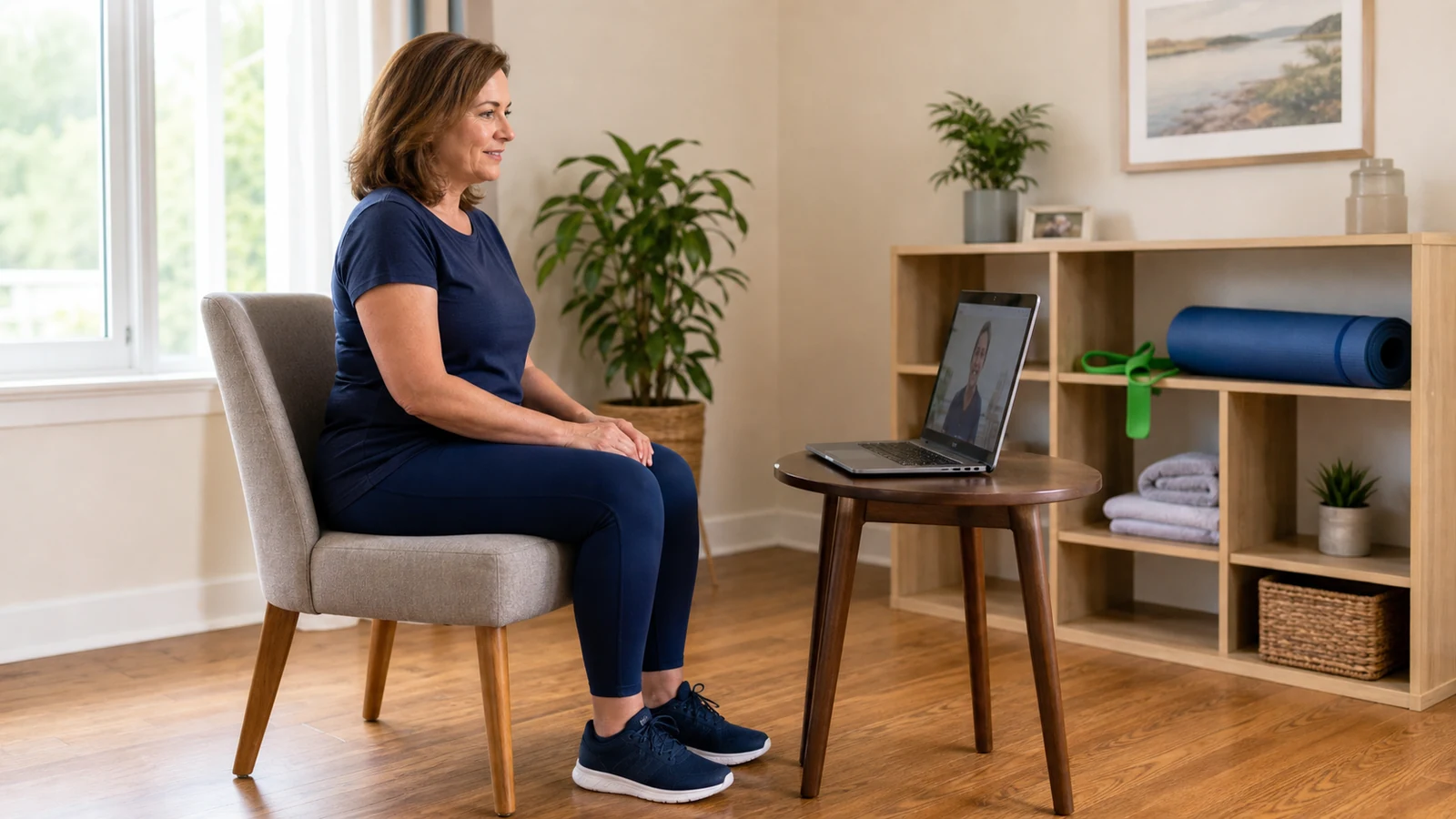
The Insight Health Services video illustrates guided exercise in a physiotherapy clinic in Walsall, England. It is a clinic presentation, not outcome data for the people shown or a controlled comparison with home care.
The research above is the basis for the condition-specific answer. The video can help you see what a session may look like, but it cannot establish that this particular program works better than another plan.
Watch the video
Primary research and professional guidance
- Hayden et al., 2021 Cochrane review of exercise for chronic low back pain.
- Lawford et al., 2024 Cochrane review of exercise for knee osteoarthritis.
- Mapinduzi et al., 2025 supervised-versus-home knee review.
- Zhang et al., 2024 home-versus-center knee review.
- GRASP randomized trial of rotator cuff care.
- Lambert et al., 2017 app-plus-support adherence trial.
- APTA guidance on reexamination and reassessment.
This article is for general information and is not medical advice. A licensed physical therapist or other appropriate healthcare professional can assess your symptoms, decide whether exercise therapy fits, and adjust a plan to your condition.