
A YouTube video claims a specific training combination can make men over 60 look and perform younger.
The claim comes from a men’s style and lifestyle channel, not a research lab.
Zone 2 cardio, easy paced walking, cycling, or similar low intensity aerobic work, is often the specific style paired with lifting in these pitches.
The combination sounds appealing because it promises one simple plan instead of a complicated routine.
We checked what real, peer reviewed research says about strength training, cardio, and biological age.
Here is what actually holds up, and what does not.
What the Video Claims
The video, titled “The New Fitness Standard That Makes Men Over 60 Athletic, Young And Impossible To Ignore,” comes from the channel StyleConnection.
It argues that pairing resistance training with cardio is a new standard for men over 60.
The framing ties this combination to looking athletic, feeling younger, and standing out in a crowd.
It also connects the idea to “biological age,” a concept describing how old your body functions compared to your birth year.
The Facebook post promoting this video framed the same idea as “the fitness combo linked to a younger biological age.”
Phrases like “impossible to ignore” and “new fitness standard” are marketing language, not scientific terms.
StyleConnection covers style and lifestyle content, not exercise science or medicine.
That does not automatically make the claim wrong.
It does mean any specific number or study mentioned needs independent verification before you repeat it as fact.
We could not confirm a specific biological age statistic tied directly to this video.
So the rest of this article checks the underlying idea against actual published research instead.
What the Real Research Actually Shows
The idea that exercise changes biological age is a real, active area of scientific research.
Several recent studies looked at strength training, cardio, and the biological markers scientists use to estimate aging.
The strongest evidence for older adults specifically comes from a 2026 systematic review and meta-analysis.
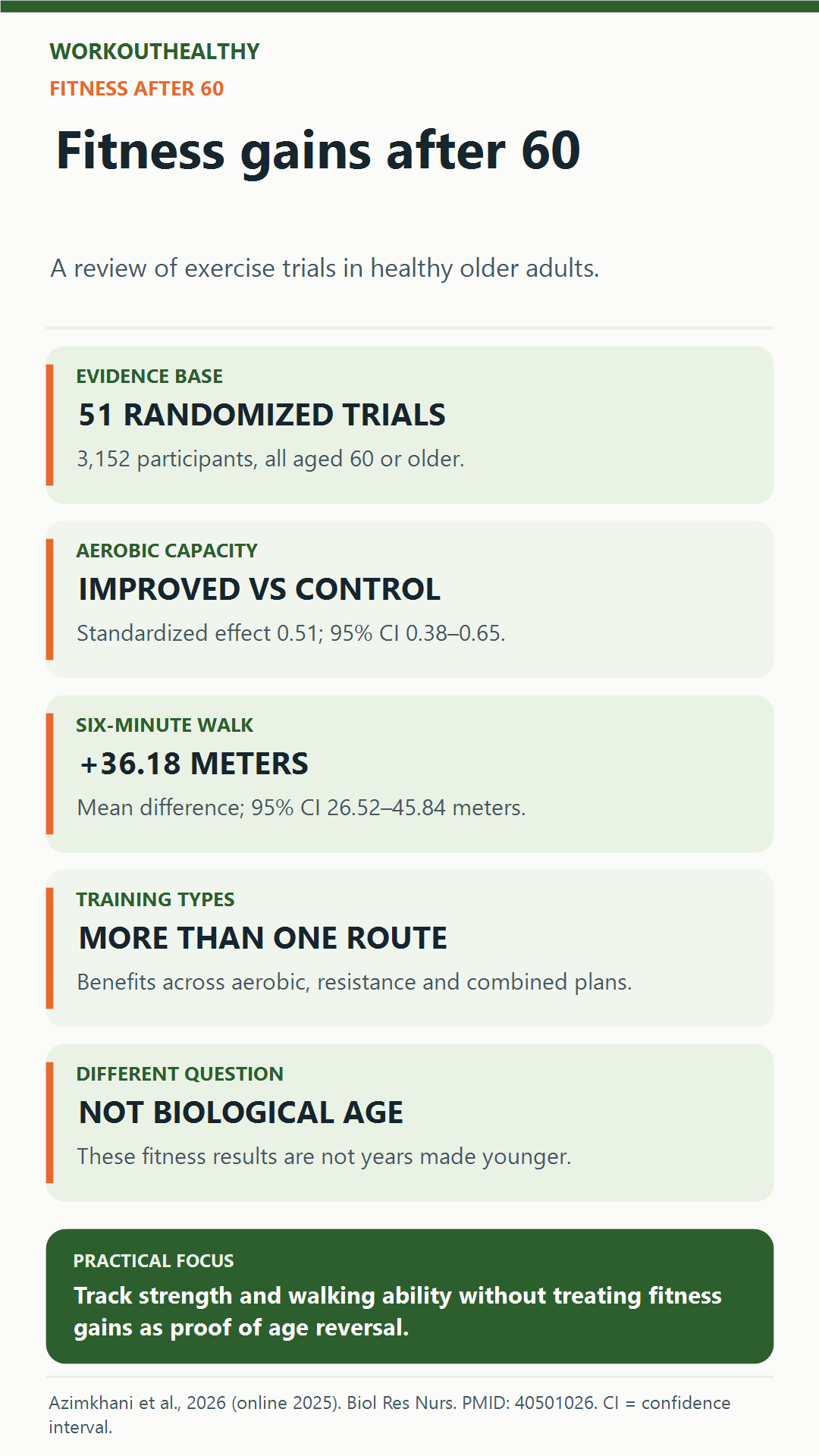
Amin Azimkhani and colleagues pooled 51 randomized controlled trials covering 3,152 participants aged 60 and older (Azimkhani et al., 2026).
They compared aerobic only training, resistance only training, and combined training against no structured exercise at all.
Exercise improved cardiorespiratory fitness with a standardized mean difference of 0.51, a genuinely meaningful effect.
Six minute walk distance improved by an average of about 36 meters compared to control groups.
Cardiorespiratory fitness is often measured as VO2 max, an estimate of how efficiently the heart, lungs, and muscles use oxygen during effort.
A large body of long running research links higher VO2 max with better long term health outcomes, which is part of why researchers track it as an aging marker.
Aerobic, resistance, and combined training all produced consistent fitness gains in adults over 60, and no single approach stood out as clearly superior.
That last point matters because the video frames combined training as a special new standard.
The actual meta-analysis found consistent benefits across aerobic, resistance, and combined training alike.
No single modality showed a clearly superior effect on cardiorespiratory fitness in this pooled data.
A separate 2025 meta-analysis looked at body composition instead of fitness scores directly.
Mousa Khalafi and colleagues reviewed 53 randomized trials covering 2,873 middle aged and older adults (Khalafi et al., 2025).
Combined training increased lean body mass by about half a kilogram more than aerobic training alone.
Combined training did not differ significantly from resistance training alone on lean mass, fat mass, or body weight.
The lean mass benefit was strongest in programs that ran 24 weeks or longer, and it applied to both men and women in the pooled data (Khalafi et al., 2025).
That supports one specific part of the video’s framing.
Adding cardio to a strength routine does not appear to erase the muscle building benefit of lifting weights.
Biological age itself is usually measured with specific tools, not a feeling of being young.
Two of the more common tools are telomere length and epigenetic clocks like GrimAge.
A 2022 systematic review looked at physical activity and telomere length across 43 separate studies (Schellnegger et al., 2022).
Moderate to vigorous aerobic activity was linked with better telomere preservation in most of that research.
Evidence for resistance training alone on telomere length was inconsistent across the studies reviewed.
Evidence for combined training was limited mostly to short term studies in specific groups, like people with obesity or postmenopausal women.
One striking data point involved ultra distance runners, who showed telomeres about 11% longer than inactive control groups (Schellnegger et al., 2022).
Researchers estimated that gap as roughly equivalent to 16 years of typical telomere shortening.
That number came from extreme endurance athletes in observational data, not from a typical man following a moderate combined program.
That is a real gap between the video’s framing and the current evidence for men over 60 specifically.
A 2026 study in the journal GeroScience used a different biological age marker entirely.
Menno Van Damme and colleagues tracked adults aged 35 to 65 through a 6 month cycling program (Van Damme et al., 2026).
Participants improved their VO2 max by about 20 percent over the course of the program.
Their GrimAge epigenetic clock, a DNA based estimate of biological age, decreased by roughly 7.44 months relative to the expected trajectory.
That is a genuinely interesting result connecting fitness gains to a slower biological clock.
The program in that study was aerobic cycling alone, not a combined strength and cardio routine, and it was not limited to men over 60.
What This Evidence Does Not Prove
None of these studies prove that combining strength and cardio is uniquely required to look or feel younger.
The 2026 fitness meta-analysis found aerobic, resistance, and combined training all produced broadly similar gains.
None of the biological age studies cited here tested a combined program specifically in men over 60.
The telomere and epigenetic age research used different exercise types, different age ranges, and sometimes different sexes entirely.
None of it measured whether someone looks more athletic, which is a subjective judgment, not a lab measurement.
Biological age tools like GrimAge are still developing science, not a single settled clock every researcher agrees on.
A single training program is also unlikely to fully offset genetics, sleep, diet, and stress on its own.
The research supports exercise as a genuine tool for healthier aging, but no single study shows that one exact combination makes anyone provably younger.
Common Mistakes People Make
One common mistake is treating biological age like a single, precise number a lab can hand you.
Different public biological age tests use different clocks, and those clocks do not always agree with each other.
Another mistake is dropping resistance training because cardio feels like the more obvious aging fix.
The research above shows resistance training holds real value for lean mass and functional strength on its own.
A third mistake is chasing intensity instead of consistency.
The 2026 fitness meta-analysis found benefits in both medium term and longer term programs, not just extreme ones.
A fourth mistake is assuming more cardio automatically means a better result.
The telomere research suggested a possible pattern where both very low and very high intensity showed weaker associations than moderate effort.
Finally, some people avoid strength training entirely after 60 out of caution.
Every study cited here included participants over 60, and none reported that properly programmed resistance training was unsafe.
A sixth mistake is expecting a visible change within a few weeks.
The studies above ran for months, and several of the strongest lean mass and fitness results came from programs lasting 24 weeks or longer.
Who Should Check With a Doctor First
Anyone starting a new exercise routine after 60 should talk to a doctor first if they have a heart condition.
The same applies to uncontrolled blood pressure, a recent joint replacement, or a recent injury.
People managing diabetes, osteoporosis, or a chronic lung condition should get personalized guidance before changing intensity.
Sudden chest pain, dizziness, or unusual shortness of breath during exercise is never something to push through.
A physical therapist can often help adapt resistance training around an existing injury instead of skipping it entirely.
Certain heart medications, like beta blockers, change how heart rate responds to exercise.
A doctor can explain how those medications affect the effort level a person actually feels during cardio.
None of the research cited here replaces an individual medical evaluation.
Practical Takeaway
The research does support a real link between exercise and healthier biological aging markers.
It does not support one dramatic new standard that guarantees results from one exact combination.
A reasonable, evidence backed approach includes both resistance training and regular aerobic activity most weeks.
Two to three resistance sessions a week matches what several of the cited studies actually tested.
Regular aerobic activity, even moderate walking, supported the fitness and telomere findings described above.
Plan for a program that lasts several months rather than a few weeks, since that is the timeframe where the research shows real change.
Track a simple marker, like how many stairs feel comfortable or how far you can walk, instead of chasing a single biological age number.
Our breakdown of what resistance training research shows for brain health covers a related benefit beyond biological age markers.
If you want a simple way to check cardio capacity, our guide to the four flight stair test explains what that kind of quick check can and cannot tell you.
For the aerobic side specifically, our look at daily steps and mortality covers what the walking research actually supports.
Progress slowly, track how you feel and perform over months, and treat any single video as a starting point for questions, not a verdict.
Watch the Original Video
Get the next evidence check.
Five practical fitness stories worth your time, every Friday.
One email a week. No product pitches. Unsubscribe in one click.
References
Azimkhani, A., Kasraei, R., Sabeti, H., & Almasoodi, A. (2026). The effect of aerobic, resistance, and combined exercise training on cardiorespiratory fitness in healthy people aged 60 years and over: A systematic review and meta-analysis of randomized controlled trials. Biological Research for Nursing, 28(1), 72 to 90. https://doi.org/10.1177/10998004251348605
Khalafi, M., Kheradmand, S., Habibi Maleki, A., Symonds, M. E., Rosenkranz, S. K., & Batrakoulis, A. (2025). The effects of concurrent training versus aerobic or resistance training alone on body composition in middle aged and older adults: A systematic review and meta-analysis. Healthcare, 13(7), Article 776. https://doi.org/10.3390/healthcare13070776
Schellnegger, M., Lin, A. C., Hammer, N., & Kamolz, L. P. (2022). Physical activity on telomere length as a biomarker for aging: A systematic review. Sports Medicine – Open, 8, Article 111. https://doi.org/10.1186/s40798-022-00503-1
Van Damme, M., Stegen, S., Steenwinckel, B., Schroé, H., Reyes del Paso, G. A., Pulopulos, M. M., De Raedt, R., Vanderhasselt, M. A., Derave, W., Ongenae, F., Boone, J., Van Criekinge, W., Rietzschel, E. R., & De Meyer, T. (2026). Epigenetic age deceleration reflects exercise induced cardiorespiratory fitness improvements. GeroScience, Article 2076. https://doi.org/10.1007/s11357-025-02076-9
Medical disclaimer: This article is for general information only and is not medical advice. If you have an injury, ongoing pain, or a medical condition, talk to a doctor or physical therapist before you change how you train or eat.