
Losing fat and building muscle at the same time sounds like the dream combination. Most people are told to pick one goal or the other.
A YouTube video called Lose Fat and Gain Muscle Faster With Body Recomposition, by fitness creator Abhinav Mahajan, argues you do not have to choose.
The video lays out a diet and workout plan built around a moderate calorie deficit, higher protein intake, and consistent resistance training, the same three ingredients researchers have studied for years.
But does the research actually back up doing both at once?
What Body Recomposition Actually Means
Body recomposition is a simple idea hiding behind a technical sounding name.
It means losing body fat and gaining muscle during the same stretch of time.
That is different from the usual advice, which tells people to bulk first and cut later, gaining weight on purpose during one phase and then losing it during another.
Recomposition tries to do both jobs at once instead of taking turns.
The video frames this as a faster path to a leaner, more muscular body than the traditional bulk and cut cycle most gyms teach.
That claim is worth checking against the actual science rather than taking it on faith.
The core plan the video describes, eating slightly below your maintenance calories, eating enough protein, and lifting weights consistently, happens to match almost exactly what researchers have tested in real studies.
That overlap is a good sign, even before looking at the results.
What the Research Actually Supports
The clearest answer comes from a 2020 review published in the Strength and Conditioning Journal, which pulled together the available research on this exact question (Barakat et al., 2020).
Its conclusion was yes, body recomposition is real, but only under specific conditions.
A person needs a modest calorie deficit, enough protein, and resistance training that actually challenges the muscles.
Without all three pieces in place at once, the effect tends to fall apart.
Body recomposition is not a myth, but it is not a shortcut either. It is what happens when resistance training, a modest calorie deficit, and enough protein all work together at the same time.
The review found that recomposition works best for certain groups of people.
Beginners tend to see the biggest results, since untrained muscle responds strongly to almost any consistent training stimulus.
People returning to training after a long break often see a similar boost, sometimes called muscle memory, that lets them regain lost muscle faster than a true beginner would build it.
People carrying more body fat also tend to recompose more easily, because their bodies have more stored energy available to help fuel muscle repair during a deficit.
Lean, already well trained lifters see the smallest effect, since their muscles no longer respond as strongly to training and their bodies have less spare fat to draw on.
Protein intake is the second major piece of the puzzle.
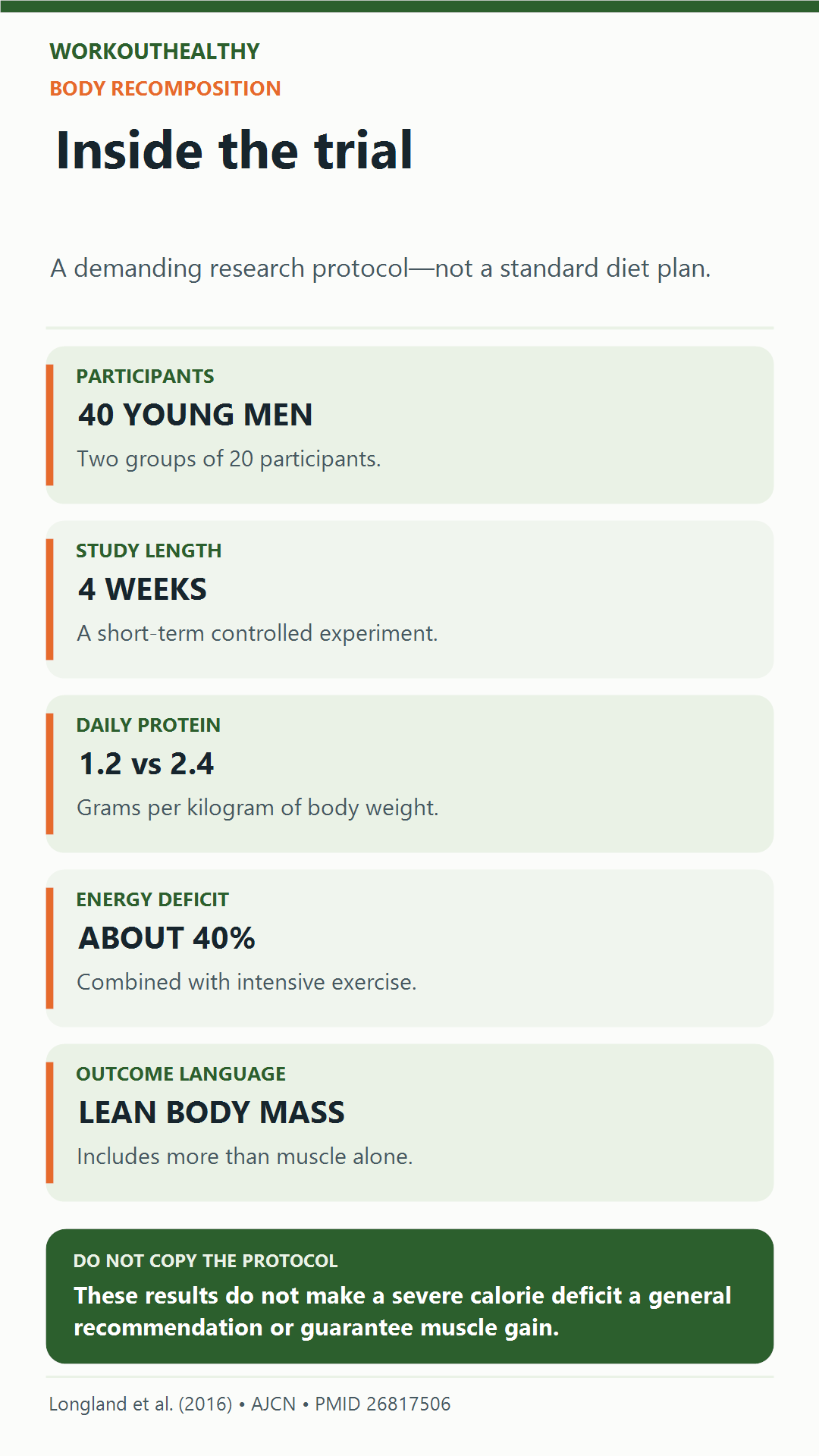
A controlled trial published in The American Journal of Clinical Nutrition tested this directly in forty young men who trained hard for four weeks on a strict calorie deficit (Longland et al., 2016).
One group ate about 2.4 grams of protein per kilogram of body weight each day, while the other ate close to half that amount.
By the end of the month, the higher protein group had gained about 1.2 kilograms of lean mass while still losing roughly 4.8 kilograms of fat.
The lower protein group lost a similar amount of fat but barely gained any muscle at all.
A separate analysis that combined results from dozens of studies found that gains in muscle mass tend to level off somewhere around 1.6 grams of protein per kilogram of body weight per day (Morton et al., 2018).
Eating more than that did not produce much extra benefit in most of the studies reviewed.
Resistance training is the third piece, and it is not optional.
Diet alone can help someone lose fat, but muscle only grows in response to a real physical demand placed on it.
That is why the video’s emphasis on structured lifting, not just cardio, lines up with what the research actually shows.
Some training styles that look nothing alike, from traditional strength work to certain explosive movements, can still contribute to this kind of muscle building stimulus, which is part of why research on unconventional exercises building real muscle keeps turning up interesting results.
What the Evidence Does Not Prove
None of this means recomposition works the same way for everyone, or that it is as fast as the video’s title suggests.
The word faster in the video title is doing a lot of work, and it is worth being skeptical of it.
Recomposition is almost always slower than focusing on one goal at a time.
A person chasing pure fat loss without worrying about muscle can usually lose weight faster than someone trying to preserve or build muscle during the same deficit.
Someone chasing pure muscle gain in a calorie surplus can typically build muscle faster than someone doing it in a deficit.
Recomposition trades some speed on both fronts for progress on both fronts at once.
The Longland trial also only ran for four weeks, which is a short window.
It does not tell us what happens over six months or a year, or how the results might change in older adults or people with different training histories.
Results also vary a lot from person to person, which is part of why some people feel like they are stuck even while doing everything right.
Genetics, sleep quality, stress levels, and hormone status can all shift how much muscle a given person builds from the same training and diet plan.
This is also why some people report losing muscle mass along with fat even when they think they are doing recomposition correctly, usually because one of the three required pieces was missing.
None of the available research proves that any single specific workout format or app based plan is the one true way to achieve recomposition.
The science supports the underlying combination of training, protein, and a modest deficit, not any one branded program built around it.
Common Mistakes People Make Chasing Recomposition
The most common mistake is watching the bathroom scale too closely.
Someone can lose a pound of fat and gain a pound of muscle in the same week and see the scale barely move.
That looks like failure, but it can actually mean the plan is working exactly as intended.
A second mistake is cutting calories too aggressively in an attempt to speed things up.
A very large deficit makes it much harder for the body to support muscle growth, even with excellent training and plenty of protein.
A modest, sustainable deficit gives muscle building a real chance while fat still comes off, just more slowly than an aggressive crash diet would.
A third mistake is treating cardio as the whole plan and skipping structured resistance training.
Without a real strength stimulus, a calorie deficit mostly just makes someone smaller, not more muscular.
A fourth mistake is spreading protein too thin or skipping it outside of workout days.
Eating enough protein across the entire week, not just on training days, is part of what separated the successful group in the Longland trial from the group that barely gained muscle.
A fifth mistake is expecting a four week video program to deliver a year’s worth of visible change.
Who Should Check With a Doctor First
Combining a calorie deficit with resistance training is safe for most healthy adults, but it is not automatically right for everyone.
Anyone with a diagnosed heart condition, uncontrolled high blood pressure, or a history of chest pain during exercise should talk to a doctor before starting a new training and diet plan.
The same caution applies to anyone who is pregnant or recently gave birth.
People recovering from a recent surgery or injury should also check in first.
Anyone returning to exercise after a long period of inactivity should ease in gradually rather than jumping straight into an aggressive plan.
A calorie deficit, even a modest one, is not appropriate for everyone either.
People with a history of disordered eating, anyone who is underweight, and growing teenagers should not adopt a calorie deficit without professional guidance.
People managing diabetes or another condition affected by diet changes should loop in a doctor or a registered dietitian before changing how much they eat.
A Realistic Approach to Body Recomposition
Start with resistance training two to four times a week, focusing on the major muscle groups with exercises you can progress over time.

Compound moves like squats, rows, presses, and deadlifts give the most muscle building return for the time invested.
Aim for a modest calorie deficit, somewhere around 10 to 20 percent below your maintenance calories, rather than an aggressive cut.
A smaller deficit is easier to sustain and leaves more energy available for training hard and recovering well.
Target roughly 1.6 to 2.2 grams of protein per kilogram of body weight each day, spread across three or four meals rather than crammed into one.
Track progress with more than just the scale.
Photos, a tape measure around the waist, and how your clothes fit all tell a fuller story than body weight alone.
Strength on your main lifts trending upward over several weeks is another good sign that muscle is being added, not just lost.
Progress in body recomposition often shows up in the mirror and the tape measure long before it shows up on the bathroom scale.
Give it real time before judging results.
Since recomposition moves slower than either pure fat loss or pure muscle gain, plan on three to six months before expecting a clearly visible change.
Sleep and stress management matter more here than most people expect, since both affect the hormones involved in building and preserving muscle.
Resistance training also carries benefits that reach well beyond the mirror, which is one more reason it belongs at the center of a recomposition plan rather than as an afterthought behind diet, and lifting weights appears to help more than just muscle tissue over the long run.
If progress stalls for several weeks in a row despite consistent training and eating, it is reasonable to slightly increase protein, double check that training intensity is still challenging, or reassess whether the calorie deficit has crept too deep.
Watch the Original Video
Want more like this? Subscribe to WorkoutHealthy Insider for practical explanations behind popular fitness claims.
References
Barakat, C., Pearson, J., Escalante, G., Campbell, B., & De Souza, E. (2020). Body recomposition: Can trained individuals build muscle and lose fat at the same time? Strength and Conditioning Journal, 42(5), 7 to 21. https://doi.org/10.1519/SSC.0000000000000584
Longland, T. M., Oikawa, S. Y., Mitchell, C. J., Devries, M. C., & Phillips, S. M. (2016). Higher compared with lower dietary protein during an energy deficit combined with intense exercise promotes greater lean mass gain and fat mass loss: A randomized trial. The American Journal of Clinical Nutrition, 103(3), 738 to 746. https://doi.org/10.3945/ajcn.115.119339
Morton, R. W., Murphy, K. T., McKellar, S. R., Schoenfeld, B. J., Henselmans, M., Helms, E. R., Aragon, A. A., Devries, M. C., Banfield, L., Krieger, J. W., & Phillips, S. M. (2018). A systematic review, meta-analysis and meta-regression of the effect of protein supplementation on resistance training-induced gains in muscle mass and strength in healthy adults. British Journal of Sports Medicine, 52(6), 376 to 384. https://doi.org/10.1136/bjsports-2017-097608
This article is for general information only and is not medical advice. If you have an injury, ongoing pain, or a medical condition, talk to a doctor or physical therapist before you change how you train or eat.