
An Oregon Army National Guard major spent one hour on green turf doing something almost nobody can survive doing for five minutes straight.
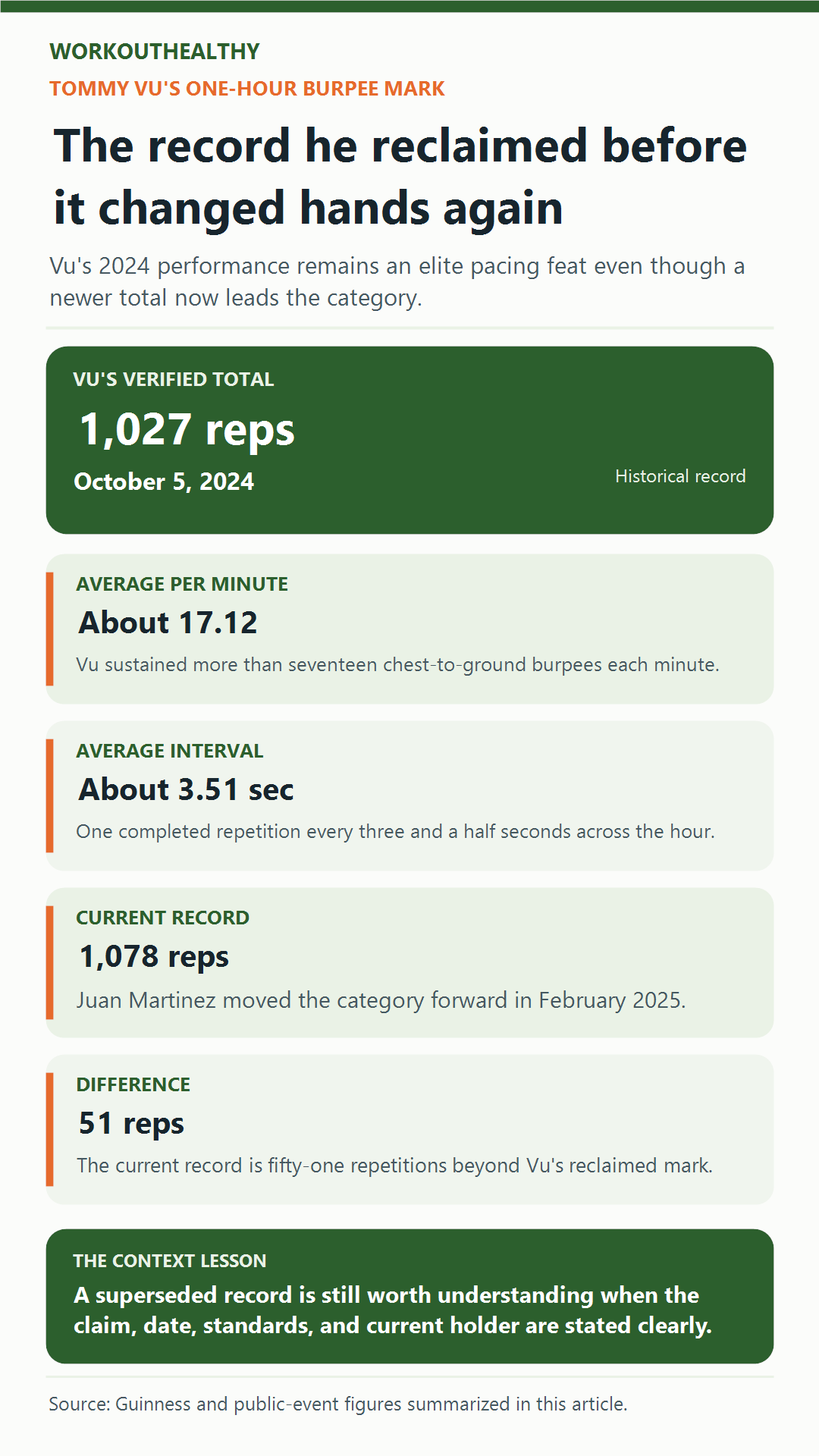
Major Tommy Vu completed 1,027 chest to ground burpees in sixty minutes on October 5, 2024.
Guinness World Records confirmed the total and credited him with reclaiming the record for most chest to ground burpees in one hour by a male.
It was not his first time holding that title.
It would not be his last time losing it, either.
Vu’s number has since been passed.
Juan Martinez of Colombia now holds the current record, with 1,078 reps set in February 2025.
That does not make the 1,027 any less real.
It is still one of the more demanding physical feats WorkoutHealthy has covered, and the story behind it says a lot about pacing, fatigue, and what a trained body can be pushed to survive.
The Record, Verified
Oregon National Guard Public Affairs filmed the attempt at Lancaster Physiq Fitness in Salem, Oregon.
Videographer Maj. Wayne Clyne captured Vu working through the hour on camera, with a running clock and judges visible in frame the entire time.
That footage lives on DVIDS, the Defense Visual Information Distribution Service.
DVIDS is the U.S. military’s own public affairs video platform, not a fan upload or a clip pulled from social media.
The footage is public domain government video.
Guinness World Records confirmed the 1,027 total as the official record for most chest to ground burpees in one hour by a male.
The National Guard’s own coverage and outlets including Task and Purpose and the U.S. Army’s official site reported the same rep count and the same date.
A Title He Had Already Lost Once
Vu is not new to this record.
He first claimed it in March 2023, with a total just over 1,000 reps.
He held it for less than a year.
In December 2023, another competitor pushed the count past 1,010 and took the title away from him.
Most people would have let a lost record stay lost.
Vu is a sports medicine orthopedic physician assistant serving with the Oregon Army National Guard’s Medical Command.
He went back to training instead of walking away.
He has explained his approach to reporters directly.
“I’ve got a really strong will, and I just don’t know how to quit.”
By October 2024, he had rebuilt his total past 1,027, enough to reclaim the record he had lost less than a year earlier.
That reclaiming is where his nickname comes from.
Guinness World Records itself later profiled him under the headline “king of burpees,” a title earned specifically because he took the record, lost it, and won it back.
A record won once can be luck. A record won back, after losing it to someone else, is closer to proof.
Vu did not stop at this one record either.
Guinness credits him with several other burpee-related marks, including most burpee pull-ups in one minute, most burpee pull-ups in one hour, fastest 25 burpees, and most chest to ground push-ups in one hour.
Taken together, they read less like one lucky day and more like a body built specifically for this kind of repeated, punishing volume.
What a Chest to Ground Burpee Actually Demands
A standard burpee already combines a squat, a plank, and a jump into one movement.
A chest to ground burpee raises the bar higher, literally.
Guinness’s rules require the chest to touch the floor on every single rep, not just the hips or thighs dropping close to it.
That means a full push-up style lowering phase, repeated over and over, layered on top of the jump and the stand back up.
Do that once and it is just a hard exercise.
Do it 1,027 times in sixty minutes and the math works out to roughly one completed rep every 3.5 seconds, sustained for a full hour.
Few exercises tax the shoulders, chest, hips, and legs all at once the way a chest to ground burpee does.
There is nowhere for a tired muscle group to hide.
Why This Is an Endurance Test, Not a Sprint
It is tempting to look at a four-figure rep count and assume this comes down to raw power.
Sports scientists who study pacing in high intensity exercise describe something more specific happening instead.
A 2014 review in the journal Sports Medicine examined how athletes distribute effort across repeated high intensity efforts in team sport competition, finding that players who compete for a full match tend to show a gradual, controlled decline in output rather than an all-out sprint followed by a hard collapse (Waldron & Highton, 2014).
The researchers describe this as evidence of an internal pacing system.
That system appears to regulate effort specifically to avoid hitting a physical wall before the task is actually finished.
An hour of chest to ground burpees runs on the same principle.
Sprint the first ten minutes and the shoulders and hips accumulate fatigue faster than the body can clear it.
That early pace is not sustainable for fifty more minutes.
Every serious burpee record attempt is really a pacing problem wearing a strength problem’s clothes.
What the Research Says About Burpees and Aerobic Fitness
Burpees show up constantly in fitness testing for a reason.
A 2022 study published in the International Journal of Environmental Research and Public Health tested athletes on a maximal three-minute burpee test and compared their results against a separate lab measurement of VO2 max, the standard marker of aerobic fitness (Tai et al., 2022).
The researchers found a significant, large positive correlation between burpee test performance and aerobic capacity.
Their conclusion was direct.
A timed burpee test works as a valid measure of lower body power, upper body strength, and aerobic fitness, all at the same time.
That helps explain why an hour-long burpee record is not just a strength stunt.
It functions closer to a full-body cardio test wearing a strength-training costume.
Why This Fits a Guardsman’s Training
Vu did not build this capacity by accident.
Military fitness programs have increasingly leaned on functional, multi-joint training rather than long, steady-state cardio alone.
A 2016 paper in the journal Military Medicine reviewed the evidence for high intensity functional training programs in military settings and found they can match or exceed traditional military fitness programs on conditioning outcomes, using training volumes that run 25 to nearly 80 percent lower (Haddock et al., 2016).
The authors pointed to shorter sessions, exercises that mimic real combat tasks, and lower equipment costs as practical advantages specific to military training.
A movement like the chest to ground burpee fits that model closely.
It needs no equipment, it trains multiple muscle groups at once, and it builds exactly the kind of repeated, whole-body output the research links to military-relevant fitness.
Vu has also tied his record attempts to causes beyond his own résumé, including fundraising for veterans’ organizations and support for people in his life facing illness.
What This Record Does Not Prove
A verified world record proves one specific thing.
On one specific day, in front of judges and a running camera, Tommy Vu completed 1,027 chest to ground burpees inside sixty minutes.
It does not prove that number is a permanent ceiling for human performance.
It was not, and the record has already moved again since then.
It also does not describe a safe training plan for someone who is not an elite athlete training under medical guidance and judged supervision.
Vu’s own history makes that point on its own.
He lost the record once and needed roughly ten months of dedicated training to build his total back past it.
The New King: Juan Martinez’s 1,078 Reps
Records like this one rarely stay still for long.
On February 22, 2025, Juan Martinez, a running coach from Ibagué, Colombia, completed 1,078 chest to ground burpees in one hour.
Guinness World Records lists that total as the current official record for most chest to ground burpees in one hour by a male.
It stands 51 reps ahead of Vu’s mark.
Colombian outlets covered the attempt as a genuine point of local pride, and Guinness’s own record page confirms the count, the date, and the location.
That makes Vu’s 1,027 a former record now, not the current one.
It does not make it a smaller feat.
Fewer than a handful of people on Earth have ever completed more than 1,000 chest to ground burpees inside sixty minutes.
Vu is still one of them, with a documented history of taking the title back once already.
Being a former record holder in an event this hard still puts a person in a room with almost nobody else on the planet.
Training Toward Real Burpee Endurance, Safely
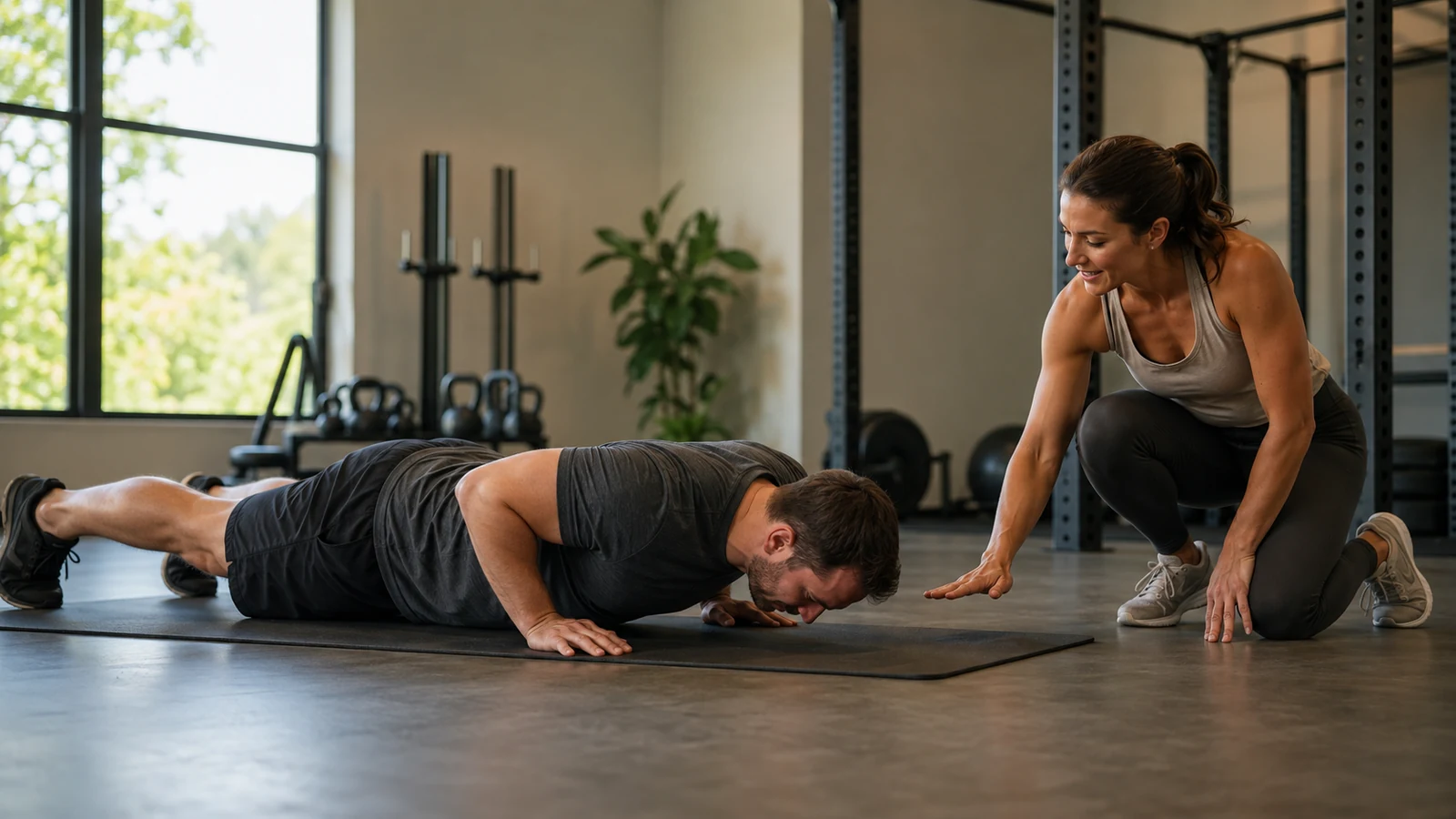
Nobody needs to chase four figures to get real value from this style of training.
Most people benefit from building toward a much smaller, steadier target first.
Anyone with an existing shoulder, wrist, or lower back injury should get medical clearance before starting high-volume burpee training of any kind.
Step 1: Master the standard burpee before adding volume.
A clean burpee, with full control through the squat, plank, and jump, should feel repeatable before speed becomes the goal.
Step 2: Add the full chest to ground lowering phase gradually.
Dropping the chest all the way to the floor on every rep adds real shoulder and chest fatigue that a standard burpee does not.
Step 3: Practice short, timed sets before attempting long ones.
A one or two minute max-effort set teaches pacing on a much smaller, safer scale.
Our breakdown of how pacing changes total output across a full hour covers this same steady-versus-sprint tradeoff in a different movement, and the lesson carries over directly.
Step 4: Build a real aerobic base, not just raw strength.
Because burpee performance correlates so closely with aerobic fitness, dedicated cardio work supports this goal as much as strength training does (Tai et al., 2022).
Step 5: Train recovery between sets on purpose.
Shrinking rest gradually over weeks, not days, builds real muscular endurance rather than just short-term fatigue tolerance.
Step 6: Respect the shoulders and wrists.
The repeated push-up style lowering phase adds real, cumulative load to joints that fatigue faster than most people expect.
Other WorkoutHealthy record profiles show this same pattern of patient, staged progress hiding behind a headline number.
DonnaJean Wilde’s push-up world record came down to the same kind of pacing math, built over years, not weeks.
Edith Connor’s record for oldest competitive female bodybuilder is proof that this kind of disciplined training pays off at almost any age.
Timing caffeine intake before a long training session can offer a small, real edge for some people attempting sustained high-output work, though it is no substitute for the training itself.
Watch the Record
Oregon National Guard Public Affairs filmed Vu’s full hour on the turf at Lancaster Physiq Fitness, with judges and a running timer visible throughout the attempt.
Want more feats like this one explained honestly, records and all? Subscribe to WorkoutHealthy Insider for practical explanations behind popular fitness claims.
References
Haddock, C. K., Poston, W. S. C., Heinrich, K. M., Jahnke, S. A., & Jitnarin, N. (2016). The benefits of high-intensity functional training fitness programs for military personnel. Military Medicine, 181(11 to 12), e1508–e1514. https://doi.org/10.7205/MILMED-D-15-00503
Tai, J. Q. J., Wong, S. F., Chow, S. K. M., Choo, D. H. W., Choo, H. C., Sahrom, S., & Aziz, A. R. (2022). Assessing physical fitness of athletes in a confined environment during prolonged self-isolation: Potential usefulness of the test of maximal number of burpees performed in 3 minutes. International Journal of Environmental Research and Public Health, 19(10), 5928. https://doi.org/10.3390/ijerph19105928
Waldron, M., & Highton, J. (2014). Fatigue and pacing in high-intensity intermittent team sport: An update. Sports Medicine, 44(12), 1645–1658. https://doi.org/10.1007/s40279-014-0230-6
This article is for general information only and is not medical advice. If you have an injury, ongoing pain, or a medical condition, talk to a doctor or physical therapist before you change how you train or eat.