

A full body dumbbell workout you can do in your living room sounds simple, but pairing strength training with a workout that keeps your heart rate up the whole time is a specific approach with real research behind it.
It’s often called body recomposition, building muscle and losing fat during the same stretch of training instead of picking one goal at a time.
What the Workout Does
Trainer Jo, who runs the growwithjo channel, built this workout around short rest periods and strength focused sets that string together with real intent.
She calls this format a Burn workout, and it rotates through arms, back, core, and legs so no muscle group gets skipped in a single session.
What the Research Actually Shows
A 2020 review in the Strength and Conditioning Journal looked at whether trained people can really build muscle and lose fat at the same time (Barakat et al., 2020).
The answer was yes, under the right conditions.
A modest calorie deficit combined with enough protein and resistance training that challenges your muscles can produce both outcomes together, though the pace is usually slower than chasing one goal alone.
The review also found that people newer to resistance training tend to see recomposition happen more easily than very experienced lifters, since untrained muscle responds strongly to almost any consistent stimulus.
Recomposition isn’t a shortcut. It’s what happens when strength training and a modest calorie deficit run at the same time instead of taking turns.
A Second Study: What Higher Protein Adds During a Deficit
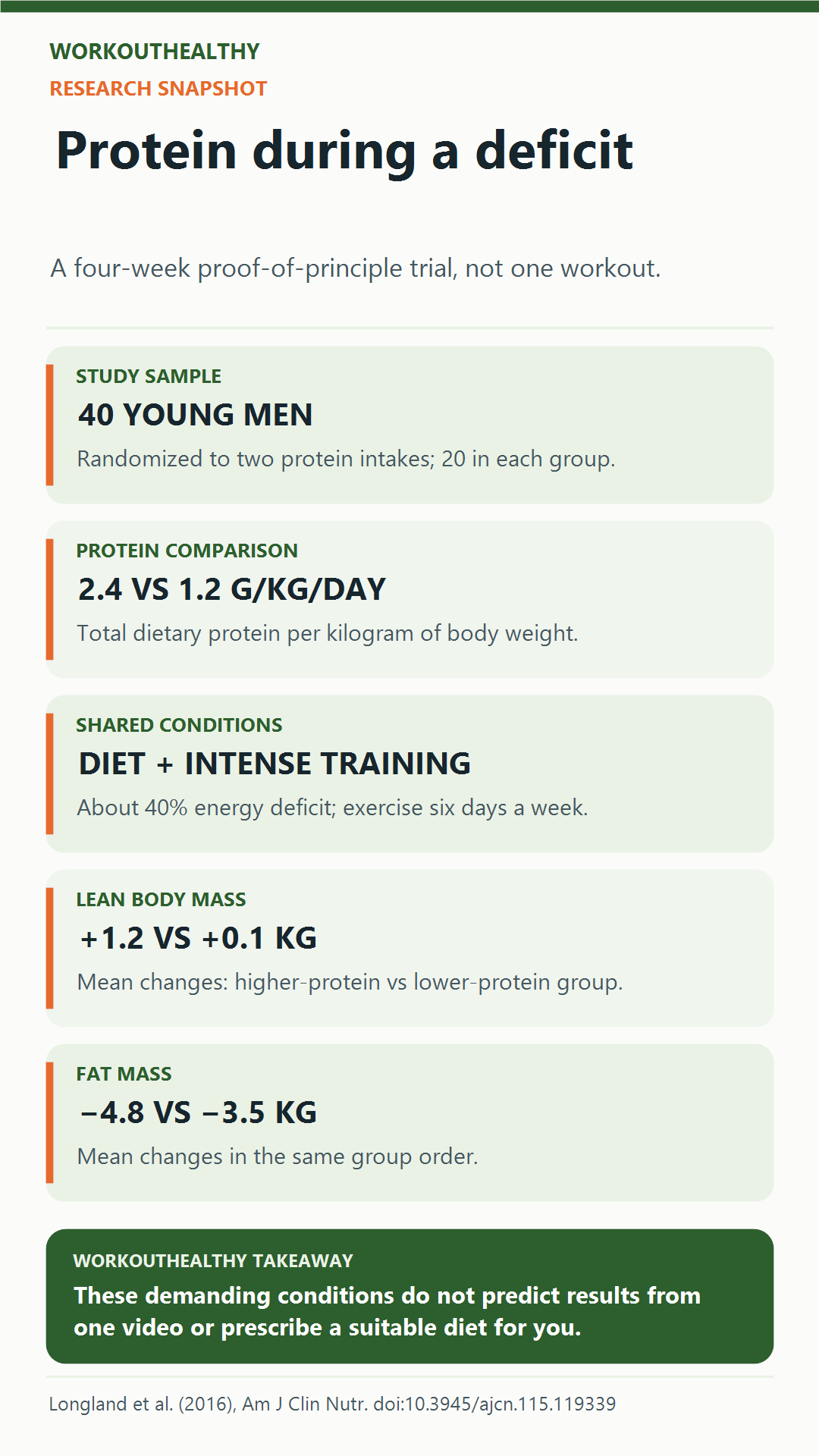
A 2016 trial in The American Journal of Clinical Nutrition tested this idea directly.
Forty young men followed a strict diet and training plan for four weeks.
Everyone trained six days a week with a mix of resistance training and short sprint intervals, and everyone ate about 40 percent fewer calories than they needed to maintain their weight (Longland et al., 2016).
The only real difference between the two groups was protein.
One group ate about 2.4 grams of protein per kilogram of body weight each day.
The other group ate about half that, close to 1.2 grams per kilogram.
By the end of the month, the higher protein group had gained roughly 1.2 kilograms of lean mass while losing about 4.8 kilograms of fat.
The lower protein group lost a similar amount of fat, close to 3.5 kilograms, but barely gained any lean mass at all.
Strength improved by about the same amount in both groups. The real difference showed up in body composition, not in performance.
That result lines up closely with what the Barakat review found.
Recomposition is real, but protein intake is one of the levers that decides how much of it shows up as muscle instead of just weight loss.
Why Short Rest Periods Matter Here
Keeping rest periods short, the way this workout does, raises your heart rate during the strength portion of the session.
That adds a calorie burning, cardio like component on top of the muscle building stimulus from the resistance work itself.
This doesn’t replace dedicated cardio for everyone, but for a time crunched at home workout, it lets one session do double duty.
The Afterburn Effect: What Happens After You Put the Dumbbells Down
The extra calorie burn from a short rest circuit doesn’t stop the moment the workout ends.
After hard exercise, your body keeps using more oxygen than normal for a while as it restores itself.
Researchers call this excess post exercise oxygen consumption, or EPOC, and it’s sometimes nicknamed the afterburn.
A systematic review looked at how different resistance training setups affect the size of this afterburn (Farinatti, Castinheiras Neto, & da Silva, 2013).
It found that shorter rest periods between sets tend to produce a bigger EPOC response than long rests do, and that circuit style training, which is close to what a Burn workout looks like, appears to be one of the more effective ways to raise it.
The review was also clear that EPOC is a real but modest contributor to total calorie burn.
It adds on top of the calories used during the workout itself.
It isn’t a substitute for the exercise, and it isn’t large enough on its own to explain fat loss without the training and diet pieces also being in place.
What This Evidence Does Not Prove
The Barakat review makes a real case for recomposition, but it doesn’t promise the same result for everyone.
Most of the strongest gains happened in people newer to resistance training, whose muscles respond to almost any consistent stimulus.
Someone who has already lifted for years should expect a slower, smaller version of the same effect.
The Longland trial adds useful detail, but it ran for only four weeks and used a large, aggressive calorie deficit in young men who were active but not on a structured lifting program.
That’s a narrow slice of the population, and it doesn’t tell us what happens over six months, in older adults, or at a milder, more sustainable deficit.
Neither study proves that one specific dumbbell workout format, on its own, causes recomposition.
The research supports the underlying combination of resistance training, adequate protein, and a modest deficit.
The workout itself is one reasonable way to deliver the resistance training piece of that formula.
It is not a separately proven intervention on its own.
Getting the Most Out of It
A pair of adjustable or moderately heavy dumbbells is enough to get real strength benefit from a full body circuit like this.
Focus on controlling the weight through a full range of motion rather than rushing through reps just to keep your heart rate up.
Protein intake and consistency across weeks matter more than any single workout, so treat a session like this as one piece of a routine rather than a one time fix.
Common Mistakes That Stall Recomposition
The most common mistake is chasing the scale instead of body composition.
Someone can lose a pound of fat, gain a pound of muscle, and see the scale barely move.
That looks like a stall, but it can actually be the goal working as intended.
A second mistake is cutting calories too hard.
A very large deficit makes it harder for the body to support muscle growth, even with plenty of protein and hard training.
A modest deficit gives the training a real chance to build tissue while fat still comes off, just more slowly.
A third mistake is letting the weights get too light because the workout is fast paced.
Short rest periods should raise your heart rate, not turn the dumbbells into an afterthought.
If you can’t feel real effort in the target muscle by the last few reps of a set, the weight is too light to build much of anything.
Skipping protein at meals outside of workout time is another common gap.
Spreading protein across the whole day, not just around training, is part of what the higher protein group in the Longland trial was doing differently from the group that gained little muscle.

Who Should Check With a Doctor First
Short rest, full body circuits raise your heart rate quickly and keep it elevated through the session.
That’s the point for recomposition, but it also makes the workout more demanding on the cardiovascular system than a slower, traditional lifting session with long rests between sets.
Anyone with a diagnosed heart condition, uncontrolled high blood pressure, or a history of chest pain during exertion should talk to a doctor before starting a format like this.
The same goes for anyone who is pregnant, recovering from a recent surgery, or returning to exercise after a long period of inactivity.
A large, aggressive calorie deficit like the one used in the Longland trial is not appropriate for everyone either.
People with a history of disordered eating, anyone who is underweight, and growing teenagers should not adopt a steep deficit without professional guidance.
The scale can’t tell the difference between a pound of fat and a pound of muscle. A tape measure and a mirror usually tell you more about recomposition than a bathroom scale ever will.
A Closer Look: Technique, Progression, and How to Tell It’s Working
Good form matters even more in a fast paced circuit than in a slow one, because there’s less time between sets to reset your setup.
Before you start, pick a weight for each exercise that lets you complete the prescribed reps with about two reps still left in the tank on the first set.
Keep your spine neutral during compound moves like rows and squats.
Brace your core before you lift, and control the weight on the way down as carefully as you lift it up.
A rushed eccentric, which is the lowering part of a rep, gives away a lot of the muscle building stimulus the exercise is supposed to provide.
Progress the workout by adding small amounts of weight once every set starts to feel like it has more than two or three reps left in reserve.
A jump of 2 to 5 pounds per dumbbell is usually enough for most exercises.
If you can’t add weight yet, add one or two reps to each set instead before you try adding more weight.
Plan for a lighter week every four to six weeks, especially if you’re keeping rest periods short across every session.
Cutting your normal reps or sets by roughly a third for one week gives your joints and nervous system a break without losing the training habit.
You’ll know the format is working if your strength on the main lifts is trending up over several weeks, your clothes fit differently even when the scale is flat, and you can finish the circuit with your heart rate elevated but your form still intact on the last round.
If your reps or weight are dropping most weeks, or if the fast pace is turning every set into sloppy form, the program needs adjusting rather than more effort.
For more on how the numbers add up, see our breakdown of how many calories different workouts actually burn, our look at what lifting weights does for you beyond muscle, and our article on what changes when you swap a bench press for a floor press.
Watch the Original Video
Get the next evidence check. Subscribe to WorkoutHealthy Insider for practical explanations behind popular fitness claims.
References
Barakat, C., Pearson, J., Escalante, G., Campbell, B., & De Souza, E. (2020). Body recomposition: Can trained individuals build muscle and lose fat at the same time? Strength and Conditioning Journal, 42(5), 7 to 21. https://doi.org/10.1519/SSC.0000000000000584
Farinatti, P., Castinheiras Neto, A. G., & da Silva, N. L. (2013). Influence of resistance training variables on excess postexercise oxygen consumption: A systematic review. ISRN Physiology, 2013, 1 to 10. https://doi.org/10.1155/2013/825026
Longland, T. M., Oikawa, S. Y., Mitchell, C. J., Devries, M. C., & Phillips, S. M. (2016). Higher compared with lower dietary protein during an energy deficit combined with intense exercise promotes greater lean mass gain and fat mass loss: A randomized trial. The American Journal of Clinical Nutrition, 103(3), 738 to 746. https://doi.org/10.3945/ajcn.115.119339
This article is for general information only and is not medical advice. If you have an injury, ongoing pain, or a medical condition, talk to a doctor or physical therapist before you change how you train or eat.