
“Best” can describe a preferred task, an immediate measurement or a lasting change. This guide separates those questions before asking how an exercise fits an individual.
The chapter map is a way to find the original discussion, rather than a schedule to complete from top to bottom. Keep the reason for a choice separate from the evidence needed to support a health claim.
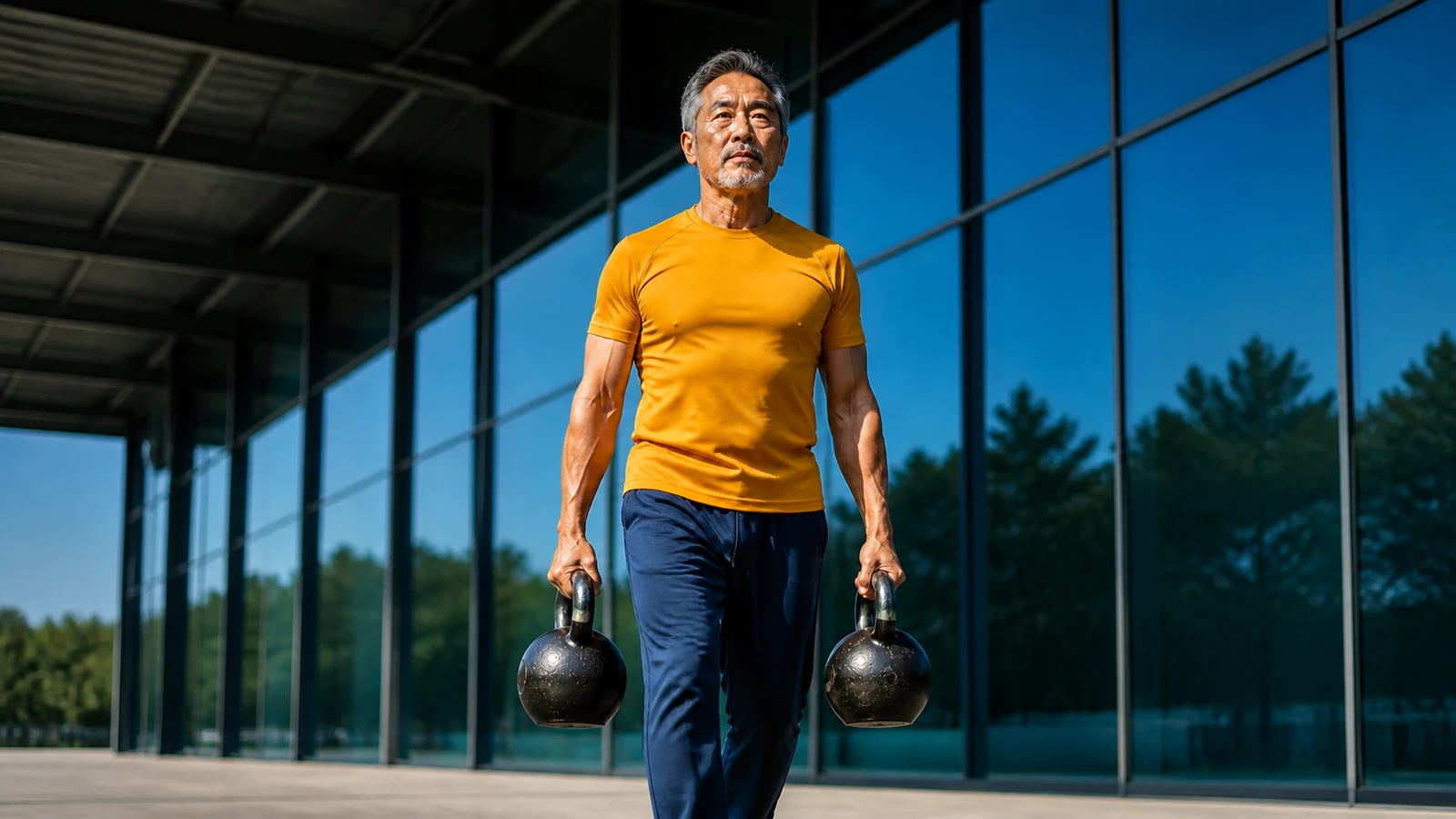
The featured gym scene is illustrative, not an image of the study participants or a demonstration filmed by the video’s presenters.
Top Choice
The farmer’s carry ranked first. Brad avoids it because other exercises suit his back better, and reports pain with side planks.
Rank and Chapter
| Rank | Exercise | Chapter | Task |
|---|---|---|---|
| 10 | Sit-ups | 0:37 | Trunk bending |
| 9 | Crunches | 1:25 | Smaller bend |
| 8 | Russian twist | 1:55 | Rotation |
| 7 | Leg raises | 2:45 | Leg lifting |
| 6 | Isometric V-up | 3:45 | Timed hold |
| 5 | Bear isometric hold | 4:57 | Floor support |
| 4 | Dead bug | 6:32 | Limb control |
| 3 | Side plank | 7:47 | Side support |
| 2 | Mountain climbers | 9:15 | Moving legs |
| 1 | Farmer’s carry | 10:25 | Loaded walking |
Starting Cues
Their starting cue: light, equal weights in both hands; use time or distance.
Keep that source summary separate from deciding a load or target for yourself. Someone who needs a walking aid should not remove needed support to imitate a demonstration.
A painful movement or an unstable walk is a reason to stop and reassess the choice. This article does not supply a fall-rehabilitation program or a test of the heaviest load you can carry.

What the Carry Study Measured
Ellestad and colleagues measured electrical activity in four trunk muscles during loaded carries, static holds and a front plank. Their usable data came from 18 college-aged adults, not seniors followed through a training program (Ellestad et al., 2024).
The bilateral farmer’s carry produced more activity than its matched static hold in all four muscles. Against the front plank, results split: the carry produced more back-muscle activity, while the plank produced more abdominal-muscle activity.
These immediate measurements did not compare all ten ranked movements or establish later strength gains, fewer falls or less back pain. The front plank comparison also differs from the side plank in the video.
A broader systematic review linked some trunk-strength measures with balance and function, but described preliminary intervention evidence (Granacher et al., 2013). It did not establish a farmer’s-carry victory over the other nine choices.
Compare the Task
| Question | What to record |
|---|---|
| What am I choosing? | Name the particular version, position and equipment, rather than only its rank. |
| What do I want to learn? | Separate understanding a demonstration from asking about symptoms, daily tasks or a longer-term goal. |
| What would answer that question? | Identify the relevant observation or discussion before treating a preference as a measured outcome. |
For another professional perspective, Harvard Health’s interview with physical therapist Marty Boehm highlights bridges, modified planks and opposite arm-and-leg raises. That different shortlist reinforces why a named ranking should not become a universal rule (Harvard Health Publishing, 2021).
A movement name alone leaves practical questions unanswered. Ask about the setup, getting into and out of position, needed support and the purpose of choosing that version.
Keep a Clear Record
When discussing an exercise you have already used, describe the version, any load, the time or repetitions, and how it felt during and afterward. A record of what happened is clearer than saying you completed the number-one exercise.
With osteoporosis, an injury, ongoing pain, a balance disorder or difficulty transferring to the floor, get advice about the particular movements and loads that fit you. Age alone does not make every listed movement equally appropriate.
Use the record to ask a focused question, not to diagnose the reason for a symptom. A general article cannot decide an individual exercise modification.
For related aerobic activity, our guide to how many miles to walk a day shows how pace and time inform walking goals. Plan those walks and loaded carries as separate tasks with their own demands.
References
Ellestad, S. H., Holcomb, T. P., Swiergol, A. M., Holmstrup, M. E., & Dicus, J. R. (2024). The quantification of muscle activation during the loaded carry movement pattern. International Journal of Exercise Science, 17(1), 480 to 490. https://digitalcommons.wku.edu/ijes/vol17/iss1/7/
Granacher, U., Gollhofer, A., Hortobágyi, T., Kressig, R. W., & Muehlbauer, T. (2013). The importance of trunk muscle strength for balance, functional performance, and fall prevention in seniors: A systematic review. Sports Medicine, 43(7), 627 to 641. https://doi.org/10.1007/s40279-013-0041-1
Harvard Health Publishing. (2021, April 1). The best core exercises for older adults. https://www.health.harvard.edu/healthy-aging-and-longevity/the-best-core-exercises-for-older-adults
Original Video
Reviewed complete automatic captions and selected frames; continuous audiovisual review incomplete.
Subscribe to WorkoutHealthy Insider for practical explanations behind popular fitness claims.
Medical disclaimer: This article is general fitness information, not medical advice. If you have an injury, ongoing pain or a medical condition, talk to a doctor or physical therapist before changing how you train.