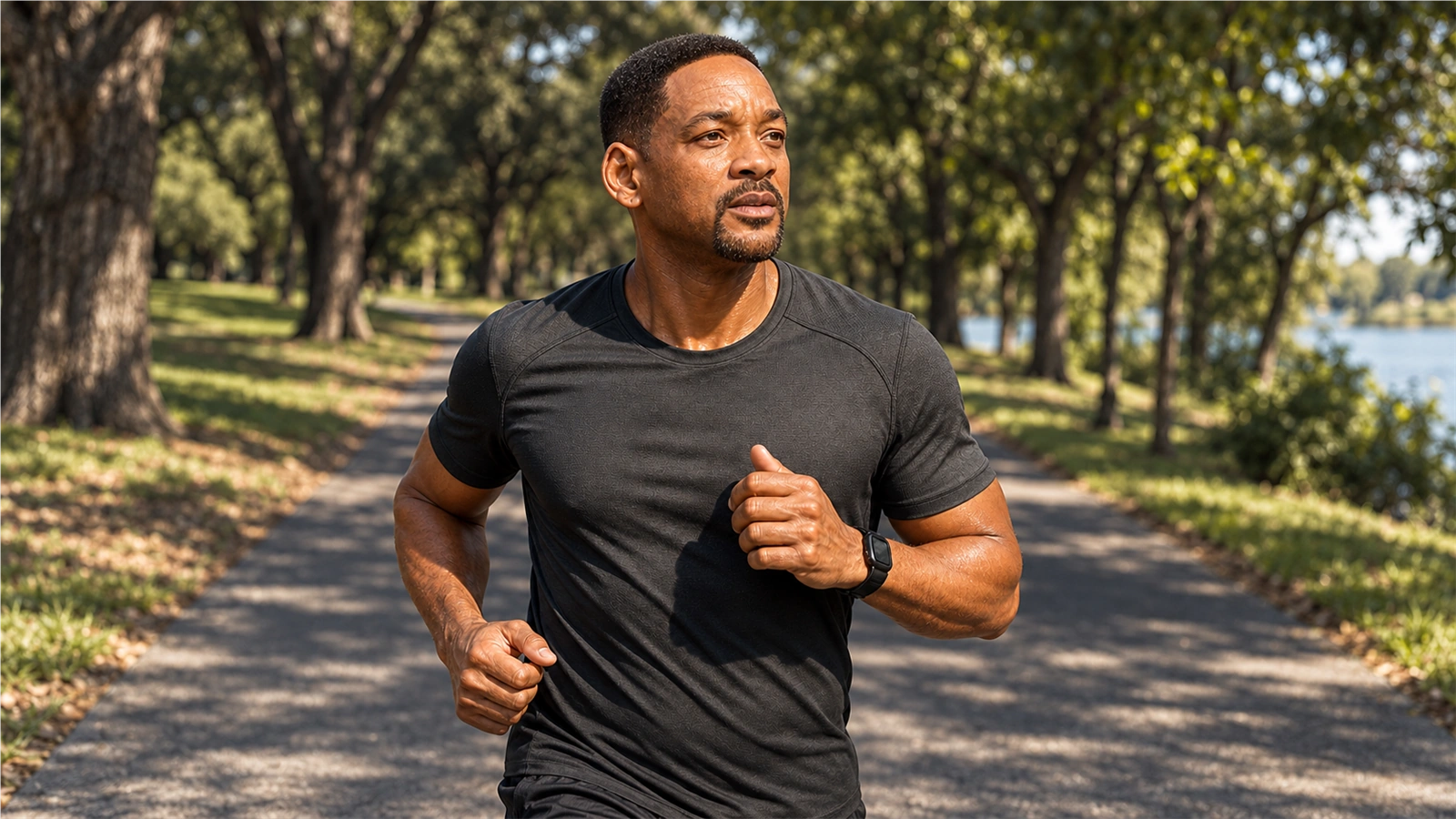

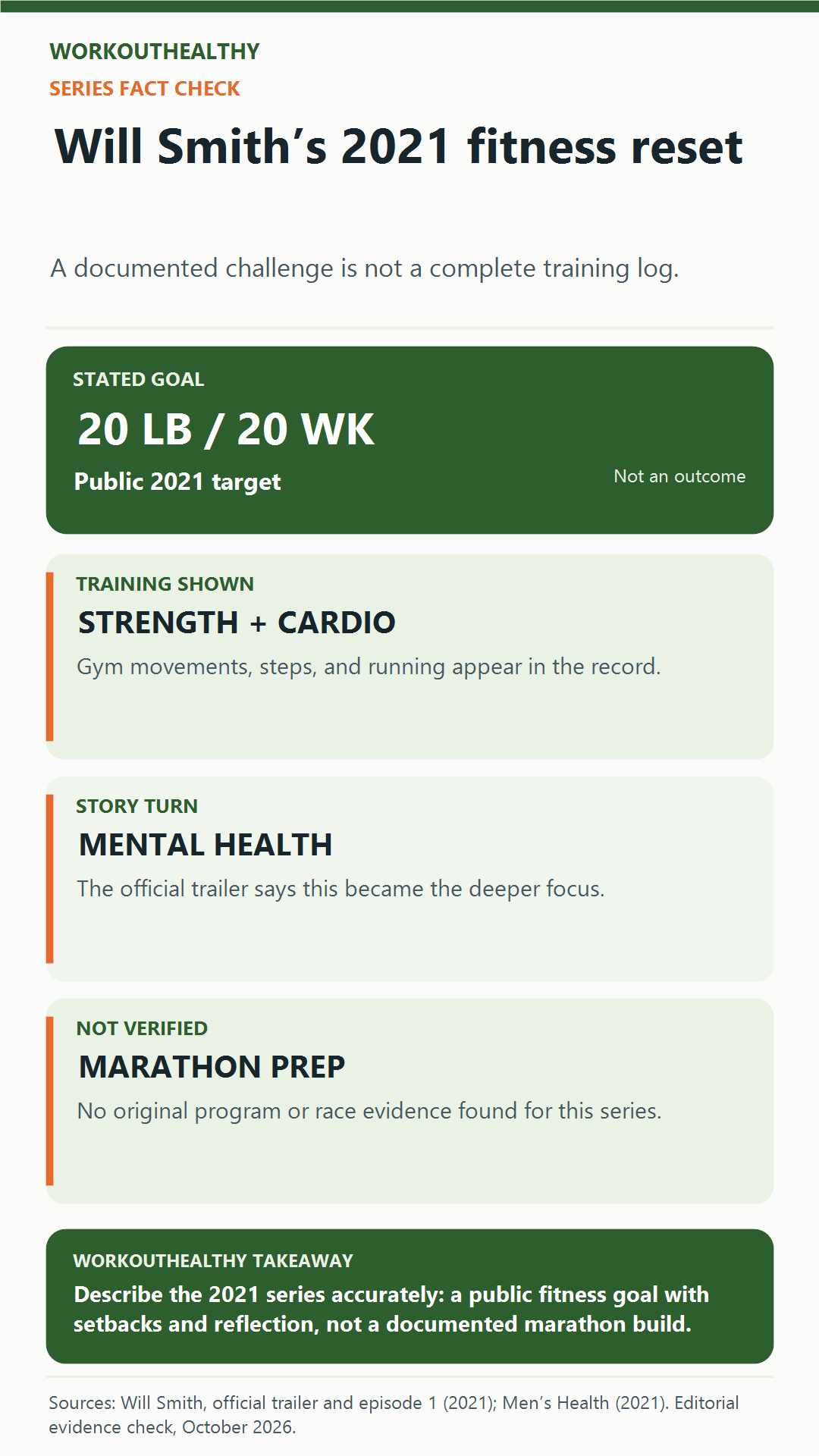
Will Smith made his 2021 fitness reset unusually public. At 52, he announced a goal to lose 20 pounds over 20 weeks while also finishing his memoir. The project became the six-part YouTube series Best Shape of My Life. It showed training, setbacks, and conversations that moved far beyond a before-and-after photo.
A social post about the series says Smith combined strength work with marathon training. The strength and running are visible in contemporary coverage, but a marathon program is not established by the series material reviewed here. That distinction matters: a documented 5K target or regular morning cardio is not the same as preparing for 26.2 miles. Here is what the primary series actually supports, what remains uncertain, and what a regular reader can take from it without copying a celebrity timetable.
The 20-week challenge was a goal, not a guaranteed result
The official series trailer framed the project as an effort to lose 20 pounds in 20 weeks and complete Smith’s memoir. The first episode, “Can Will Smith Lose 20lbs in 20 Weeks?”, opened with that target and the practical difficulty of fitting it around work and writing. The stated number was a target for the show, not proof that every week progressed smoothly.
That is a more useful story than a clean transformation graph. Weight can fluctuate over days for reasons unrelated to fat change, and a target written at the start of a project does not tell us what happened on any particular morning. Contemporary coverage of the first episode noted an early week when Smith’s scale weight rose despite substantial training. The episode’s value is the visible adjustment and conversation that followed, not a claim that hard work always produces a predictable weekly number.
Smith was 52 when he announced the project in May 2021. He turned 53 before the series premiered in November. Keeping those dates straight avoids making his age part of a misleading “overnight” narrative. This was a months-long production following a person with coaches, filming demands, and other professional support.
What training can actually be documented?
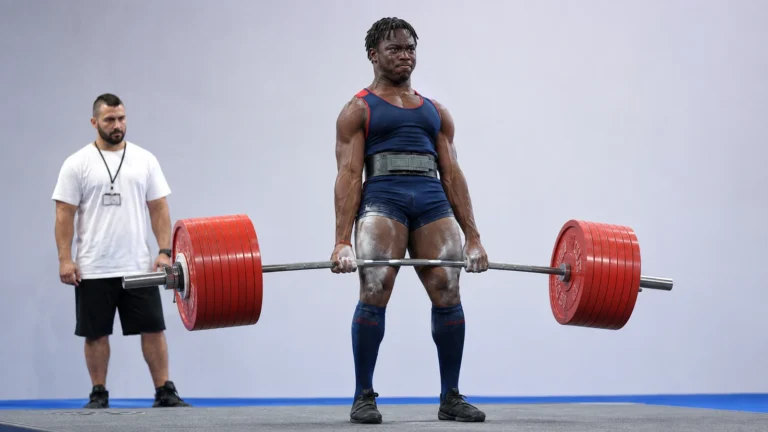
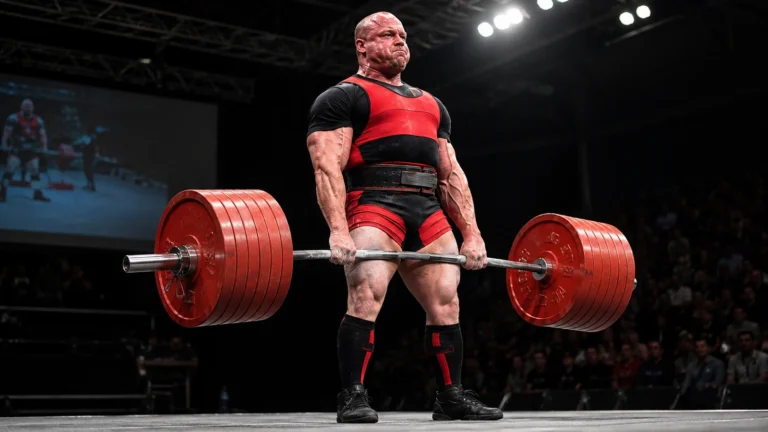
Smith’s public workout montage showed conventional gym movements, including squats, leg presses, rows, shoulder presses, and pulldowns, as described by Men’s Health’s 2021 account of his shared footage. These are not secret celebrity methods. They are variations of lower-body pushing, upper-body pulling, and pressing that many ordinary strength programs also contain.
The first episode introduced trainer Aaron Ferguson and emphasized cardio as part of the routine. Ferguson later described a daily step challenge, while contemporary reporting described a 5K time target. A timed 5K is a specific, shorter running goal; it does not establish marathon preparation. We have not found an original episode, training log, race entry, or statement from Smith documenting a marathon build as part of this 2021 project. The article therefore does not repeat that portion of the social caption as fact.
The combination of resistance work and aerobic activity is entirely plausible and broadly useful. Yet the public clips do not provide a complete weekly program: we cannot infer exact sets, loads, progression, recovery days, or total running mileage from a montage. Those missing details make it impossible to prescribe “Smith’s routine” faithfully to someone else.
Why the early setbacks matter more than the montage
The series documented a mismatch between effort and expectation. It is tempting to treat a hard workout as a guarantee that the next weigh-in will be lower. Bodies do not work on that schedule. A single measurement mixes normal shifts in water, food, and other short-term factors with any longer-term change. That is why a week of training should be evaluated with more than one data point.
For a reader building a sustainable plan, the better questions are practical. Did you complete the sessions you meant to complete? Can you repeat them next week? Are your technique and recovery allowing gradual progress? Is the plan compatible with sleep, work, and family? Smith’s public frustration is a reminder that even a well-resourced project can collide with ordinary limits.
The documentary also showed how multiple ambitions can compete for the same attention. Smith was trying to train and write a memoir under a public deadline. Time spent in one demanding pursuit is not automatically available for the other. A schedule that looks impressive in a trailer may still feel unsustainable from the inside.
The show ultimately became a mental-health story
The official trailer explicitly says that Smith came to view his mental health as the part of the project most in need of attention. Later episodes brought personal and family conversations into the foreground. That is a description of what the series presents, not a diagnosis or a claim that exercise treats a particular mental-health condition.
This shift changes the meaning of “best shape.” The program began with a body-weight target and visible workouts, then widened into questions about pressure, identity, and what success was supposed to feel like. Reducing it to a physique reveal misses the central turn the creators themselves advertised.
Exercise can support well-being for many people, but a workout plan is not a substitute for mental-health care when someone needs it. Nor should a viewer infer that a celebrity’s filmed conversations provide a template for their own treatment. The practical lesson is narrower: a physical target can be worth pursuing while still being revised if the process is damaging other parts of life.
What a non-celebrity can borrow after 50
You do not need a camera crew or a 20-week challenge to combine strength and cardio. The current U.S. adult activity guidance calls for at least 150 minutes of moderate-intensity aerobic activity each week plus muscle-strengthening activity on two days. Someone who is inactive can begin with smaller amounts and build gradually; the guideline is a destination, not a first-week test.
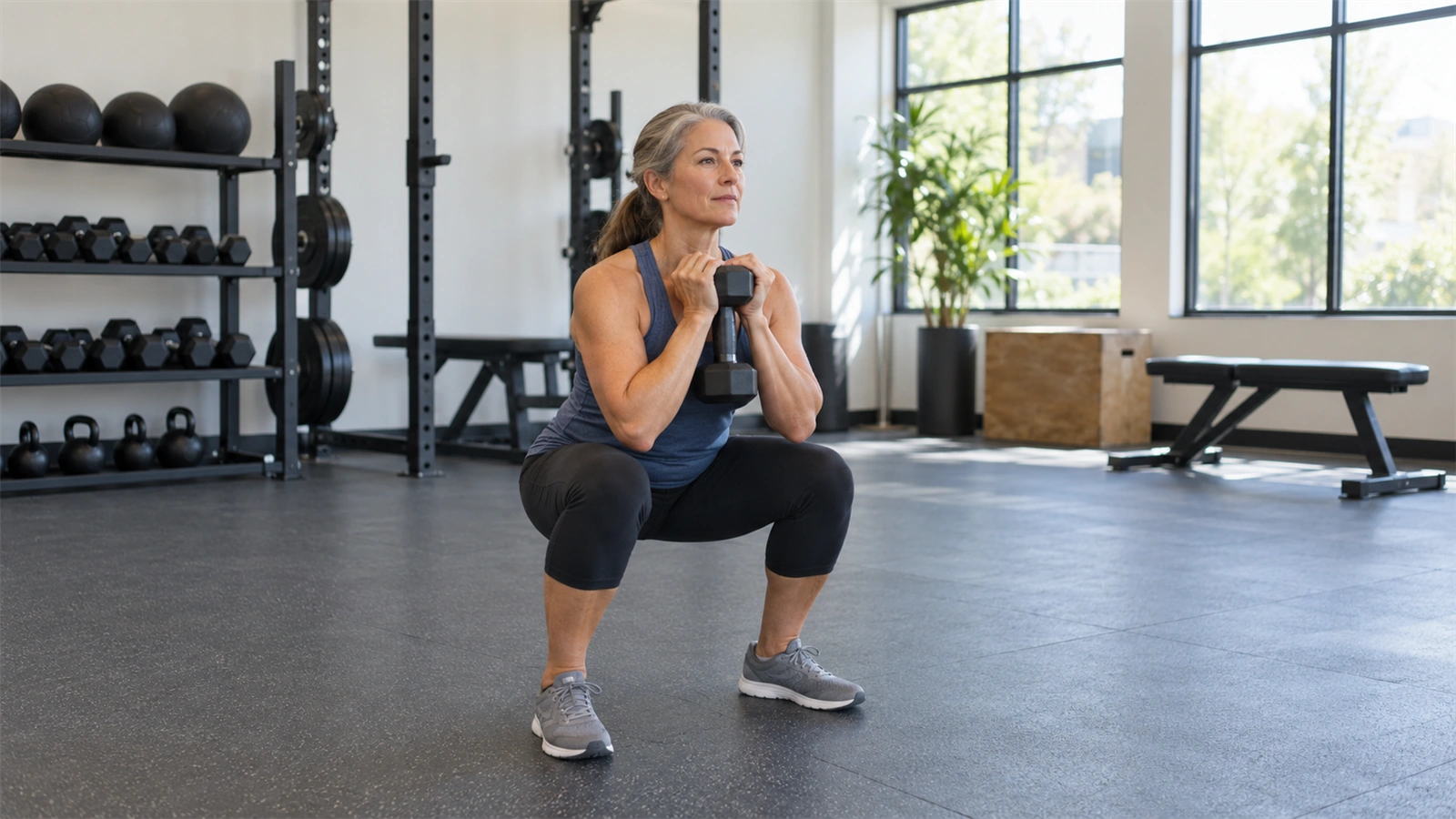
Choose movements you can perform with control. A first strength day might include a sit-to-stand or squat variation, a hip hinge, a push, a pull, and a carry or other trunk task. Keep the initial dose manageable enough that you can return to it. Progress can mean an extra repetition, a slightly longer walk, a modest load increase, or simply better control at the same level. None of those requires chasing exhaustion.
For cardio, a brisk walk is a legitimate start. If running appeals to you and your joints tolerate it, short run-walk intervals can build toward a 5K without pretending that every 5K plan is a marathon plan. People with heart disease, significant joint symptoms, or other relevant conditions should discuss a new vigorous program with a clinician. The CDC specifically advises that previously inactive adults with certain health conditions check before jumping into vigorous activity.
A reader can also borrow the series’ willingness to inspect the process. If the plan is so demanding that it crowds out sleep or becomes impossible to repeat, make it smaller. A sustainable schedule is more valuable than a dramatic first week followed by nothing.
A realistic three-check framework
Check 1: Is the claim documented? When a social caption names a celebrity routine, look for an original training log, interview, or episode before copying it. Smith’s series documents a 20-week weight-loss goal, resistance exercise, cardio, and a mental-health turn. It does not, on the sources checked here, document marathon training.
Check 2: Is the dose yours? A public figure’s footage shows what was interesting to film, not the minimum amount required for health. Start from your own baseline. Two repeatable strength days and gradually accumulated aerobic activity are more defensible than imitating a montage with unknown recovery and coaching.
Check 3: Is the plan improving your life? Track outcomes that matter beyond one scale reading: sessions completed, walking or running comfort, strength on a familiar movement, energy, and whether the routine still fits your week. If one metric rises while the rest of life deteriorates, revisit the goal rather than treating the goal as sacred.
Those checks are an editorial framework, not Smith’s stated program. They make the documentary useful without pretending we possess an unpublished celebrity blueprint.
What remains uncertain
The available public footage and reporting do not disclose Smith’s full periodized training plan, medical history, calorie targets, or coaching decisions. They also do not prove which individual component caused any change shown on screen. A filmed series is a curated account of a person’s experience, not a controlled study of an exercise intervention.
The show’s weight-loss target should not be turned into a universal recommendation. An appropriate goal depends on health status, preferences, starting point, and the reason a person is training. The same caution applies to claims about a particular body shape at a particular age. Good training is not measured only by resemblance to a celebrity image.
The bottom line
Will Smith publicly pursued a 20-pound, 20-week goal at 52, trained with strength and cardio work, and let viewers see setbacks as well as progress. His own series then made mental health a central part of the story. The available primary material does not substantiate the social post’s marathon-training label; documented running and a 5K challenge should be described on their own terms.
For readers, the useful takeaway is not an exact celebrity routine. It is to build a repeatable mix of strength and aerobic work, check claims against original sources, and allow a goal to change when the process reveals a more important need.
References
- Will Smith. The Best Shape of My Life: Official Trailer. YouTube, 2021.
- Will Smith. Can Will Smith Lose 20lbs in 20 Weeks? Episode 1, YouTube, November 8, 2021.
- Men’s Health. Will Smith Shared a Workout Montage Showing Off His Weight Loss. May 2021.
- Men’s Health. Exclusive clip from Best Shape of My Life. November 2021.
- Men’s Fitness. Will Smith’s Best Shape of My Life: What We Learned. 2021.
- Centers for Disease Control and Prevention. Adding Physical Activity as an Adult. Updated December 2025.
This article is for general information only and is not medical or mental-health advice. If you have an injury, ongoing pain, or a medical condition, ask a qualified clinician about changes to exercise or care.