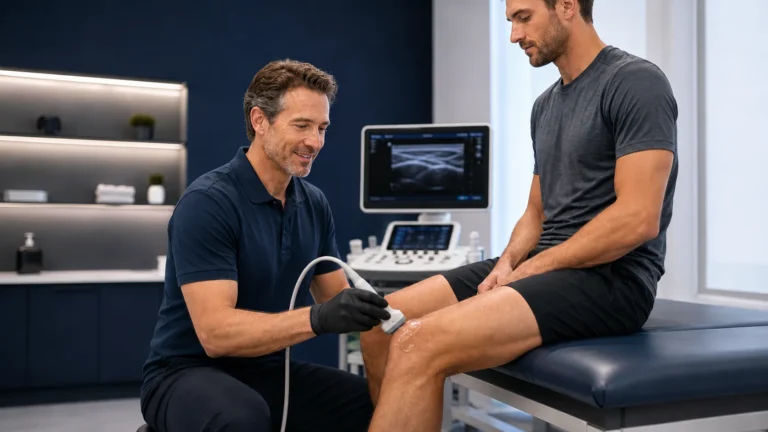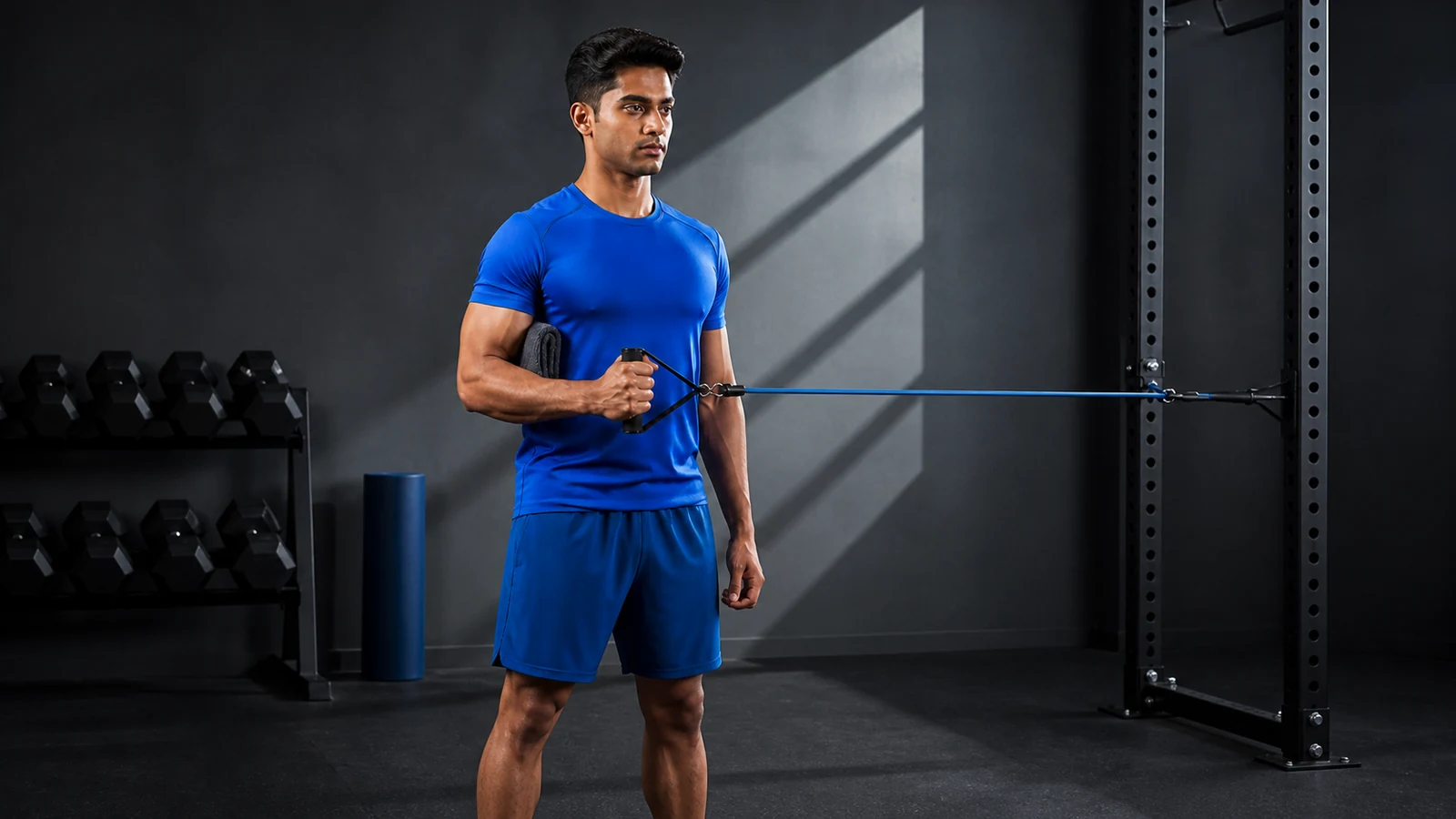

Biceps tendinitis is a common complaint among people who lift weights, throw, swim, or work overhead.
The word gets used loosely online.
Sometimes it means true inflammation.
Other times it means a tendon that broke down slowly, without ever feeling hot or swollen.
A YouTube video from a creator named Karthik Rajendran walks viewers through a set of rehabilitation exercises for this exact problem.
This article checks that video’s general approach against the actual published research on tendon injury and tendon repair.
It also looks honestly at how much of that research is specific to the biceps tendon itself, versus borrowed from tendon studies done elsewhere in the body.
What the Video Claims
The video is titled “Biceps Tendinitis Rehabilitation Exercises.”
It presents a series of movements meant to help someone recover from biceps tendon pain, generally framed around gradually reloading the tendon rather than resting it completely.
That general framing, gradual loading instead of full rest, lines up with the direction tendon research has moved over the last three decades.
We could not verify specific medical credentials for Karthik Rajendran.
The channel that hosts the video is called KPN Kudumbam, a name that uses the Tamil word for family.
YouTube’s own channel data confirms the creator’s name and the channel handle.
The channel’s about page did not list any stated professional title, license, or clinical credential in the sources we could check.
That does not mean the creator lacks training.
It means we could not independently confirm one, so readers should treat the video as general fitness content rather than confirmed clinical advice from a licensed provider.
The exercise approach itself is worth examining on its own merits, separate from who presents it.
What Real Research Shows About the Causes
Biceps tendinitis usually refers to the long head of the biceps tendon, which runs through a groove at the front of the shoulder before attaching inside the joint.
That location matters.
The tendon sits right next to the rotator cuff, and problems in one area often show up alongside problems in the other.
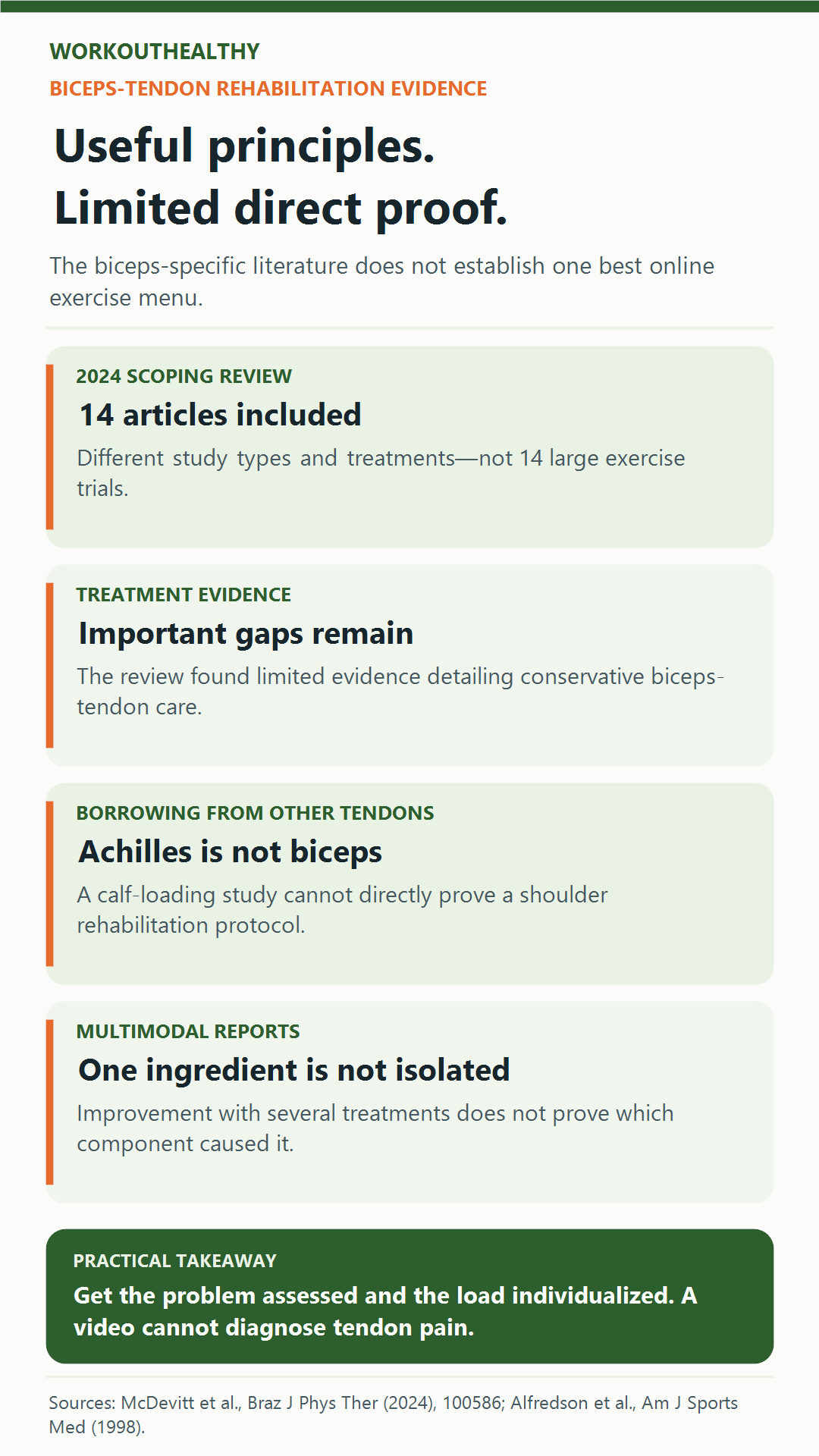
A 2024 scoping review looked at what physical therapy interventions researchers have actually studied for biceps tendinopathy (McDevitt et al., 2024).
The reviewers found real evidence gaps.
Most published work on biceps tendon pain is small case series and case reports, not large controlled trials.
That is an honest limitation of this specific area of research, and it is worth saying plainly rather than papering over.
The tendon can become painful from repeated overhead motion, from sudden heavy loading it was not prepared for, or simply from years of cumulative use.
Distal biceps tendon pain, at the elbow rather than the shoulder, tends to show up more in people who do repeated heavy lifting or gripping (Holshouser & Jayaseelan, 2020).
Most of what researchers know about treating biceps tendon pain comes from small case reports, not large trials, and that gap is worth naming honestly rather than glossing over.
What Real Research Shows About Eccentric Loading
Eccentric loading means lengthening a muscle under tension, like slowly lowering a weight instead of just lifting it.
This idea did not start with biceps research.
It started with the Achilles tendon.
A landmark 1998 study put patients with chronic Achilles tendon pain through twelve weeks of heavy, slow eccentric calf training (Alfredson et al., 1998).
The results were striking for their time.
All fifteen patients in that eccentric group returned to their previous running activity, while a comparison group treated the conventional way at that time mostly ended up needing surgery.
That single study helped shift tendon rehabilitation away from rest and toward controlled loading across the whole field, not just the Achilles.
Biceps-specific eccentric work exists too, though on a much smaller scale.
One case report described a volleyball player with proximal biceps tendon pain who improved using eccentric training with a kettlebell alongside taping (Jaiswal et al., 2024).
A separate case series combined eccentric-concentric exercise with dry needling and stretching for people with chronic bicipital tendon pain.
Patients in that series reported meaningful improvement (McDevitt et al., 2020).
One case series is not proof that eccentric loading is the single best approach for every biceps tendon problem.
It is early, real evidence pointing in a consistent direction with the broader tendon literature.
What Real Research Shows About Progressive Tendon Loading Protocols
Eccentric-only loading was an early breakthrough, but the field has moved further since 1998.
Later research compared pure eccentric protocols against combined concentric and eccentric loading, sometimes finding similar outcomes between the two approaches for Achilles tendon pain.
The bigger shared idea across nearly all of this newer work is progressive loading itself.
Start light, add load gradually, and let the tendon adapt at its own pace rather than rushing it.
Researchers describe tendinopathy as sitting somewhere on a continuum (Cook & Purdam, 2009).
It moves from a reactive, irritated state toward more structural tissue changes if the tendon keeps getting overloaded without enough recovery.
Where a person’s tendon sits on that continuum should change how aggressively they load it.
An early, reactive tendon generally needs a gentler entry point than one that has been painful for years.
This is part of why generic exercise lists, biceps-specific or otherwise, can only go so far without some way to judge how irritated the tendon currently is.
Our piece on what the research actually shows about lifting weights covers a similar theme.
Gradual, well-dosed loading tends to outperform either total rest or doing too much too soon.
What Real Research Shows About Combining Approaches
Exercise alone is rarely the entire treatment plan in the studies that exist.
The 2020 case series that used dry needling alongside eccentric-concentric exercise and stretching is one example of a multimodal approach (McDevitt et al., 2020).
The overhead athlete case report used a staged plan too (Holshouser & Jayaseelan, 2020).
It started with isometric holds, moved into eccentric loading, then concentric strength work, and finally sport-specific plyometric movement.
That staged structure, isometric first, then eccentric, then concentric, then more dynamic work, shows up again and again in tendon rehabilitation research generally, not just for the biceps.
None of these are large randomized trials.
They are detailed accounts of individual patients improving under a clinician’s care, which is a real form of evidence, just a more limited one than a controlled trial.
This staged, gradual structure shows up in joint recovery well beyond the biceps tendon too.
Our piece on returning to training after a major joint procedure describes a similar pattern.
People tend to do best easing back in stages, rather than jumping straight to full intensity.
A Five-Part Whole-Shoulder Framework
The Facebook post mentions rotator cuff, shoulder-blade, mid-back and core work. Here is a five-part way to discuss those pieces with a physical therapist, not a fixed protocol or proof that every exercise belongs in every case.
- Confirm what hurts. Pain at the front of the shoulder can overlap with rotator cuff or other shoulder problems. A clinician can distinguish proximal biceps symptoms from an elbow-side tendon problem, a tear, or referred pain before choosing exercises.
- Adjust the provoking load. Reduce movements that repeatedly flare symptoms without stopping all comfortable activity. The 2022 expert Delphi study included activity and load modification, but it did not test one universal dose (McDevitt et al., 2022).
- Rebuild shoulder and shoulder-blade capacity. A clinician may use light band external rotation and scapular strengthening when assessment finds those deficits. The 2024 scoping review describes such multimodal approaches, while emphasizing that direct biceps-specific trials remain limited (McDevitt et al., 2024).
- Address mobility and trunk work only when relevant. Thoracic spine mobility work may be useful for someone with restricted motion; a Pallof press is one optional trunk exercise. Neither a stiff mid-back nor weak core has been shown to be a universal cause of biceps tendinopathy, and no study here proves that the Pallof press treats it.
- Progress tendon loading and the return to the task. Start with a tolerable level, then work toward controlled biceps resistance and eventually the person’s lifting or sport demands. The exercise selection, pain response, progression and return criteria should be individualized rather than copied from a video.
The five parts describe a decision process, not five exercises to perform today. Persistent pain, a sudden pop, visible deformity or major strength loss warrants professional evaluation.
Watch the video
The Mechanism
Tendons are mostly collagen, arranged in a rope-like structure built to handle tension.
Healthy loading, done in the right dose, appears to stimulate the tendon’s cells to produce and reorganize that collagen (Magnusson et al., 2010).
Too little load, and the tendon does not get the stimulus it needs to remodel and strengthen.
Too much load, especially too suddenly, can outpace the tissue’s ability to repair itself.
Repeated overload without enough recovery time is thought to push the tendon further along that pathology continuum mentioned earlier (Cook & Purdam, 2009).
Eccentric loading specifically may work in part because of the lengthening phase of the movement.
That phase creates real tension through the tendon without adding as much joint compression as some other movement patterns.
That is a proposed mechanism, not a fully settled fact.
Researchers still debate exactly why eccentric loading helps as much as it seems to in some tendons.
What This Evidence Does Not Prove
This is the section where honesty matters most.
The research on biceps tendinopathy specifically is thin.
Most of it is case reports and small case series, not the large randomized controlled trials that exist for the Achilles or the patellar tendon (McDevitt et al., 2024).
A case report describes what happened to one person under one clinician’s care.
It cannot tell us how a typical person, with a different injury history and different tissue, would respond to the same plan.
The 1998 Achilles study, while genuinely influential, was also small, with fifteen people in the treatment group (Alfredson et al., 1998).
Applying findings from the Achilles tendon directly to the biceps tendon assumes the two structures behave the same way under load.
That assumption is reasonable given what is known about tendon biology in general, but it is still an assumption, not a proven fact specific to the biceps.
None of this research proves that any single YouTube video’s specific exercise selection, sets, or reps are the ideal protocol for a given person’s biceps tendon.
General principles from the literature are on solid ground.
Specific exercise menus, without an in-person assessment, are not something the current evidence can fully validate.
Common Mistakes
Complete rest is one common mistake.
Full rest can calm pain short term, but tendons that never get loaded again tend to stay weak and can flare right back up once normal activity resumes.
The opposite mistake is just as common.
Pushing straight back into heavy pressing, curling, or overhead work as soon as pain drops a little is risky.
Without a gradual buildup, that is a fast way to reinjure an already irritated tendon.
Skipping the isometric or light-load starting phase is another frequent error.
Jumping straight to heavy eccentric work before the tendon can tolerate any load at all often backfires.
People also tend to judge progress purely by pain, rather than by pain combined with actual strength and function.
A tendon can feel quiet at rest while still being far from ready for a heavy lift.
Another mistake is ignoring the shoulder and scapula entirely and only working the tendon in isolation.
Weakness or poor mechanics upstream often contributed to the problem in the first place.
Readers who already favor structured strength training, and most of our readers do, are exactly the population most likely to push back into full loading too quickly out of habit.
Who Should Be Extra Careful
Anyone with sudden, severe shoulder pain after a specific incident should see a doctor before trying any rehabilitation exercise.
A sudden pop, a visible deformity in the upper arm, or a dramatic loss of strength can signal a tendon rupture rather than simple tendinitis.
That is a different injury with a different treatment path.
People with diabetes should also be cautious, since diabetes is associated with slower tendon healing and a higher rate of tendon problems generally.
Anyone on long-term corticosteroid use, or with a history of a steroid injection into the same tendon, should check with a doctor first.
Both are linked to weaker tendon tissue.
Older adults and anyone with a prior rotator cuff tear should be evaluated carefully too, given how closely the biceps tendon sits to the rotator cuff.
Pain that keeps getting worse despite several weeks of a sensible loading program is a signal to get a professional assessment rather than pushing through it alone.
This applies whether the exercises came from a video, an article like this one, or anywhere else online.
A Practical Takeaway
Start with pain-free or nearly pain-free movement, not maximum range or maximum load on day one.
Isometric holds, simply holding the arm still under light tension, are a common and reasonable starting point in the research reviewed here.
From there, progress to slow, controlled eccentric movement before adding heavier concentric lifting back in.
Track more than pain.
Track strength, range of motion, and how the shoulder feels the next morning, not just how it feels mid-set.

Give the plan real time.
The studies referenced here used programs lasting weeks to months, not days.
Consider the shoulder as part of a whole system rather than an isolated joint, since scapular strength and posture both influence how much load the biceps tendon ends up absorbing.
If pressing movements aggravate the shoulder during this process, a shorter range of motion may help.
Our comparison of the floor press and the bench press covers similar tradeoffs, and a variation like that may be more tolerable while the tendon settles down.
Finally, get an actual diagnosis before assuming any shoulder or elbow pain is tendinitis, since several other shoulder problems can feel similar from the outside.
A physical therapist or sports medicine doctor can confirm the diagnosis and help set a loading dose that matches where the tendon currently sits on that continuum.
Want more like this? Subscribe to WorkoutHealthy Insider for practical explanations behind popular fitness claims.
References
McDevitt, A. W., Cleland, J. A., Addison, S., Calderon, L., & Snodgrass, S. J. (2022). Physical therapy interventions for the management of biceps tendinopathy: An international Delphi study. International Journal of Sports Physical Therapy, 17(4), 677 to 694. https://doi.org/10.26603/001c.35256
Alfredson, H., Pietilä, T., Jonsson, P., & Lorentzon, R. (1998). Heavy-load eccentric calf muscle training for the treatment of chronic Achilles tendinosis. The American Journal of Sports Medicine, 26(3), 360 to 366. https://doi.org/10.1177/03635465980260030301
Cook, J. L., & Purdam, C. R. (2009). Is tendon pathology a continuum? A pathology model to explain the clinical presentation of load-induced tendinopathy. British Journal of Sports Medicine, 43(6), 409 to 416. https://doi.org/10.1136/bjsm.2008.051193
Holshouser, C., & Jayaseelan, D. J. (2020). Multifaceted exercise prescription in the management of an overhead athlete with suspected distal biceps tendinopathy: A case report. Journal of Functional Morphology and Kinesiology, 5(3), 56. https://doi.org/10.3390/jfmk5030056
Jaiswal, P. R., Ramteke, S. U., & Tikhile, P. (2024). Rehabilitation with eccentric training using kettlebell and kinesio taping in a young volleyball player with proximal biceps tendinopathy: A case report. Cureus, e62887. https://doi.org/10.7759/cureus.62887
Magnusson, S. P., Langberg, H., & Kjaer, M. (2010). The pathogenesis of tendinopathy: Balancing the response to loading. Nature Reviews Rheumatology, 6(5), 262 to 268. https://doi.org/10.1038/nrrheum.2010.43
McDevitt, A. W., Snodgrass, S. J., Cleland, J. A., Leibold, M. B. R., Krause, L. A., & Mintken, P. E. (2020). Treatment of individuals with chronic bicipital tendinopathy using dry needling, eccentric-concentric exercise and stretching; a case series. Physiotherapy Theory and Practice, 36(3), 397 to 407. https://doi.org/10.1080/09593985.2018.1488023
McDevitt, A. W., Young, J. L., Cleland, J. A., Hiefield, P., & Snodgrass, S. J. (2024). Physical therapy interventions used to treat individuals with biceps tendinopathy: A scoping review. Brazilian Journal of Physical Therapy, 28(1), 100586. https://doi.org/10.1016/j.bjpt.2023.100586
This article is for general information only and is not medical advice. If you have an injury, ongoing pain, or a medical condition, talk to a doctor or physical therapist before you change how you train or eat.