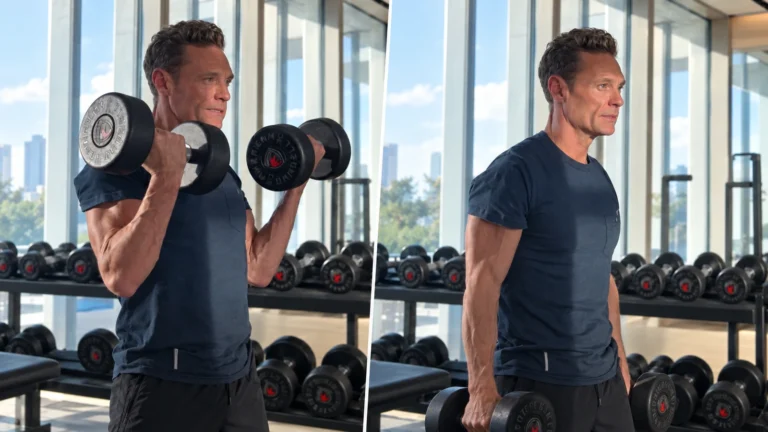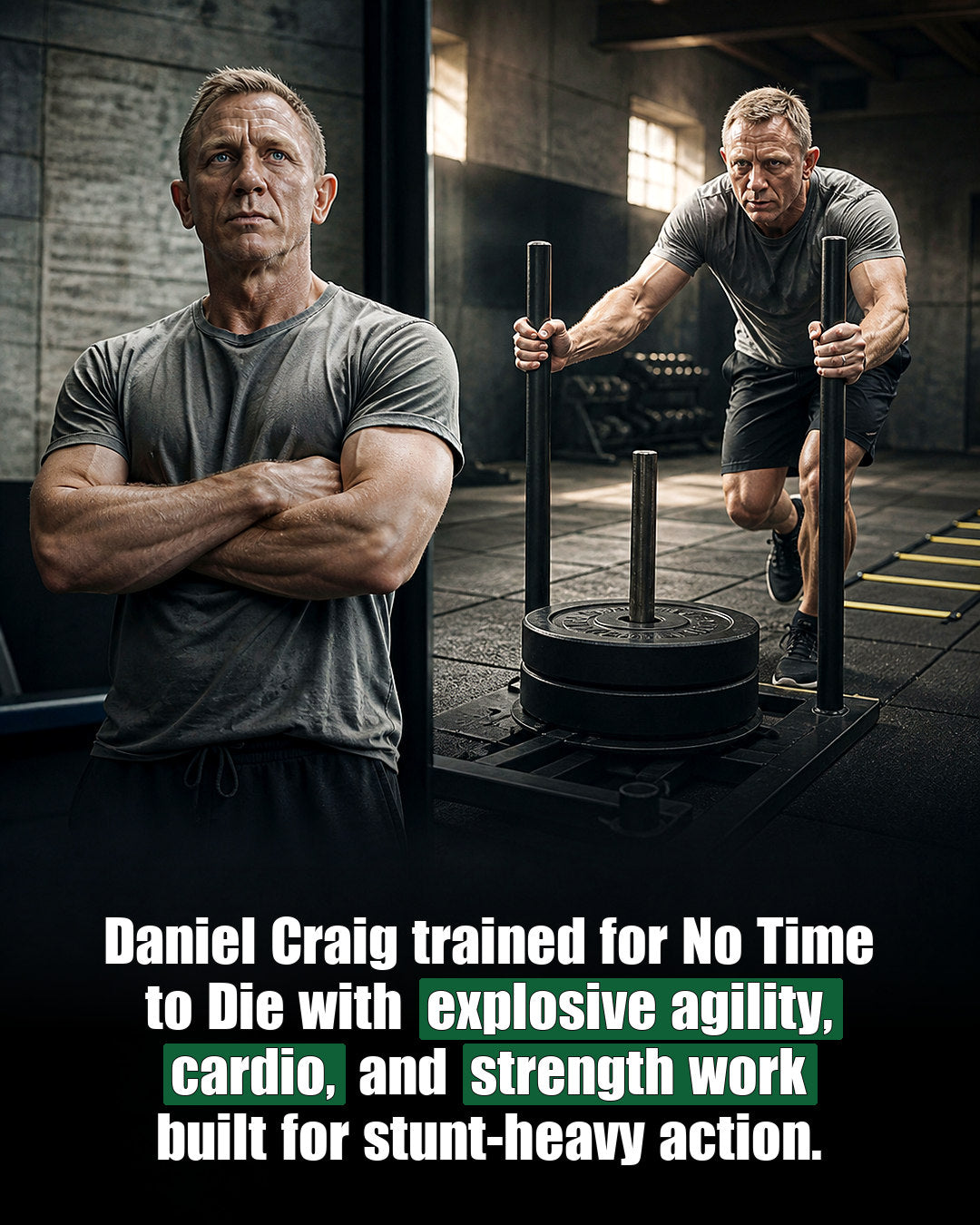

Daniel Craig is a British actor who played James Bond in five films, from “Casino Royale” in 2006 to “No Time to Die” in 2021.
He is the longest serving Bond actor by total years in the role.
Craig was born in 1968, which put him at about 51 or 52 during the main training and filming for his last Bond movie.
That last film was not an easy shoot.
Craig had knee surgery during a break in filming for “Spectre” in 2015.
He needed ankle surgery in 2019 after an injury sustained while filming “No Time to Die.”
Those injuries are part of why his final Bond training looked different from his earlier films.
His trainer for the role, Simon Waterson, is the same trainer who later shaped Chris Evans’s compound lift program for Captain America.
Two very different characters, one trainer, and two very different approaches based on age and physical history.
Craig is still an active actor today, most recently returning to the role of detective Benoit Blanc in the “Knives Out” mystery film franchise.
He remains a well known example of an actor who kept doing demanding physical roles well into his fifties, not just a nostalgic case study from years ago.
What Waterson Says About Training Past Fifty
Waterson has spoken publicly about how his approach to Craig changed as Craig aged through the Bond franchise.
“You’ve got to be aware that your body isn’t necessarily as capable of doing as much as you did in your thirties. That doesn’t mean you can’t be just as fit, or look as aesthetically amazing as you did 20 years ago.”
That quote is not about giving up on intensity.
It is about changing how that intensity gets applied.
Craig himself has described the shift in his own words, talking about how he now approaches training for a role.
“Training for a Bond movie is completely unique. If I can, I start a year before we begin shooting and build slowly. I try to avoid the ‘last-minute’ thing. You get less injuries that way.”
That is a meaningfully different mindset from a four month sprint to a deadline.
It is a year of gradual building, aimed at staying healthy enough to actually do the job.
What the No Time to Die Training Actually Involved
Craig’s earlier Bond training, for films like “Casino Royale” and “Skyfall,” leaned on heavy compound lifts and a powerlifting influenced style.
For “No Time to Die,” reporting on the program describes a clear shift away from that approach.
One Men’s Journal headline about the training put it directly: the program did not include big weightlifting.
Instead, the routine was built around five supersets, done at moderate rep ranges of roughly 10 to 20 reps per exercise.
The named exercises include low cable chest flies, abdominal rollouts, Bosu ball mountain climbers, traditional pull ups, and Russian twists.
Other exercises in the program include kettlebell side bends, TRX rows, TRX pistol squats, bodyweight dips, hanging leg raises, and reverse cable flies.
Sessions reportedly opened with about 10 minutes on a stationary bike or air bike before moving into the superset block.
Recovery work was built into the plan too, including foam rolling, resistance band stretching, and percussive massage.
That is a very different exercise list from four sets of five on a back squat.
The Exercise Science Behind Training This Way Past Fifty
Muscle mass and strength naturally decline with age, a process researchers call sarcopenia.
That decline usually speeds up after age 50, and it affects both muscle size and how fast muscles can produce force.
A 2010 meta-analysis in Ageing Research Reviews looked at resistance training studies in older adults and found consistent, meaningful strength gains from structured training, even in people well past middle age (Peterson et al., 2010).
That means the goal past 50 is not to avoid hard training.
It is to structure that training around what an aging body handles well.
Moderate rep ranges done through supersets put less peak stress on any single joint compared to a single maximal lift.
That matters more when a person has a surgically repaired knee or ankle, like Craig did during this training block.
Core and stability work, like the ab rollouts and TRX exercises in his program, also becomes more important with age.
A stronger, more stable core protects the spine during everyday movement, not just during a workout.
The official position statement on this topic from the National Strength and Conditioning Association confirms that resistance training remains both safe and effective for older adults when the program accounts for individual joint history and recovery capacity (Fragala et al., 2019).
How This Compares to a Heavy Compound Lift Approach
A younger actor without joint history, like Chris Evans during his first Captain America film, can reasonably train with four sets of five on heavy back squats and deadlifts.
That approach maximizes strength and size gains in a short window of time.
Craig’s approach traded some of that raw strength ceiling for something else: durability across a full year of preparation and months of physically demanding filming.
Both approaches are built around real exercise science.
The difference is which variable each program is optimizing for, maximum load or sustainable output over time.
Someone in their twenties or thirties, without injury history, has more room to train near their physical limits.
Someone managing joint history has more to gain from training that stays a step back from that limit, while still applying real, honest effort.
Common Mistakes People Over Fifty Make Starting a New Program
The most common mistake is copying a younger person’s program exactly, without adjusting for personal joint history.
A 25 year old’s knees have absorbed a lot less wear than a 55 year old’s knees, even if both people feel strong in the gym.
A second mistake is skipping the warm up.
Waterson’s program starts every session with roughly 10 minutes of easy cardio before any strength work begins.
A third mistake is training too hard, too fast, after years away from consistent exercise.
Craig’s own comment about starting a year ahead and building slowly is the opposite of that instinct.
A fourth mistake is ignoring recovery tools like stretching and mobility work, treating them as optional extras instead of part of the actual program.
Who Should Be Cautious
Anyone with a recent joint surgery, like Craig’s knee or ankle procedures, should get specific clearance and guidance from their surgeon or physical therapist before returning to structured training, and working with a qualified personal trainer familiar with post surgical clients can help build that program safely.
People with diagnosed osteoporosis or significant joint arthritis should talk to a doctor before starting high impact moves like mountain climbers or box style jumps.
Anyone with uncontrolled high blood pressure or a heart condition should get medical clearance before starting a new, more intense training program at any age.
People who have not exercised regularly in years should start well below what they think their capacity is and build from there.
That caution is not about avoiding exercise.
It is about making sure the body is ready for the specific demands being placed on it.
Anyone on blood thinners or medication that affects balance should also talk to a doctor before adding stability focused exercises like single leg balance work.
A short conversation with a doctor before starting is a small time cost compared to a preventable injury months into a new program.
A Practical How-To for Training Well Past Fifty
Start every session with a real warm up, not a token one.
Five to ten minutes of easy cardio, followed by a few minutes of dynamic stretching, prepares joints and muscles for the work ahead.
Build your main workout around supersets, pairing two exercises back to back with little rest between them.
A simple pairing is a push exercise, like a cable chest press, with a pull exercise, like a seated row.
Keep most rep ranges in the 10 to 15 range rather than chasing very heavy, very low rep sets.
Include real core work every session, not just at the end when you are already tired.
A plank, a dead bug, or a slow ab rollout all count and are gentler on the spine than a heavy weighted crunch.
Add balance and stability focused work, since balance naturally declines with age and directly affects fall risk later in life.
Standing on one leg while brushing your teeth is a genuinely useful, zero cost way to practice this.
Train four to five days a week if your schedule allows it, but keep the intensity moderate rather than maximal on most days.
Finish every session with five to ten minutes of stretching or foam rolling.
Give your body a full year, not a few weeks, if the goal is a real, sustainable change in strength and fitness.
Keep a simple training log so you can see whether your rep counts, weights, or balance times are actually improving month to month.
Small, steady progress over a year adds up to far more than a few weeks of maximum effort followed by an injury that stops training completely.
What This Approach Does Not Prove
Craig’s training shows that a person over 50 can stay genuinely strong and capable with the right program.
It does not prove that heavy compound lifts become unsafe or unnecessary after 50.
Plenty of people in their fifties, sixties, and beyond safely train with heavy squats and deadlifts, especially if they have built that strength gradually over years.
Craig’s specific program was shaped by his specific joint history, not by his age alone.
The real lesson is not “train lighter after 50.”
It is “train according to your own body’s actual history, not just your age or someone else’s routine.”
References
- Fit&Well, “Daniel Craig’s personal trainer shares how the No Time to Die actor stays ripped at 53”
- Men’s Journal, “Daniel Craig’s ‘No Time to Die’ Strength and Conditioning Workout”
- SuperHeroJacked, “Daniel Craig No Time To Die Workout: No ‘Big Weightlifting'”
- Peterson, M. D., Rhea, M. R., Sen, A., & Gordon, P. M. (2010). Resistance exercise for muscular strength in older adults: A meta-analysis. Ageing Research Reviews, 9(3), 226 to 237.
- Fragala, M. S., Cadore, E. L., Dorgo, S., Izquierdo, M., Kraemer, W. J., Peterson, M. D., & Ryan, E. D. (2019). Resistance Training for Older Adults: Position Statement From the National Strength and Conditioning Association. Journal of Strength and Conditioning Research, 33(8), 2019 to 2052.
This article is for general information and is not personal medical or training advice. Talk to a doctor or a qualified strength coach before starting a new lifting program, especially if you have an injury or a health condition.