
Chip Gaines built his public career on home renovation, not endurance sports.
He and his wife Joanna became household names through Fixer Upper, and the couple has since built Magnolia into a media and home goods brand based in Waco, Texas.
According to Runner’s World’s coverage of celebrity marathon runners, Gaines added a very different kind of project to his resume: his first marathon, run in his signature tool belt.
Chip Gaines was born in 1974 and grew up in Texas, where he later met Joanna Stevens.
The couple married in 2003 and eventually built Magnolia into a multi part business that includes a home goods store, a bakery, a coffee shop, and television programming.
They have five children and remain based in Waco.
What Actually Happened
Runner’s World reported that Gaines took on the Silo District Marathon in Waco, a race tied to the couple’s own Magnolia district downtown, without any previous marathon experience.
He finished the full 26.2 mile course wearing a tool belt, a nod to the home renovation work he is best known for.
The race benefited the Brave Like Gabe Foundation, an organization that funds research into rare cancers.
According to that same reporting, two of Gaines’s daughters joined him for parts of the course, and he crossed the finish line still smiling.
These specific details, the tool belt, the finish, and the family moments, come from Runner’s World’s own reporting rather than an independently verified race record, so they are presented here as reported facts from that coverage.
Who Brave Like Gabe Honors
The Brave Like Gabe Foundation was founded in memory of Gabriele Grunewald, a professional middle distance runner who competed for the United States at an elite level for years.
Grunewald was diagnosed with adenoid cystic carcinoma, a rare cancer that begins in glandular tissue, in 2009.
She underwent multiple surgeries and rounds of treatment over the following decade, including the removal of a salivary gland and her thyroid.
Even after her cancer returned in 2017, Grunewald kept competing at a national level while undergoing chemotherapy, becoming a well known voice for rare cancer awareness in the running community.
She died in 2019, and the foundation she started continues to fund research at major cancer centers focused specifically on rare cancers, which historically receive far less research funding than more common cancer types.
Running a marathon for that specific cause gives Gaines’s story a purpose beyond a personal athletic milestone.
Rare cancers as a group receive a small fraction of the research funding that goes to more common cancers, even though rare cancers collectively make up a significant share of all cancer diagnoses.
Foundations like Brave Like Gabe exist specifically to close some of that funding gap for the specific cancers that individual research budgets tend to overlook.
His Own Approach
Gaines has talked in general terms about taking on new physical challenges as a way to test himself outside of his usual work.
Runner’s World’s coverage frames his marathon as exactly that kind of challenge, a first time athletic goal chosen partly because of the cause behind it.
Tying a personal athletic goal to a cause he and his family care about appears to have been part of what made a first marathon appealing in the first place.
The Science of Why a Cause Based Goal Works
There is real research behind the idea that a meaningful cause can make a difficult physical goal easier to commit to.
A 2012 systematic review published in the International Journal of Behavioral Nutrition and Physical Activity examined self determination theory as it applies to exercise motivation.
Researchers Pedro Teixeira and colleagues found that autonomous motivation, meaning a person’s own sense of purpose or personal values driving their behavior, was consistently linked to better exercise adherence than motivation based purely on guilt or external pressure.
Running for a cause, rather than only for a personal fitness goal, is a common example of that kind of autonomous, values driven motivation.
There is also real physical benefit to training for a first marathon, even later in life or without a competitive running background.
A 2020 study in the Journal of the American College of Cardiology followed a group of first time marathon runners through their training and the race itself.
Researchers led by Anish Bhuva found that just six months of marathon training measurably reduced aortic stiffness, a marker connected to cardiovascular aging, in runners who had never trained for a marathon before.
The effect was strongest in older and slower runners, the group researchers considered least fit at the start of training, suggesting a first marathon can meaningfully improve heart health even for someone starting from a relatively low baseline.
What This Evidence Does Not Prove
The vascular benefits found in the Bhuva study came from a structured, roughly six month training program, not from running a single marathon without preparation.
The study also measured a specific marker, aortic stiffness, rather than every possible health outcome, so it should not be read as proof that marathon training prevents heart disease outright.
Similarly, the motivation research on cause based exercise describes a general pattern across many people, not a guarantee that everyone will find a charity race easier to finish than a personal goal.
Gaines’s specific race details rely on Runner’s World’s own reporting, so any exact figures, like his finish time, are not independently confirmed here.
How This Compares to General Advice for First Time Marathoners
Most running coaches recommend a training block of at least sixteen to twenty weeks for a first marathon, built around a gradual increase in weekly mileage.
General guidance also stresses including rest days and shorter easy runs, not just long runs, to reduce injury risk while building endurance.
Gaines’s story fits the broader pattern seen in a lot of first time marathon runners: a specific personal reason for choosing that particular race, and a goal big enough to justify months of consistent training.
Readers who are curious about building a walking or running base before attempting something like a marathon can start with general guidance on how many miles to walk in a day as a foundation.
Common Mistakes First Time Marathoners Make
One common mistake is increasing weekly mileage too quickly, which raises the risk of overuse injuries like shin splints or stress fractures.
A safer approach increases total weekly distance gradually, typically by no more than about ten percent from one week to the next.
A second mistake is skipping strength training entirely during marathon prep, assuming running alone builds enough durability.
Basic strength work for the hips, core, and legs helps protect against the repetitive stress of marathon training.
A third mistake is trying new gear, like shoes or a costume element, for the first time on race day instead of testing it during training.
Anyone planning to run in an unusual outfit, the way Gaines reportedly did in a tool belt, should train in that exact setup beforehand to make sure it does not cause chafing, balance issues, or added strain.
A fourth mistake is ignoring hydration and fueling strategy until race day, rather than practicing it during long training runs.
Readers who enjoy comparing running to other training approaches can also see how weightlifting and running fans debate their preferred training style.

A Practical Way to Train for a First Marathon
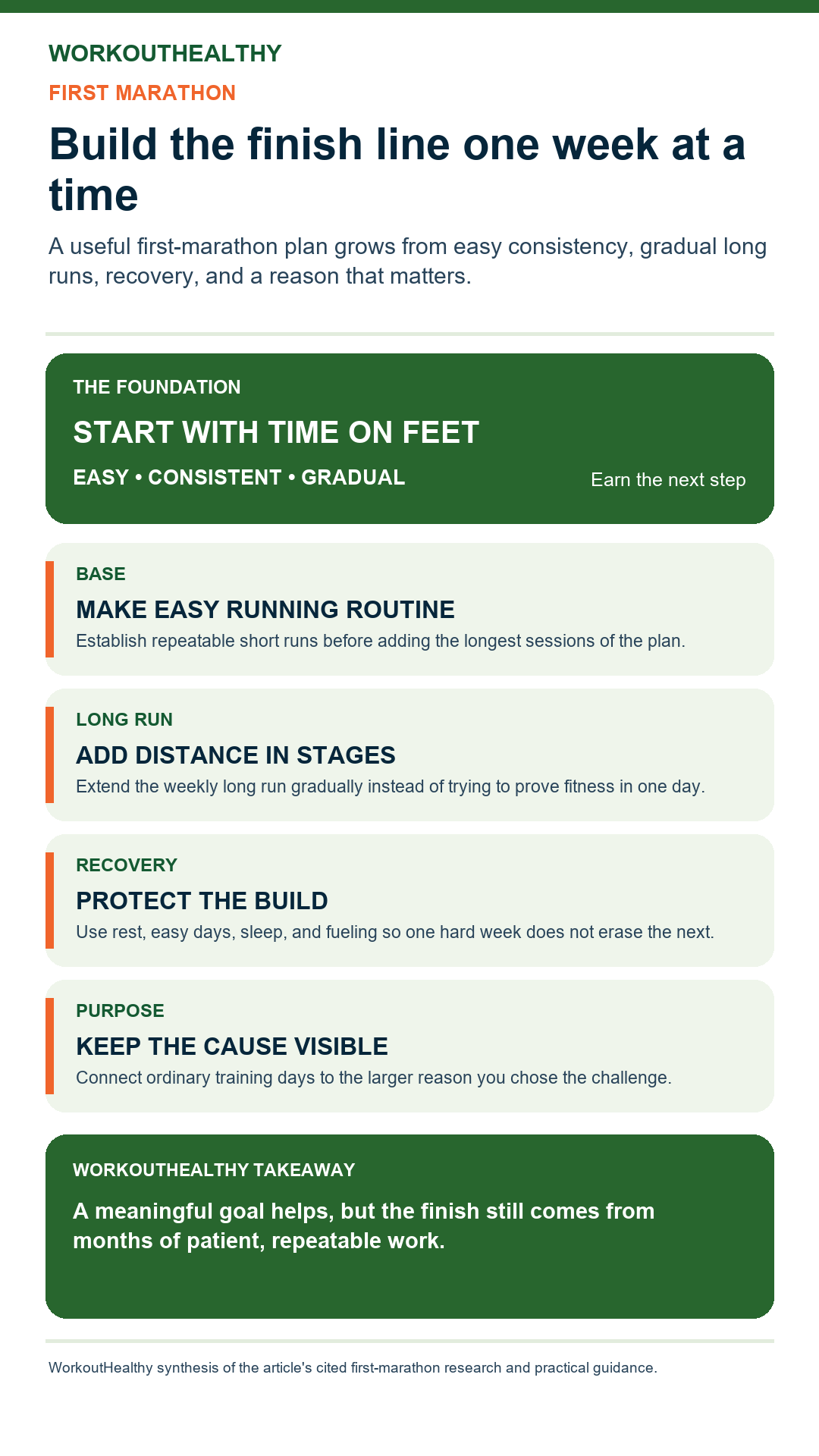
Start with a baseline fitness check. If you can comfortably jog or briskly walk three to five miles, you have a reasonable starting point for a sixteen to twenty week training plan.
Build your weekly long run gradually, adding no more than one or two miles most weeks, with an occasional lower mileage week to let your body recover.
Include two to three shorter, easier runs during the week alongside your long run, rather than running hard every session.
Add two strength training sessions a week focused on the legs, hips, and core to help your body handle the repetitive impact of marathon training.
Practice your race day nutrition and hydration strategy during your longer training runs, not for the first time on race day itself.
If you plan to run for a cause, connect with the organization early so you understand how your fundraising or awareness effort actually supports their work.
Schedule at least one full rest day each week, and treat it as part of the plan rather than something to skip if you feel behind.
Get a checkup before starting marathon training if you have not exercised regularly, have an existing joint issue, or have any heart related risk factors.
Break the full training block into smaller monthly goals, since a distant twenty week finish line can feel overwhelming without intermediate markers of progress.
Recruit a training partner or a local running group if possible, since accountability from other people tends to make the long buildup easier to stick with.
Plan for a recovery period after the race itself, including several weeks of lighter activity, since the body needs real time to repair after 26.2 miles of effort.
References
- Runner’s World, Celebrity Marathoners coverage: runnersworld.com
- Brave Like Gabe Foundation: bravelikegabe.org
- Teixeira, P. J., Carraca, E. V., Markland, D., Silva, M. N., & Ryan, R. M. (2012). Exercise, physical activity, and self determination theory: A systematic review. International Journal of Behavioral Nutrition and Physical Activity, 9(1), 78.
- Bhuva, A. N., D’Silva, A., Torlasco, C., Jones, S., Nadarajan, N., Van Zalen, J., Chaturvedi, N., Lloyd, G., Sharma, S., Moon, J. C., Hughes, A. D., & Manisty, C. H. (2020). Training for a first time marathon reverses age related aortic stiffening. Journal of the American College of Cardiology, 75(1), 60 to 71.
- Dillon, P. M., Chakraborty, S., Moskaluk, C. A., Joshi, P. J., & Thomas, C. Y. (2016). Adenoid cystic carcinoma: A review of recent advances, molecular targets, and clinical trials. Head and Neck, 38(4), 620 to 627.
This article is for general information and is not medical advice. Talk with a doctor before starting a marathon training program, especially if you have an existing health condition or have not exercised regularly.