
Claire Holt built her early career on Australian television.
American audiences got to know her as Rebekah Mikaelson on “The Vampire Diaries” and its spinoff, “The Originals.”
These days, she is just as likely to show up in headlines for a very different reason.
She has become a serious presence in the marathon world.
Holt ran her first marathon in New York City in November 2022.
She donated her entire entry fee to Boston Children’s Hospital.
According to her own public accounting of that first effort, the donation totaled $162,000.
She did not stop after one race.
She ran a second marathon in Chicago in October 2024.
That race raised more than $100,000 on top of the $250,000 she had already raised for the same hospital.
Then she went further still.
Runner’s World’s coverage of celebrity marathoners describes Holt racing a major marathon and lining up again for the TCS New York City Marathon just weeks later.
She came away from that second race with a personal best.
Holt has continued the pattern since.
She ran her third and fourth marathons, her second and third in New York City, in partnership with the beauty brand Maybelline.
By her fourth race, she had built a running history few actors bother to build at all.
Running one marathon is a serious physical undertaking on its own.
Running two of them close together, and getting faster the second time, raises a more specific question.
What does a body actually need to recover between two marathons run weeks apart?
It is a question with real stakes beyond one actress’s race calendar.
Recreational running has grown fast in recent years, and more everyday runners are now stacking multiple marathons into a single fall racing season the way elite athletes have long done.
Understanding what the body actually needs between those efforts matters for anyone tempted to follow the same pattern.
Living in the “Pain Cave”
Holt has described the back half of a marathon in blunt terms.
She has talked about entering what she calls the pain cave starting around mile four.
That is a stretch where grit matters as much as fitness.
That kind of honesty is common among experienced marathoners.
The middle and late miles of 26.2 are rarely comfortable, no matter how well trained a runner is.
What makes Holt’s story unusual is the timeline, not the discomfort itself.
Doing that twice within a matter of weeks demands more than willpower.
It demands a body that has actually recovered from the first effort before being asked to do it again.
What a Marathon Does to Muscle in the Days After
Researchers Kim Petersen, Claus Bugge Hansen, Per Aagaard, and Klavs Madsen studied exactly this question in highly trained runners.
Their work appeared in the European Journal of Applied Physiology.
They tracked muscle function before and after a full marathon race.
They measured strength output and mechanical performance in the runners’ leg muscles at several points after the finish line.
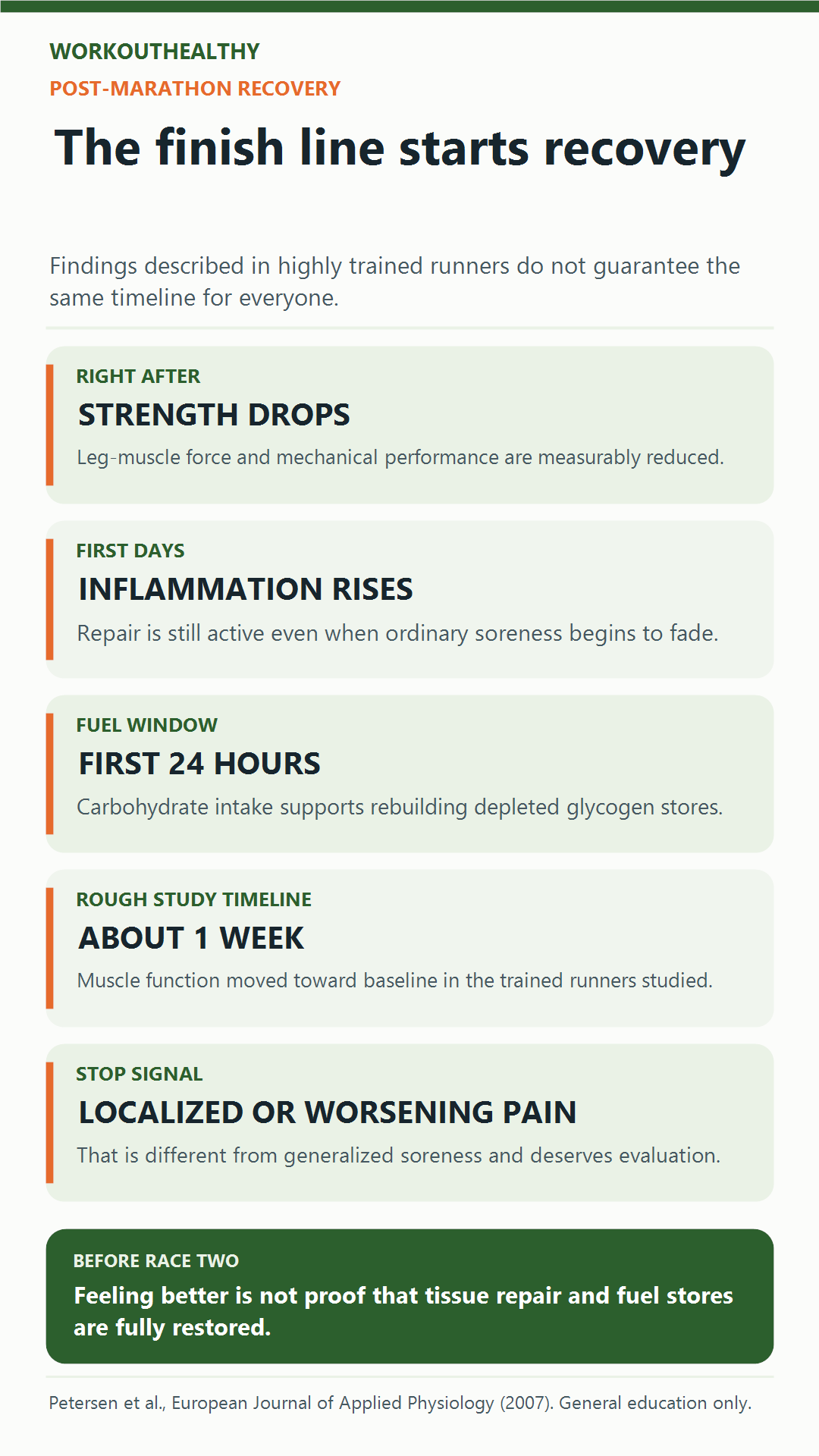
They found measurable reductions in muscle strength immediately after the race.
That kind of damage comes from tens of thousands of repeated footstrikes pounding the same muscle fibers over and over.
Recovery was not instant.
The study tracked declines that persisted for days afterward.
Muscle function gradually returned toward baseline over roughly a week.
That timeline matters for anyone considering a second marathon close behind a first.
A body that has not finished repairing microscopic muscle damage from race one is not starting race two from a clean slate.
The same research also tracked markers of inflammation in the runners’ blood.
Those markers rose sharply right after the race and took several days to settle back down.
Inflammation is a normal part of how muscle repairs itself, but a body still dealing with elevated inflammation from race one is working with less of a buffer for race two.
What Happens to Fuel Stores After a Marathon
Muscle damage is only part of the story.
A marathon also drains glycogen, the stored form of carbohydrate that muscles burn for fuel during endurance exercise.
Most runners exhaust much of their glycogen supply somewhere in the final miles of the race, which is part of why the last stretch feels so much harder than the first.
Refilling those stores takes time and deliberate eating, not just rest.
A runner who under-eats in the days after a marathon can show up to a second race with muscles that are structurally healed but still short on fuel.
Why Recovery Looks Different for Every Runner
Not every runner recovers at the same rate.
Sex is one factor researchers have specifically studied.
A review by researchers Christophe Hausswirth and Yann Le Meur, published in the journal Sports Medicine, looked specifically at post-exercise recovery needs in female athletes.
Their review found that hormonal fluctuations across the menstrual cycle can influence recovery speed.
Those fluctuations can affect how quickly muscle damage repairs.
They can also affect how effectively the body replenishes glycogen after a hard effort.
The review’s larger point is that generic recovery advice does not always transfer cleanly.
Much of the foundational research on exercise recovery was built around male athletes.
Sleep, nutrition timing, and training load in the days after a hard race all play a role.
The optimal approach can shift depending on the individual and where they are in their training cycle.
Recovery is not just about how a body feels the next morning. It is about whether the underlying tissue and fuel stores have actually caught up before the next hard demand arrives.
Sleep plays an outsized role in that catch-up process.
Deep sleep is when the body releases most of its growth hormone, a key driver of the tissue repair that follows hard exercise.
Cutting sleep short in the days after a marathon can slow that repair process at exactly the moment a runner needs it most.
What This Evidence Does Not Prove
None of this research proves that racing two marathons weeks apart is safe or advisable for every runner.
The muscle recovery research followed highly trained athletes with an established running background.
It did not study people attempting their first marathon or returning after a long layoff.
Holt’s own marathon history spans multiple years of training by her fourth race.
That fits the “highly trained” profile in the research far better than a beginner’s history would.
A personal best in a second closely spaced marathon is also not proof that the strategy is optimal for performance.
It shows that recovery was sufficient for that individual on that specific day.
Other runners attempting the same approach might see a slower second race.
They might also face a higher injury risk, depending on their own training history.
Common Mistakes Runners Make Between Back to Back Races
Trying to replicate Holt’s approach without her training background is where most runners run into trouble.
A frequent mistake is treating the days right after a marathon as a normal training week.
The body needs true rest, not a light jog, in the first several days after 26.2 miles.
Skipping sleep is another common error.
Sleep is when much of the muscle repair process actually happens.
Cutting it short slows recovery more than most runners realize.
Some runners also under-fuel in the recovery window, worried about weight gain after a big training block.
That approach can backfire, since the body needs adequate protein and carbohydrate to actually rebuild muscle tissue.
Ignoring pain that lingers past the expected recovery window is a fourth common mistake.
Ordinary post-marathon soreness should ease within a week or so.
Pain that gets worse, or that concentrates in one specific spot, is a different signal entirely.
How to Approach Racing Two Marathons Close Together
Anyone considering a similar back-to-back attempt should build the approach carefully.
Start with an honest look at training history.
This approach fits experienced runners with a strong aerobic base far better than someone on their first or second marathon.
Plan the recovery week deliberately.
Light movement, extra sleep, and higher protein intake in the days right after race one help set up race two.

Prioritize carbohydrate intake in the first 24 hours after finishing.
That window is when the body is most efficient at rebuilding glycogen stores.
Watch for warning signs, not just soreness.
Sharp, localized pain, swelling, or pain that worsens instead of easing over the following week deserves a pause and a medical opinion.
Adjust the goal for race two.
Chasing a personal best on tired legs is possible for some runners, as Holt’s story shows, but it is not guaranteed.
Finishing comfortably is a reasonable goal on its own.
Consider the cause alongside the challenge.
Holt has tied her marathon running to fundraising for Boston Children’s Hospital, which gives the physical demand a purpose beyond the finish time.
Track how sleep, mood, and resting heart rate feel in the days after race one.
A resting heart rate that stays noticeably elevated a few days out is a common, low-effort signal that the body has not finished recovering.
Talk to a coach or a sports medicine provider before attempting a repeat effort, especially without a long history of endurance training to draw on.
References
- Petersen, K., Hansen, C. B., Aagaard, P., & Madsen, K. (2007). Muscle mechanical characteristics in fatigue and recovery from a marathon race in highly trained runners. European Journal of Applied Physiology, 101(3), 385-396. https://doi.org/10.1007/s00421-007-0504-x
- Hausswirth, C., & Le Meur, Y. (2011). Physiological and nutritional aspects of post-exercise recovery: Specific recommendations for female athletes. Sports Medicine, 41(10), 861-882. https://doi.org/10.2165/11593180-000000000-00000
- Runner’s World. Celebrity Marathoners. https://www.runnersworld.com/runners-stories/g20704412/celebrity-marathon-runners/
This article is for general educational purposes and is not a substitute for individualized advice from a doctor, physical therapist, or certified running coach. Anyone considering racing multiple marathons close together should talk to a qualified coach or medical provider about their own training history and recovery needs first.