
Jennifer Lopez’s reported ab routine is memorable because the numbers are extreme.
Trainer Dodd Romero described three movements performed for descending rounds of 50, 35, and 21 repetitions.
The routine is real as a trainer-reported snapshot from 2019.
It is not a universal prescription, a beginner target, or proof that one sequence creates one particular appearance.
A celebrity routine is a case study, not an entry-level template.
What Romero Reported
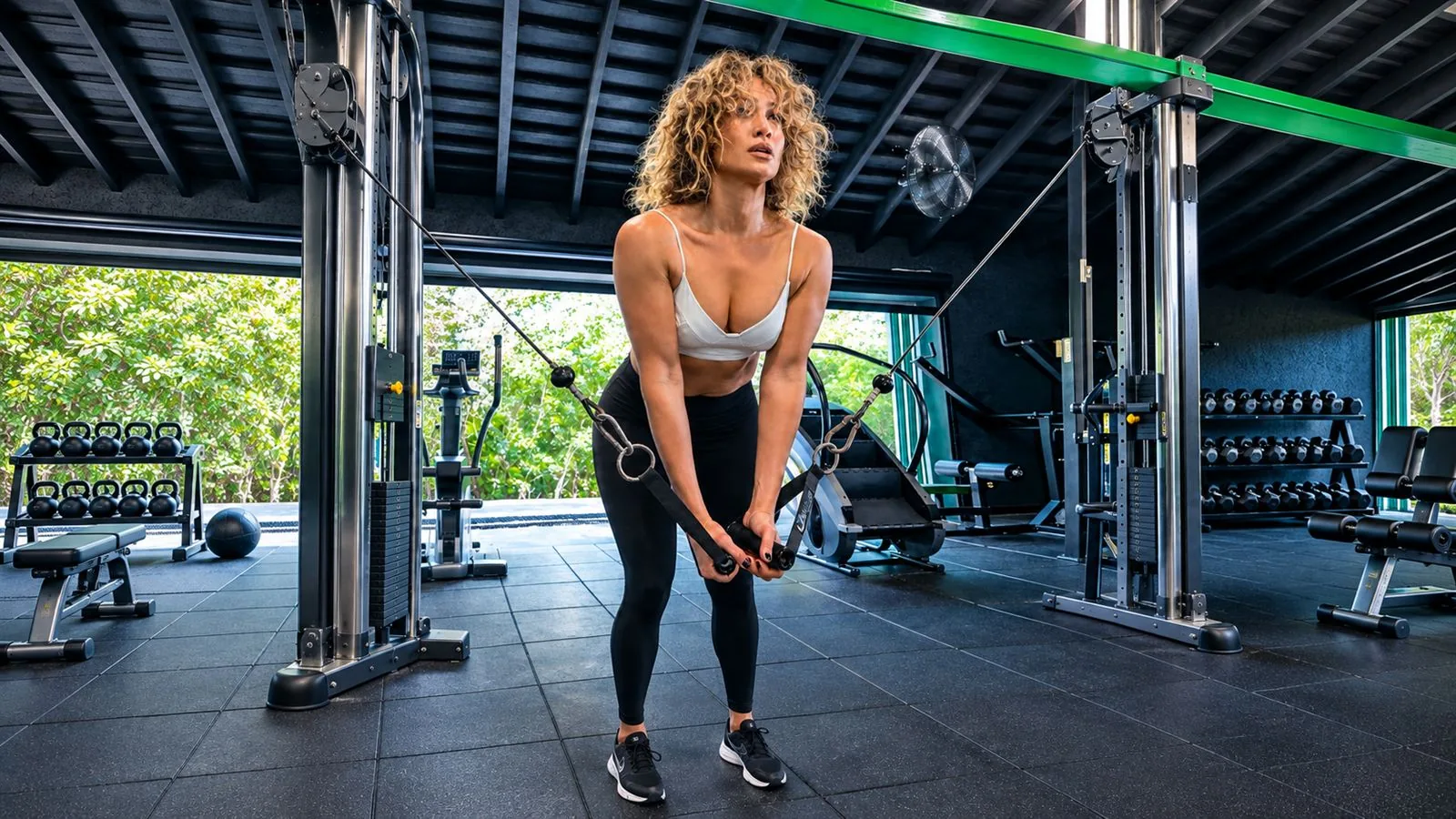
Romero told Oprah Magazine that Lopez’s typical ab routine began with 50 hanging ab raises, 50 rope crunches, and 50 incline sit-ups holding a 45-pound plate.
The second round repeated the same three movements for 35 repetitions each.
The third round used 21 repetitions each.
He also said she did not rest between sets.
The description came from a direct conversation with her trainer, but it represents a routine reported at that time.
It should not be read as a permanent daily plan.
How the Three Moves Divide the Work
The hanging raise asks the athlete to control the pelvis and legs while suspended from a bar.
The rope crunch uses a cable to add external resistance to trunk flexion.
The incline sit-up changes the body angle and adds a 45-pound plate in the version Romero described.
Together, the three movements create a mix of hanging control, cable resistance, and incline work.
That variety is more informative than the celebrity label.
It shows that the routine was built around multiple demanding patterns rather than hundreds of identical crunches.
The 318-Rep Reality Check
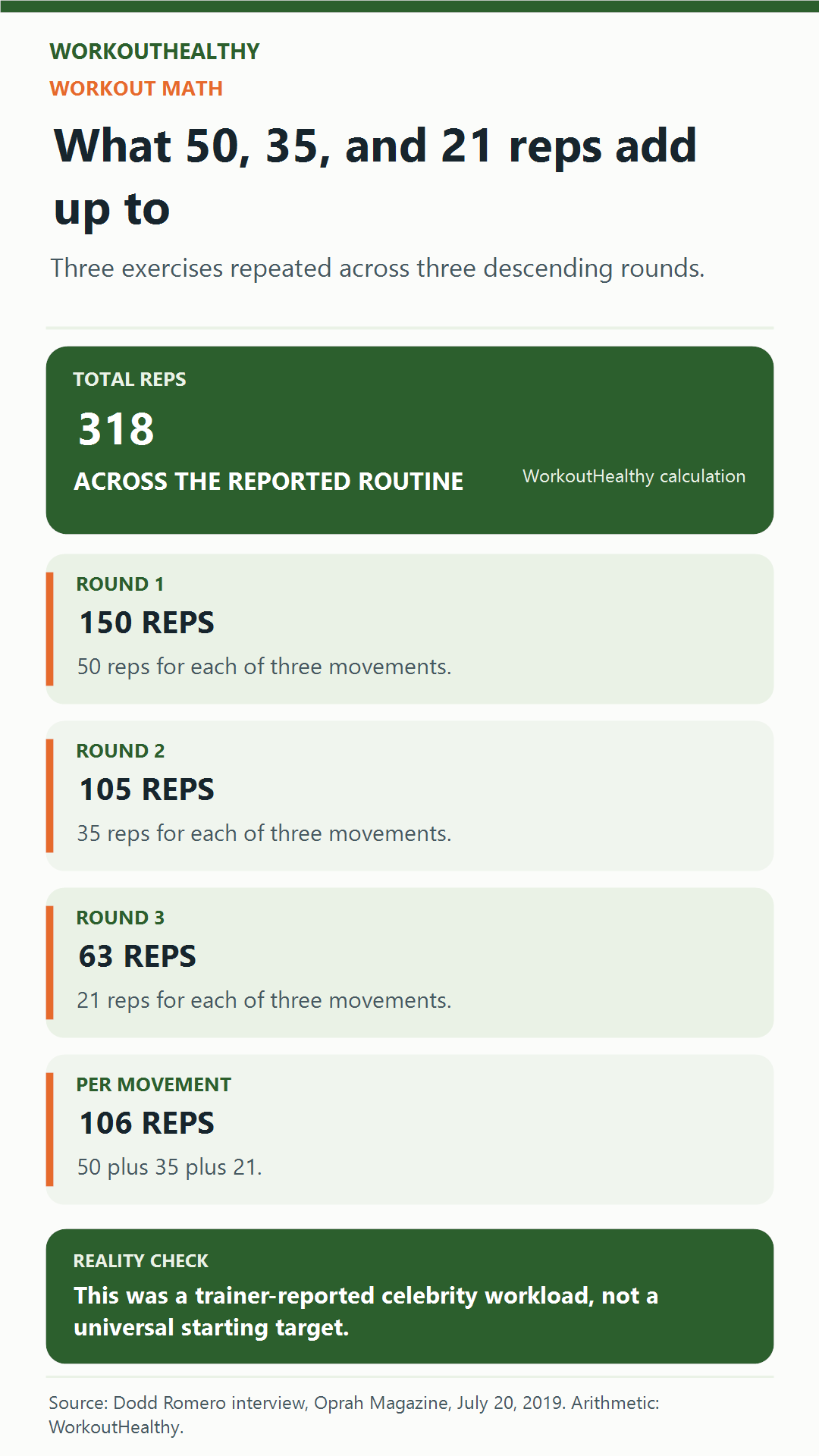
The round totals are 150 repetitions, then 105, then 63.
Adding those numbers gives 318 total repetitions across the routine.
Each movement receives 106 repetitions because 50 plus 35 plus 21 equals 106.
The incline sit-ups alone also involve 4,770 pounds of listed external plate load when 45 pounds is multiplied by 106 repetitions.
That load total does not include body weight and does not measure muscular effort, but it makes the scale of the reported session easier to see.
Why the Numbers Are Not a Starter Plan
Lopez was training as an experienced performer with professional supervision and a schedule built around rehearsals and shows.
Romero described the intensity as difficult to duplicate.
The hanging movement alone can become limited by grip, shoulder position, and control before the abdominal muscles receive the intended work.
High repetition targets can also encourage shorter range of motion when fatigue rises.
The useful question is therefore not whether you can copy 50, 35, and 21 today.
It is whether you can perform a smaller number of controlled repetitions that still match the movement you intended.
A Scaled Version With the Same Structure
You can preserve the descending-round idea without pretending to train at Lopez’s reported level.
Choose three core movements that you already control, then use rounds of 12, 10, and 8 repetitions.
That produces 30 repetitions per movement and 90 total repetitions across the session.
Rest between rounds when your grip, breathing, or technique needs it.
Use a load that lets the final repetition resemble the first.
This is a WorkoutHealthy scaling example, not a claim about Lopez’s current program.
How It Fits Her Broader Training
Romero’s description also included lower-body work such as supported lunges, leg presses, hip thrusts, and calf raises.
Women’s Health later reported that her resistance training continued to combine core and lower-body work while her trainers changed the details over time.
That broader context matters because the three-move ab sequence was not her entire fitness routine.
Dance, rehearsals, full-body resistance work, and performance preparation all formed part of the picture.
Our profile of Lopez’s own comments about staying active adds the habit-focused side of that story.
Form Matters More Than Copying the Rep Count
For hanging raises, reduce swinging and stop the set when you can no longer control the lowering phase.
For rope crunches, keep the movement at the trunk instead of turning every repetition into a hip hinge.
For weighted incline sit-ups, use a load and angle that you can repeat without rushing.
If a movement does not fit your experience or available equipment, replace it with a simpler pattern rather than forcing the celebrity version.
The same principle appears in our look at Cameron Diaz’s long-term training priorities: the routine has to serve the person’s real goal.
The structure is worth borrowing. The celebrity-sized workload is optional.
The Useful Takeaway
The three exercises are not secret movements.
The distinctive part is the density created by descending rounds and the reported lack of rest.
That density made sense inside one highly trained performer’s supervised program at one point in time.
Most readers will get more value from scaling the workload, keeping the movement quality high, and fitting core work into a balanced plan.
For another example of consistency without copying a celebrity detail, read our breakdown of Lenny Kravitz’s long-running fitness rule.
Follow WorkoutHealthy Insider for sourced celebrity routines, realistic scaling ideas, and the context that viral workout posts leave out.