

Andrew Huberman has become one of the most listened to voices in fitness.
His podcast turns dense exercise science into simple rules, and millions of people use those rules in the gym every week.
That reach is exactly why it matters when someone checks the rules against the actual research.
Dr. Milo Wolf is an exercise scientist who studies resistance training for a living.
He researches variables like proximity to failure and range of motion.
He publishes that work in peer reviewed journals alongside other strength researchers.
In a recent video, Wolf walks through several of Huberman’s most repeated workout claims and compares them to the studies behind them.
This article does the same thing in writing, using two of the specific claims Huberman has made on his own podcast: how close to failure you need to train, and how long you should rest between sets.
The honest answer is not a simple verdict. Some of it holds up well. Some of it is more nuanced than a podcast clip can capture.
What Andrew Huberman Has Actually Said About Training to Failure
On the Huberman Lab podcast episode covering muscle growth and recovery, Huberman has described training to true muscular failure as something to use sparingly.
He has said that only a small share of your sets, roughly one in ten, need to reach the point where your form breaks down or you truly cannot complete another rep.
For most sets, his advice is to stop a couple of reps before that point, often described as leaving a few reps in reserve.
His stated reasoning is that grinding out every set to failure adds fatigue that can hurt the rest of your workout, and it can make recovery between sessions harder.
This is a specific, checkable claim.
It is not the same as saying failure training is useless, and it is not the same as saying you should never approach failure.
What the Research Says About Training to Failure and Muscle Growth
The most detailed answer to this question comes from a 2023 systematic review and meta-analysis published in Sports Medicine by Refalo and colleagues (Refalo et al., 2023).
The researchers pooled 15 randomized controlled trials that compared sets taken to true failure against sets stopped short of failure.
Across that pooled data, training all the way to failure produced only a small, largely trivial extra benefit for muscle growth compared with stopping a rep or two short.
The data does not show that training to complete failure is required for muscle growth. It shows the opposite risk, that chasing failure on every set adds cost without adding much benefit.
The same review found something more interesting than a flat yes or no.
The relationship between proximity to failure and muscle growth is not a straight line. It bends upward near the very end of a set.
Going from two reps in reserve to one rep in reserve barely moves the needle.
Going from one rep in reserve to zero, true failure, produces a noticeably bigger jump than that.
In practical terms, this lines up with Huberman’s advice more than it contradicts it.
Stopping close to failure most of the time, with occasional true failure sets, sits right in the range the data supports.
Milo Wolf has written about this same non-linear pattern on his own coaching site, describing it as evidence that the last couple of reps in a set carry more weight than people assume, without requiring failure on every single set to get most of the benefit.
Why Stopping Short of Failure Might Help You Recover Faster
The muscle growth data only tells half the story. The other half is what training to failure costs your body afterward.
A 2017 study in the European Journal of Applied Physiology tracked resistance trained men for three days after sets performed either to failure or stopped short of it (Morán-Navarro et al., 2017).
The failure group showed a bigger immediate drop in jump height and bar speed, both common markers of neuromuscular fatigue.
That group also took longer to return to their normal numbers.
Some measures were still not fully recovered at the 24 to 48 hour mark, while the non-failure group bounced back faster.
The researchers concluded that avoiding failure on most sets left lifters in better shape to train again sooner.
This is the mechanism behind Huberman’s caution.
It is not that failure training doesn’t work.
It is that it comes with a recovery bill, and that bill adds up if every set gets charged to it.
Our earlier look at Mike Mentzer’s Heavy Duty training system covers a related idea from the opposite direction, built entirely around training to failure and then resting far longer than most lifters do.

What Andrew Huberman Has Said About Rest Periods Between Sets
The second claim worth checking is about rest, not effort.
Huberman has recommended resting between two and five minutes between sets for both strength and hypertrophy goals, describing that window as a practical sweet spot for most lifters.
That is longer than the 60 to 90 seconds many casual lifters default to, and longer than what some older bodybuilding routines called for.
A Second Study: Longer Rest Periods and Muscle Growth
This claim has strong direct support.
A 2016 study in the Journal of Strength and Conditioning Research compared one minute of rest against three minutes of rest in resistance trained men over eight weeks (Schoenfeld et al., 2016).
The three minute rest group came out ahead on nearly every measure.
Bench press strength improved about 12.7 percent in the long rest group, compared with a smaller gain in the short rest group.
Squat strength told a similar story, with a noticeably larger improvement in the long rest group.
Muscle thickness in the quadriceps also grew more in the long rest group than in the short rest group.
The authors were direct about it.
Longer rest periods produced greater gains in both strength and muscle size in lifters who already had training experience.
On this specific claim, the research lines up closely with what Huberman has said on his podcast.
What This Evidence Does Not Prove
None of this adds up to a simple scorecard where Huberman is fully right or fully wrong.
The failure research comes mostly from lifters training two to four times a week on standard hypertrophy programs.
It says less about elite powerlifters, very advanced bodybuilders, or people rehabbing an injury.
The rest period study used a fixed three minute protocol.
It does not prove that three minutes beats four minutes, or that five minutes is better than three.
It also does not prove that everyone recovers at the same rate. Individual recovery varies with age, training history, sleep, and stress.
Both bodies of research also measure averages across groups.
Any single lifter can respond differently than the group average, and that is normal, not a sign the research is wrong.
The honest reading of this evidence is that Huberman’s two claims are reasonable summaries of real research, with rougher edges than a ten minute podcast segment usually allows for.
Common Mistakes People Make With These Two Rules
The most common mistake is treating “train close to failure” as permission to grind every set into the ground.
The research supports training near failure sometimes, not training to complete exhaustion on every exercise every session.
A second mistake is ignoring rest periods entirely and rushing through a workout to save time.
Cutting rest down to 30 or 45 seconds on heavy compound lifts trades away real strength and size gains for a shorter gym visit.
A third mistake is applying the same failure and rest rules to every exercise.
Isolation movements like a bicep curl carry less injury risk near failure than a heavy barbell squat does.
Our piece on Arnold Schwarzenegger’s famous rep quote looks at this same tension between chasing the hardest possible reps and training in a way you can actually repeat week after week.
A fourth mistake is assuming more soreness always means a better workout.
Soreness and muscle growth are only loosely related, and a wrecked next-day recovery is not proof that a session worked better than one that left you fresher.
Who Should Check With a Doctor Before Changing How They Train
Training close to failure is not automatically risky, but it is not automatically safe for everyone either.
Anyone with a history of joint injuries, herniated discs, or uncontrolled blood pressure should talk to a doctor or physical therapist before adding more near failure sets to heavy compound lifts.
People returning from surgery or a long layoff should build back gradually rather than testing failure early.
Older adults and anyone new to lifting benefit from working with a qualified coach who can watch technique up close, especially as fatigue increases near the end of a set.
If you are unsure whether your current program is appropriate for a health condition, that is exactly the kind of question a qualified personal trainer or physical therapist can help answer before you change anything.
How to Apply This in Your Own Training
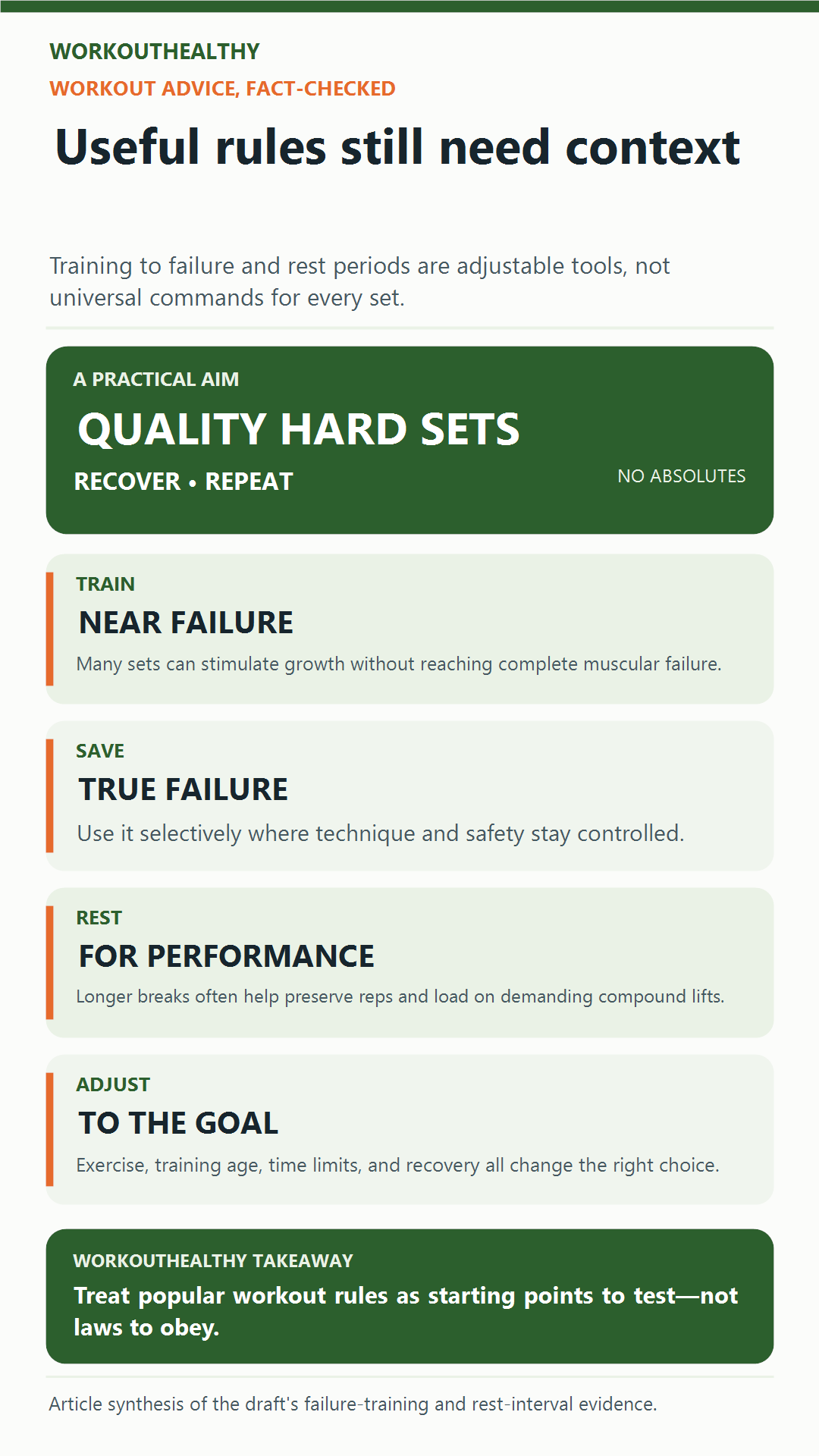
Start by picking one to two compound lifts per session where you will occasionally push closer to true failure.
Squats, presses, rows, and deadlifts are common choices.
On most working sets for those lifts, aim to stop with about one to two reps left in the tank rather than grinding to failure.
Reserve true failure for roughly the last set of an exercise, and not every session.
A simple way to judge this is asking yourself if you could have done one more clean rep with good form.
If the honest answer is yes, you likely had reps left in reserve.
For isolation exercises like curls, lateral raises, or leg extensions, failure carries lower injury risk, so training closer to it more often is reasonable.
Set a timer for your rest periods rather than guessing. Aim for two to three minutes on heavy compound lifts.
You can trim rest to 60 to 90 seconds on lighter isolation work without losing much.
Track your top set weight or reps each week.
If a lift stalls for two to three weeks in a row, that is a signal to reassess rest periods, proximity to failure, or overall recovery before changing the exercise itself.
Give any new approach at least four to six weeks before judging it. Strength and hypertrophy adaptations take longer than a single week to show up clearly.
Finally, keep a simple training log.
Writing down reps, sets, and how close you came to failure makes it much easier to see real progress instead of guessing from memory.
Watch the Original Video
Want more claims checked like this one? Subscribe to WorkoutHealthy Insider for practical explanations behind popular fitness claims.
References
Morán-Navarro, R., Pérez, C. E., Mora-Rodríguez, R., de la Cruz-Sánchez, E., González-Badillo, J. J., Sánchez-Medina, L., & Pallarés, J. G. (2017). Time course of recovery following resistance training leading or not to failure. European Journal of Applied Physiology, 117(12), 2387–2399. https://doi.org/10.1007/s00421-017-3725-7
Refalo, M. C., Helms, E. R., Trexler, E. T., Hamilton, D. L., & Fyfe, J. J. (2023). Influence of resistance training proximity-to-failure on skeletal muscle hypertrophy: A systematic review with meta-analysis. Sports Medicine, 53(3), 649–665. https://doi.org/10.1007/s40279-022-01784-y
Schoenfeld, B. J., Pope, Z. K., Benik, F. M., Hester, G. M., Sellers, J., Nooner, J. L., Schnaiter, J. A., Bond-Williams, K. E., Carter, A. S., Ross, C. L., & Just, B. L. (2016). Longer interset rest periods enhance muscle strength and hypertrophy in resistance-trained men. Journal of Strength and Conditioning Research, 30(7), 1805–1812. https://doi.org/10.1519/JSC.0000000000001272
This article is for general information only and is not medical advice. If you have an injury, ongoing pain, or a medical condition, talk to a doctor or physical therapist before you change how you train or eat.