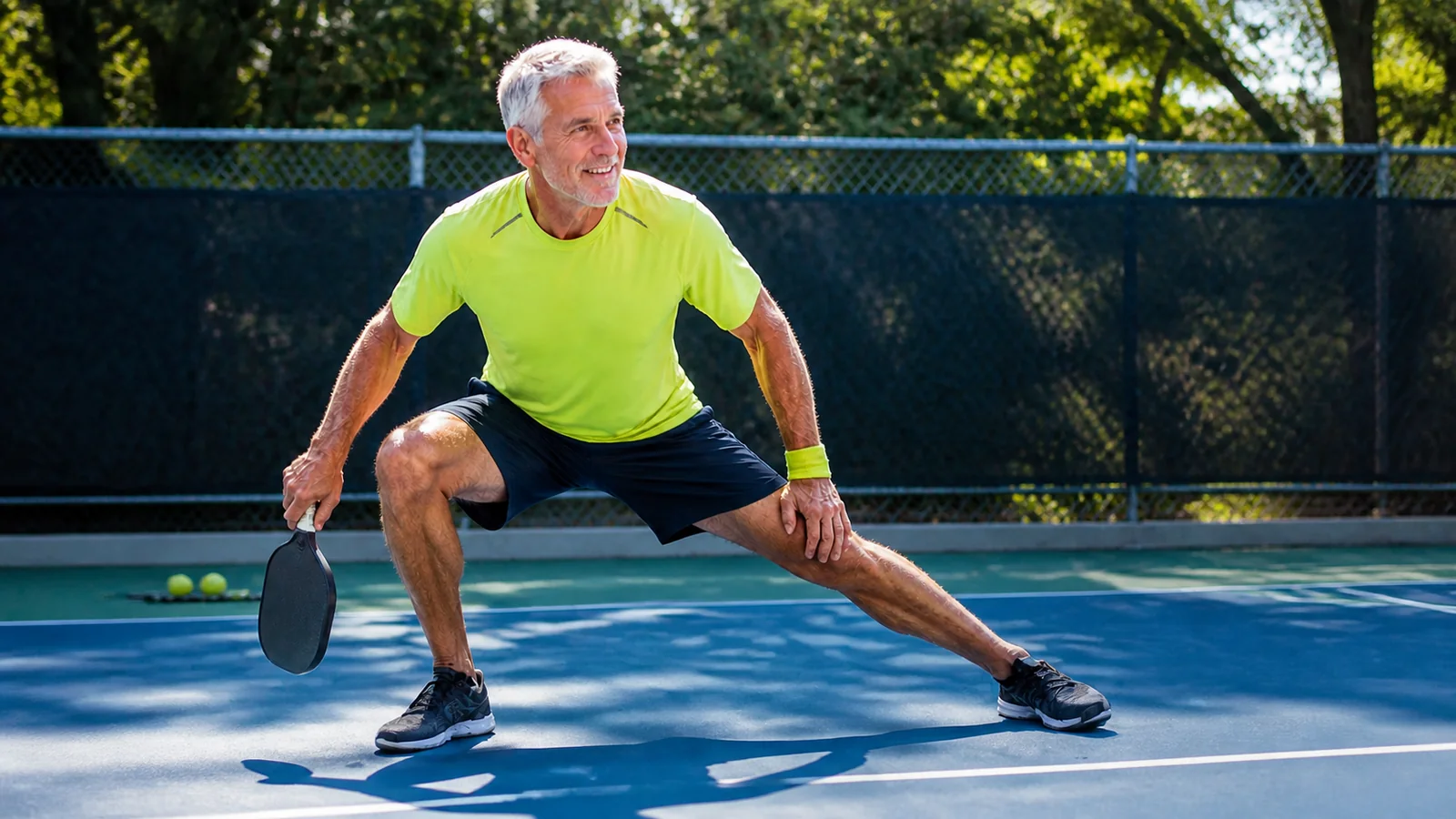

Pickleball injury prevention starts with understanding what the available studies can and cannot tell us. Falls, upper-body strains, and ankle or Achilles problems appear in the research, but no study cited here proves that one short warm-up or equipment choice prevents a set percentage of injuries.
A practical approach is to prepare for the movements you expect, choose footwear suited to lateral steps, pace early sessions to your current ability, and get individual advice when an old injury or medical condition changes the decision. The five-minute card below is an editorial example for a comfortable, symptom-free player, not a tested prevention protocol.
A five-minute court-side preparation card
| Clock | Easy activity | What to notice |
|---|---|---|
| 0:00 to 1:00 | Walk around the court at a comfortable pace | Notice dizziness, unusual breathlessness, or pain before adding speed |
| 1:00 to 2:00 | Take short side steps in both directions | Keep steps controlled rather than lunging to the edge of your reach |
| 2:00 to 3:00 | Practice a gentle turn and forward step toward a pretend lob | Look where you are going; avoid blindly backpedaling |
| 3:00 to 4:00 | Make relaxed practice swings with the paddle | Use a comfortable grip and stop if a shoulder, wrist, or elbow hurts |
| 4:00 to 5:00 | Try a slow cooperative rally or continue easy footwork without a ball | Build game speed only if movement feels steady |
The minutes add to five, and none requires jumping or a deep lunge. Modify or skip a step that does not fit your mobility, balance, or clinician’s instructions.
The American Medical Association’s physician advice covers warming up, shoes, conditioning, and knowing when to seek care. The five-minute card above gives one short sequence to consider immediately before recreational play.
What injuries do the studies count?
| Source | Who and what was counted | Useful finding | Limit |
|---|---|---|---|
| Weiss et al., 2021 | Nationally estimated emergency-department visits among adults 60 and older from 2010 to 2019 | About 63% of pickleball injury visits in this older group involved a slip, trip, fall, or dive | Emergency visits miss milder injuries and do not give the injury rate per player |
| Hanks and Myers, 2025 | Anonymous online survey completed by 253 recreational players with at least six months of play | 41% reported an upper-extremity injury; consecutive-day play was associated with relative risk 4.97 for an acute upper-extremity injury | Self-report and self-selection limit generalization, and the wide confidence interval does not prove a rest-day intervention works |
| Lee et al., 2025 | Nationally estimated emergency-department injuries from 2004 to 2023 | The national estimate was 100,914 before final exclusions and 99,816 in the final analysis | That is a sample-derived national count, not an individual’s chance of injury |
The older-adult emergency study describes serious enough injuries to reach an emergency department. The player survey describes reported upper-body injuries, while the 20-year emergency analysis counts a different population and period.
These denominators should not be mixed into a single “pickleball injury rate.” Growing numbers of emergency visits may reflect more participation as well as risk, and the studies do not measure whether the five-minute card above changes outcomes.
What precautions are reasonable between games?
Well-fitting court shoes are designed for side-to-side movement, unlike shoes chosen mainly for straight-ahead running. The AMA physician interview and clinical injury commentary discuss footwear as a practical precaution, not as a proven way to eliminate falls.
Let early sessions reflect how often you have recently played rather than assuming an old sports background guarantees current readiness. A comfortable grip and controlled footwork may make play easier, but the 253-player survey’s grip and consecutive-day associations cannot prove that changing either one prevents an injury.
General strength and balance training may support activity, and a physical therapist can help tailor it after an injury. The available pickleball-specific studies did not randomize people to this article’s five-minute routine or to a particular strength plan.
Protective sport eyewear is another option to discuss, especially for someone with an eye condition or past eye injury. Published injury reports show that eye trauma occurs in pickleball, but the sources here do not quantify the protective effect of any specific eyewear product.
Adapt the decision to the player
| Situation | Reasonable next step |
|---|---|
| New player or a long break from activity | Begin with slower drills and shorter play that you can comfortably complete; increase only as your response allows |
| Prior ankle, knee, shoulder, or wrist injury | Ask the treating clinician about return-to-play limits, movement modifications, and whether support or rehabilitation is needed |
| Unsteady balance or a recent fall | Seek individual assessment before trying fast pivots or chasing difficult lobs |
| Chest pain, fainting, or severe unexpected breathlessness | Stop play and seek emergency medical help |
| Sudden tendon pain, a pop, inability to bear weight, or marked swelling | Stop and seek prompt medical assessment rather than testing the injury through more rallies |
This card does not diagnose an injury or clear someone to return after surgery. Clinical restrictions and individualized exercise advice take priority over a general article.
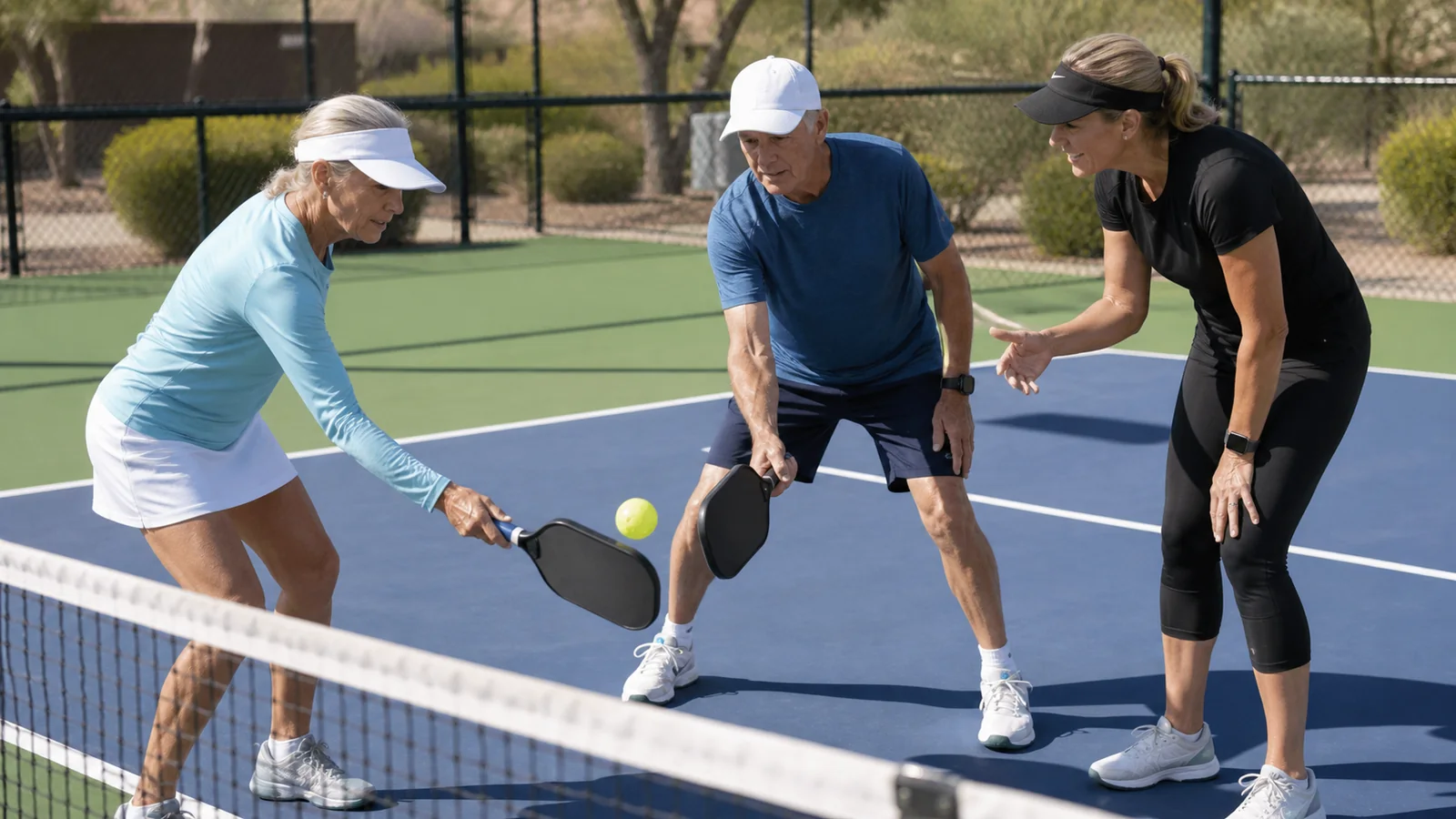
How the original video fits
Dr Barb Wally’s closing video in a five-part series offers general pickleball safety advice. The ChoosePT listing supports the presenter and practice connection, but credentials alone cannot establish that any tip in a video reduces injuries.
The video is retained for context, with the injury figures and evidence limits above checked against research publications. The most useful outcome of the evidence is a sensible question for each player: what movement, exposure, or medical issue should be addressed before the next game?
Watch the video
Research and professional sources
- Weiss et al., 2021 senior emergency-department surveillance.
- Hanks and Myers, 2025 recreational-player survey.
- Lee et al., 2025 national emergency-department analysis.
- Clinical pickleball injury considerations.
- American Medical Association physician safety interview.
This article is general information, not a medical assessment or a guarantee against injury. A qualified healthcare professional can advise on symptoms, past injuries, balance concerns, and return to play.