
Vince Gironda remains one of bodybuilding’s most quotable characters, which also makes him easy to misquote. A WorkoutHealthy Facebook post featured a line about refusing to attend bodybuilding “drug festivals” and presented it as Gironda’s explanation for avoiding contests.
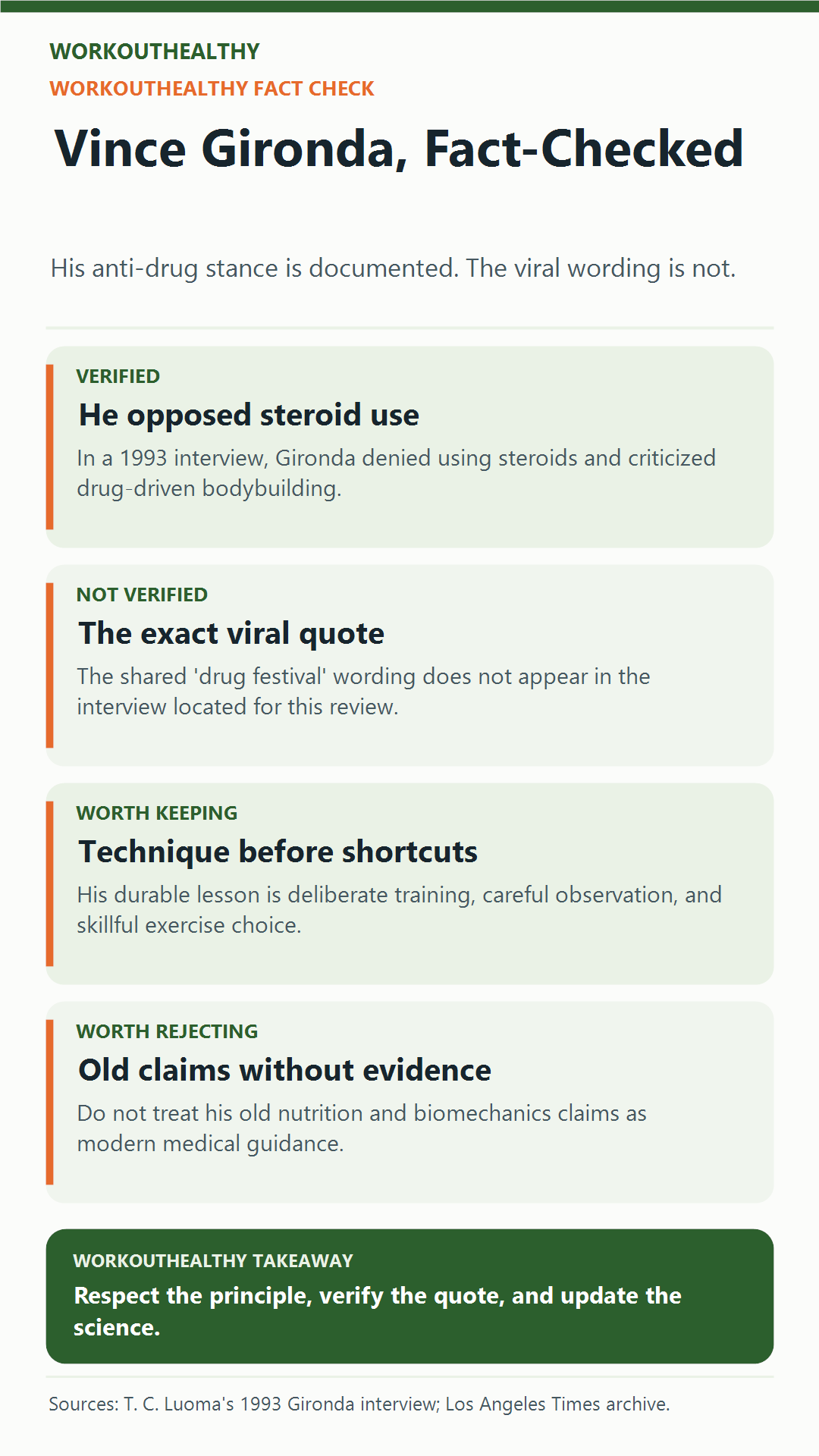
The source trail supports the larger point. Gironda publicly opposed steroids and sharply criticized the drug culture he believed had taken over competitive bodybuilding. The exact viral wording, however, does not appear in the 1993 interview located for this review.
That distinction matters. Gironda’s documented views are forceful enough without improving them for social media. The most useful version of his legacy separates what he actually said from what later fans turned into a cleaner slogan.
A true principle does not need a false quote to make it stronger.
What the viral post gets right
Gironda was openly anti-steroid. He trained during an era when physique competition was changing quickly, and he believed growing drug use had shifted attention away from training knowledge, proportion, and presentation.
He also preferred the language of sculpting over simple size. Gironda did not view bodybuilding as a contest to make every muscle as large as possible. He cared about silhouette, balance, definition, and how an exercise changed the visual relationship between body parts.
Those ideas explain why a line about avoiding drug-dominated contests sounds believable. It fits his documented tone and his criticism of the direction of the sport. Plausibility is not the same as verification, though.
A quote should be tied to a traceable interview, book, article, audio recording, or contemporary report. Without that connection, the honest label is “attributed to,” not a clean quotation mark and a famous name.
What Gironda put on the record
In a 1993 interview conducted by T. C. Luoma, Gironda was asked directly whether he had experimented with steroids. He said no. When asked about bodybuilding at the time, he described it as a drug culture and said he no longer attended contests.
The interview also shows why Gironda’s remarks spread so easily. His answers were blunt, compact, and combative. He rejected polite framing and often turned a question into a challenge about the interviewer’s assumptions.
A 1985 Los Angeles Times profile independently described him as opposing drugs, including steroids. That is useful corroboration because it predates the later interview and comes from a mainstream newspaper profile of his gym and training business.
Together, those sources support the substance of the Facebook post: Gironda opposed steroid use and disliked what he saw in competitive bodybuilding. They do not establish every vivid sentence later attached to him.
Why the exact quote stays unverified
The located 1993 interview contains Gironda’s criticism of a drug culture, but it does not contain the phrase “drug festival.” A broad search of indexed interviews and profiles did not produce a reliable primary or contemporary source for the full viral line.
That does not prove he never used the phrase. Bodybuilding history lived in gym conversations, newsletters, seminars, and magazines that are not all digitized. It does mean the quote should not be presented as settled fact.
The difference may feel small because the paraphrase is consistent with his views. It becomes important when a story is about a real person, especially one known for extreme statements. A sharper paraphrase can gradually replace the historical record.
The better article keeps both facts in view. Gironda did not need the phrase to be a fierce critic of drug-driven bodybuilding, and readers do not need a perfect sound bite to understand the principle.
Body sculpting was his real obsession
Gironda’s training reputation came from exercise selection, density, and visual judgment. He wanted movements to serve a specific purpose in a physique rather than appear on a universal list of mandatory lifts.
That led him to champion unusual variations, short rest periods, and methods such as sets of eight. It also led him to reject or modify popular exercises when he believed they developed the wrong area for a client’s aesthetic goal.
Some of those biomechanics explanations were oversimplified. A squat does not send nearly all its work to one muscle, and exercise effects cannot be read from appearance alone. Still, the question behind his choices remains useful: what adaptation is this movement supposed to create?
Modern lifters can apply that question without adopting every Gironda rule. A bench press and a floor press overlap, but they create different ranges of motion and loading options. Our guide to the floor press versus bench press shows how context changes which variation fits.
The training principles that still translate
First, perform exercises deliberately. Gironda valued control and attention. A repetition is more useful when the target muscles, range of motion, and progression are clear than when momentum merely moves the weight from one point to another.
Second, use rest periods as a variable. Shorter rests can increase session density and create a different challenge without adding endless exercises. They also reduce the load a lifter can maintain, so the choice should match the goal rather than serve as punishment.
Third, judge training by a body of evidence. Gironda observed clients closely and changed methods when the response did not match the intention. A modern version adds performance logs, repeatable measurements, and current research to that coaching eye.
Fourth, resist shortcuts that remove the skill from training. This does not mean supplements, machines, or efficient programs are automatically suspect. It means no tool replaces consistent sessions, progressive challenge, adequate food, and recovery.
If feedback is difficult to interpret alone, a qualified coach can shorten the learning curve. Our guide to deciding whether to hire a personal trainer explains how to look beyond charisma and marketing.
The claims that should stay in the past
Gironda promoted nutrition practices that included large quantities of eggs, red meat, raw dairy, supplements, and highly restrictive phases. Personal anecdotes from famous trainees do not establish the safety or effectiveness of those diets for the general public.
His interview also dismissed medical expertise in ways that should not be copied. A strong physique does not prove that someone understands cardiovascular risk, foodborne illness, medication interactions, or the management of a health condition.
Natural bodybuilding is not automatically evidence-based bodybuilding. A drug-free choice can reduce one category of risk while leaving poor programming, extreme dieting, dehydration, or unsafe supplement use untouched.
The same skepticism should apply to training claims. A method can be demanding and memorable without being superior for every body, schedule, and goal. Gironda’s certainty was part of his coaching persona, not a substitute for comparison research.
The WorkoutHealthy legacy filter
Here is the original-value framework for using an old-school coach responsibly. Put each claim through four filters: source, mechanism, outcome, and risk.
Source: Can you locate the original statement, or are you relying on a quote graphic? If the wording cannot be verified, describe the documented principle without quotation marks.
Mechanism: Does the explanation match current anatomy and physiology, or does it use a dramatic story that only sounds scientific? A method may work even when its original explanation was wrong.
Outcome: What result is being measured? An exercise that creates a strong pump may be useful, but the pump alone does not prove long-term muscle growth. A demanding workout can improve work capacity without being the best strength plan.
Risk: Who might be harmed by copying the advice? Nutrition, pain, rehabilitation, and drug-related claims deserve a much higher standard than a harmless change in exercise order.
This filter lets readers keep Gironda’s useful habits of observation and intention while refusing to inherit every certainty attached to his name.
The filter also prevents a common historical mistake: judging a coach only by the athletes pictured around him. A famous gym attracts unusual genetics, experienced trainees, and people using many methods at once. The result cannot be assigned to one exercise, one diet rule, or one personality without stronger evidence.
Use a training idea as a testable proposal. Keep the exercises stable for several weeks, record loads and repetitions, and note joint comfort and recovery. If the method improves the chosen outcome, it may deserve a place. If it only produces novelty and soreness, the legend attached to it does not rescue the plan.
The same standard protects natural athletes from a different shortcut: believing that hardship makes a routine pure. Drug-free training still needs enough food, realistic progression, sleep, and safe technique. Refusing steroids is a health decision, not a complete coaching system.
The bottom line
Vince Gironda’s anti-steroid stance is documented. The specific “drug festival” quote shared on social media could not be tied to a reliable original source and should remain labeled unverified.
His stronger legacy is a set of questions: Are you training with intention? Does each exercise serve the result you want? Are you learning from performance rather than chasing shortcuts? Those questions survive even when the quote and some of the old science do not.
Respecting a legend means preserving the record, not polishing it.
Get the next evidence check.
Five practical fitness stories worth your time, every Friday.
One email a week. No product pitches. Unsubscribe in one click.
Medical disclaimer: This article is general product information, not medical advice. The equipment described here is not a treatment for any condition. If you have an injury, ongoing pain, or a medical condition, talk to a doctor or physical therapist before using any of it.