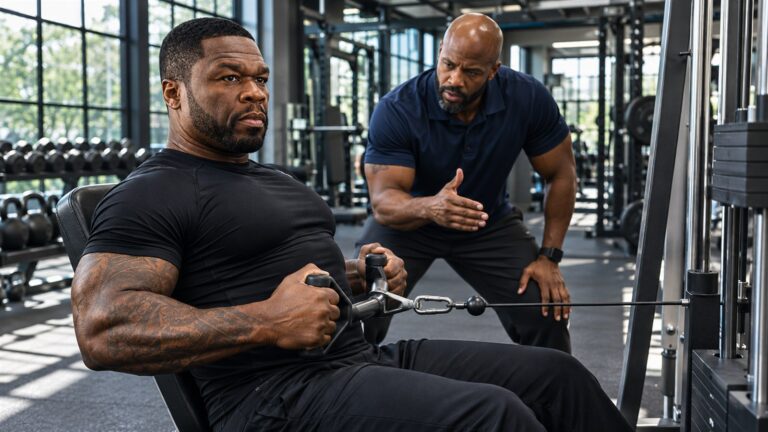

Loud grunts and slammed weights are part of the scene in many gyms.
For a nervous beginner, that noise can be a reason to stay home.
Vic Tanny, who built one of America’s first big gym chains, reportedly wanted none of it.
A popular post says Tanny promised controlled, comfortable workouts and insisted there was no need for overstraining, grunting, or groaning.
The spirit of that claim has some support. The exact source is less clear.
What We Could Confirm
In a 2015 book review in The Spectator, writer Mark Mason described Tanny as the American whose gyms asked members to refrain from grunting or groaning.
The review covered Eric Chaline’s book The Temple of Perfection: A History of the Gym.
One online profile of Tanny also says members were cautioned against overstraining and grunting and groaning.
That same profile says new members started on a 30 minute program, three days a week, built from 24 approved exercises.
So the “no grunting” idea is reported by more than one source.
We could not find an original Tanny advertisement with this wording.
For that reason, it is safer to call it a reported house rule than a quoted ad slogan.
A Quick Look at Tanny
Tanny was born in 1912 in Rochester, New York, and died in 1985.
His chain expanded across the United States. Contemporary TIME reporting counted roughly 80 clubs in 1961; later histories describe growth toward about 100 before the business collapsed in the 1960s.
His clubs were known for carpeting, bright colors, and music.
The best-equipped locations combined exercise rooms with swimming pools, steam rooms, tanning rooms, and even bowling alleys, according to TIME‘s 1961 account. Amenities varied by location.
A calm, no-grunting rule fits the club’s polished public image, but it is not evidence that every member had a welcoming experience.
The Business Context Behind the Polished Gym
The appealing rooms were only part of Tanny’s story. TIME reported in 1961 that the chain used commission-driven sales teams and aggressively pursued membership contracts. The article described consumer complaints and a New York fair-practices agreement intended to curb deceptive or misleading sales methods.
That contemporary account reported allegations, not court findings that every complaint was true. It is useful context for the contrast between the quiet, controlled workout ideal and the pressure some prospective members said they encountered while signing up.
The specific phrase about avoiding grunting is reported in a later review of Eric Chaline’s gym history. We have not verified it against an original Vic Tanny advertisement, so this article does not present the wording as his direct quote or a documented ad slogan.
Image note: The featured scene is an AI editorial reconstruction of a mid-century health club, not an archival photograph of Vic Tanny or one of his facilities.
Why the Rule Made Sense for His Members
Tanny’s clubs aimed at ordinary people, not only serious lifters.
Many of them were likely new to training.
For them, a short, steady routine was a gentler way in.
Straining to the limit on day one can leave a beginner sore, discouraged, or hurt.
A quieter floor also sends a message: you do not have to perform for anyone here.
Hard work does not have to be loud. Most progress comes from steady sets you can repeat next week.
Do You Have to Train to Failure?
This is where modern research is useful.
Training to failure means doing reps until you cannot complete another.
Those final reps are usually where the straining, and the grunting, happens.
In a 2022 meta-analysis, Jozo Grgic and colleagues compared training to failure with stopping short of failure.
They found no significant difference between the two for strength or muscle growth overall.
When studies did not match training volume, stopping short of failure led to better strength results.
Among people who already lifted, training to failure did show an advantage for muscle growth.
In a 2023 review, Martin Refalo and colleagues looked at 15 studies on how close to failure people trained.
They found only a trivial advantage for training to set failure when all definitions were pooled.
For true momentary failure versus stopping short, they found no advantage for muscle growth.
They concluded there is no evidence that training to momentary failure beats non failure training for muscle growth.
Where Tanny’s Idea Falls Short
The widely shared version deserves a caution.
Controlled training is not the same as easy training.
Stopping short of failure is not the same as stopping early.
Experienced lifters working near their maximum will strain, and some will make noise.
That is not automatically bad form.
A short, forceful exhale on a hard rep is common in many sports.
What matters more is whether the weight moves with good control.
The Grgic review also found an edge for failure training in trained lifters seeking muscle growth.
So “never strain” is too simple as a rule for everyone.
What This Does Not Prove
Neither review studied Tanny’s program or gym rules.
They also did not measure whether a quiet gym helps people stick with training.
The reviews focused on strength and muscle size, not on injuries or joint health.
And our sources on Tanny’s rule are secondhand, not his own words.
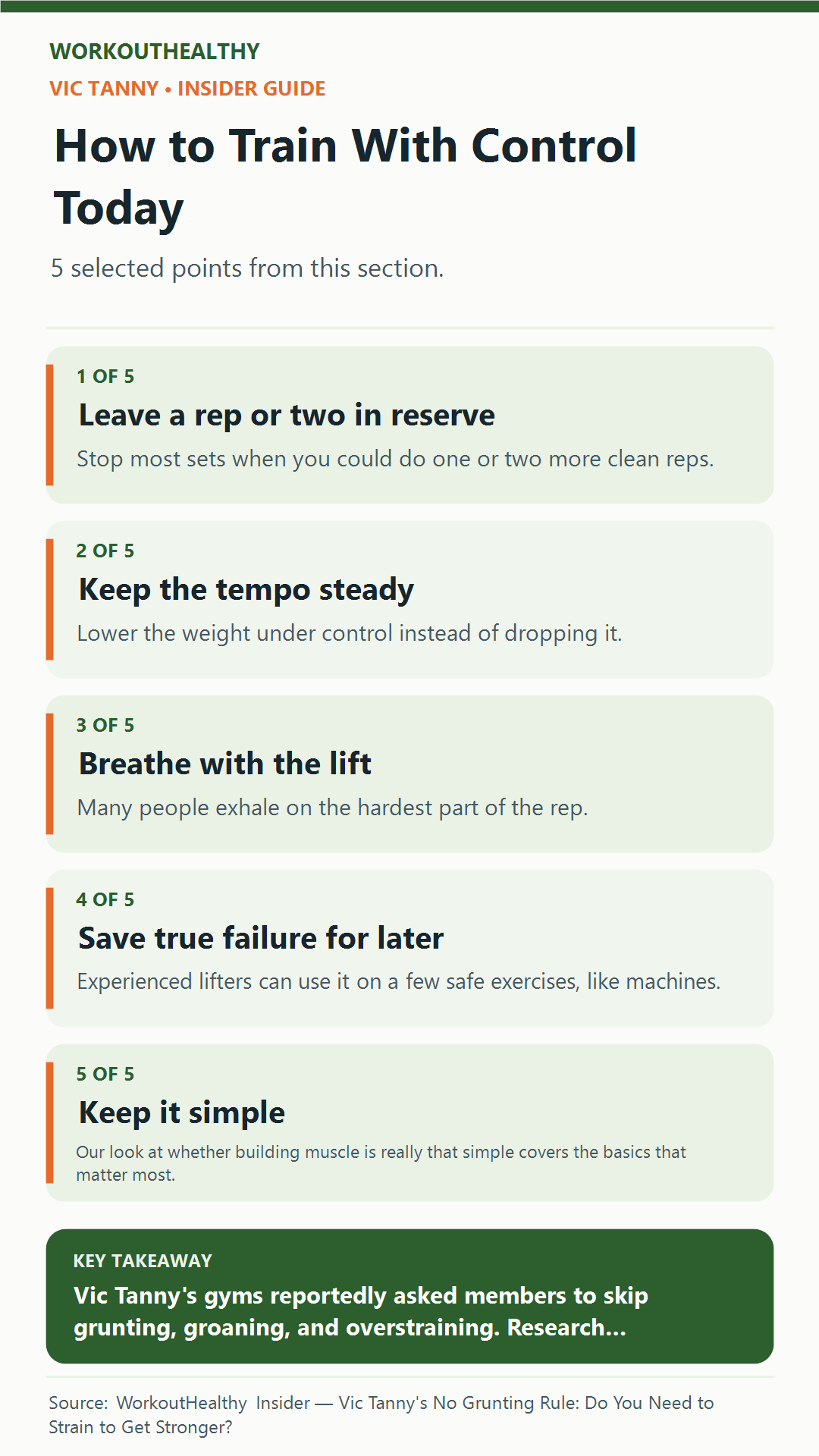
How to Train With Control Today
- Leave a rep or two in reserve. Stop most sets when you could do one or two more clean reps.
- Keep the tempo steady. Lower the weight under control instead of dropping it.
- Breathe with the lift. Many people exhale on the hardest part of the rep.
- Save true failure for later. Experienced lifters can use it on a few safe exercises, like machines.
- Keep it simple. Our look at whether building muscle is really that simple covers the basics that matter most.
- Plan your next block. When a routine ends, see what to do after a workout program ends.
Adults starting in midlife can also use this strength plan for your 40s as a controlled starting point.
Common Mistakes
One mistake is treating every set as a max effort.
That adds fatigue without much extra benefit for most people.
Another is going so easy that sets never feel challenging.
Stopping short of failure still means the last reps should feel hard.
A third is judging a workout by how loud or exhausting it felt.
Progress shows up in your logbook over weeks, not in how wrecked you feel after one session.
A fourth is copying the loudest lifter in the room.
Their program may fit their goals and experience, not yours.
Who Should Be Careful
People with high blood pressure, heart disease, eye conditions, or hernias should ask a doctor about heavy straining.
Holding your breath while pushing hard can raise pressure in the chest and head.
Beginners and anyone returning from injury should stay well short of failure at first.
Stop if you feel dizzy, sharp pain, or chest discomfort.
The Bottom Line
Vic Tanny’s gyms reportedly asked members to skip grunting, groaning, and overstraining.
Research suggests most people can build strength and muscle without training to failure.
But hard sets still matter, and advanced lifters will sometimes strain on purpose.
Want more stories like this? Subscribe to WorkoutHealthy Insider for practical explanations behind popular fitness claims.
References
- Grgic, J., Schoenfeld, B. J., Orazem, J., & Sabol, F. (2022). Effects of resistance training performed to repetition failure or non-failure on muscular strength and hypertrophy: A systematic review and meta-analysis. Journal of Sport and Health Science, 11(2), 202 to 211. https://doi.org/10.1016/j.jshs.2021.01.007
- Mason, M. (2015, March 5). 2,500 years of gyms (and you’re still better off walking the dog). The Spectator. https://spectator.com/article/2-500-years-of-gyms-and-you-re-still-better-off-walking-the-dog-/
- Refalo, M. C., Helms, E. R., Trexler, E. T., Hamilton, D. L., & Fyfe, J. J. (2023). Influence of resistance training proximity-to-failure on skeletal muscle hypertrophy: A systematic review with meta-analysis. Sports Medicine, 53(3), 649 to 665. https://doi.org/10.1007/s40279-022-01784-y
- TIME. (1961, February 10). Modern living: Tannyed & fit. https://time.com/archive/6809791/modern-living-tannyed-fit/
- Pollack, B., & Todd, J. (2016). American Icarus: Vic Tanny and America’s first health club chain. Iron Game History. https://starkcenter.org/igh/igh-v13/igh-v13-n4-v14-n1/igh1304-1401p17.pdf
This article is for general information only and is not medical advice. If you have an injury, ongoing pain, or a medical condition, talk to a doctor or physical therapist before you change how you train or eat.