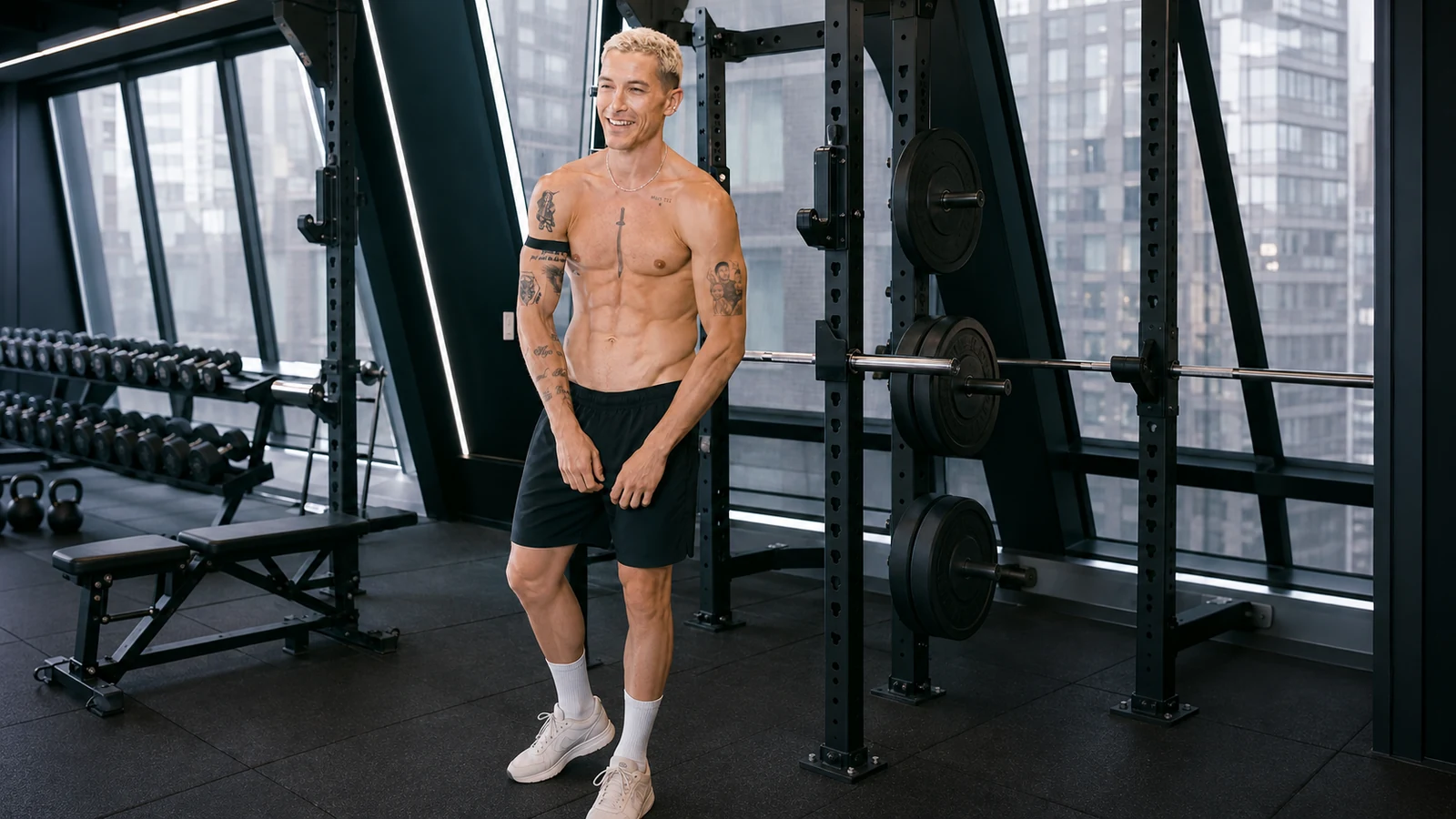

Taz Skylar plays Sanji in Netflix’s live action One Piece, a role built almost entirely around kicks.
Sanji fights with his legs and never his hands. He holds onto that rule to protect his hands, which he also needs for cooking.
To move like that convincingly on screen, Skylar has leaned on a mix of martial arts drills, kettlebell work, and cardio conditioning.
Kick heavy training demands things that traditional lifting alone does not build. It demands hip mobility. It demands core control. It demands balance under fatigue.
Fight choreography training is different from training for strength alone. It requires speed and flexibility too. It requires the stamina to repeat explosive movements again and again, take after take, for hours at a time.
Who Is Taz Skylar
Taz Skylar was born December 5, 1995, in Tenerife, in Spain’s Canary Islands.
He holds dual British and Spanish citizenship and is fluent in Spanish. His father is Lebanese, born in Sierra Leone. His mother is English, from Yorkshire.
Before acting, Skylar spent his teenage years building surfboards, starting around age 15. He tried to join the British Army as a reservist in 2016 but did not pass the required medical evaluations after a car accident. During the waiting period that followed, he pivoted toward writing and acting instead, a shift that ended up defining his career.
He co-wrote and starred in an off West End play called Warheads in 2019. The play was inspired by a friend’s real military experience. It earned an Olivier Award nomination, one of British theater’s top honors.
He also wrote and starred in the Amazon Prime film Gassed Up, continuing to build a career as a writer as well as an actor.
Skylar joined Netflix’s live action One Piece as Sanji in 2021. The show’s first season premiered in 2023. Season two arrived in 2026, with season three currently in production.
A Character Who Fights Entirely With His Legs
Sanji is one of the more physically demanding roles in modern action television, precisely because of one creative constraint.
In the source material, Sanji refuses to use his hands in a fight. He considers them tools for cooking, not fighting, so every offensive move in his arsenal comes from his legs instead. That single rule shapes an entire fighting style built around kicks, spins, and rapid footwork.
Playing that character means an actor’s kicking has to look fast, controlled, and powerful. It cannot just be technically correct.
According to reporting on his preparation, Skylar trained extensively in martial arts. He did this specifically so he could perform most of his own stunts, rather than relying entirely on a stunt double for the character’s signature kicks.
Why Kicking Is Harder to Train Than It Looks
A high, fast, controlled kick is one of the more technically demanding movements in combat sports.
A 2022 study in the journal Applied Sciences looked closely at this exact question. It examined what drives kicking speed in a taekwondo roundhouse kick, a close cousin of the kicks Sanji throws on screen.
Researchers Taewoon Jung and Hyoungjin Park analyzed how different parts of the body contribute to the speed of the kicking foot.
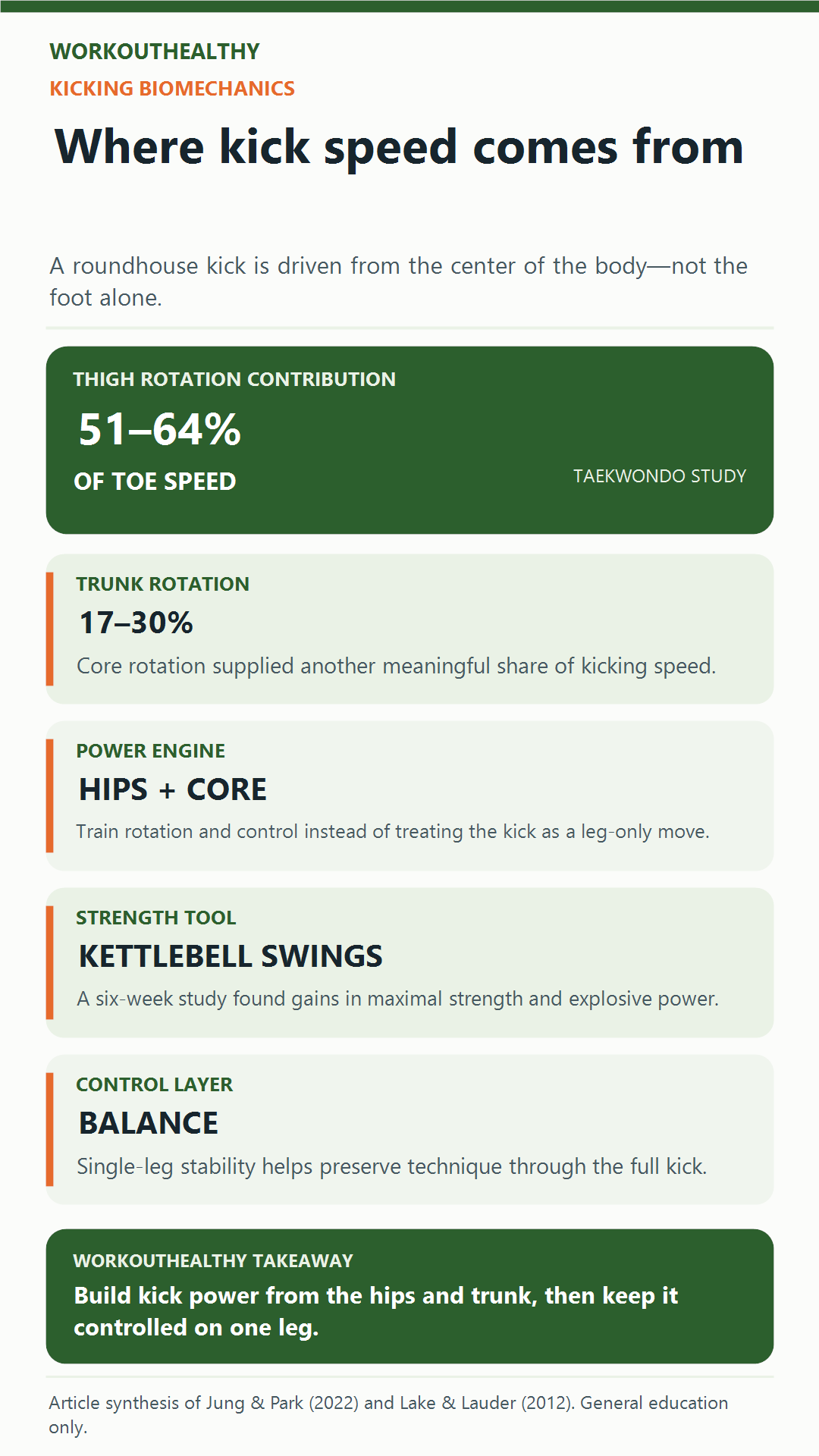
Their findings were clear. Thigh rotation contributed the most to kicking speed, accounting for roughly 51 to 64 percent of the total. Trunk rotation came next, contributing another 17 to 30 percent.
A fast, powerful kick is not really an arm and leg exercise. It is a hip and core exercise that happens to end at the foot.
That finding explains why hip and core control matter so much for this role. Skylar’s reported training emphasis on both makes physical sense, beyond simply looking dramatic on screen. The muscles that actually generate a kick’s speed and power sit closer to the center of the body than most people assume.
Where Kettlebells Fit Into Kick Training
Kettlebell training shows up often in combat sports conditioning, and the reasons are backed by real research.
A 2012 study led by Jason Lake and Mike Lauder tested this directly. It ran six weeks of kettlebell swing training in a group of recreational athletes, and the results were published in the Journal of Strength and Conditioning Research.
The researchers measured maximal strength and explosive power before and after the training block.
The results showed meaningful improvements in both areas. Kettlebell swing training improved maximal strength and standing long jump performance, a marker of explosive lower body power, in a relatively short six week window.
That kind of explosive hip power translates directly to kicking. The kettlebell swing trains the same hip hinge pattern that generates force in a kick, just in a simpler, more repeatable movement that is easier to load and progress safely.
The Cardio Side of Fight Choreography
Filming a fight scene is not one explosive kick. It is dozens of takes of the same sequence, repeated until a director is satisfied.
That repetition demands a different kind of conditioning than a single competitive match. An actor has to be able to throw the same combination of kicks at full speed and full control, over and over, without the movement quality breaking down from fatigue partway through a long filming day.
This is likely why cardio conditioning is also a stated part of Skylar’s training. Building a large aerobic base supports faster recovery between takes. It also helps maintain technique when the body is tired, which is exactly the condition an actor is in by the tenth or twentieth take of a fight sequence.
What This Evidence Does Not Prove
A few honest limits are worth stating clearly.
No detailed, verified training log from Skylar’s own preparation has been published. That means no specific sets, reps, or weekly training splits are publicly confirmed.
The general description here comes from entertainment reporting on the production. It does not come from a formal interview transcript with every detail confirmed.
Both studies cited here come from controlled research on other populations. Neither study involved Skylar specifically.
They explain why this training makes sense for a kicking based fighting style. They do not confirm the exact program Skylar personally followed.
What Balance Adds to the Picture
Kicking is not just about generating power. It is also about staying upright while doing it.
A high kick briefly shifts a fighter onto one leg, often at speed. The whole body’s weight ends up balanced over a small base of contact with the ground. Losing balance mid kick does not just look bad on camera. It can genuinely increase injury risk, especially during repeated takes when fatigue starts to affect coordination.
That is one more reason core control matters so much here. A strong, stable core helps a fighter control their balance through the full range of a kick, from the wind up through the strike and back down to a ready stance.
Balance training does not have to be complicated. Single leg standing drills, controlled step ups, and slow, deliberate practice of the kick itself at partial speed all build the same underlying skill that a fast, full speed kick eventually depends on. Explosive lower body work like this shares a lot in common with other jump and power training, including the kind covered in this look at whether box jumps can build muscle.
Common Mistakes People Make Training for Kicking Power
A few mistakes show up often in people trying to build this kind of explosive, kick focused conditioning.
The first mistake is training the legs without training hip and core rotation. Straight leg strength alone will not produce a fast kick if the hips and trunk cannot rotate quickly and powerfully to drive that leg forward.
The second mistake is skipping mobility work. Tight hips limit how high and how fast a kick can travel, no matter how strong the surrounding muscles are.
The third mistake is training explosive power without a strength foundation first. Explosive movements like kettlebell swings work best once a person has built a baseline of general strength and can move with good control under load.
The fourth mistake is neglecting the aerobic side of conditioning. Pure strength and power training alone will not prepare a person for repeated, high output movement over a long stretch of time, whether that is a fight scene or a real sparring session.
How to Build a Kick Focused Training Plan
Anyone interested in this style of training can build a simplified version without a martial arts background.
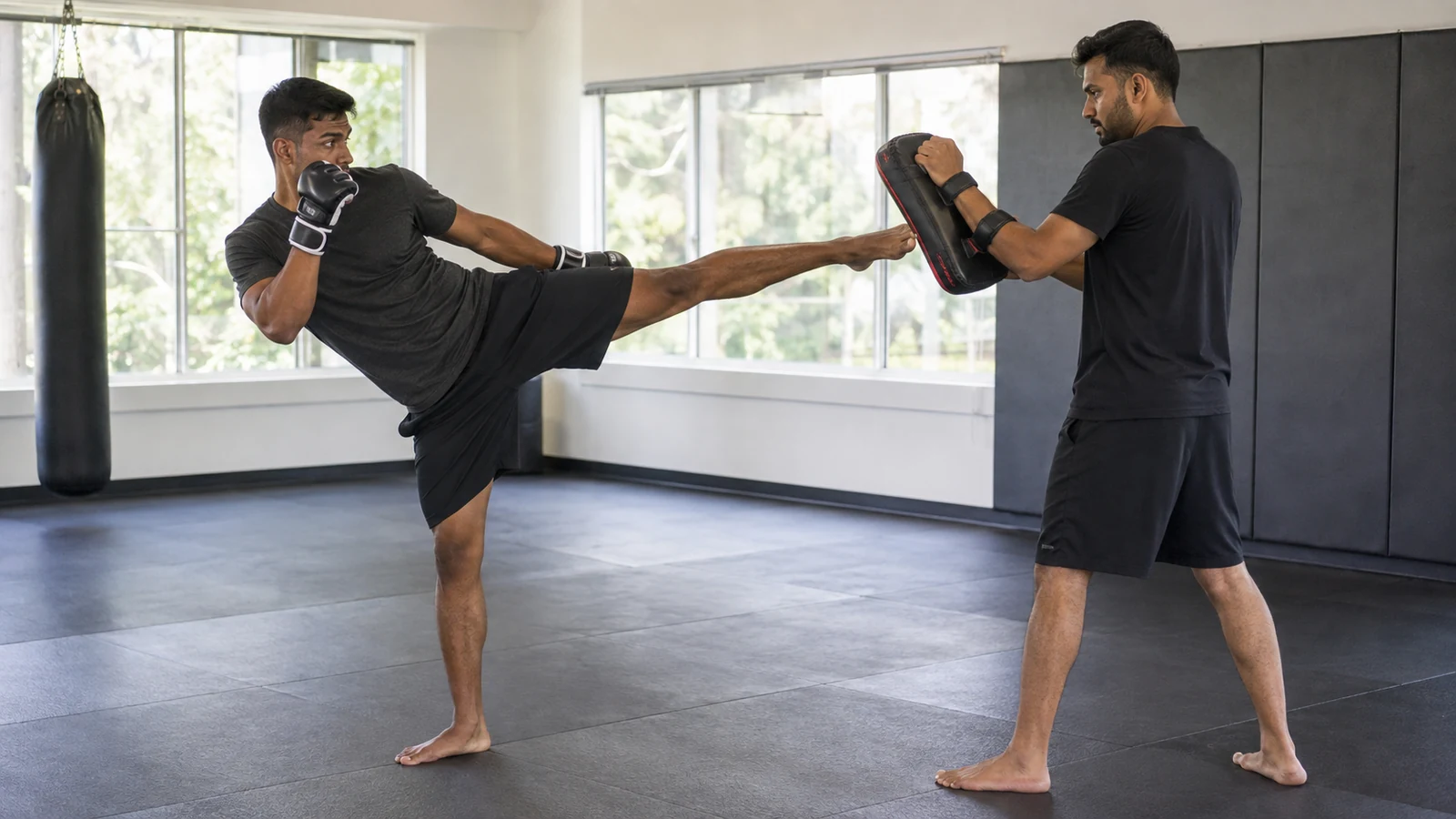
Start with hip and ankle mobility work at the beginning of every session. Dynamic leg swings, hip circles, and deep squat holds all help prepare the joints that a kick depends on most.
Add kettlebell swings two to three times a week. Three to five sets of ten to fifteen reps is a reasonable starting point. This builds the explosive hip hinge power that research links directly to kicking speed.
Include rotational core work, like cable rotations or medicine ball throws, to train the trunk rotation that contributes meaningfully to kicking speed alongside the hips.
Add steady state cardio or interval conditioning two to three times a week. Even 20 to 30 minutes of continuous movement helps build the aerobic base needed to maintain quality movement across a long session.
Practice the actual kicking technique on its own, separate from strength and conditioning work. Qualified coaching helps here more than almost anywhere else in this plan. Technique and timing matter as much as raw physical output when it comes to a kick that looks fast, clean, and controlled. For anyone deciding whether to bring in outside coaching for any of this, this guide on whether a personal trainer is worth it and how to hire one covers what to look for.
The Takeaway
Sanji’s fighting style on screen looks effortless. It is really the product of months of unglamorous conditioning work behind the scenes.
Both studies point to the same underlying idea. Kicking power comes mostly from the hips and core, not the leg alone.
Building that power takes a deliberate mix of mobility, strength, and conditioning work. That is exactly the combination Skylar has reportedly used to bring Sanji to life on screen.
References
Jung, T., and Park, H. (2022). Contributions of body segments to the toe velocity during taekwondo roundhouse kick. Applied Sciences, 12(15), 7928. https://doi.org/10.3390/app12157928
Lake, J. P., and Lauder, M. A. (2012). Kettlebell swing training improves maximal and explosive strength. Journal of Strength and Conditioning Research, 26(8), 2228 to 2233. https://doi.org/10.1519/jsc.0b013e31825c2c9b
Wikipedia. Taz Skylar. Retrieved September 2026.
This article is for general information and is not medical or fitness advice. Talk with a doctor or a qualified coach before starting a new martial arts or high intensity training program, especially if you have an existing joint issue, injury, or health condition. Individual results from any training plan will vary.