
Taraji P. Henson’s training story is more useful when it is about attention, not imitation.
The actor has described exercise as valuable for her mental well-being, and a scheduled WorkoutHealthy post highlights a gym reel with several strength movements.
The central idea is supported by her interviews: training matters to her for reasons beyond appearance.
The exact reel’s full context is less certain.
That makes this a story about verified priorities and sensible takeaways, not a reconstruction of a celebrity workout plan.
Here is what we can establish, what a short clip cannot show, and how to use the inspiration without copying someone else’s training demands.
What Henson Has Actually Said
In a 2025 Harper’s Bazaar interview, Henson identified Mike T. at Force Fitness as her trainer and described exercise as mentally important to her.
She also described a demanding weekly schedule.
That is a firsthand account of her priorities, not a recommended schedule for everyone reading it.
The useful part is the reason she gives for showing up.
Appearance can be one motivation without being the only measure of a successful session.
A workout may also offer a break from the day, a task to concentrate on, or the satisfaction of following through on a plan.
Her relationship with Mike T. is not new.
A 2015 W interview with the trainer described mixing weight training with treadmill work around Henson’s schedule.
That older account supports a long-running training relationship, but it cannot establish what she does in every current workout.
Dates matter here.
An interview from a decade ago is context, not a fresh prescription.
A recent social caption is a glimpse, not a complete record of her sets, recovery, medical history, or coaching decisions.
Why a Gym Reel Is Not a Complete Program
The WorkoutHealthy Facebook post describes a reel featuring cable raises, preacher curls, and a landmine movement.
It emphasizes focus and enjoyment rather than a precise program.
We could independently confirm Henson’s broader explanation of why she trains, but not the full original reel or its exact exercise sequence.
That limit changes what an article should promise.
There is no verified set-by-set Taraji workout here, no confirmed load for the movements, and no basis for saying the clip shows a normal week.
Treat the named exercises as the social post’s description, not as a routine she has personally prescribed.
A short clip also leaves out the decisions that make training appropriate for a person.
You may not see the warm-up, an earlier session, a coach’s adjustments, or the time between filmed sets.
Camera angles can hide how a handle, bench, or attachment is positioned.
The practical question is therefore not, “Can I copy everything in this video?”
It is, “Which training idea is useful to me, and what would I need to understand before trying it?”
That approach keeps the inspiration while dropping the guesswork.
What the Named Movements Can Teach
A cable raise, a supported curl, and a landmine exercise are different movement problems.
Simply seeing all three in one clip does not tell you which muscles Henson’s trainer intended to emphasize or how the exercises fit together.
Even the phrase “landmine movement” could describe several exercises.
Use the equipment names as a starting point for learning, not as permission to improvise under load.
For a cable movement, understand where the line of resistance comes from and how to keep the handle under control.
Check that the attachment is secure before starting.
With a preacher curl, the support changes how you position your upper arm.
It does not make any weight automatically appropriate.
If you cannot control the lowering phase without shifting or rushing, choose a lighter load and ask a qualified trainer to check the setup.
A landmine uses one anchored end of a barbell.
Before trying any version, identify whether you are learning a press, a row, or another pattern.
A stable anchor, adequate clearance, and a demonstration of that exact exercise matter more than copying the look of a celebrity clip.
These are general learning cues, not Henson’s coaching instructions.
The point is to make a movement understandable before making it harder.
The Mental Benefits Need the Right Context
The broader evidence supports treating physical activity as more than a way to change appearance.
CDC guidance describes reduced short-term feelings of anxiety after moderate-to-vigorous activity and mental-health benefits from regular activity.
Those population-level benefits do not prove what happens in one person’s mind during one filmed set.
Feeling more focused after training is a personal experience, not a diagnostic test.
Another person may finish a session tired, frustrated, or unchanged.
A bad day at the gym does not mean they have failed, and a good day does not establish that exercise has treated a mental-health condition.
Keep the distinction between support and treatment clear.
Movement can be part of caring for yourself while professional mental-health care remains important when needed.
It is not a reason to stop treatment or to assume someone else should be able to exercise their way out of distress.
A more useful check-in is specific and modest: did this session fit your energy, let you practice something, or give you a manageable break?
You do not need a dramatic emotional transformation to count the time as worthwhile.
Three Checks for a More Focused Session
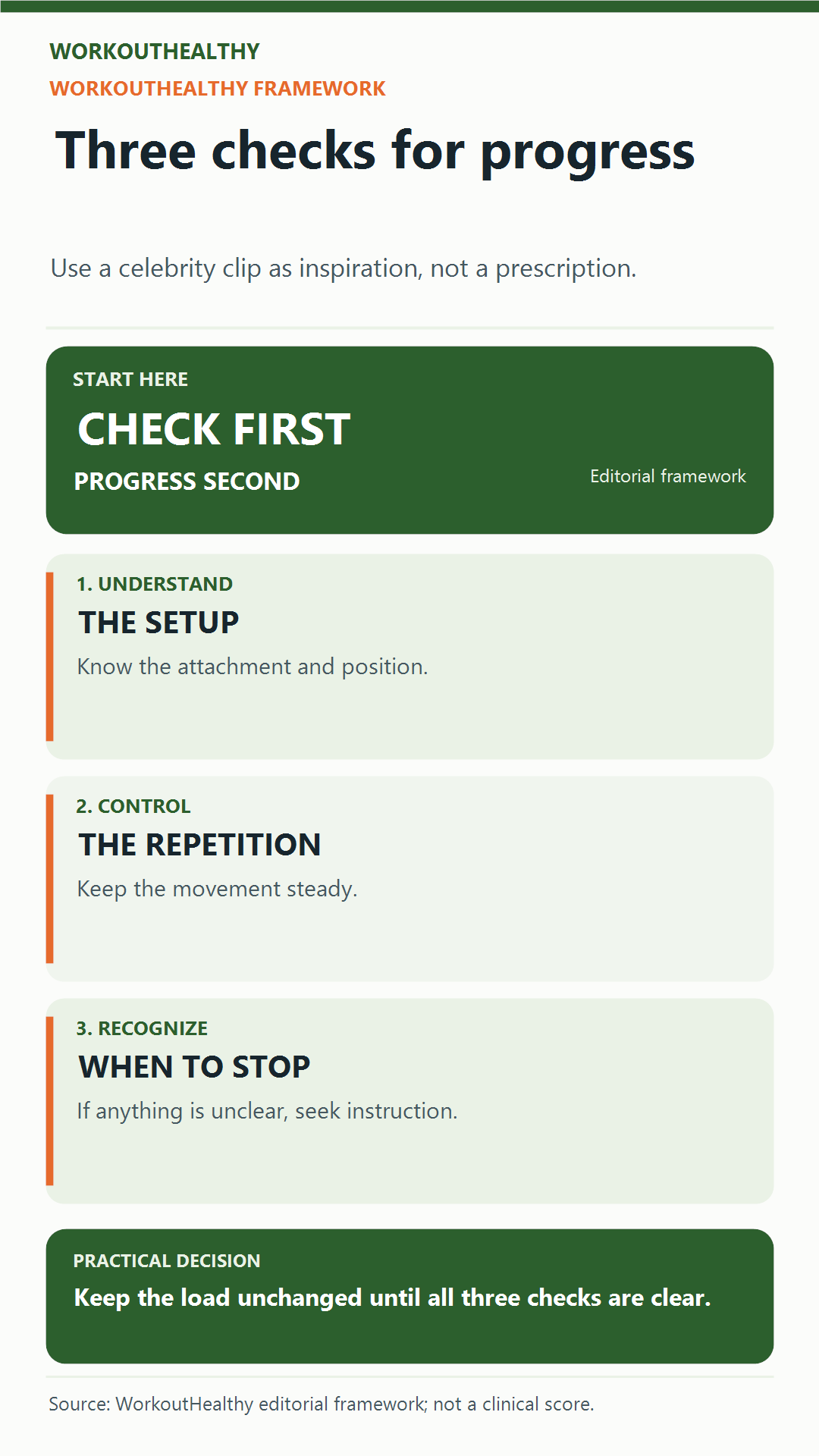
WorkoutHealthy’s decision rule uses three checks before making a movement harder: understand the setup, control the repetition, and know when to stop.
If any answer is unclear, keep the load unchanged and seek instruction before progressing.
This is an editorial learning framework, not a validated clinical score or Henson’s personal method.
“Stay focused” is easy to say and hard to measure.
Give it a concrete job instead.
Before a set, choose one thing you can observe, such as keeping the movement controlled, following the coach’s cue, or stopping before fatigue changes the position you are trying to practice.
After the set, note what actually happened.
Did the final repetitions look like the first?
Did you rush because you were watching somebody nearby?
Were you paying attention to the movement or worrying about how you looked?
These questions provide useful feedback without turning the session into a verdict on your character.
A short training note can include the exercise, load, repetitions, and a sentence about control.
Do not use it to force improvement every time.
The record can also tell you that a setup felt awkward or that today called for less work.
Keep one aim distinct from another.
Learning a new exercise, practicing a familiar movement, and completing a demanding session are not identical tasks.
Choosing the day’s priority can make a session feel clearer without pretending there is one ideal mindset for everyone.
A celebrity workout can provide an idea. It cannot provide your starting point.
Build Consistency Without Copying Her Volume
A celebrity’s reported training frequency comes with circumstances you cannot see in a caption.
Coaching, scheduling flexibility, recovery resources, and years of practice may all differ from your own situation.
More sessions are not automatically the next step for someone rebuilding a habit.
Choose an arrangement you can repeat in an ordinary week, not just an unusually quiet one.
Decide when training is likely to fit, which equipment you know how to use, and what help you need.
Leave room for changing plans when work, family, illness, or fatigue intervenes.
Consistency is easier to evaluate across several weeks than from one impressive day.
If an ambitious plan keeps falling apart, reducing its demands is a reasonable adjustment.
It is not proof that you lack discipline.
A realistic plan should acknowledge the life it needs to fit.
Henson’s long association with a trainer also highlights the value of continuity rather than novelty.
You do not have to discover a new exercise each session for the work to have a purpose.
Familiar movements can give you a clearer way to notice control and progress.
For another example of exercise fitting the day instead of taking it over, read Alessandra Ambrosio’s travel yoga habit.
The lesson is portability and routine, not copying a model’s schedule.

Let Enjoyment and Support Count
The social post says Henson credits Mike with pushing her while making the session fun.
Without the complete original reel, that remains the post’s framing.
Independently, the interviews establish a sustained trainer relationship, which is useful context for understanding the support behind her training.
A coach’s role should be more than making exercise difficult.
Clear explanations, appropriate adjustments, and feedback you can understand make it easier to learn what you are doing.
You should be able to ask why an exercise is there and what to change when it does not fit.
Enjoyment does not require loving every repetition.
It might mean appreciating the setting, feeling comfortable asking questions, or liking the experience enough to return.
If embarrassment or pressure dominates the session, reconsider the environment rather than assuming discomfort is the price of commitment.
Training with a friend, attending a familiar class, or having a clear independent plan are different ways to add support.
None guarantees consistency, and you do not need to purchase celebrity-level coaching to begin.
Look for an arrangement that makes the next sensible session easier to organize.
Our article on Miley Cyrus and running for joy explores another public account of exercise being meaningful beyond an appearance goal.
What to Take From Henson’s Example
Henson’s verified interviews support a grounded story: training is personally important to her mind as well as her physique, and she has worked with Mike T. over many years.
The available evidence does not turn the Facebook reel into a complete current routine or a universal formula.
Take the transferable parts rather than the unverified details.
Ask what movement you understand, what kind of support helps you, and what schedule you can sustain.
Keep your exercise choices separate from assumptions about someone else’s body, results, or private health.
If a movement causes pain, do not use a celebrity example as a reason to push through.
Stop and seek appropriate guidance.
If you have a medical condition or are returning after injury, work with a clinician or qualified exercise professional on an appropriate starting point.
You can also read Emma Willis’s strength-training story, which separates sourced habits from exaggerated diet claims.
The useful benchmark is a session you can understand and repeat, not a physique you saw on a screen.
That is the strongest way to read this post: not as an invitation to duplicate Henson’s weights or weekly volume, but as a reminder that exercise can have a purpose beyond the mirror.
A manageable session, a clear learning goal, and the right support are enough to make that purpose your own.
Get the next evidence check.
Five practical fitness stories worth your time, every Friday.
One email a week. No product pitches. Unsubscribe in one click.
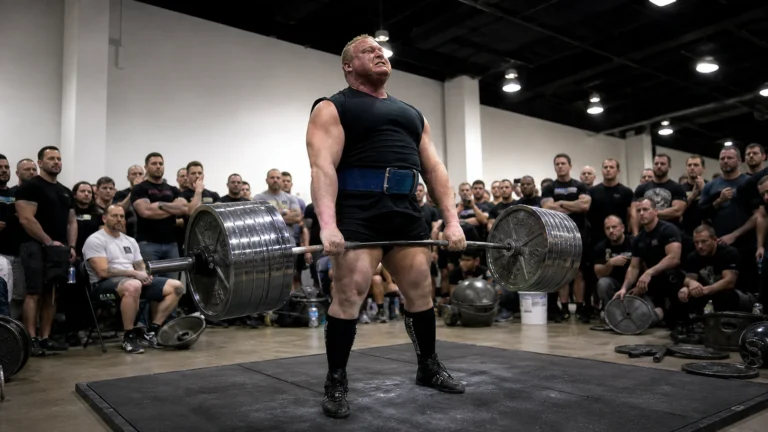
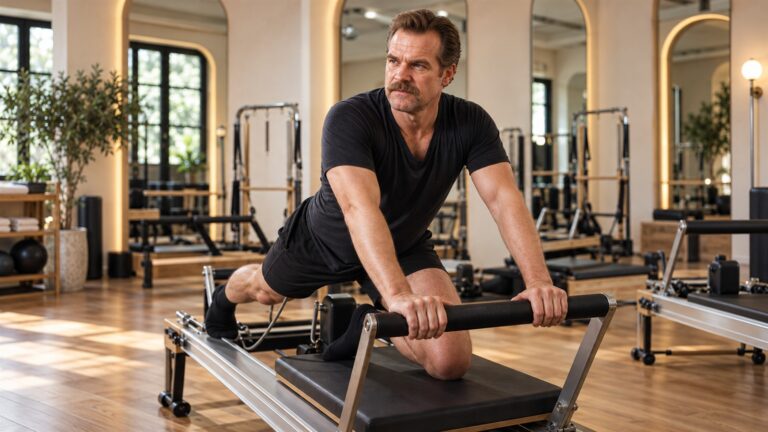
Image note: Article imagery is illustrative, based on the WorkoutHealthy Facebook creative.
It is not documentary evidence of Henson’s original reel or an endorsement.
Medical disclaimer: This article is general product information, not medical advice. The equipment described here is not a treatment for any condition. If you have an injury, ongoing pain, or a medical condition, talk to a doctor or physical therapist before using any of it.