
Richard Simmons made joyful cardio feel possible for people who did not see themselves in the usual fitness class.
His own account of losing weight helped shape a career built around music, encouragement and participation.
In a 2002 CNN interview, Simmons reported losing 123 pounds.
That is a historical personal account, not a result someone should expect from following a video or attending a class (CNN, 2002).
The useful question today is what helps you return to suitable activity.
This article follows the documented story, explains the relevant motivation research and offers a practical way to assess a class.
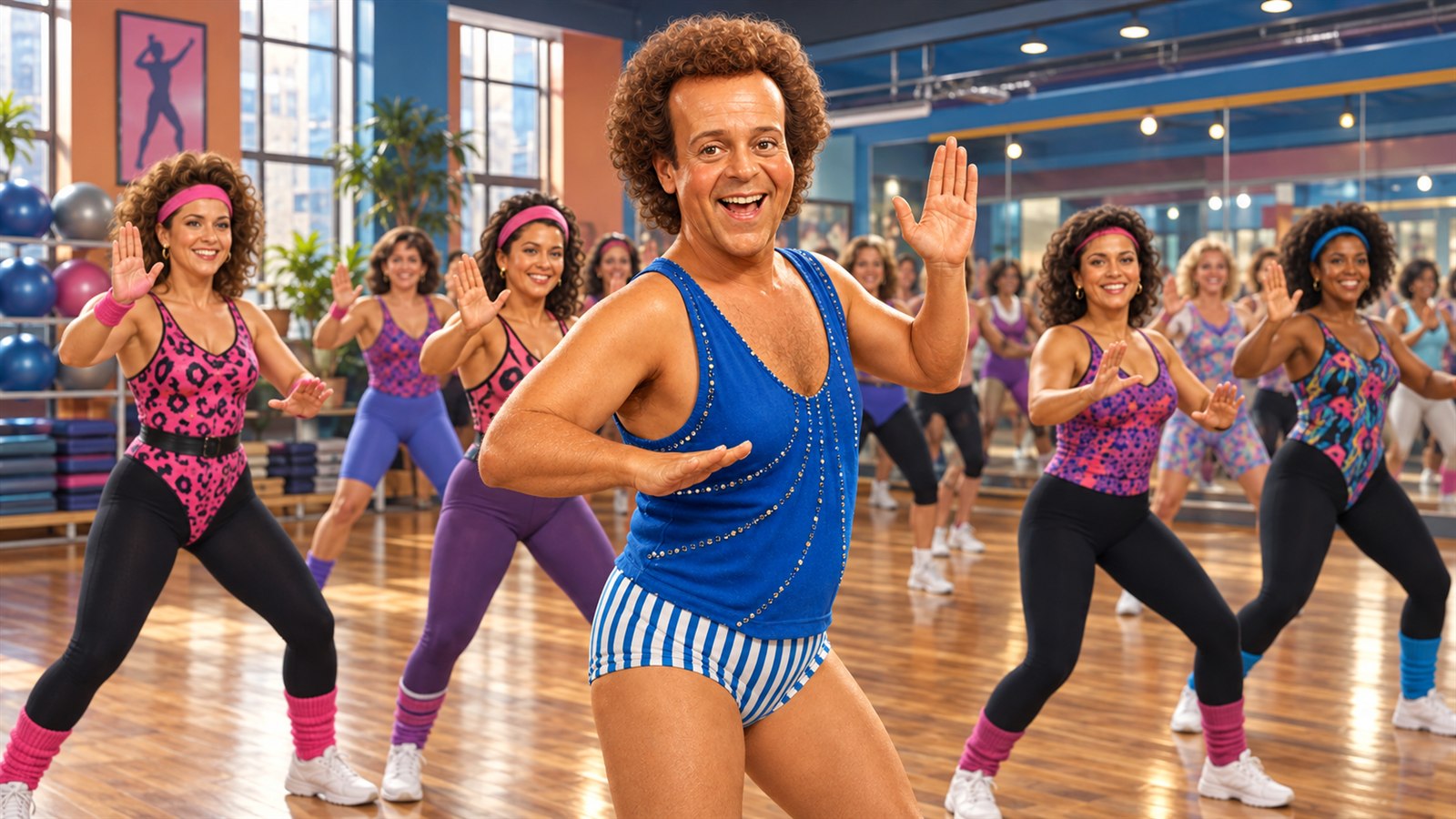
Illustration note: The hero is an editorial illustration of Simmons leading an upbeat class. It does not document a particular workout, location or event.
What Simmons said about his own weight loss
Simmons told CNN that he had lost 123 pounds and described being a heavier child.
The interview connects that experience to his interest in helping people begin exercising, including older adults and people who needed seated options (CNN, 2002).
His official biography describes a difficult early relationship with food and harmful attempts at dieting, followed by changes in eating and activity.
It also records his dissatisfaction with exercise settings that welcomed people who were already fit (Richard Simmons, n.d.-b).
Those accounts explain the origin of a public message.
They do not provide a controlled study of his program, a complete medical history or a formula for another person’s weight change.
Keep the reported loss in that biographical context.
A person’s starting health, circumstances, treatment and goals differ, and a celebrity’s story cannot determine an appropriate target for you.
The historical value is more concrete: someone who remembered feeling excluded built a business around inviting other people into exercise.
That invitation became a visible part of the way he taught.
If you are interested in changing your activity, begin with the activity itself and the support you need to do it.
You do not have to set a goal matching Simmons’s reported loss before you can choose a suitable class.
How he widened the invitation to exercise
According to his official biography, Simmons opened his Beverly Hills studio in 1974 and welcomed people across ages, sizes and abilities.
The studio became known as Slimmons (Richard Simmons, n.d.-b).
That approach extended beyond adult classes.
In testimony to Congress on July 24, 2008, he described feeling left out of sport at school and argued for physical education that included children with different abilities (U.S. House of Representatives, 2008).
The testimony documents his advocacy.
His personal recollections and the questionnaire discussed in the hearing should not be treated as a representative population study or as current national statistics.
When NPR reported his death at age 76 in July 2024, it described his broad invitation to exercise while also acknowledging criticism of weight-focused aspects of his legacy (Norris, 2024).
Both belong in the historical picture.
A welcoming personality can open a door, while the language used about bodies still deserves attention.
For a class you are considering now, look for observable behavior: whether the instructor explains options, respects a participant’s choice to pause and avoids making body size the basis of belonging.
A welcoming class gives you a place to begin and room to choose an appropriate pace.
What music and a home video offered
Simmons’s television appearances and home exercise videos brought his class style to audiences beyond a studio.
His official site describes the use of familiar music in the Sweatin’ to the Oldies series (Richard Simmons, n.d.-a).
A home video offers practical choices about location and timing.
You can inspect it before starting, check how the movements are explained and decide whether the available space and equipment fit.
It also has limits.
A recorded instructor cannot see your movement, respond to symptoms or tailor the session to a medical condition.
The convenience of a recording does not establish its suitability.
Before using any unfamiliar video, watch enough to understand the movements, transitions and available alternatives. Check whether instructions are clear without depending on loud music or rapid visual changes.
If choreography feels confusing, choose a format you can follow more comfortably.
Walking, an appropriate beginner class or a different style of dance may fit your preferences better.
You can appreciate Simmons’s energy without copying every movement or choosing the same soundtrack.
The practical choice is a format you understand, enjoy sufficiently and can use in your own circumstances.
What exercise motivation research can tell us
A 2012 systematic review examined 66 studies of exercise and self-determination theory.
Motivation connected to personal values and enjoyment was consistently associated with exercise participation, although the authors called for stronger long-term evidence (Teixeira et al., 2012).
That supports paying attention to why you want to exercise and how much choice you feel you have.
It does not prove that one instructor, personality or commercial program creates lasting adherence.
A separate review of 24 studies found that more positive feelings during moderate exercise were associated with later activity.
Feelings measured after exercise did not show the same relationship, and the findings did not establish a guaranteed causal effect (Rhodes & Kates, 2015).
This is a useful reason to notice the session while it is happening.
Completing a difficult class and feeling relieved afterward is a different experience from finding its pace and format pleasant enough to repeat.
Enjoyment also varies.
A room full of music and conversation can be appealing to one participant and distracting to another, so the class atmosphere should remain a choice.
Our article on Miley Cyrus and running for joy explores another public account of enjoying movement.
Neither celebrity account substitutes for the research or for knowing your own preferences.
Five questions before choosing a class
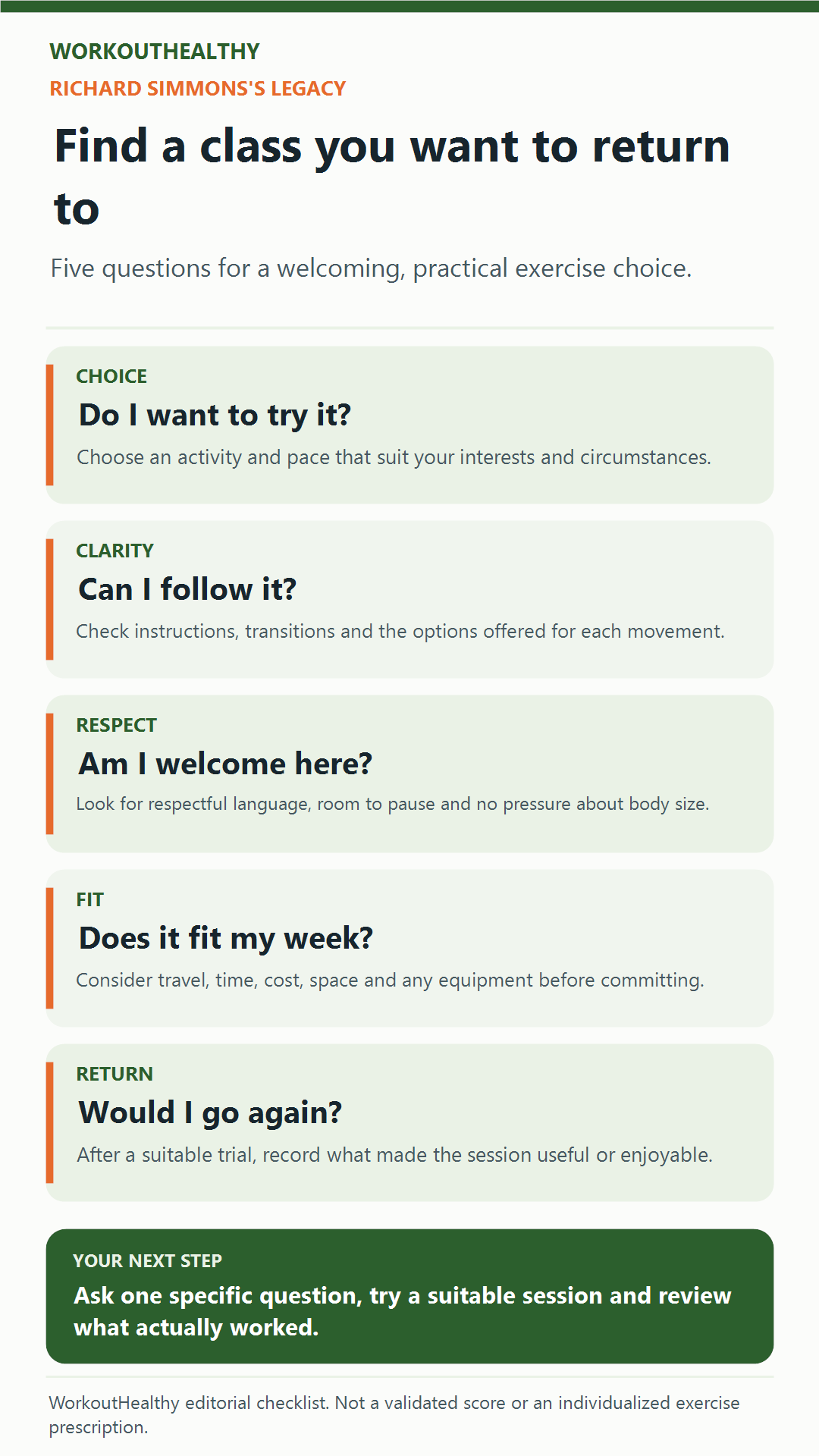
Use the following questions to turn a general impression into a decision you can explain.
This is an original WorkoutHealthy planning worksheet, not a validated score or a personalized exercise prescription.
- Choice: Does the activity interest you, and can you choose a suitable pace?
- Clarity: Can you follow the instructions and understand the available movement options?
- Respect: Does the instructor welcome participants without body judgments or pressure to continue?
- Fit: Do the location, timing, cost and needed equipment work in your actual week?
- Return: After trying it, is there a specific reason you would attend again?
Ask about the class format before committing.
A session advertised as beginner friendly may still have quick transitions or movements that need instruction, and that information helps you choose.
For example, a hypothetical participant might enjoy familiar music but prefer fewer direction changes.
Their question for the instructor could be whether a simpler option is explained throughout the session.
Another participant might like a quiet walk more than a group class.
Their worksheet can record the same practical details, including the route, available time and plan for poor weather.
Write down the answer that matters most to you.
If the main obstacle is the travel time, an inspiring instructor may still be difficult to reach regularly.
There is no passing score.
The purpose is to identify a suitable next step and a concrete concern to resolve before turning a class into part of your routine.
Make the first session manageable
Current CDC guidance recommends at least 150 minutes of moderate aerobic activity, 75 minutes of vigorous activity or an equivalent combination each week, plus strength activity on at least two days covering the major muscle groups (Centers for Disease Control and Prevention [CDC], 2025).
Activity can be spread into smaller periods, and some is better than none.
That weekly framework can guide planning without making the whole target the assignment for a first session (CDC, 2025).
Choose an appropriate starting activity and a practical stopping time.
A short session you can describe is easier to place in a calendar than an open-ended promise to exercise whenever motivation arrives.
If you attend a class, arrive with enough time to ask about modifications and explain any relevant access needs.
An instructor’s enthusiasm should leave room for questions, breaks and a different option.
CDC advises people with chronic conditions to discuss suitable activity with a health professional, and people who are inactive or have certain other circumstances to seek advice before vigorous activity (CDC, 2025).
General guidance and a class checklist cannot resolve an individual’s medical questions. Get appropriate instruction or clinical advice when your circumstances require it.
Choose a session that has a clear place in your week and a reason you want to return.
Record more than a number on the scale
After the session, make a brief note of what you did, whether the instructions were clear and how the experience felt while you were exercising.
Add one practical observation, such as whether the journey was manageable or the video required more floor space than expected.
These details explain how the plan works in ordinary life.
Attendance and enjoyment are useful observations about a routine.
They are different from measurements of strength, fitness, blood pressure or weight, and they should not be presented as proof of those outcomes.
If you want to track a training goal, choose a relevant measure with appropriate guidance. Avoid treating every session as a test of whether your body resembles a celebrity’s.
A missed session can reveal a schedule conflict or an unsuitable format.
Review that cause and adjust the detail you can change before making the plan more demanding.
Our article on Alexander Ludwig, consistency and moderation offers another perspective on making training fit a life.
Use it as context while evaluating what your own notes show.
The takeaway
Simmons’s reported weight loss belongs to his personal history, while his wider legacy includes helping people imagine themselves as participants in exercise.
The transferable idea is an invitation: look for activity with understandable instructions, appropriate options and an atmosphere that respects the people taking part.
Ask the five planning questions, try a suitable first session and record what makes returning practical.
A thoughtful choice about your next activity is a useful place to begin.
Get the next evidence check.
Five practical fitness stories worth your time, every Friday.
One email a week. No product pitches. Unsubscribe in one click.
References
Centers for Disease Control and Prevention. (2025, December 4). Adding physical activity as an adult. https://www.cdc.gov/physical-activity-basics/adding-adults/index.html
CNN. (2002, August 3). CNN Saturday Morning: Interview with Richard Simmons [Transcript]. https://transcripts.cnn.com/show/smn/date/2002-08-03/segment/06
Norris, K. (2024, July 13). Richard Simmons, who believed fitness is for everyone, dies at 76. NPR. WLRN. https://www.wlrn.org/npr-breaking-news/2024-07-13/richard-simmons-who-believed-fitness-is-for-everyone-dies-at-76
Rhodes, R. E., & Kates, A. (2015). Can the affective response to exercise predict future motives and physical activity behavior? A systematic review of published evidence. Annals of Behavioral Medicine, 49(5), 715-731. https://doi.org/10.1007/s12160-015-9704-5
Richard Simmons. (n.d.-a). Books and videos! https://richardsimmons.com/books-and-videos/
Richard Simmons. (n.d.-b). Richard’s story. https://richardsimmons.com/richards-story/
Teixeira, P. J., Carraça, E. V., Markland, D., Silva, M. N., & Ryan, R. M. (2012). Exercise, physical activity, and self-determination theory: A systematic review. International Journal of Behavioral Nutrition and Physical Activity, 9, Article 78. https://doi.org/10.1186/1479-5868-9-78
U.S. House of Representatives, Committee on Education and Labor. (2008, July 24). The benefits of physical and health education for our nation’s children [Hearing, Serial No. 110-104, testimony of Richard Simmons, pp. 26-29]. U.S. Government Printing Office. https://www.govinfo.gov/content/pkg/CHRG-110hhrg43471/pdf/CHRG-110hhrg43471.pdf
Medical disclaimer: This article is for general information only and is not medical advice. If you have an injury, ongoing pain, or a medical condition, talk to a doctor or physical therapist before you change how you train or eat.