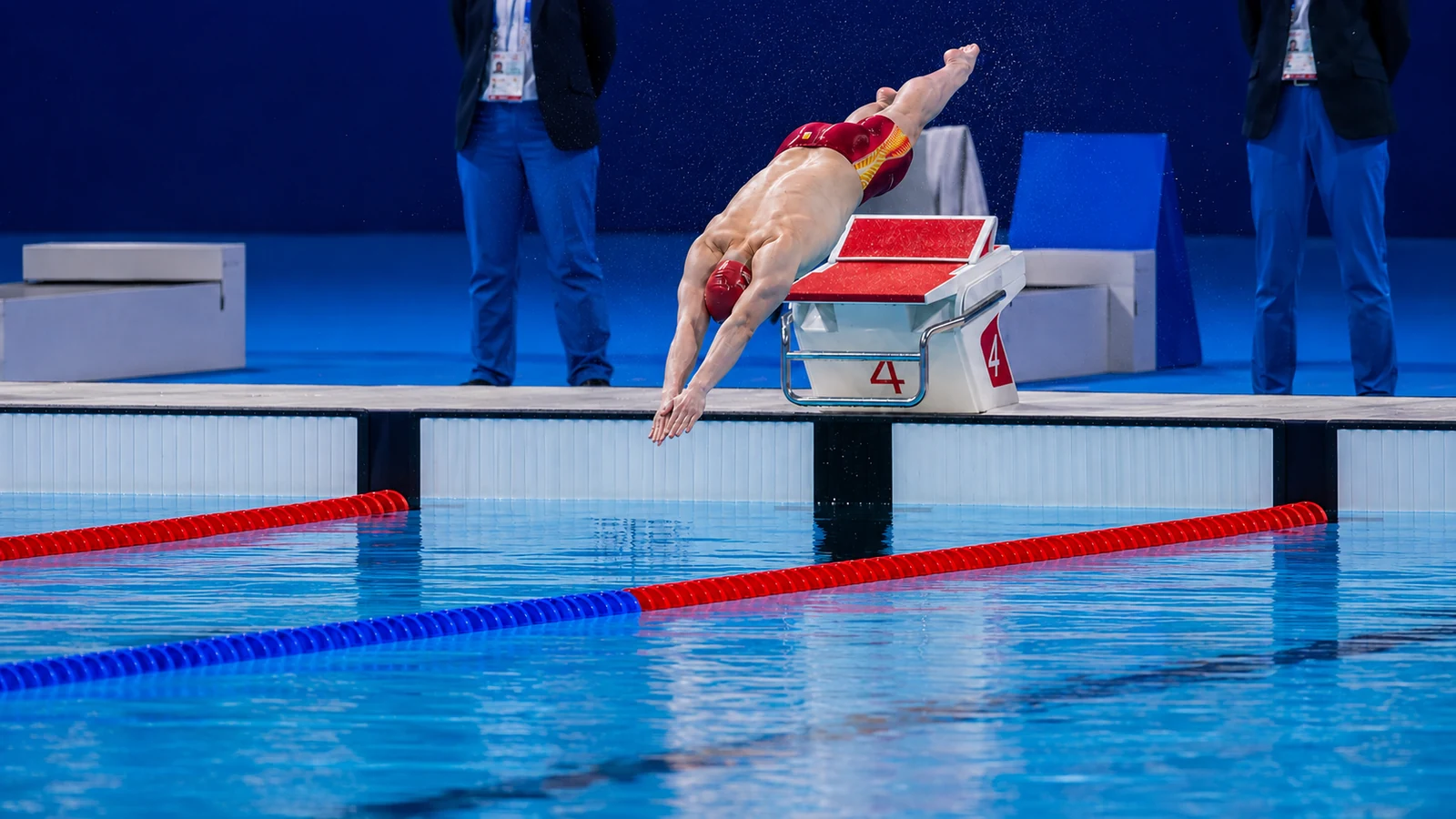

Pan Zhanle touched the wall in 46.40 seconds on night five of the Paris 2024 Olympics, and no man had ever swum the 100m freestyle that fast.
It was his first individual Olympic final.
He won by more than a full second, in an event where medals are usually decided by hundredths of a second.
A gap that size almost never happens in a 100m freestyle final at this level of competition.
This article breaks down what actually happened in that race, why sports scientists say a swim like this is possible, whether the record still stands today, and what the swim actually teaches anyone chasing slow, unglamorous progress in their own training.
A World Record Broken Twice in Six Months
Pan Zhanle did not arrive in Paris as an unknown quantity.
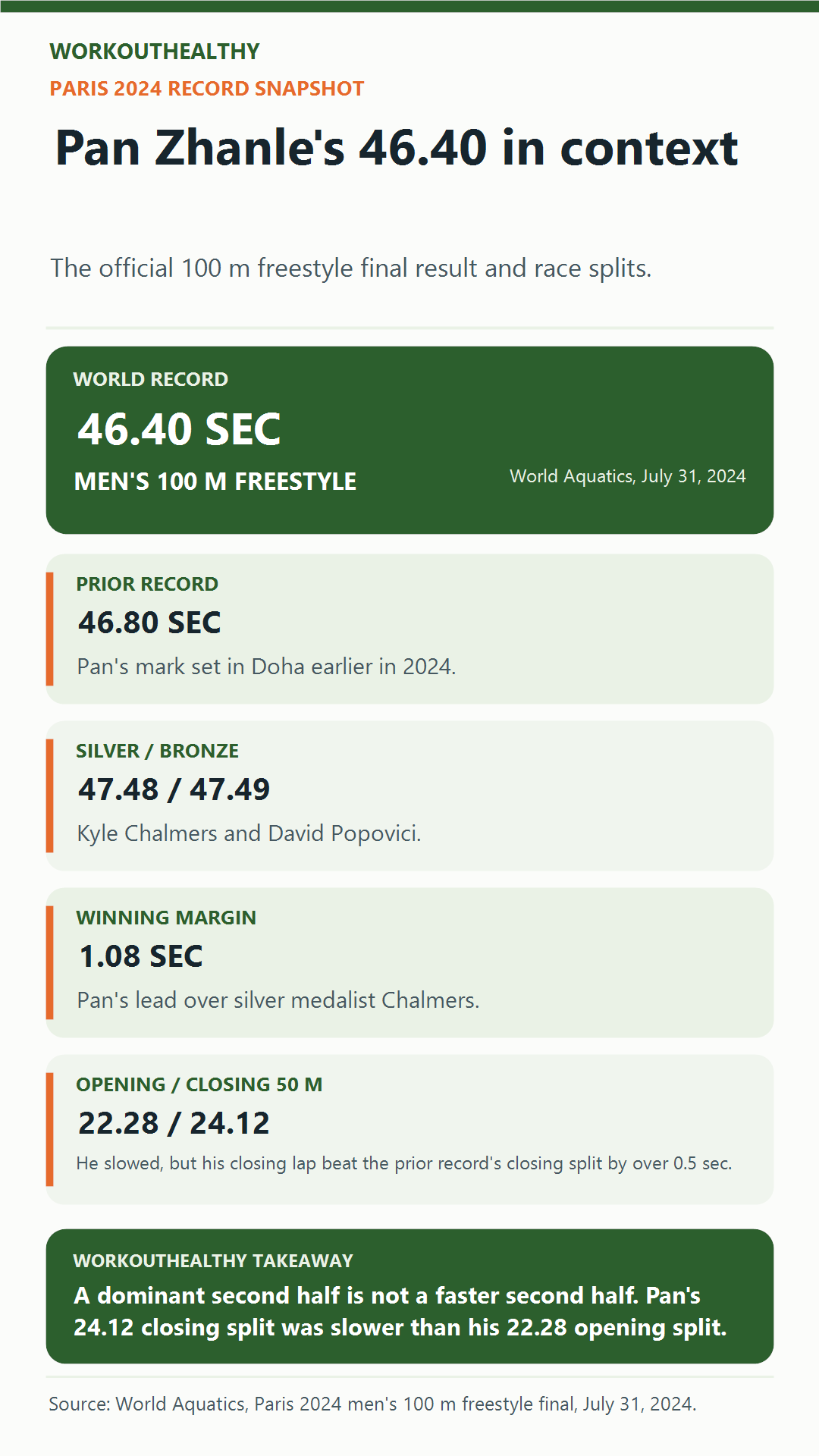
Earlier in 2024, at the World Aquatics Championships in Doha, Qatar, he had already broken the men’s 100m freestyle world record with a time of 46.80 seconds.
That mark alone would have made him one of the fastest swimmers in history.
Then, months later in the Olympic final, he broke his own record again, cutting another four tenths of a second to reach 46.40.
Before that final, Pan told World Aquatics he believed he could go even faster than his Doha time.
“I believe I will swim faster than 46.80, today is just the beginning, it is a part of the process.”
He was right, and by a wider margin than almost anyone expected.
Pan improved his own mark from 46.80 in Doha to 46.40 in Paris within the same year. That verified progression is striking without assuming how long future records will stand.
The Numbers Behind the Fastest 100 Freestyle Ever
The final results show just how far ahead Pan was that night.
He won gold in 46.40 seconds.
Silver went to Kyle Chalmers of Australia, who touched in 47.48.
Bronze went to David Popovici of Romania, who touched in 47.49.
That means Pan beat the silver medalist by 1.08 seconds.
In an Olympic 100m freestyle final, a margin over a full second is enormous.
Most finals in this event are decided by fractions of a second, sometimes by a single hundredth.
One detail from the race needs careful wording. World Aquatics lists Pan’s opening 50m at 22.28 seconds and his closing 50m at 24.12 seconds.
His second half was slower than his first, as the arithmetic shows. World Aquatics said the 24.12-second return was more than half a second quicker than the closing lap of his previous 46.80 world-record swim.
That is an unusually strong finish relative to his earlier record, not a faster second half than first half in the Paris race.
What Actually Makes a Swimmer This Fast
A performance this dramatic raises an obvious question: what actually separates a 46.40 from a 47.48?
Sports scientists who study competitive swimming point to a combination of factors, not a single trick.
A widely cited review of swimming biomechanics and energetics groups elite sprint performance into three interacting areas: how efficiently a swimmer converts effort into forward motion, how well they reduce drag moving through the water, and how consistent their stroke technique stays as fatigue builds late in a race (Barbosa et al., 2010).
In practice, that means a swimmer like Pan is not simply trying harder than everyone else in the pool.
Propulsion, drag, and technique under fatigue are established factors in sprint swimming. This review does not measure Pan’s individual stroke mechanics, so it cannot tell us which factor explains his margin over the field.
His closing 50m was slower than his opening 50m, although it was faster than the closing lap of his previous world-record swim.
Sprint freestyle performance also depends heavily on the start and the underwater phase right after it, since even a few hundredths gained off the blocks compound across a race this short.
A strong start shaves fractions of a second off the swim before a single stroke is even taken, and those fractions matter more in a sprint like this one than they would in a longer race, where fitness has more distance to separate the field on its own.
Who Should Be Cautious Before Copying Elite Sprint Training
Sprint freestyle training asks a lot of the shoulders, and it is not the right entry point for everyone.
Swimmers coming back from a shoulder injury should be especially careful with high-volume sprint sets, since the repetitive overhead motion of freestyle stresses the same joint structures over and over.
Anyone new to structured swim training benefits from building an aerobic base first, rather than jumping straight into race-pace sprint work modeled on an Olympic final.
Older adults returning to the pool after years away should also ease in gradually, since stroke mechanics and shoulder mobility both take real time to rebuild.
None of that is a reason to avoid the pool.
It is a reason to build toward intensity instead of starting there.
He Almost Didn’t Make the Final
The most surprising part of Pan’s week in Paris had nothing to do with his gold medal swim.
In the heats, he finished 13th, barely inside the cutoff to advance.
He made it into the semifinal by just 0.05 seconds, a margin smaller than the blink of an eye.
Coverage of that round described him easing off in the final stretch, apparently saving effort for the rounds that actually mattered.
Whether that was a deliberate tactic or a genuine scare, the gap between his heat swim and his final swim was enormous.
It is a useful reminder that one early result rarely tells the full story of what an athlete is actually capable of doing.
Is 46.40 Still the World Record Today
Record status can change, so the governing body’s current result listing is the right place to check.
When checked on October 1, 2026, World Aquatics’ athlete results still marked Pan Zhanle’s 46.40 from the Paris 2024 Olympic final as the men’s long-course 100m freestyle world record.
World Aquatics both ratified the 2024 swim and currently labels the 46.40 mark as a world record in its athlete results. Those are official records; this article does not rely on a third-party progression list.
It is worth being precise about who governs a claim like this one.
This is a World Aquatics world record, not a Guinness World Records title.
World Aquatics is the international federation that oversees competitive swimming and ratifies its official world records, which makes it the correct authority to cite here, rather than a general records organization better known for oddities and mass-participation feats, the kind covered in this site’s look at a Guinness bodybuilding record.
Records in a sprint event like this one do eventually fall, sometimes within a year or two of being set.
That means this status is worth rechecking again down the line rather than treated as permanent.
What This Record Does Not Prove
A performance this dominant invites some tempting but shaky conclusions, and it is worth being honest about what one elite swim does and does not show.
It does not prove that Pan’s specific training program would produce the same result for another swimmer, let alone for someone outside competitive swimming.
Elite sprint performance depends on a mix of genetics, years of structured training, and a body built for the specific demands of the event, and no single factor explains a swim like this one on its own.
It also does not mean this particular record is unbreakable.
Swimming’s history is full of times that looked untouchable for a few years and then fell to the next generation of swimmers with better technique, training, or equipment.
And one standout race does not erase the years of unremarkable, repetitive training sessions that came before it.
The final itself is only the visible sliver of the work.
Common Mistakes People Make Chasing “Overnight” Breakthroughs
Stories like Pan’s tend to get flattened into a highlight reel, and that flattening leads people toward a few predictable mistakes.
The first is treating a breakthrough swim as if it appeared out of nowhere, when it was actually built on a training base that started years earlier.
The second is assuming that because a swimmer looked calm and effortless in the final, the process behind it felt effortless too.
The third is comparing a beginner’s early results to an elite athlete’s peak performance, which sets an unrealistic and demoralizing bar.
The fourth is quitting after one disappointing outing, the way Pan easily could have after finishing 13th in the heats.
A rough qualifying round is not the end of the story.
It is usually just one data point in a much longer process, the same way a slow week in the gym is one data point in a training log, not a verdict on the whole plan (a distinction covered in more depth in this site’s guide to structuring that kind of long-term training).
What Everyday Athletes Can Actually Take From It
Nobody training in a normal pool or gym needs to chase a 46.40 to take something useful from this swim.
The clearest lesson sits in the size of that margin: roughly a full second, built up over years of showing up to train, refining technique in small increments, and trusting a process that rarely pays off dramatically on any single day.
For a recreational or competitive swimmer, that translates into a few concrete habits.
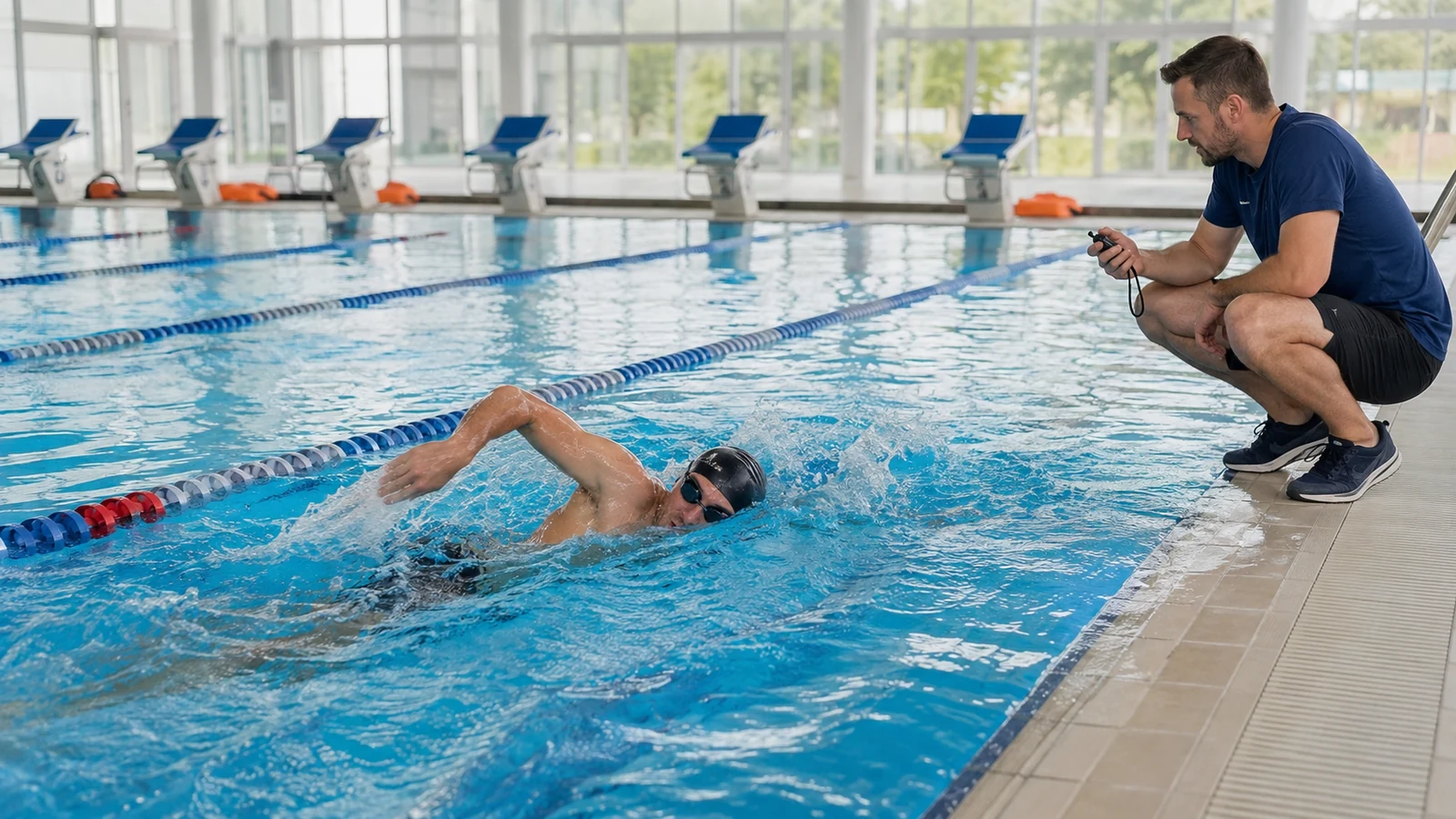
Track technique consistency across a full set, not just the first few reps, since fatigue is exactly where form usually breaks down first.
Treat a bad early result, whether it is a slow qualifying heat or a rough training block, as information rather than a verdict.
Build a training history long enough that small, steady technical gains actually have time to compound, instead of expecting one big leap.
Pay attention to the closing stretch of any race or set.
Finishing with controlled technique is a useful training goal, but Pan’s race alone does not establish which training method produced his closing split.
The same pacing discipline shows up in other verified feats on this site, including the pacing math behind a push-up world record, where holding a steady rate mattered more than any single burst of effort.
None of that requires Olympic-level talent.
It just requires the same patience that let one swimmer turn a 46.80 into a 46.40 in under six months.
Watch the Original Video
Want more verified breakdowns like this one? Subscribe to WorkoutHealthy Insider for practical explanations behind popular fitness claims.
References
Barbosa, T. M., Bragada, J. A., Reis, V. M., Marinho, D. A., Carvalho, C., & Silva, A. J. (2010). Energetics and biomechanics as determining factors of swimming performance: Updating the state of the art. Journal of Science and Medicine in Sport, 13(2), 262-269. https://doi.org/10.1016/j.jsams.2009.01.003
World Aquatics. (2024, July 31). Pan Zhanle sets 100m freestyle world record: Paris 2024 Olympic Games. https://www.worldaquatics.com/news/4072542/pan-zhanle-sets-100m-freestyle-world-record-paris-2024-olympic-games
World Aquatics. (2026). Zhanle Pan: Results. https://www.worldaquatics.com/athletes/1313859/zhanle-pan/
This article is for general information only and is not medical advice. If you have an injury, ongoing pain, or a medical condition, talk to a doctor or physical therapist before you change how you train or eat.