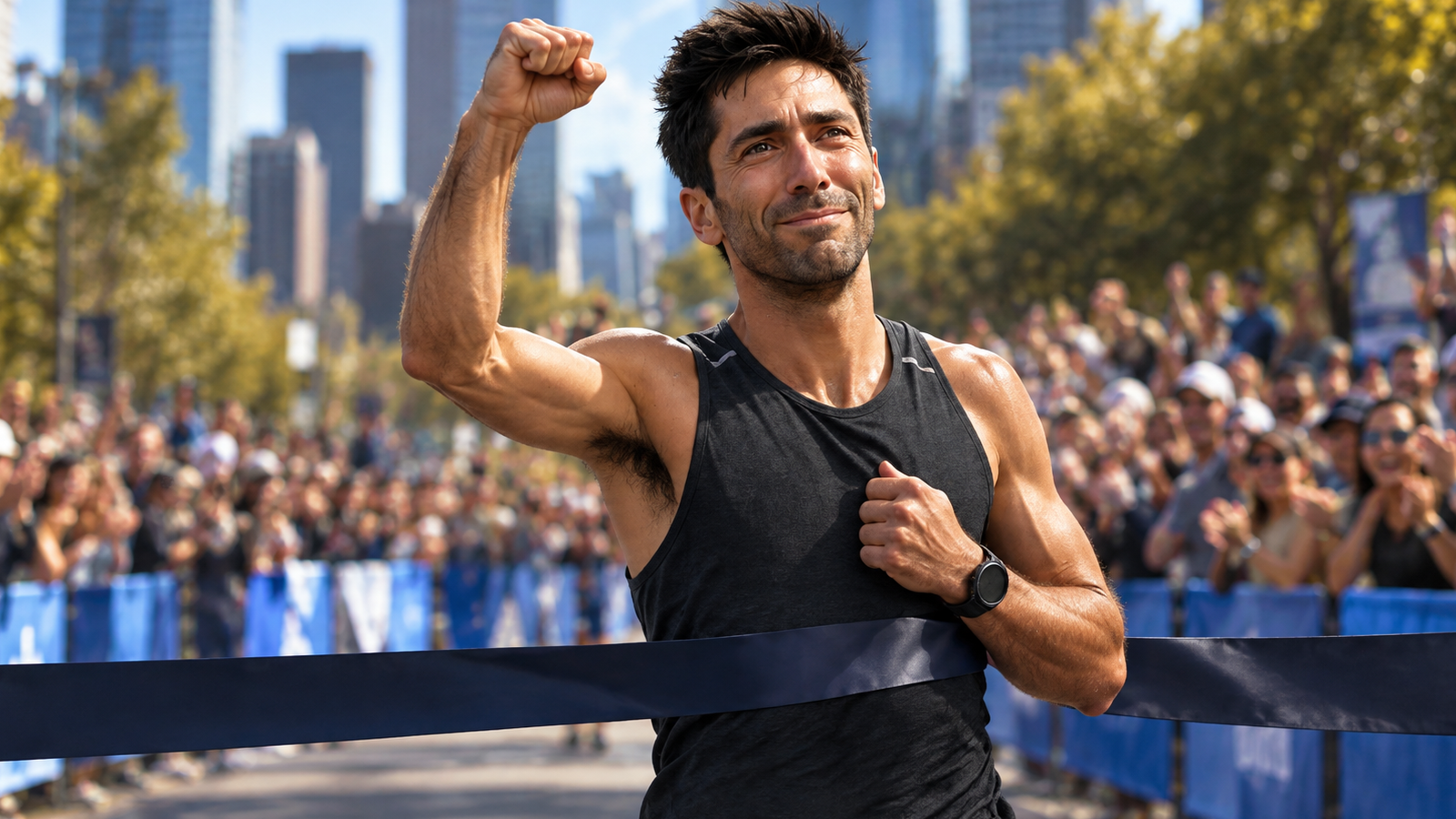

Fact check: Nev Schulman’s widely reported marathon comeback after a broken neck was the 2024 New York City Marathon, not a newly verified 2026 race. The date matters because it puts his return roughly three months after the August 2024 bicycle crash. This article explains what is documented, what remains personal to his medical case, and what ordinary runners can learn without treating a remarkable recovery as a training prescription.
The crash that changed his season
In August 2024, the television host and distance runner was struck while riding his bike. He reported fractures around the C5 and C6 levels of his cervical spine and underwent emergency surgery. The initial concern was not whether he could finish a marathon; it was whether he would be able to move normally. He later described the shock of hearing medical staff discuss how fortunate he was to have avoided an even worse neurological outcome.
Schulman was already an experienced marathoner, and the 2024 New York City race had been on his calendar. A serious neck injury abruptly changed the meaning of that goal. Instead of building mileage in a conventional training block, he first had to heal, regain ordinary movement, and follow the judgment of the clinicians who knew his scans, surgery, and progress.
That distinction gets lost in inspiring social posts. An athlete’s finish line makes an arresting image, but the decisive work began in an operating room and continued in the less visible weeks of rehabilitation. The publicly available reporting does not provide a day-by-day medical protocol, and it would be unsafe to invent one.
What happened at the 2024 New York City Marathon?
New York Road Runners announced Schulman as part of the celebrity field for the November 3, 2024, marathon. Its October announcement specifically noted that he had recently broken his neck in an August cycling accident. Contemporary interviews described his intention to return to the start line after receiving medical clearance. Accounts published after the race described him completing the event.
He was not pursuing a personal-best narrative. Reporting around the race focused on his return, his charitable connection to Team for Kids, and his relationship with Achilles International. He had previously guided blind runner Francesco Magisano at the 2023 New York City Marathon. The 2024 comeback therefore sat inside a longer running story, not a sudden attempt to prove that anyone can race soon after spine surgery.
One source of confusion is the way later posts recycle the event as if it were new. When a caption says he completed a comeback marathon in 2026, it should not be read as proof of a separate 2026 event. The documented post-crash comeback is the 2024 New York City Marathon. We have not found an authoritative race result establishing the claimed 2026 comeback race.
Why his recovery is exceptional, not a standard timeline
Three months is a strikingly short interval between a cervical fracture requiring surgery and a marathon. It is also the wrong number to turn into an expectation for someone else. Two injuries given the same casual label—“broken neck”—can involve very different bones, stability, neurological effects, operations, and restrictions. The appropriate rehabilitation schedule depends on those details and on repeated clinical assessment.
Schulman also arrived with a substantial endurance base. Years of training can help an athlete preserve some aerobic capacity during a forced break, but prior fitness does not make a healing spine less important. A marathon remains 26.2 miles of repeated loading and fatigue. The fact that one runner reached the finish does not demonstrate that a similar decision would be safe for another person.
His story is most useful when the extraordinary outcome is separated from the ordinary principle. A meaningful goal can help someone stay engaged with recovery. It cannot substitute for clearance, rehabilitation, or a willingness to change the goal if healing takes longer than hoped.

What a comeback goal can do—and what it cannot
A calendar event gives rehabilitation a shape. It can make small daily tasks feel connected to a larger purpose. For Schulman, returning to a race he knew well offered an emotional marker after a frightening accident. That kind of motivation is real, but it works best when it remains flexible. The goal is a direction, not a deadline that overrides symptoms or a surgeon’s advice.
Runners often think in splits, weekly mileage, and finish times. Injury recovery forces a different set of measures: tolerating normal activities, restoring comfortable motion, rebuilding strength, and managing fatigue. Progress may be uneven. Some days can feel like setbacks without meaning that the overall course has failed. A good comeback respects those quieter milestones even when a public finish line gets the attention.
It is also worth remembering that race completion is only one snapshot. A finish photo does not reveal how someone felt during the next week, what follow-up care was needed, or whether a training choice was optimal. Celebrating a comeback does not require pretending that it was simple.
How can recreational runners use this story responsibly?
First, verify the dates before drawing lessons from a viral caption. Schulman’s accident occurred in August 2024 and his documented marathon return occurred that November. A misdated post can make the recovery appear to follow a different timeline or suggest a new achievement that the available sources do not establish.
Second, take the medical details seriously. Neck pain after trauma, weakness, numbness, or neurological symptoms need professional evaluation. Someone recovering from a spinal fracture or surgery should not copy another person’s running plan from an article. The treating team is the only group that can interpret that individual’s imaging, restrictions, and readiness to progress.
Third, think of the comeback as a sequence rather than a leap. Most runners return to longer distances through tolerated daily movement, rehabilitation work, shorter easy sessions, and gradual progression. The exact steps vary. A plan that increases distance while symptoms worsen is not a badge of toughness; it is a reason to reassess with a qualified professional.
Fourth, preserve the joy and social meaning of running. Schulman’s connection to a race community and to charitable running made the event more than a test of speed. For many people, those relationships provide better long-term motivation than trying to replicate someone else’s dramatic timeline.
Why the calendar can mislead
There are two separate dates in this story: the date of the athletic event and the date someone chooses to post about it. A social account can publish an old achievement tomorrow without making it a new race tomorrow. That sounds obvious, but evergreen celebrity fitness posts often blur that line. Readers see a fresh post, notice a current year in the caption, and reasonably assume the event itself happened recently. In this case, the contemporary organizers’ announcement places the comeback squarely in the 2024 New York City Marathon.
The distinction affects the health message. If readers think he raced in 2026, they may never realize that the original feat was accomplished about three months after his accident. If they know the 2024 timeline, they can appreciate how unusual it was while also recognizing why it must not be generalized. Accurate dates are part of responsible storytelling, especially when injury and surgery are involved.
Resilience does not mean ignoring uncertainty
Comeback stories often compress uncertainty into a neat before-and-after arc: crash, recovery, finish line. Real life does not unfold so cleanly. At the time of an injury, nobody can know exactly how healing will progress or whether a previous athletic goal will still be appropriate. One day of better movement may not predict the next month. Medical clearance is not a ceremonial step at the end of the story; it is an ongoing assessment of what a patient can safely attempt.
This is why the inspiring part of Schulman’s return should be framed carefully. His determination helped him stay connected to a valued activity. It did not erase the possibility of complications or give other athletes a shortcut around medical judgment. A responsible coach would celebrate the effort while still telling a newly injured runner to ask entirely different questions: What is the diagnosis? What movements are restricted? Which symptoms require stopping? What kind of progress has the clinician actually cleared?
Choosing a goal that can change
For an injured runner, the first useful goal may be walking comfortably through the day. The next might be completing rehabilitation exercises consistently, or tolerating a short easy session without a symptom flare. A race can remain on the horizon, but the date should be adjustable. Deferring an entry or choosing a shorter event is not failure; it is often the choice that protects a longer athletic future.
There is a psychological advantage to that flexibility. A rigid deadline makes every slower week feel like defeat. A layered plan offers several ways to succeed even if the original race becomes unrealistic. People can still regain independence, rebuild fitness, reconnect with friends, and eventually return to competition. Schulman’s finish is one possible ending to a recovery story, not the only worthwhile one.
The real takeaway
Nev Schulman’s finish was a memorable example of resilience after a serious cycling injury. It was also a highly individual result shaped by his injury, care team, previous endurance background, and personal circumstances. The supported date is 2024. The lesson is not “run a marathon three months after spine surgery.” It is to value a meaningful goal while giving medical recovery the authority to set the pace.
Sources: New York Road Runners’ October 2024 marathon announcement; NY1’s pre-race interview; InsideHook’s November 2024 reporting.