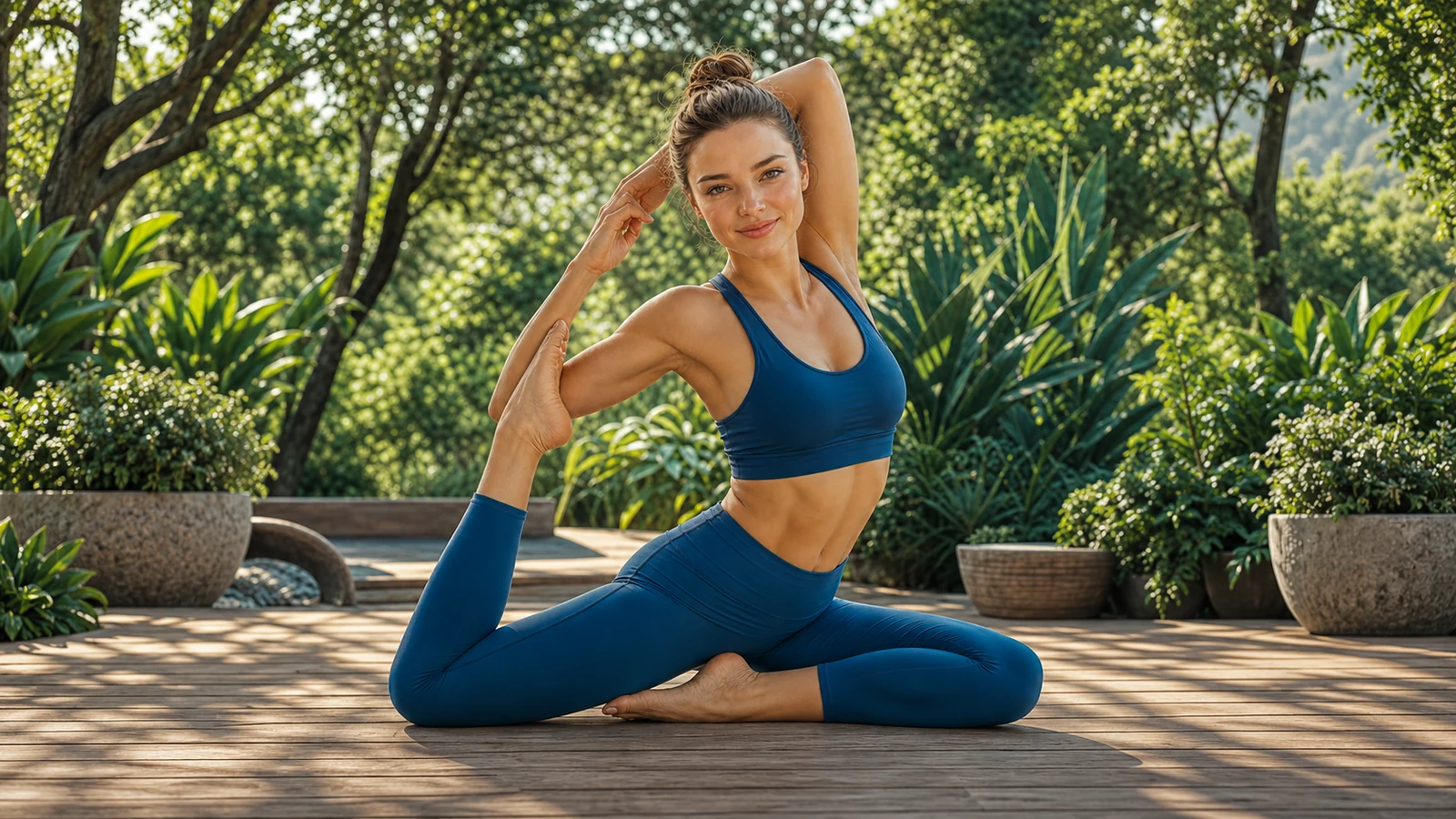

Miranda Kerr has talked about yoga and stretching for years. Her account is more useful as a story about a repeatable practice than as a demonstration of a difficult pose.
In a 2013 Vogue interview, she said that her morning exercise was often yoga or Pilates. In a 2020 British Vogue interview, she said she had practiced yoga and stretching since age 18.
Those are descriptions of her own routine at those moments, not a prescription or a promise that someone else will look or move like her. The useful question is what regular practice can realistically change.
A sustainable yoga practice starts at the range you can control today, then earns more room through repetition.
What Kerr Has Actually Said
Kerr’s public accounts span different years and different life circumstances. They should not be compressed into a claim that she performs the same sequence every morning.
In 2013, she told Vogue that she liked at least 20 minutes of exercise, generally yoga or Pilates. That interview also described a morning meditation practice.
In 2020, she told British Vogue that she did yoga and stretching and had done so since she was 18. She also described meditation, other online movement classes, and a weekend Kundalini yoga session with an instructor.
Another Vogue interview from 2020 described a mix of yoga, ballet, and Pilates. The pattern is varied movement that she said she enjoyed, not one secret exercise.
Her words establish that yoga has been part of her routine for a long time. They do not establish her current weekly schedule, her measured joint range, or how much of her flexibility came from yoga rather than genetics, other training, or earlier gymnastics.
Flexibility Is Not One Trait
Flexibility describes how far a particular joint can move under particular conditions. A person can have mobile shoulders and stiff hips, or a comfortable forward fold but limited ankle movement.
That is why one impressive photo tells so little. It captures a pose, a camera angle, and a moment. It does not show the person’s warm-up, control, comfort, or movement on an ordinary day.
Yoga combines movement with breathing and attention. Different styles also ask very different things of the body, from gentle supported positions to demanding balance and strength work.
The National Center for Complementary and Integrative Health notes that this variation makes yoga studies difficult to compare. It also means a beginner should choose a style for their own goals and starting point.
If the goal is easier everyday movement, a gentle class may be a better entry point than trying to copy a celebrity photo. If the goal is to relax after work, breath-led practice may feel more useful than a flexibility challenge.
What the Yoga Evidence Shows
There is evidence that yoga can improve some measures of mobility. The size and timing of any change depend on the style, population, joint, and way the outcome was measured.
A 2024 systematic review examined eight studies of yoga for spine and shoulder mobility. It found potential benefits for spinal flexibility and mobility, including in people with chronic low-back pain.
The authors also said more research is needed. The included studies were small and used different designs, so the findings are not a promise for every participant or every pose.
A separate meta-analysis of seven randomized trials of Thai yoga found flexibility improvements after four and eight weeks compared with controls. Thai yoga is a specific practice, so those results should not be presented as an exact timetable for all yoga styles.
Broader stretching research gives another useful check. A meta-analysis of 77 studies in healthy participants found that repeated stretching can increase joint range of motion over time.
That evidence supports patient practice. It does not support the social-media claim that meaningful gains can only appear after months. Some studies observed change within several weeks.
The practical lesson is to notice your own response across repeated sessions. Compare a movement with your earlier comfortable range, not with another person’s most dramatic pose.
Consistency Without a Magic Frequency
Repeated practice gives someone more chances to learn a movement, adjust effort, and notice discomfort early. It can also make a session easier to fit into ordinary life.
But there is no universal yoga frequency that guarantees a certain number of degrees of mobility. In the 77-study stretching meta-analysis, frequency and several other programming variables did not clearly explain the size of range-of-motion improvements across studies.
That does not mean frequency is irrelevant to an individual. It means a claim such as “practice every day or it will not work” goes beyond that evidence.
For someone balancing work, caregiving, or other exercise, two short sessions that actually happen may be a better start than seven ambitious sessions that disappear after a week.
Kerr’s interviews show a long relationship with several forms of movement. The part a reader can copy is the decision to make room for enjoyable practice, not the assumption that her exact routine or body is a template.
For another example of a celebrity discussing yoga in a practical setting, read about Alessandra Ambrosio’s travel yoga habit. The details of any person’s routine still need to be read in their original context.
An Eight-Week Starter Plan You Can Adjust
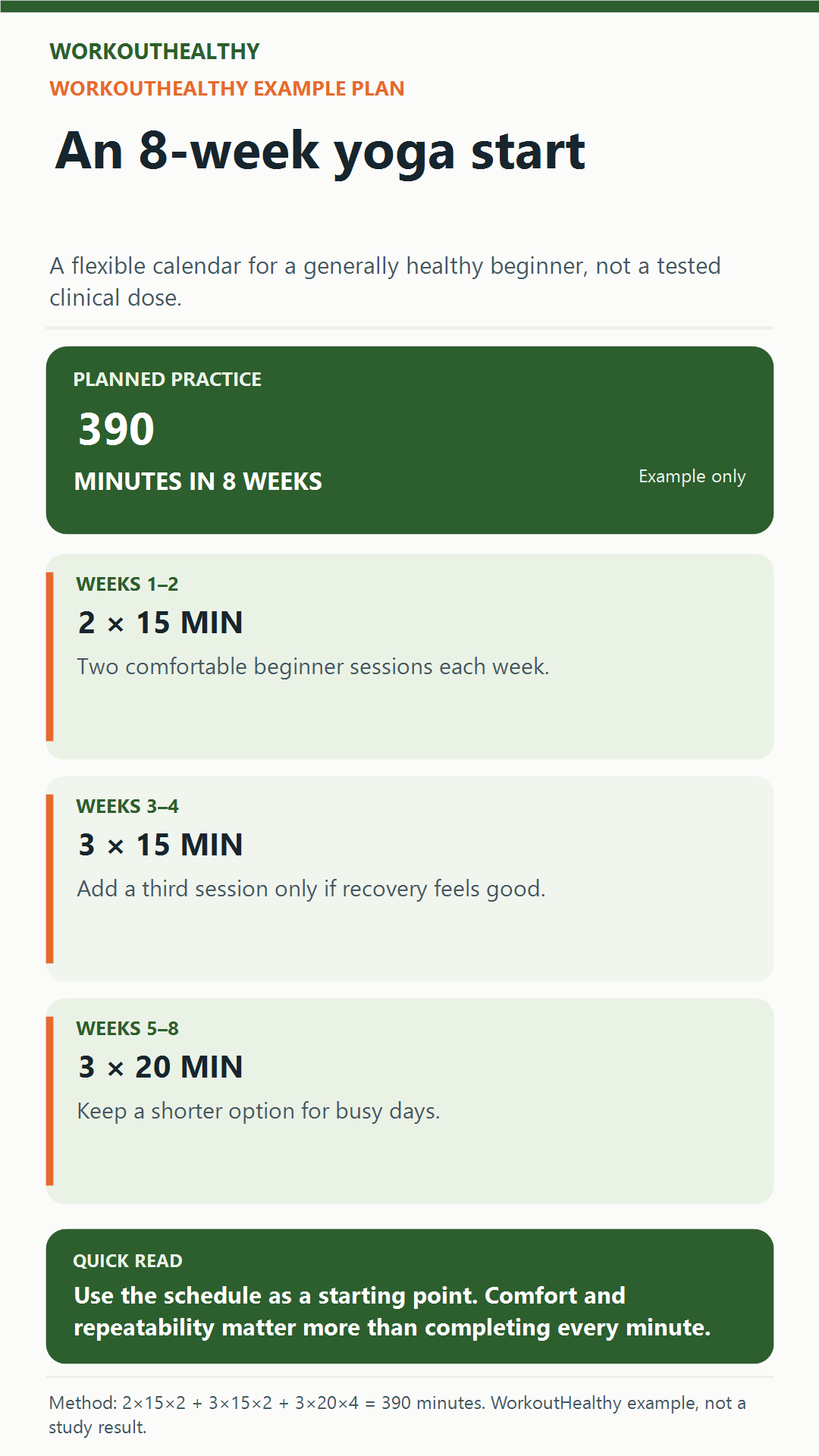
Here is a WorkoutHealthy example plan for a generally healthy beginner. It is an organizing tool, not a protocol tested in the studies above or a target Kerr reported following.
For weeks one and two, try two 15-minute beginner sessions each week. Use a qualified instructor or a class that offers clear modifications, and stop each movement before pain.
For weeks three and four, consider three 15-minute sessions if the first phase felt manageable. Repeating familiar movements can be more useful than collecting harder poses.
For weeks five through eight, three 20-minute sessions make a possible next step. Keep a lighter option available for busy days and leave time for other activity and recovery.
The arithmetic is transparent: two sessions times 15 minutes times two weeks is 60 minutes; three times 15 times two is 90 minutes; and three times 20 times four is 240 minutes. That makes 390 planned minutes across eight weeks.
The total is a scheduling illustration, not a dose that guarantees flexibility or stress relief. Someone who can only manage less can still build a useful routine; someone with symptoms may need a clinician’s advice before starting.
Attach the sessions to a repeatable cue, such as finishing work or waking on a weekend. If a session is missed, resume at the next planned time instead of trying to make up every minute.
Keep the plan easy enough that you can finish it without dreading the next session. In this context, consistency means returning to practice, not completing a perfect streak.
The Self-Care Part of the Practice
Kerr has described yoga alongside meditation and other personal rituals. It is reasonable to understand that as a self-care preference, but her experience cannot tell us how yoga affects everyone else.
The National Center for Complementary and Integrative Health says yoga may help with stress management, mental well-being, sleep, and balance. It presents these as possible benefits, with evidence that varies by outcome.
A 2024 review of randomized trials in stressed adults found evidence of a short-term reduction in perceived stress compared with passive controls. The authors graded that evidence as low quality.
That is a useful middle ground. A yoga class can be worth trying for relaxation, and it is not a substitute for treatment when stress or anxiety is persistent or severe.
Readers interested in the overlap between movement and mood can compare this with Kerry Washington’s Pilates and yoga account. Both stories are strongest when the person’s own words stay separate from the research.
The most useful result may be a practice you can return to, even when the pose never looks like a photograph.
Practice Without Chasing Pain
More range is not automatically better. A useful session should leave you able to breathe, control the position, and come out of it comfortably.
The National Center for Complementary and Integrative Health considers yoga generally safe for healthy people when it is practiced appropriately. It also notes that injuries can occur and recommends guidance from a qualified instructor.
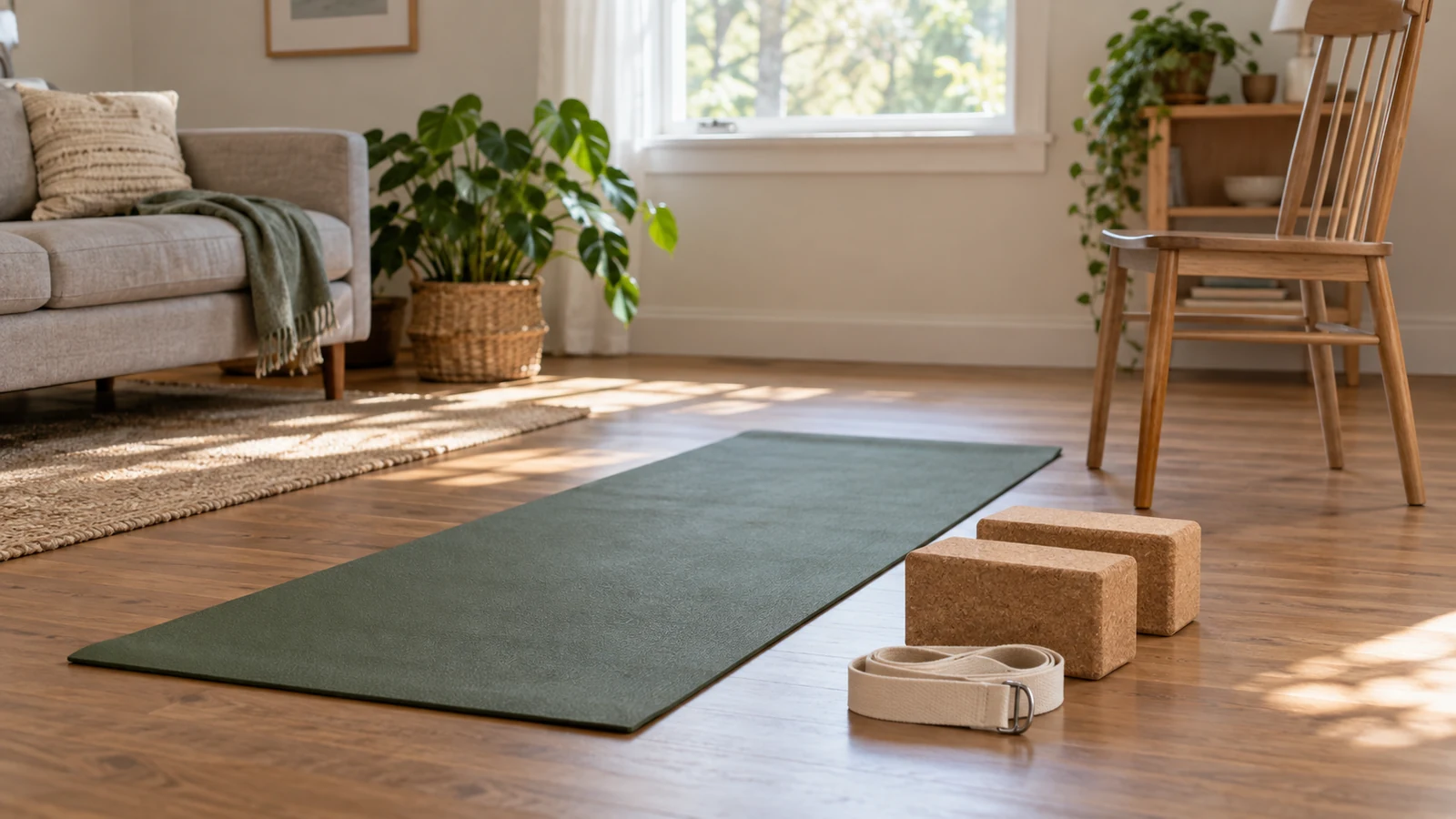
Start with movements you can modify. A block, strap, chair, or bent knee can let you explore a position without forcing your joints to match the class leader’s shape.
Avoid pushing through sharp pain, numbness, or dizziness. Those signals call for stopping the movement and, when appropriate, getting medical advice.
Pregnancy, a recent injury, a chronic condition, or limited balance can change which poses are suitable. Ask a health professional or qualified instructor how to adapt the practice for your situation.
If you are interested in whether stretching after exercise speeds recovery, our cool-down stretching review addresses that separate question. Feeling more mobile and recovering faster are different outcomes.
Measure Progress That Matters
Choose one or two ordinary movements that matter to you. It might be reaching overhead without shrugging, sitting on the floor comfortably, or moving through a gentle hip stretch without bracing.
Record the starting position and the conditions. A note about the movement, discomfort, and how much support you used is more useful than a photo alone.
Repeat the check every two to four weeks under similar conditions. Warm-up, time of day, and effort can change how far a joint appears to move, so avoid interpreting one unusually good session as a permanent transformation.
Notice what improves besides range: balance, breathing, confidence, or willingness to return. Those outcomes may be the reason a practice remains valuable even if the measured stretch changes little.
If progress stalls, first ask whether the activity still meets your goal. Someone practicing for stress relief does not need a deeper backbend to count the time as worthwhile.
Someone pursuing a specific mobility goal may benefit from a qualified instructor or physical therapist who can identify the limiting joint and adapt the program. A generic internet sequence cannot make that assessment.
The Takeaway
Miranda Kerr’s interviews support a long-standing interest in yoga and stretching, alongside other forms of movement and meditation. They do not establish a single secret routine or a measured flexibility result.
Research suggests yoga and stretching can improve some mobility measures, while yoga may help some people manage stress. The studies do not give everyone the same timetable or guarantee a particular pose.
Start with a comfortable practice you can repeat. Let your own movement, recovery, and enjoyment guide the next step.
Get the next verified fitness story.
Five practical fitness stories worth your time, every Friday.
One email a week. No product pitches. Unsubscribe in one click.
Medical disclaimer: This article is for general information only and is not medical advice. Ask a qualified health professional before starting or changing a yoga practice if you have an injury, medical condition, are pregnant, or experience pain or dizziness.