
Melissa Roxburgh’s story about training for Manifest starts with a change in her relationship with exercise. In an interview published by Shape, the actor described a long struggle with compulsive workouts and said that rebuilding a healthier relationship with food and movement had taken time.
Trainer Paolo Mascitti later shared a demanding full-body strength circuit associated with her return to training. The circuit is interesting, but it should not eclipse her larger point: exercise can support a person’s life only when the approach also respects their physical and mental health.
Visual note: the featured outdoor-gym scene is an editorial illustration adapted from WorkoutHealthy’s Facebook creative. It does not show Roxburgh or document a particular workout.
What Roxburgh Actually Shared
Shape reported Roxburgh’s account of a past struggle with what she called “exercise bulimia.” She said running, once her usual exercise, no longer fit into her life in a healthy way. A friend connected her with Mascitti while she was in Los Angeles during a break from filming.
That is a personal account, not a diagnosis for readers to apply to themselves or to Roxburgh. It also does not mean running is harmful in general. The important distinction is how an activity functions in an individual’s life: chosen movement can be enjoyable, while a rigid obligation can cause distress.
Mascitti told Shape that Roxburgh wanted to return to filming feeling strong and fit after time away from structured exercise. During the hiatus, they trained together two or three times weekly for about an hour per session. He described squats, deadlifts, and overhead presses among the movements they used.
These are the details the published reporting supports. It does not provide a complete record of every session, her food intake, or her private health history, and readers do not need those details to understand the practical lesson.
How the Shared Strength Circuit Fits the Story
The trainer’s published circuit combines lower-body, upper-body, and trunk work. Its six stations include a squat-to-press, a push-up variation, a staggered-stance hinge, a row with a jump, a lunge with a raise, and a stability-ball movement. The Shape article gives the exact sequence and demonstrations.
That design asks several muscle groups to work during one session. It can also elevate breathing and challenge coordination. It is a trainer’s example of an advanced circuit, not proof that the same workout or volume suits every person returning from a break.
The published version calls for four or five rounds. For a novice, that can mean a substantial amount of work, especially when push-ups, jumps, loaded lunges, and stability-ball work are combined. Exercise selection, loading, and rest should match current capacity rather than a celebrity headline.
A person drawn to the circuit can instead identify its broad movement patterns: squat, hinge, push, pull, and a form of trunk work. Those patterns can be practiced separately and scaled. For example, a supported squat or a seated press may be more appropriate than a fast compound movement at first.
The value of a trainer is not simply that the session looks difficult. Good coaching adjusts the session, notices how a person responds, and gives them room to build skill without treating discomfort or exhaustion as the objective.
What Strength-Training Evidence Says
The 2026 American College of Sports Medicine position stand synthesized 137 systematic reviews of resistance training in healthy adults. Compared with no resistance training, it found improvements in strength, muscle size, power, endurance, and several measures of physical function.
That is a useful evidence base for training, but it does not establish Roxburgh’s individual results or validate every element of a particular circuit. The review found that several heavily marketed details, including equipment type and exercise complexity, did not consistently determine outcomes.
For strength, the review identified benefits from progressive training that includes an adequate range of motion and at least two sessions per week. That broad finding fits the reported two-to-three-day schedule, but it is not evidence that more rounds, harder variations, or the same trainer are necessary.
For a generally healthy beginner, a simple repeatable program can be a better entry point than a six-move circuit. Learn the movements, use a manageable load, and leave enough room to recover before the next session. Progress can be measured over weeks rather than in a single exhausting day.
Our look at cardio and strength training for longevity explains how the two forms of activity can complement one another without making either a punishment for eating.
Why Enjoyment and Choice Matter for Consistency
The Facebook caption says genuinely motivated training supports consistency. Research offers a more precise version of that idea. A 2025 review of systematic reviews found positive relationships between physical activity and competence, intrinsic motivation, and personally valued reasons for being active.
Another 2025 research review reported that interventions built around self-determination theory often produce small to moderate improvements in physical activity and related outcomes. The effects were commonly linked to greater autonomous motivation and support for competence.
Neither review says every workout must feel fun from its first minute. Someone may value being able to carry groceries, play with children, or feel steadier on stairs even when a training session itself is ordinary. A chosen, meaningful reason can still be different from guilt or fear.
It also helps to separate a difficult workout from a harmful relationship with exercise. Hard effort can be part of a healthy plan when it is voluntary, suitable, and recoverable. Distress when a session is missed, or pressure to exercise despite injury, calls for a different response.
WorkoutHealthy’s story about Latoya Snell running for joy rather than a smaller body offers another example of valuing what movement adds to life.
When Exercise Stops Feeling Like a Choice
The National Eating Disorders Association describes warning signs of excessive exercise that include intense guilt or distress after missing a workout, continuing despite injury or illness, and letting a rigid routine interfere with important activities. Those signs are about loss of flexibility and harm, not about a specific number of minutes.
MedlinePlus similarly advises contacting a health professional if exercise feels out of control, is no longer enjoyable, or continues despite illness or injury. The right support may include clinicians who understand both physical training and eating disorders.
These resources should not be used to label a celebrity or diagnose a friend. They can help a reader recognize when ordinary fitness advice is no longer enough. Someone recovering from an eating disorder may need individualized guidance before following general exercise templates.
Rest is a normal part of training. It is also a useful test of flexibility: can a session move when life changes, and can a missed workout remain just a missed workout? If the answer is consistently no and the experience is distressing, asking for help is a constructive next step.
A person does not have to wait for a crisis or a severe injury to discuss these concerns. A qualified healthcare or mental-health professional can help evaluate the full context, including nutrition, mood, injury history, and the role exercise is playing.
A More Flexible Way to Return to Strength Work
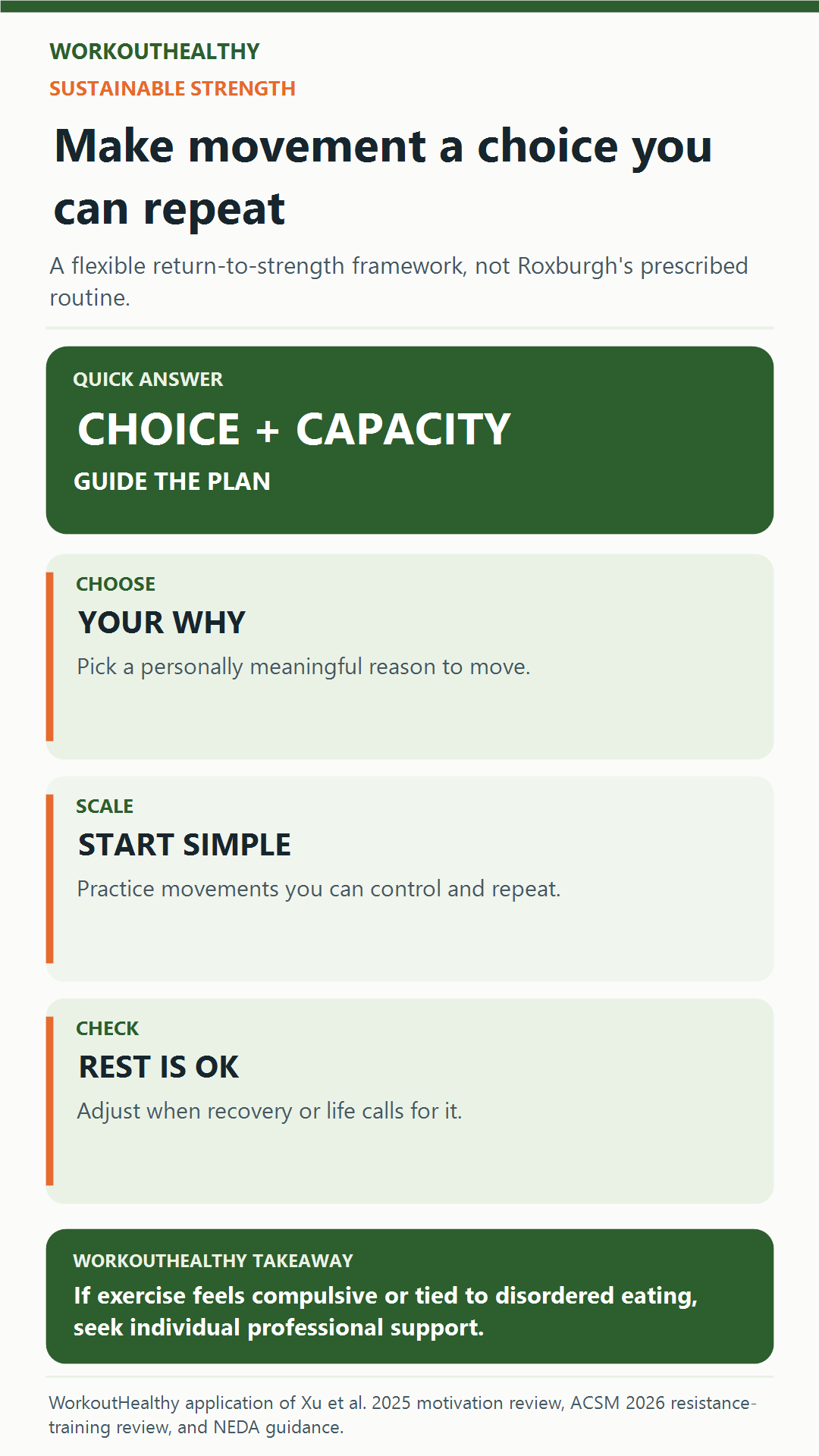
For people without a medical restriction or an active eating-disorder concern, Roxburgh’s story suggests a gentler starting question than “How do I copy that circuit?” Ask what sort of movement feels useful enough to repeat, and what level of effort leaves you ready to return.
Choose a reason you own. Better balance, greater confidence in daily tasks, or learning a lift are all legitimate aims. An appearance goal is not automatically wrong, but it should not erase rest, nourishment, or other parts of life.
Begin with a small number of sessions. Two nonconsecutive strength days can leave time to learn technique and notice recovery. A shorter session still counts when that is what the week permits.
Scale the movement before increasing speed. Practice a comfortable squat, hinge, push, and pull. Use a machine, a wall, a bench, or lighter resistance when it makes the movement more controlled. There is no prize for starting with the hardest variation.
Keep a flexible record. Note the movements, a few repetitions or sets, and how the session felt. A log can show progress without turning every number into a command. If recording exercise increases distress, you can track fewer details or stop.
Notice recovery and choice. Soreness, persistent fatigue, and anxiety about missing a workout are different kinds of feedback. Reduce the load or pause the plan when needed, and seek professional advice when symptoms persist or feel difficult to control.
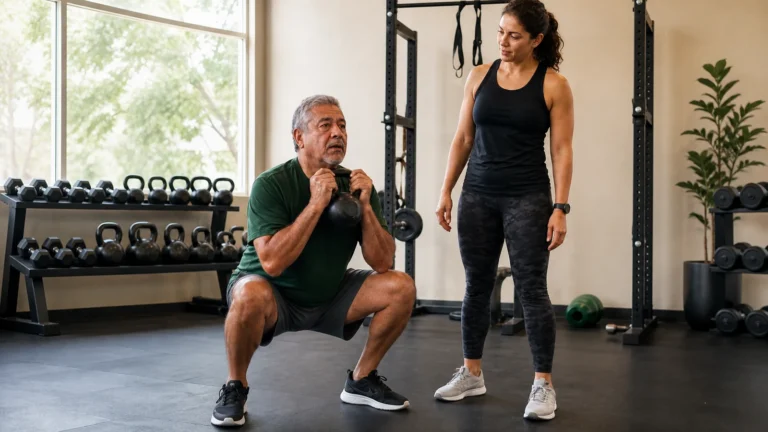
Our gentle standing strength workout offers a simpler option for readers who want to start without jumping or a high-pressure circuit.
What We Can and Cannot Take From a Celebrity Routine
Roxburgh’s reported two-to-three-day schedule is a useful example of consistency that did not require daily training. Mascitti’s circuit shows one way a professional can combine several patterns into a session. Her account of a changed exercise relationship is the part that makes those details meaningful.
We cannot infer from an interview that a specific circuit caused a specific mental-health outcome. Nor can we know how every aspect of her training changed over time. The sources document an experience and an example workout, while broader research helps explain why choice, competence, and adaptable resistance training may matter.
The strongest takeaway is practical and modest: build a plan that serves your own reasons for moving, can adapt to real life, and allows rest without guilt. If exercise has become compulsive or tied to disordered eating, personalized professional support takes priority over a celebrity workout template.
References
- Shape: Melissa Roxburgh interview and Paolo Mascitti’s circuit
- American College of Sports Medicine position stand on resistance training (2026)
- Systematic review of self-determination theory and physical activity (2025)
- Review of self-determination-theory-informed activity research (2025)
- National Eating Disorders Association: excessive exercise
- MedlinePlus: signs of too much exercise
This article is for general education and is not a diagnosis or individual exercise or mental-health treatment plan.