
The Meadows row is a one-arm landmine exercise made famous by the late bodybuilder and coach John Meadows.
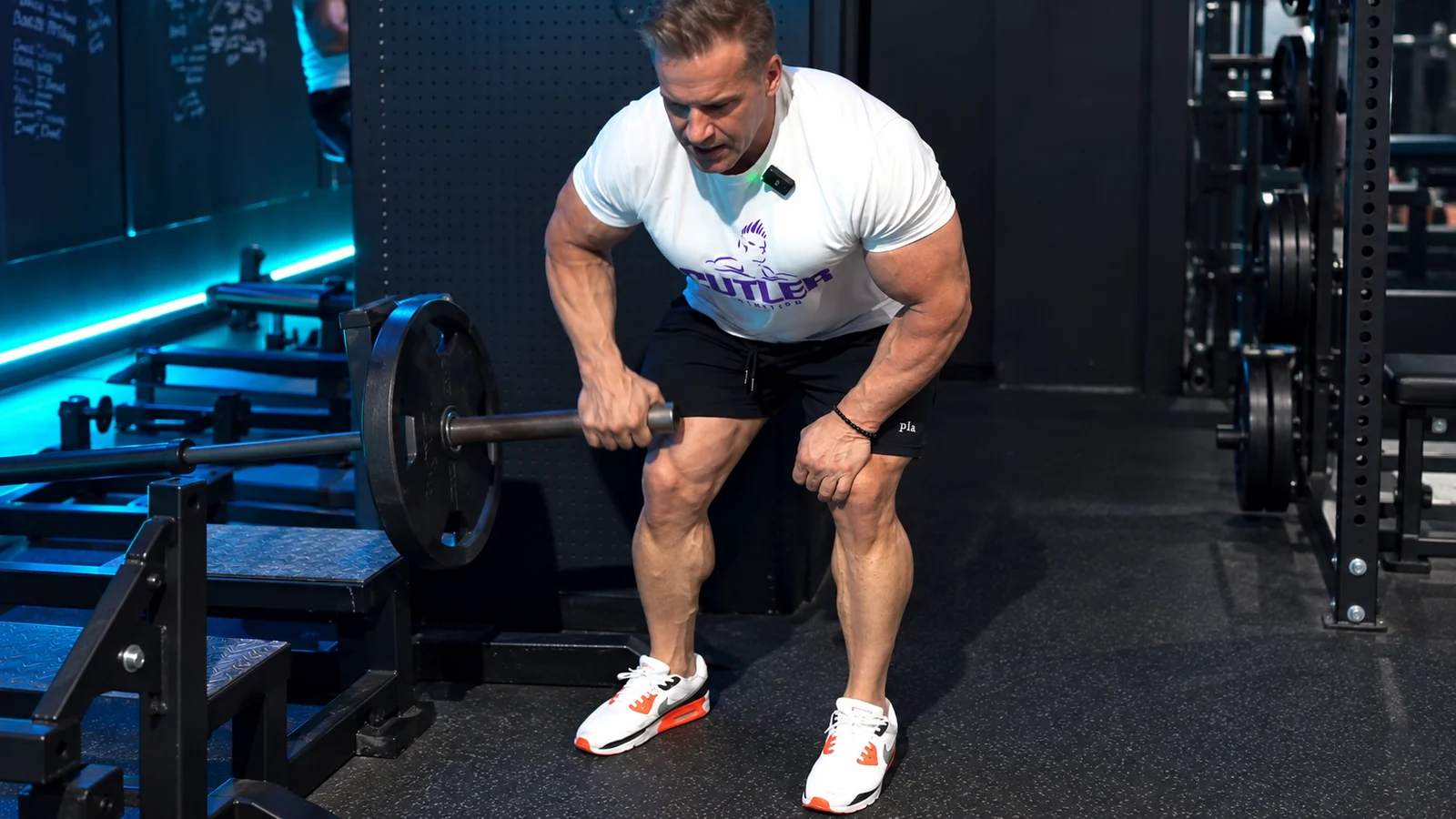
Jay Cutler demonstrated it on his official channel in October 2025, explaining that he learned techniques from Meadows and used the movement like a one-arm dumbbell row.
Cutler said the exercise could help someone “develop the biggest back possible.”
That is an authentic bodybuilding endorsement, but no comparative trial shows that this row builds more lat width or back thickness than every dumbbell, cable, or chest-supported alternative.
The move is still useful because it offers a stable arc, a long reach, and simple progressive loading.
Its value comes from how well it fits the lifter, not from the caption’s incorrect claim that a landmine automatically creates more tension at the top.
Verified video: JayCutlerTV, “MEADOWS ROW FOR BACK GAINS.” The video ID and channel attribution were cross-checked against the original embed reported with Cutler’s October 2025 demonstration.
Where the Exercise Came From
John Meadows described the movement on his official Team Mountain Dog site as the row he made famous. His 2013 rowing guide also recommended smaller plates so the lifter could reach farther at the bottom.
The exercise places one end of a barbell in a landmine pivot while the lifter stands beside the loaded sleeve.
Gripping the sleeve rather than a handle creates the thick grip and sideways pulling angle people associate with the Meadows variation.
Cutler’s 2025 demonstration supports the caption’s historical connection.
He said he had trained with Meadows, learned from his methods, and used the exercise to reach and contract the back from a one-arm setup.
That history does not mean Meadows claimed the exercise was the only way to build lats. He presented it as one rowing option within a much larger back-training system.
What the Meadows Row Trains
The working arm moves through shoulder extension while the shoulder blade retracts toward the spine.
The latissimus dorsi, teres major, posterior deltoid, trapezius, and rhomboids all contribute, while the biceps and brachialis flex the elbow.
The forearm must hold a thick bar sleeve, which can make grip the first limit.
The abdominal wall, obliques, spinal erectors, glutes, and legs work isometrically to keep the torso and pelvis from rotating with the load.
Elbow path shifts emphasis rather than isolating one muscle.
Pulling the elbow closer to the hip generally favors shoulder extension, while a more flared path asks more from the upper back and posterior shoulder.
No direct long-term study has compared Meadows-row hypertrophy with other rows.
A particular lifter may feel the lats clearly, but sensation alone cannot establish that the exercise produces uniquely superior growth.
How to Set It Up
Secure the bar in a landmine attachment and load the free sleeve with smaller-diameter plates when possible. Add a collar so the plates cannot slide as the sleeve moves through its arc.
Stand beside the sleeve with the working shoulder closest to it. Use a staggered or roughly shoulder-width stance that lets you hinge without the plate hitting your shin or knee.
Hinge at the hips until the torso is inclined enough for a long arm path, then brace before lifting. Place the free hand on the thigh, bench, or rack if support improves control.
Grip the sleeve near its end with the palm facing across the body.
Straps are optional when a thick sleeve makes the hand fail before the back, but the load must still be controlled.
How to Perform Each Repetition
Begin with the arm long and let the shoulder blade move forward under control. Do not relax so completely that the weight jerks the shoulder or pulls the torso out of position.
Pull the elbow back and slightly toward the hip while keeping the chest and pelvis mostly square.
The upper arm can reach the torso or pass it slightly, but twisting open to manufacture more range changes the exercise.
Pause only if you can hold the position without rolling the shoulder forward. Lower the sleeve slowly enough to keep control, then allow a repeatable reach before the next pull.
Cutler emphasized the contraction, while Meadows emphasized useful range and smaller plates.
Both cues work when they improve the repetition rather than becoming a reason to shorten the bottom or swing through the top.
The Resistance-Curve Claim Is Backward
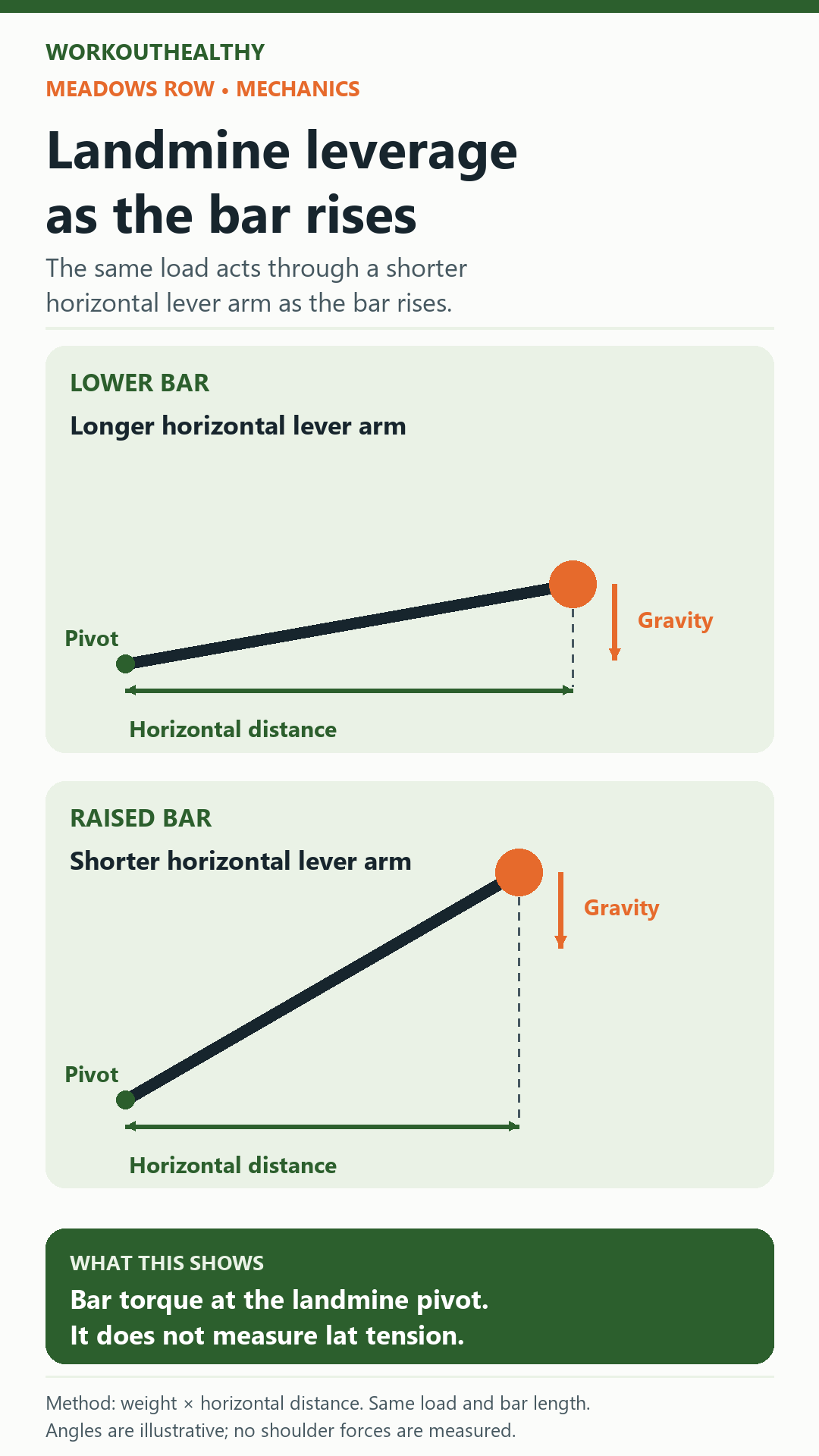
A landmine rotates around a fixed point, so the plates travel on an arc. Gravity creates external torque according to the load and its horizontal distance from that pivot.
When the bar is closer to horizontal, that horizontal distance is larger.
As the loaded sleeve rises and the bar becomes more vertical, the distance usually shortens, so the bar’s external torque tends to decrease near the top.
This does not mean the top feels effortless. The shoulder moment arm, torso angle, elbow path, acceleration, and muscular leverage all change during the repetition.
It does mean the caption cannot promise more top-end tension because the bar pivots.
Bands or a cable can alter a resistance profile deliberately, while the plain landmine generally becomes mechanically lighter as it approaches vertical.
What the Loaded Stretch Can and Cannot Do
The sideways stance allows a controlled reach at the bottom, and many lifters feel a strong stretch through the working side.
Smaller plates help because a large plate may contact the floor before the shoulder reaches its useful range.
Research on training at longer muscle lengths is promising for hypertrophy in several muscles.
The evidence remains muscle- and exercise-specific, and no study has shown that a Meadows row uniquely lengthens or grows the lats.
Cutler’s phrase about lengthening the lats is best understood as a coaching cue for reaching into the bottom.
A set does not permanently lengthen the muscle, and a deeper position is valuable only when the shoulder remains controlled and comfortable.
The useful rule is simple: use the longest repeatable range that keeps tension, position, and joint comfort. Do not chase an extreme stretch by letting the shoulder collapse under a load you cannot reverse smoothly.
The Low Back Is Working, Not Protected
An unsupported hip hinge asks the spinal erectors and trunk muscles to resist flexion and rotation.
That can be a legitimate training demand, but it is not proof that the exercise stabilizes or protects every lower back.
A small laboratory study compared three different row variations and found the standing bent-over row produced the greatest lumbar load.
The study did not test a Meadows row, but it shows why hip-hinged rows should not be sold as free lower-back conditioning.
Use the free hand for support when trunk fatigue limits the back work.
If supporting the torso lets the target muscles receive a harder, cleaner set, the support is a programming choice rather than cheating.
Our guide to deadlift alternatives by goal applies the same principle: choose a back or hinge movement for the job it needs to do, not because one exercise is universally superior.
How to Program the Exercise
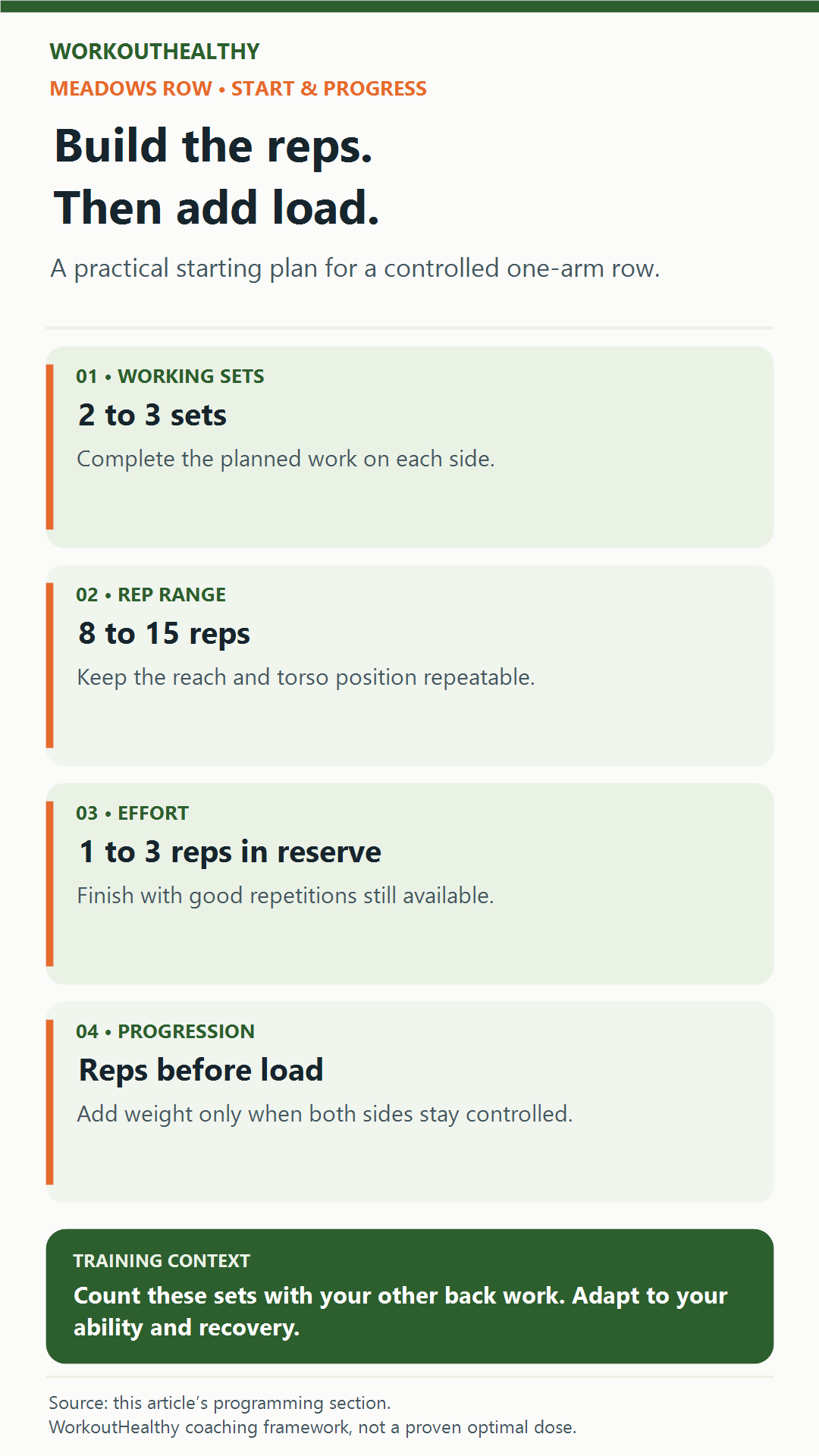
Start with two or three sets of 8 to 15 repetitions per side.
Finish most sets with one to three good repetitions still available, especially while learning to hold the hinge and control the bottom.
Use double progression by adding repetitions within the range before adding another plate. Increase load only when the reach, elbow path, and torso position remain consistent on both sides.
Place the exercise after a pull-up or pulldown when you want it as a focused rowing movement. It can also lead the session when unilateral back training is the priority and the low back is fresh.
One hard row does not make a complete back program.
Our breakdown of Derek Lunsford’s multi-angle back workout shows how elite bodybuilding sessions combine vertical pulls, rows, and rear-shoulder work.
Across a week, count the Meadows-row sets with the rest of your direct back work. The complete training-program guide can help place that volume beside pressing, lower-body training, and recovery.
Common Mistakes
- Using full-size plates that stop the bottom range early.
- Loading the bar until the torso twists on every repetition.
- Pulling the hand toward the chest instead of driving the elbow.
- Letting the shoulder drop suddenly at the bottom.
- Turning a controlled row into a whole-body heave.
- Refusing support even when the low back fails before the upper back.
- Assuming a burn, stretch, or pump proves superior hypertrophy.
When Another Row Is Better
Choose a chest-supported row when the lower back needs less loading or when the previous exercise already taxed the hinge.
A supported one-arm dumbbell row offers a similar unilateral pattern without the fixed landmine arc.
A one-arm cable row is useful when you want adjustable line of pull and more consistent external tension across the range.
A machine row can reduce setup time and make proximity to failure easier to judge.
The best alternative is not the exercise that looks most advanced.
It is the row you can load progressively, perform through a repeatable range, recover from, and keep in the program long enough to measure.
Stop if the movement produces sharp shoulder or back pain, radiating symptoms, numbness, or loss of control. Persistent symptoms deserve an appropriate clinical assessment rather than a technique cue from a video.
The Bottom Line
Jay Cutler authentically demonstrated the Meadows row and credited John Meadows for the technique.
It is a useful one-arm landmine row that can train the lats, upper back, rear shoulder, arms, grip, and trunk.
The exercise does not have proven unique hypertrophy powers, and the plain landmine does not automatically create more tension at the top.
Its strongest practical features are a long controllable reach, simple loading, and a path some lifters find comfortable.
Use smaller plates, secure the bar, control the bottom, limit torso rotation, and progress the work honestly.
Keep it because it earns results in your program, not because an exercise named after a respected coach must be magical.
Get the next evidence check.
Five practical fitness stories worth your time, every Friday.
One email a week. No product pitches. Unsubscribe in one click.
References
- Meadows J. Exercise Index: Meadows Row. Team Mountain Dog. May 20, 2019. https://www.youtube.com/watch?v=EsmIWi_0lio
- Meadows J. The 3 Best Rowing Exercises. T Nation. December 5, 2013. https://archive.t-nation.com/training/the-3-best-rowing-exercises/
- JayCutlerTV. MEADOWS ROW FOR BACK GAINS. YouTube. October 21, 2025. https://www.youtube.com/watch?v=zLc2ztkdqZc
- Fenwick CMJ, Brown SHM, McGill SM. Comparison of different rowing exercises: trunk muscle activation and lumbar spine motion, load, and stiffness. Journal of Strength and Conditioning Research. 2009;23(5):1408-1417. https://pubmed.ncbi.nlm.nih.gov/19620925/
- Currier BS, et al. Resistance training prescription for muscle strength and hypertrophy in healthy adults: a systematic review and Bayesian network meta-analysis. British Journal of Sports Medicine. 2023;57(18):1211-1220. https://pubmed.ncbi.nlm.nih.gov/37414459/
- Refalo MC, Helms ER, Trexler ET, Hamilton DL, Fyfe JJ. Influence of Resistance Training Proximity-to-Failure on Skeletal Muscle Hypertrophy: A Systematic Review with Meta-analysis. Sports Medicine. 2023;53(3):649-665. https://pubmed.ncbi.nlm.nih.gov/36334240/
- Kassiano W, et al. Which ROMs Lead to Rome? A Systematic Review of the Effects of Range of Motion on Muscle Hypertrophy. Journal of Strength and Conditioning Research. 2023;37(5):1135-1144. https://pubmed.ncbi.nlm.nih.gov/36662126/
- Androulakis-Korakakis P, et al. Optimizing Resistance Training Technique to Maximize Muscle Hypertrophy: A Narrative Review. Journal of Functional Morphology and Kinesiology. 2024;9(1):9. https://pubmed.ncbi.nlm.nih.gov/38249086/
Medical disclaimer: This article is for general information only and is not medical advice. If you have an injury, ongoing pain, or a medical condition, consult a qualified clinician before changing your training.