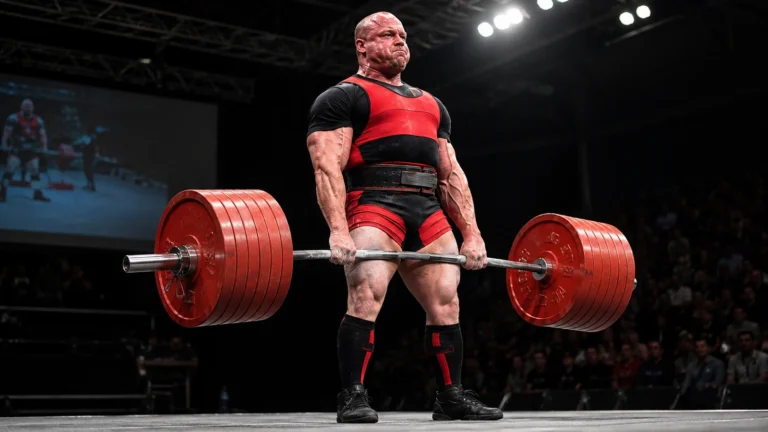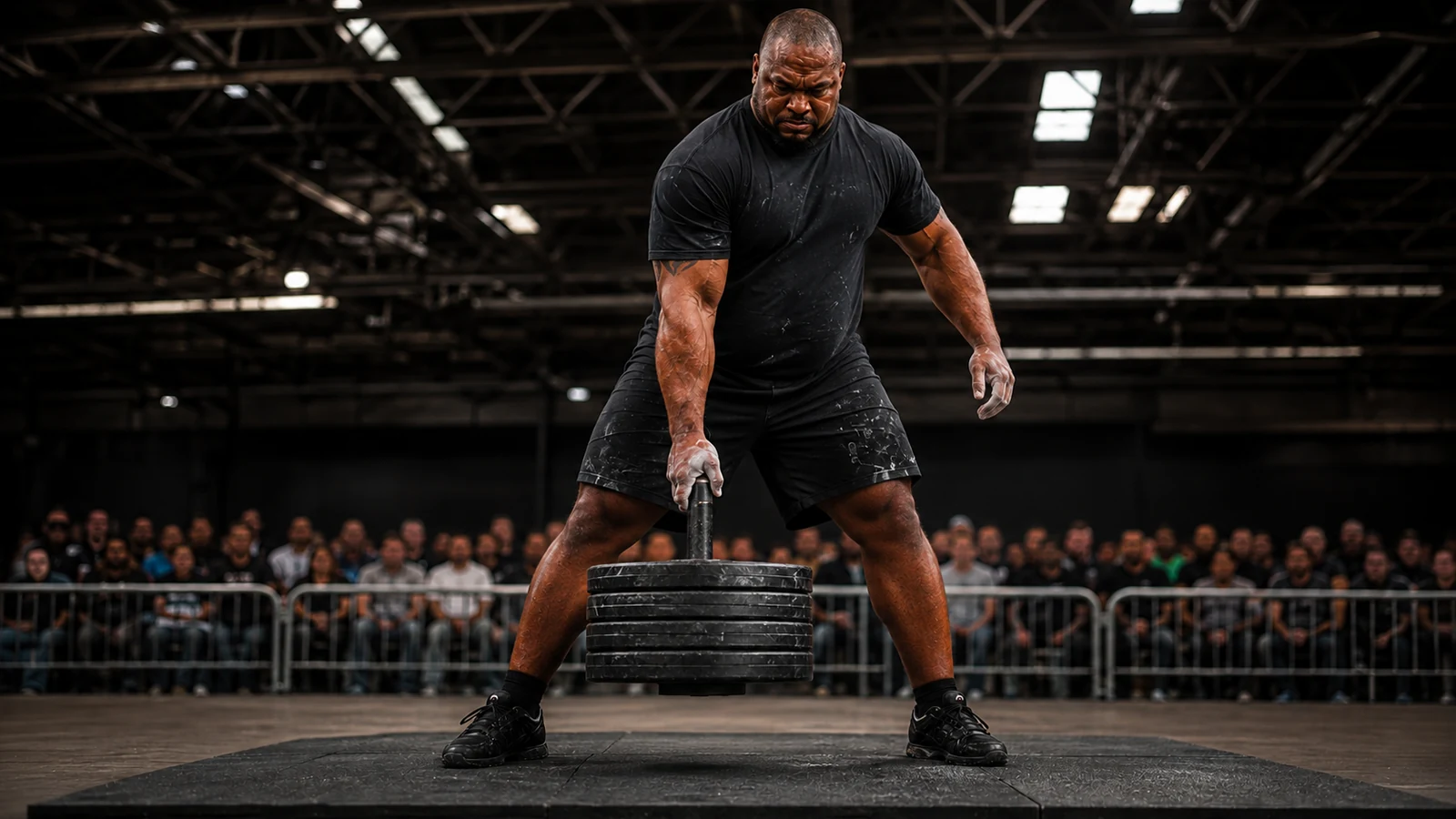

A WorkoutHealthy Facebook post credited Mark Felix with the Rolling Thunder world record for a one-hand lift of 323.5 pounds.
That claim traces back to a real event, a real company, and a real report.
It also turns out to be more complicated than a single number, and the fuller picture is worth knowing before you repeat it.
What Actually Happened at Bodypower
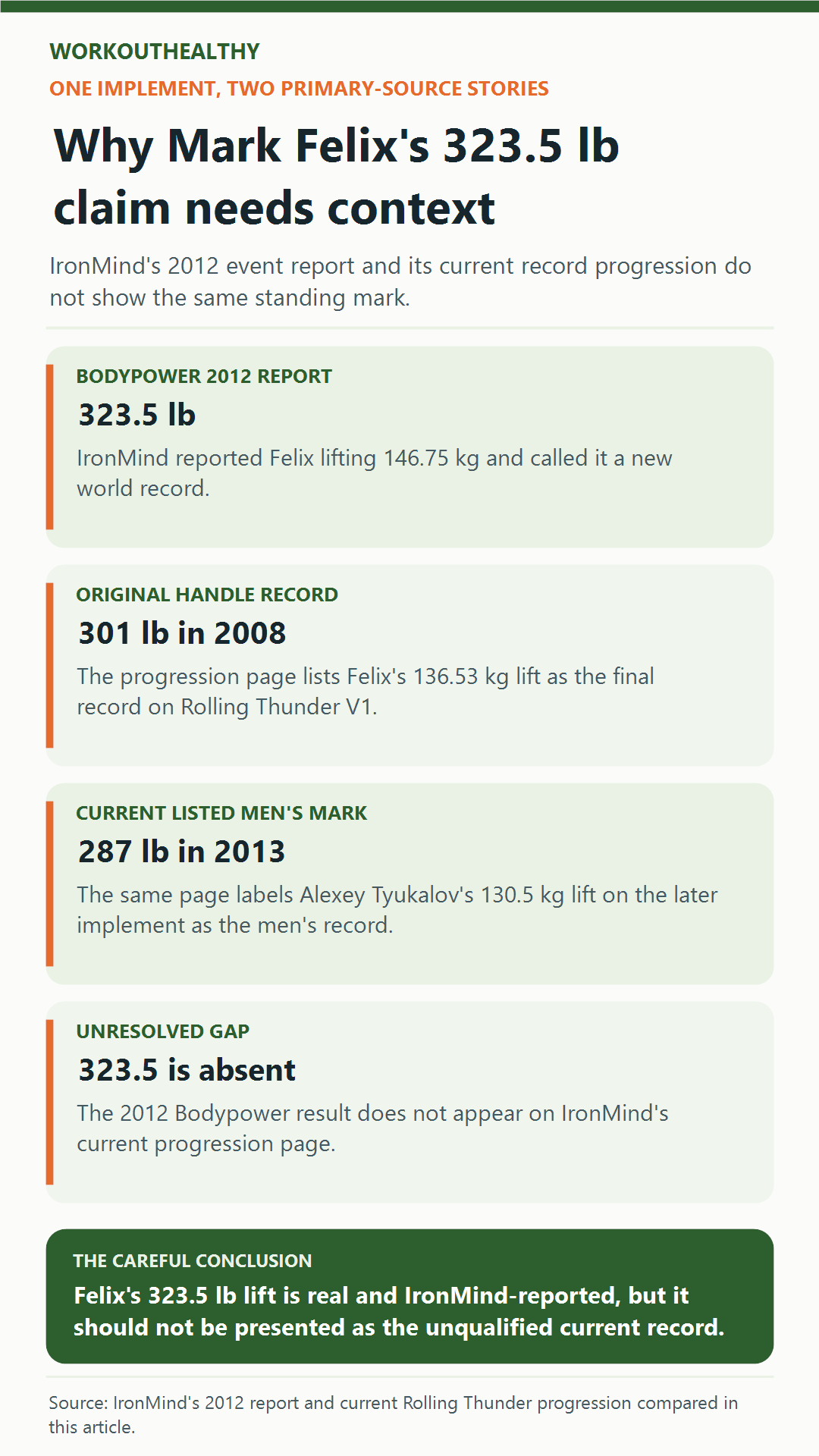
On Sunday, May 22, 2012, at the Bodypower Expo in Birmingham, England, Mark Felix pulled 146.75 kilograms, 323.5 pounds, off the floor with one hand on a Rolling Thunder.
IronMind, the company that manufactures the Rolling Thunder and is the recognized authority for certifying lifts on it, reported the pull itself and called it a new world record.
According to that report, Felix beat the standing mark by more than 20 pounds.
The mark he beat also belonged to him.
Felix had set it in January 2008, pulling 136.53 kilograms, 301 pounds, and becoming the first man on record to break the 300 pound barrier on the implement.
Felix is a professional strongman from the United Kingdom who built much of his reputation on exactly this kind of lift, isolated finger and hand power rather than total body size.
What the Rolling Thunder Actually Is
The Rolling Thunder does not look like it should be hard.
It is a thick steel handle attached to a loading pin, and the lift itself is a simple deadlift, stand up with the weight and lock out the hips and knees.
The catch is that the handle spins freely on its own axis.
A normal barbell or dumbbell handle stays still in your hand while your fingers do the work of closing around it.
A Rolling Thunder handle rotates the instant your grip loses tension, so the weight tries to roll straight out of your fingers under load.
There are no wrist straps allowed, no hooks, no chalk crutch that fixes the problem.
It is skin, tendon, and bone against a spinning steel bar, and the diameter of that bar is wide enough that a normal closed-fist grip cannot fully wrap around it.
A thicker, rotating handle does not just make a lift harder. It changes which muscles and tendons are doing the limiting work, shifting the load away from the arms and back and onto the smaller structures of the hand and forearm.
The Record IronMind Actually Verified, and Where the Story Gets Complicated
Here is where the honest fact check has to slow down.
IronMind’s own news report from 2012 is specific and credible: date, venue, exact weight, and a direct comparison to the record it replaced.
But IronMind also maintains a separate reference page, its official Rolling Thunder rules and world record progression, and that page tells a different story.
On that page, Felix’s 2008 lift of 301 pounds is listed as the final world record set on the original Rolling Thunder design, footnoted as “Final world record on Rolling Thunder, V1.”
The very next entry on that same page is Alexey Tyukalov, who lifted 130.5 kilograms, 287 pounds, in June 2013, and that lift is the one currently labeled the men’s world record.
The 2012 Bodypower number, 323.5 pounds, does not appear on that progression page at all.
That is a real discrepancy between two pages published by the same organization, not a rounding difference or a caption error.
The most likely explanation is an equipment change.
The “V1” footnote suggests IronMind updated the Rolling Thunder’s specifications at some point, and record progressions on strongman implements typically restart, sometimes at a lower number, whenever a harder version of the tool replaces an easier one.
It is also possible the reference page simply has not been refreshed to include the 2012 result, since its most recent entries across every category date to 2017 or earlier.
Either way, the fair and accurate statement is this: Mark Felix’s 323.5 pound lift at Bodypower 2012 is a real, IronMind-reported result and one of the heaviest one-hand pulls ever recorded on a Rolling Thunder, but it is not the figure IronMind’s own current record-keeping page lists as the standing world record.
Readers repeating this claim should know both halves of that sentence, not just the impressive one.
One thing is not in dispute: this is a lift certified and tracked by IronMind, the manufacturer and governing authority for the implement, not by Guinness World Records.
The two organizations keep separate record books, and Guinness has never been the authority for Rolling Thunder marks.
Why a Rotating Handle Beats a Fixed One
The mechanism behind the Rolling Thunder is well supported by basic grip biomechanics, even outside the strongman world.
Grip force is limited less by arm strength and more by how much of the hand’s surface can close around an object and stay closed under load.
Basic hand biomechanics research shows that grip force output changes as a handle’s diameter moves away from what a given hand can comfortably wrap, which is part of why implement makers can create a much harder lift without adding much weight at all.
A rotating handle adds a second problem on top of that.
Instead of holding a fixed object still, the lifter has to constantly resist the handle trying to roll open inside a closing fist.
That turns a strength task into an endurance and coordination task for the small flexor muscles of the fingers and forearm, which fatigue far faster than the bigger muscles of the back and legs doing the actual pulling.
It is the same reason a small change in an exercise’s mechanics, like removing leg drive from a press, can shift which muscles hit failure first without changing the weight on the bar at all.
Grip Strength Is a Real Health Marker, Not Just a Strongman Stunt
It would be easy to read a Rolling Thunder record as pure spectacle, a party trick for people who already lift heavy.
The research on grip strength suggests otherwise.
A landmark study followed a large group of middle-aged men for roughly 25 years and found that weaker grip strength in midlife predicted a meaningfully higher risk of disability in old age, independent of other health measures (Rantanen et al., 1999).
A much larger, more recent study tracked nearly 140,000 adults across 17 countries and found that every 5 kilogram drop in grip strength was associated with a 16 percent higher risk of death from any cause during the follow-up period (Leong et al., 2015).
Reviews of the broader evidence base describe grip strength as one of the most useful simple biomarkers available for tracking functional aging, cheap to measure and strongly tied to outcomes like falls, hospital stays, and recovery from illness (Bohannon, 2019).
None of that means training for a Rolling Thunder record extends your life.
It means the underlying trait, how much force your hand can produce and sustain, is worth caring about even if you never touch a rotating steel handle.
What This Record Does Not Prove
A single elite lift by one professional strongman does not tell an average gym-goer much about their own training.
Felix’s grip power came from years of specialized, high-risk training most lifters have no reason to copy directly.
A record this specific also cannot be generalized into a claim like “grip training builds total body strength,” since the Rolling Thunder isolates one narrow skill rather than testing overall muscular development.
And the discrepancy between IronMind’s two pages is a reminder that even a well-sourced viral claim can outrun the organization’s own current records, so a widely shared number is worth double-checking against the primary source before it gets repeated as settled fact.
Common Mistakes People Make Training Heavy Grip Work
The most common mistake is jumping straight to a maximal one-hand pull without months of submaximal grip conditioning first.
Tendons and ligaments in the fingers adapt far more slowly than muscle does, so a lifter can feel strong in the hand while the connective tissue is still catching up.
A second mistake is training grip only through crush exercises, like hand grippers, while ignoring the pinch and support grip needed for something like a rotating handle.
Those are different skills that need different training, not one exercise that covers all of them.
A third mistake is chasing heavy singles every session instead of building volume at lighter loads, which is how most serious grip athletes actually spend the bulk of their training time.
Who Should Be Cautious With This Kind of Training
Anyone with a history of finger, wrist, or elbow tendon injuries should be especially careful with thick-bar or rotating-handle work, since those are exactly the structures under the most strain.
People with diagnosed arthritis in the hands or wrists should check with a doctor or physical therapist before adding heavy grip-specific loading to their routine.
Anyone new to strength training in general should build a base of standard deadlifts and carries first, since grip specialization tools reward an already-trained hand rather than building one from nothing.
How to Actually Train Grip Strength Safely
Start with support grip work you already have access to, like farmer’s carries with dumbbells or a trap bar, for sets of 20 to 40 seconds.
Add thick-bar or fat-grip attachments to normal exercises, like rows or curls, before attempting a dedicated implement like a Rolling Thunder.
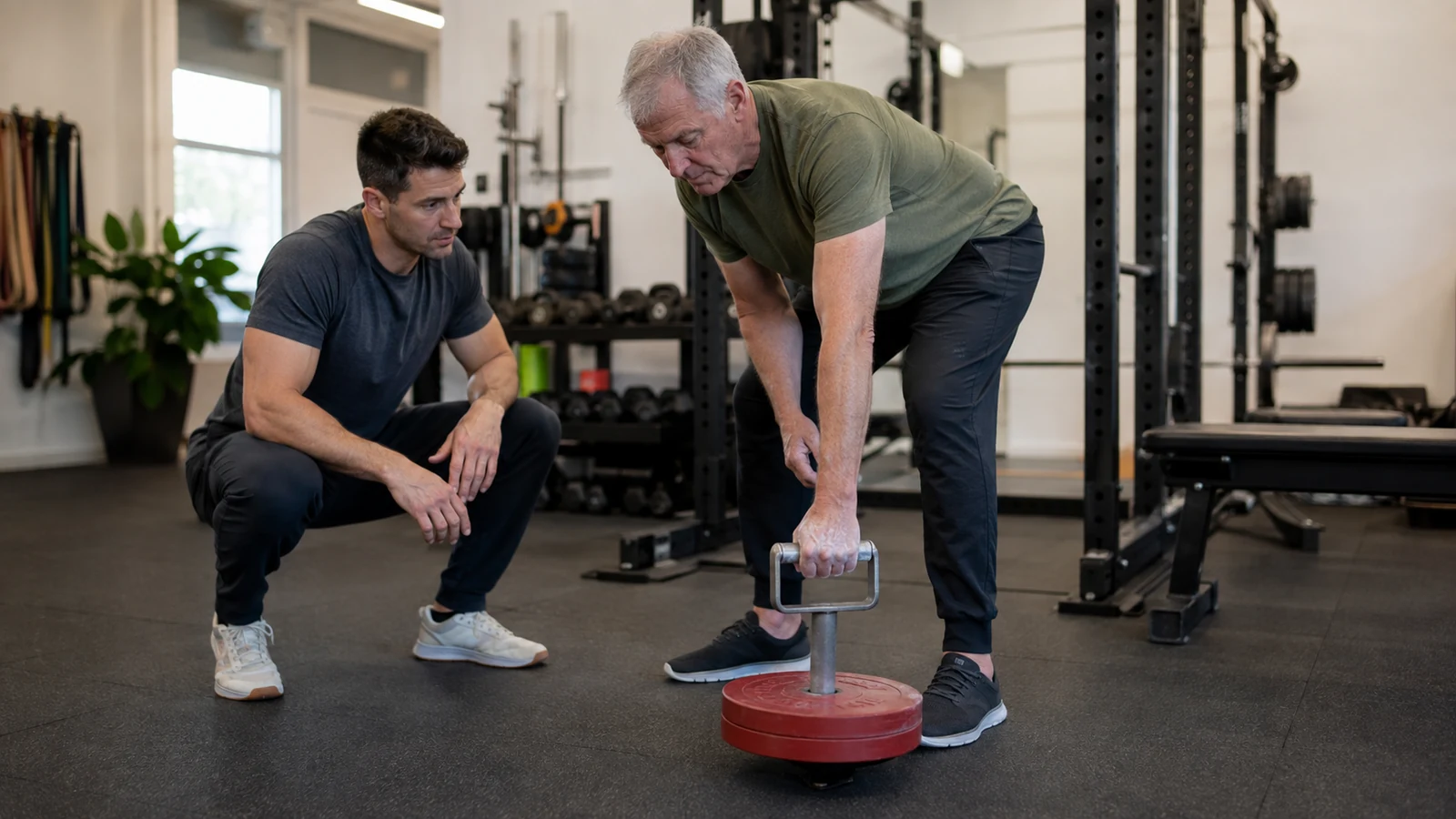
Train grip two to three times per week rather than daily, since the small muscles and tendons involved need more recovery time relative to their size than most lifters expect.
Progress load slowly, in small increments, and stop a set the moment your grip fails rather than fighting to complete a rep with your wrist or fingers rolling out of position.
If you want structured guidance on adding a specialized skill like this to an existing program, working with a qualified coach is often worth it, and our guide on deciding whether you need a personal trainer walks through how to find one who actually knows strength sport, not just general fitness.
For more on how record attempts like this one get pressure-tested against the numbers behind them, our breakdown of DonnaJean Wilde’s push-up world record looks at a very different kind of feat with the same fact-checking approach.
And for another case where a viral claim about a world record needed real verification, see our piece on Edith Connor’s Guinness record for oldest female bodybuilder.
Watch the Original Video
Want more claims like this checked against the actual source? Subscribe to WorkoutHealthy Insider for practical explanations behind popular fitness claims.
References
Bohannon, R. W. (2019). Grip strength: An indispensable biomarker for older adults. Clinical Interventions in Aging, 14, 1681–1691. https://doi.org/10.2147/CIA.S194543
Leong, D. P., Teo, K. K., Rangarajan, S., Lopez-Jaramillo, P., Avezum, A., Orlandini, A., Seron, P., Ahmed, S. H., et al. (2015). Prognostic value of grip strength: Findings from the Prospective Urban Rural Epidemiology (PURE) study. The Lancet, 386(9990), 266–273. https://doi.org/10.1016/S0140-6736(14)62000-6
Rantanen, T., et al. (1999). Midlife hand grip strength as a predictor of old age disability. JAMA, 281(6), 558–560. https://doi.org/10.1001/jama.281.6.558
IronMind Enterprises. (2012, May). Mark Felix demolishes Rolling Thunder world record. https://www.ironmind.com/news/Mark-Felix-Demolishes-Rolling-Thunder-World-Record/
This article is for general information only and is not medical advice. If you have an injury, ongoing pain, or a medical condition, talk to a doctor or physical therapist before you change how you train or eat.