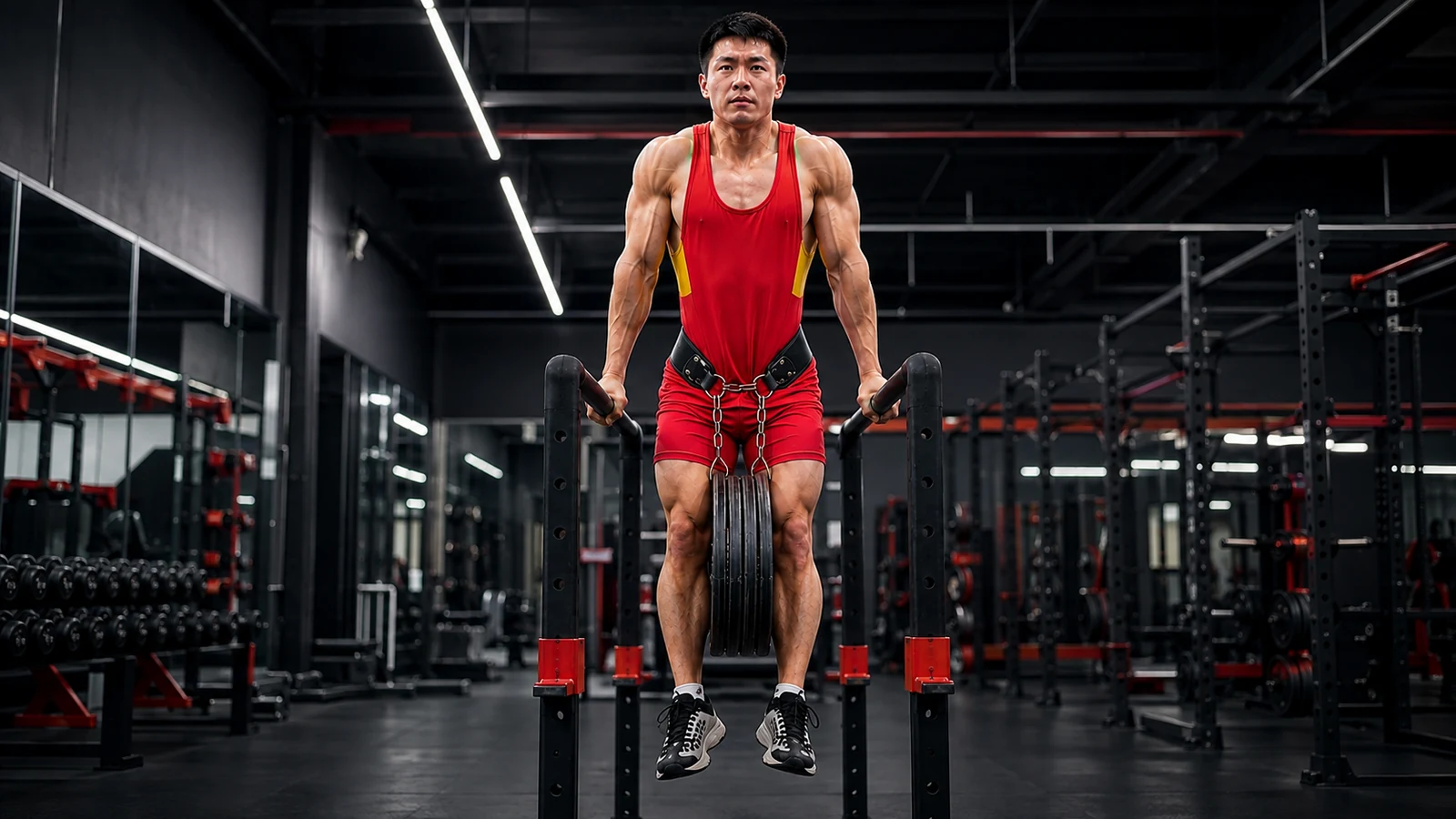

Liu Weiqiang walked up to a set of parallel bars, strapped on a belt loaded with 191.94 kilograms, and dipped his own body weight plus that load through a full range of motion.
That is 423.15 pounds of added weight.
It is roughly the size of a large adult male lion, hanging from a belt around his hips while his arms alone controlled the descent and the drive back up.
Guinness World Records lists this as the heaviest weighted tricep dip on record.
We checked the claim directly against Guinness’s own site before writing a word of this article, because a viral fitness clip is not the same thing as a verified record.
Here is what actually held up, what the real exercise science says about how a human body handles a load like that, and what it takes to build toward a heavy weighted dip yourself, without chasing a number that is not realistic for almost anyone.
What Liu Weiqiang Actually Did
The record is real, and it is independently confirmed.
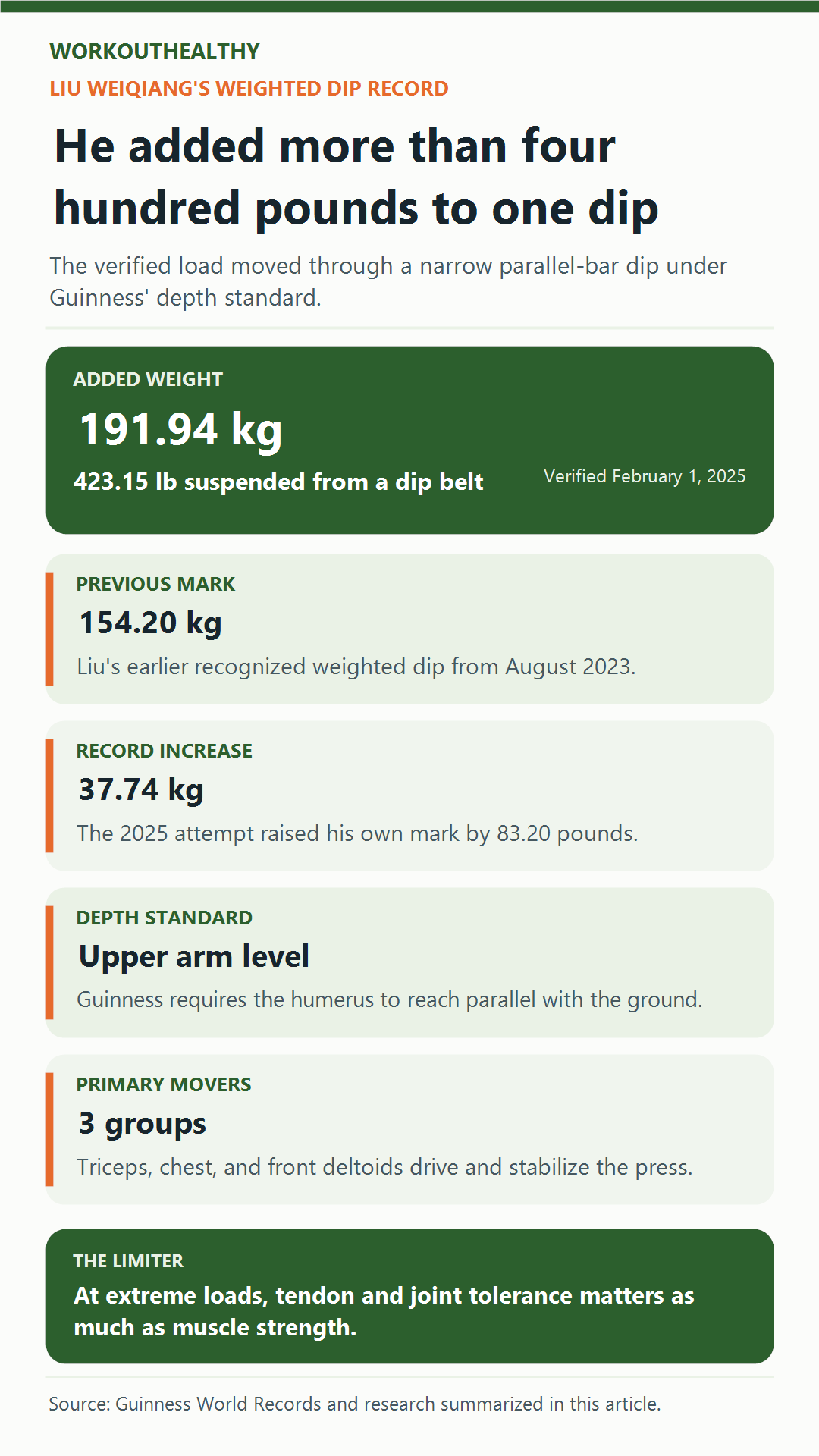
Guinness World Records’ own record page lists Liu Weiqiang of China as the current holder of the heaviest weighted tricep dip, at 191.94 kg (423.15 lb), achieved on February 1, 2025, in Zhangjiakou, Hebei, China.
Guinness defines the movement precisely.
A tricep dip is defined as a narrow, shoulder-width dip of the arms where the elbow bends so that the humerus is parallel to the ground.
This was not Liu’s first attempt at this exact record.
Guinness previously recognized him for a lighter weighted tricep dip of 154.20 kg (339.95 lb) in August 2023, one of eight separate strength records he set that year.
The February 2025 attempt broke his own earlier mark by more than 37 kilograms.
That is a huge single jump for an absolute strength record.
What we could not independently verify is everything around the edges of the number itself.
We did not find independent sports press coverage confirming the exact February 2025 date beyond Guinness’s own listing, so we treated the source video, a repost from the official Guinness World Records account, as supporting evidence rather than the primary proof.
The primary proof is the official Guinness record page itself, and that page does list Liu Weiqiang as the current holder at this exact weight.
That makes this a confirmed official Guinness World Record, not an unverified social media claim.
Why a Simple-Looking Exercise Can Carry This Much Weight
A dip looks like a small movement.
You lower your body between two bars and push it back up.
But the muscles doing that work are some of the strongest pressing muscles in the upper body, and this record stays firmly inside a pressing pattern, not a pulling one.
A 2022 study published in the International Journal of Environmental Research and Public Health used surface electromyography to measure muscle activation during bar dips, bench dips, and ring dips in trained lifters.
The triceps brachii, the muscle on the back of the upper arm that straightens the elbow, showed higher peak activation during bar dips than during bench dips.
The pectoralis major and the anterior deltoid, the front of the shoulder, also showed significantly greater activation on the bar dip compared to the bench dip.
That matters here because Guinness’s tricep dip standard uses parallel bars, the same setup as the bar dip tested in that research.
The elbow extension task, driving the humerus back up from a bent position to straight, falls mostly on the triceps.
The chest and front shoulder handle the pushing and stabilizing that happen alongside it, since the torso also moves through shoulder extension as the body descends and rises.
Add over 400 pounds to that pattern and the demand on those same three muscle groups scales up directly.
No new muscle group gets recruited by adding weight.
The triceps, chest, and front deltoids simply have to produce far more force to move the same joint angles.
How the Weighted Dip Compares to the Bench Press
Both movements are pressing patterns built on the same core muscles: triceps, pectoralis major, and anterior deltoid.
That overlap is exactly why coaches often use dips as an accessory or alternative to bench pressing for building pressing strength.
The two movements are not identical, though.
A barbell bench press is fixed by the bar path and the bench itself, which limits how much stabilizer muscle has to work to keep the body in position.
A dip is different.
The whole body hangs between two bars with nothing holding the torso or shoulder blades in place except the lifter’s own muscles.
A separate 2022 study from the same research group, published in the same journal, looked at what happens to dip mechanics under fatigue.
It found that stabilizing muscles, including the serratus anterior, lower trapezius, and latissimus dorsi, showed significantly increased activation as fatigue set in during repeated bar dips.
A fixed-bar-path exercise like a barbell bench press simply does not place that same stabilizer demand on the body.
Readers who want a closer look at how a fixed surface changes a pressing pattern can see a smaller version of the same principle in how removing the bench itself changes a bench press.
What Actually Limits How Much Weight a Person Can Add
Muscle strength is rarely the ceiling on an exercise like this.
Tendons and joints usually are.
A 2017 systematic review published in the journal Hand looked specifically at triceps tendon ruptures.
The researchers described these injuries as almost always traumatic, requiring a large amount of force.
They noted that the injuries typically occur from forced bending of the elbow during a pushing activity, with heavy resistance training and weightlifting listed among the common settings where they happen.
That is a direct description of the exact joint action inside a heavily weighted dip.
The shoulder carries its own separate limit.
A dip already places the shoulder into a deep extension position at the bottom of the movement, farther back than most other pressing exercises ask the shoulder to go.
Adding external load increases the force running through that end-range position on every single repetition, not just the top set.
The 2022 fatigue study on bar dips found something reassuring here, though it comes with a caveat.
Even as fatigue increased muscle activation substantially, the researchers found no significant change in the maximal joint angles lifters reached at the bottom of the dip.
Well-trained lifters did not lose control of their depth as they got tired.
That is a sign of technical mastery under fatigue, not proof that any lifter at any weight is automatically safe going deep under a heavy external load.
How Elite Lifters Build Toward a Weighted Dip This Heavy
Liu Weiqiang’s own record history is itself a case study in patient progression.
He held a lighter version of this same record at 154.20 kg in 2023.
It took roughly a year and a half of continued training before he added another 37-plus kilograms to set the February 2025 mark.
That timeline reflects a broader pattern in how strength athletes approach any absolute-load record.
Progress comes in small increments measured over months, not sudden jumps.
The general approach strength coaches use for building toward a heavy weighted bodyweight exercise follows a familiar shape.
First comes mastering strict bodyweight reps through a full, controlled range of motion.
Only after that base is solid does small external load get added, often just a few pounds at a time on a dip belt.
Volume gets built at each new weight before the next increase happens.
Heavy single-repetition attempts stay rare, reserved for tested lifters who already move confidently under lighter loads for multiple reps.
This is the same periodization logic used in barbell strength sports, just applied to a bodyweight-based movement with external load layered on top of it.
What This Record Does Not Prove
A verified Guinness record confirms one thing precisely: that one specific lifter moved one specific load through one specific range of motion, one time, on one day, under Guinness’s judging standards.
It does not prove weighted dips build more muscle than any other pressing exercise.
It does not prove that heavy external loading is safe for the average gym goer to attempt.
It does not tell us anything about Liu Weiqiang’s specific training program, since none of that is part of the record verification itself.
It also does not set a target for anyone else to chase.
A performance like this one sits at the far edge of a distribution shaped by genetics, years of specific training, body proportions, and other advantages that are simply not visible in a highlight clip.
Common Mistakes and the Injury Risks Worth Knowing
Most weighted dip injuries do not happen at world record loads.
They happen at ordinary gym weights, performed with technique that has quietly gotten worse under load.
Flared elbows are one common mistake.
When the elbows drift wide instead of tracking back close to the torso, more stress shifts toward the front of the shoulder joint instead of staying centered on the triceps and chest.
Excessive depth is another mistake.
The kinematics study on bench, bar, and ring dips found that the bench dip variation demanded a notably larger shoulder extension range of motion than the bar or ring dip.
Going deeper than your shoulder can control under load raises injury risk without adding meaningful muscle benefit.
Bouncing at the bottom of the rep, using momentum instead of a controlled tempo, and adding weight before technique is genuinely solid round out the most common mistakes lifters make with this exercise.
Who Should Be Cautious With Weighted Dips
Anyone with a history of shoulder impingement, a prior shoulder dislocation, or ongoing elbow or triceps tendon pain should treat weighted dips as a movement to approach carefully, not skip blindly into.
The deep shoulder extension position at the bottom of a dip is exactly the range where irritated shoulders tend to flare up.
Beginners without a solid base of strict bodyweight dips are another group worth flagging.
Adding external load onto a movement pattern you have not yet mastered with just your own body weight tends to bake bad habits in rather than build strength safely.
A Practical Path Toward Your First Weighted Dip
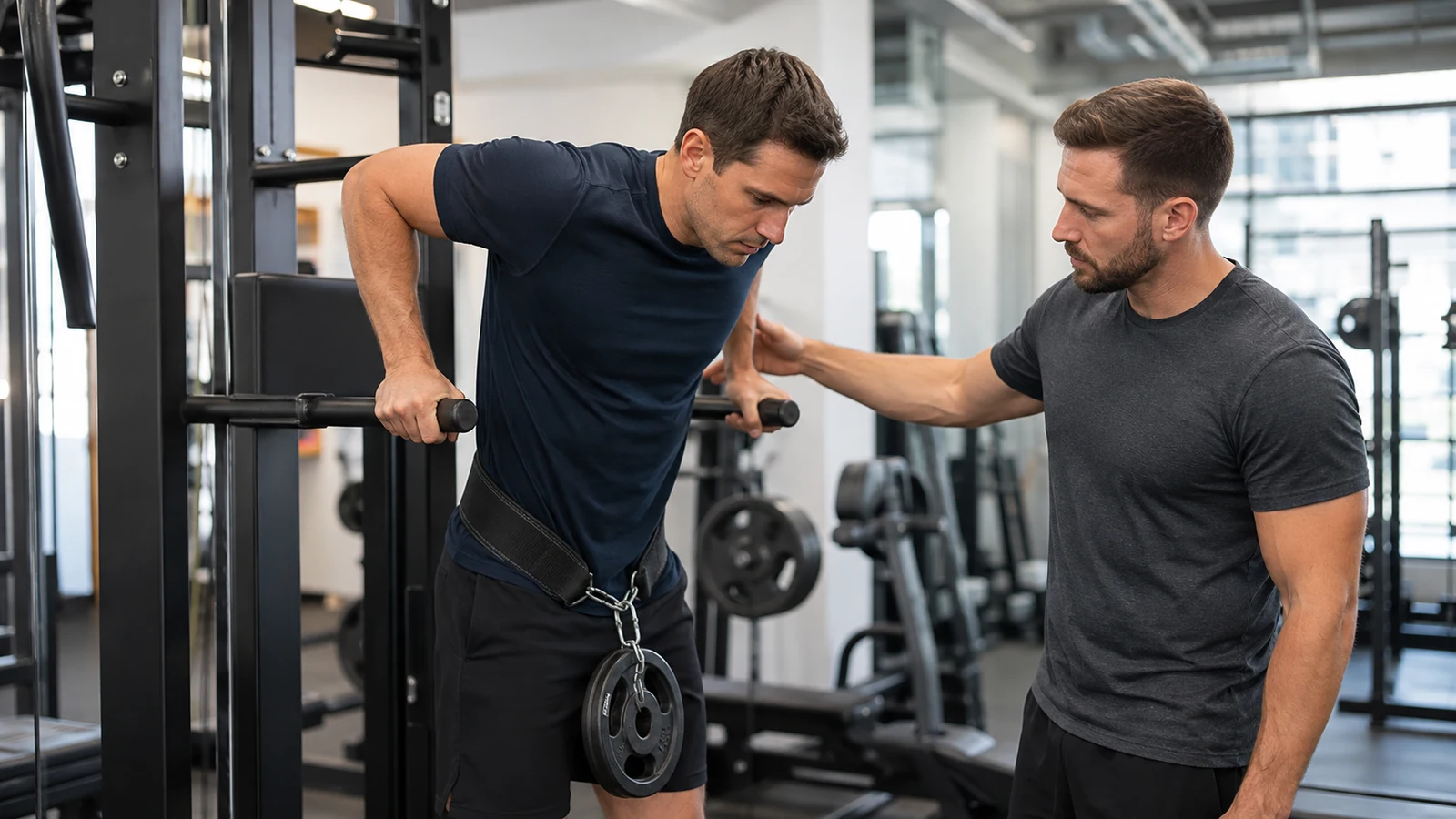
Start with strict bodyweight dips through a full, pain-free range of motion.
Aim for two to three sets of 10 to 15 clean reps before you even think about adding external load.
That baseline tells you your joints and connective tissue can already handle repeated pressing under your own body weight.
Once that baseline is solid, add weight in small steps.
A dip belt with a chain or strap works well for this.
The standard approach is 2.5 to 5 pounds at a time, held for two to three weeks before the next increase.
Jumping straight to a heavy plate the first week you touch a dip belt is how good lifters get hurt.
Warm the shoulders up thoroughly before any weighted set.
Band pull-aparts, light shoulder circles, and a few sets of bodyweight dips as a specific warm-up all help prepare the joint for the deep range it is about to load.
Keep your elbows tracking back near your torso rather than flaring outward.
Stop your descent at a depth you can control, not the deepest point your shoulders happen to allow.
A slight forward lean through the torso keeps more of the work on the chest and triceps rather than dumping stress onto the front of the shoulder.
If you are training toward a genuinely heavy single-repetition attempt someday, that is also the point where working with a qualified coach who can check your technique becomes worth the cost, since form breakdown under a near-maximal load is exactly when injuries happen.
Track your progress the same way strength athletes do.
Log the added weight, the reps completed, and how controlled the last rep looked, not just whether you finished the set.
A rep that falls apart at the bottom is a sign to hold the current weight for another week, not push higher.
Watch the Record
The verified record listing, with the exact weight, date, and location, is on Guinness World Records’ official record page for the heaviest weighted tricep dip.
Records like this one are fun to watch, but the real value is in the training science behind them. Subscribe to WorkoutHealthy Insider for practical explanations behind popular fitness claims.
References
Dunn, J. C., Kusnezov, N., Fares, A., Rubin, S., Orr, J., Friedman, D., & Kilcoyne, K. (2017). Triceps tendon ruptures: A systematic review. Hand, 12(5), 431-438. https://doi.org/10.1177/1558944716677338
McKenzie, A., Crowley-McHattan, Z., Meir, R., Whitting, J., & Volschenk, W. (2022). Bench, bar, and ring dips: Do kinematics and muscle activity differ? International Journal of Environmental Research and Public Health, 19(20), 13211. https://doi.org/10.3390/ijerph192013211
McKenzie, A., Crowley-McHattan, Z., Meir, R., Whitting, J., & Volschenk, W. (2022). Fatigue increases muscle activations but does not change maximal joint angles during the bar dip. International Journal of Environmental Research and Public Health, 19(21), 14390. https://doi.org/10.3390/ijerph192114390
This article is for general information only and is not medical advice. If you have an injury, ongoing pain, or a medical condition, talk to a doctor or physical therapist before you change how you train or eat.