
Leon Battista Alberti is remembered as an architect, writer, and thinker of the early Renaissance.
He is also remembered for some unusual athletic boasts.
A popular post says he practiced and praised varied physical feats like jumping, wrestling, and horse taming throughout his adult life.
Most of those feats rest on his own word.
Some parts of the popular version we could not confirm at all.
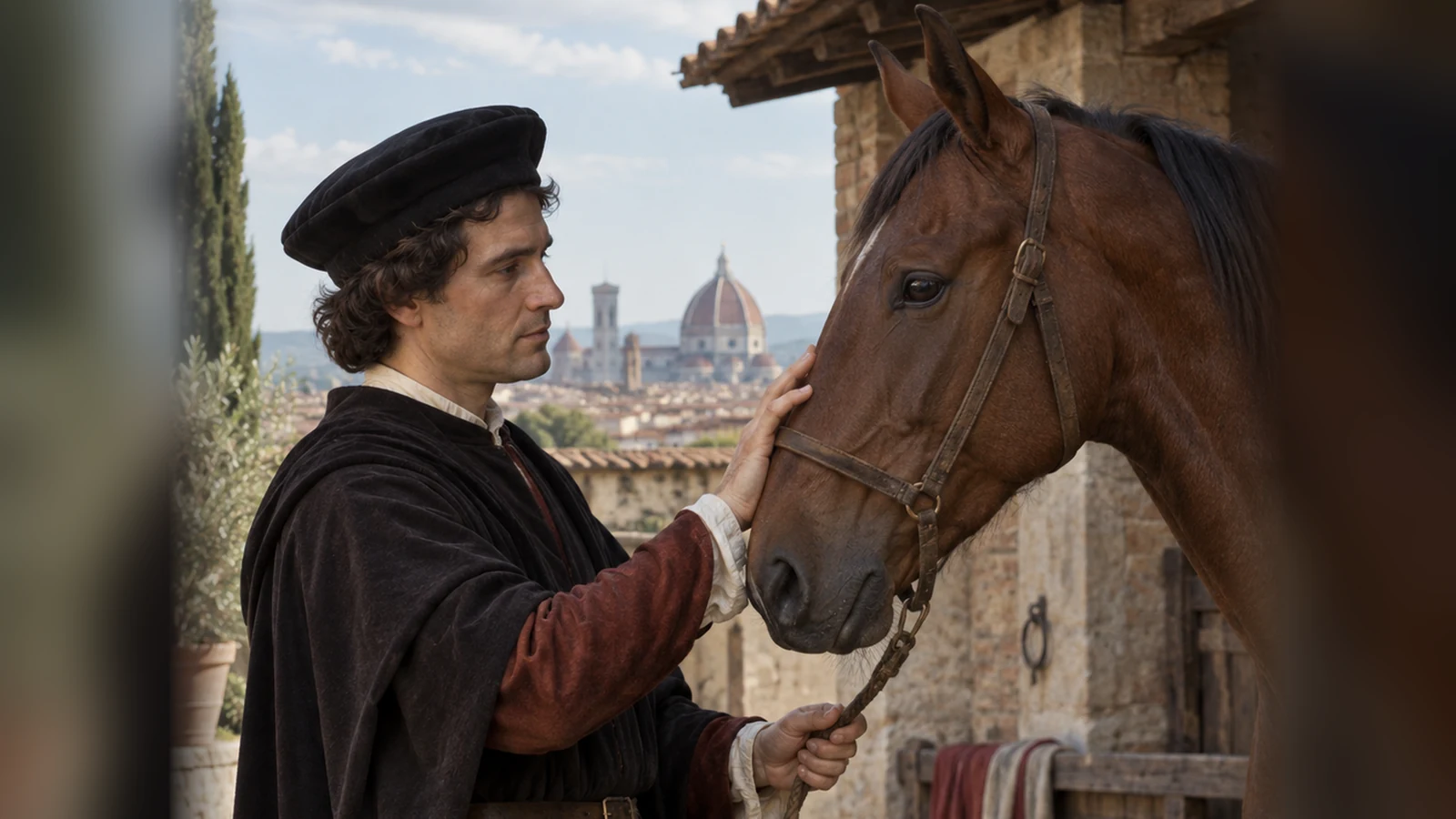
The featured image is an AI editorial reconstruction, not an archival portrait or a record of a verified event.
Who Alberti Was
Alberti was born on February 14, 1404, in Genoa, and died on April 25, 1472, in Rome.
He wrote on painting, architecture, family life, and much more.
His book on painting was begun in 1435, and his major work on architecture was completed in 1452.
His writings on the family were begun in 1432.
The historian Jacob Burckhardt called him “a truly universal genius.”
That is why he is often held up as an early model of the well rounded Renaissance figure.
The Source of the Athletic Stories
Most of the famous feats come from a short Latin autobiography written around 1438.
It is written in the third person, as if someone else were describing him.
That style can make it read like an outside account, but it is Alberti telling his own story.
So these claims are best treated as self reported, not independently confirmed.
What He Claimed He Could Do
The autobiography describes Alberti as tall, strong, and skilled on horseback.
It claims he could stand with his feet together and spring over a man’s head.
It says that, with his feet tied, he could leap over a standing man.
He reportedly could throw a coin high enough to ring against the vault of a cathedral.
It also credits him with taming wild horses and climbing mountains.
A body that can jump, throw, climb, and carry is ready for far more of life than a body trained for one trick.
What We Could and Could Not Confirm
The jumping, coin throwing, horse taming, and climbing claims all appear in summaries of his autobiography.
We did not find wrestling in the sources we checked, so that part of the popular post is unconfirmed.
The claim that he kept these skills “throughout his entire adult life” is also shaky.
The autobiography dates to about 1438, when Alberti was in his mid thirties.
It says nothing about what he could do in his fifties or sixties.
We also did not verify any specific passage in his family writings that praises exercise at every age.
A fair summary is this: Alberti presented himself as a skilled, all around athlete, and his admirers accepted that picture.
Why a Scholar Cared About His Body
Renaissance thinkers often valued a well rounded person.
For Alberti, physical skill sat alongside art, writing, and design as part of a full life.
His athletic boasts were partly about showing that kind of balance.
That idea still appeals to people who want to be capable in many ways, not just strong in one lift.
What Research Says About Variety in Activity
Modern studies cannot test Alberti’s coin throw. They can compare different kinds of activity.
A 2017 study by Pekka Oja and colleagues followed 80,306 British adults for about 9.2 years.
Some sports were linked to lower risk of death from any cause.
Racquet sports had a hazard ratio of 0.53, swimming 0.72, aerobics 0.73, and cycling 0.85.
Running and football showed no statistically significant link in that analysis.
A 2022 meta analysis by Haruki Momma and colleagues looked at muscle strengthening activities in 16 cohort studies.
Strength work was linked to a 10 to 17 percent lower risk of all cause death, cardiovascular disease, total cancer, diabetes, and lung cancer.
The largest drop in several risks appeared at about 30 to 60 minutes per week.
Combining strength work with aerobic activity was linked to even lower risk of death.
Put together, these findings suggest that no single activity does everything.
A mix of movement types may cover more bases, which is close to the spirit of Alberti’s boasts.
What the Research Does Not Prove
Both studies are observational.
People who play several sports or lift weights may differ in many ways, such as income or health.
These studies show links, not proof that a given sport causes a longer life.
Momma’s team also said the effect of higher amounts of strength training on some outcomes was unclear.
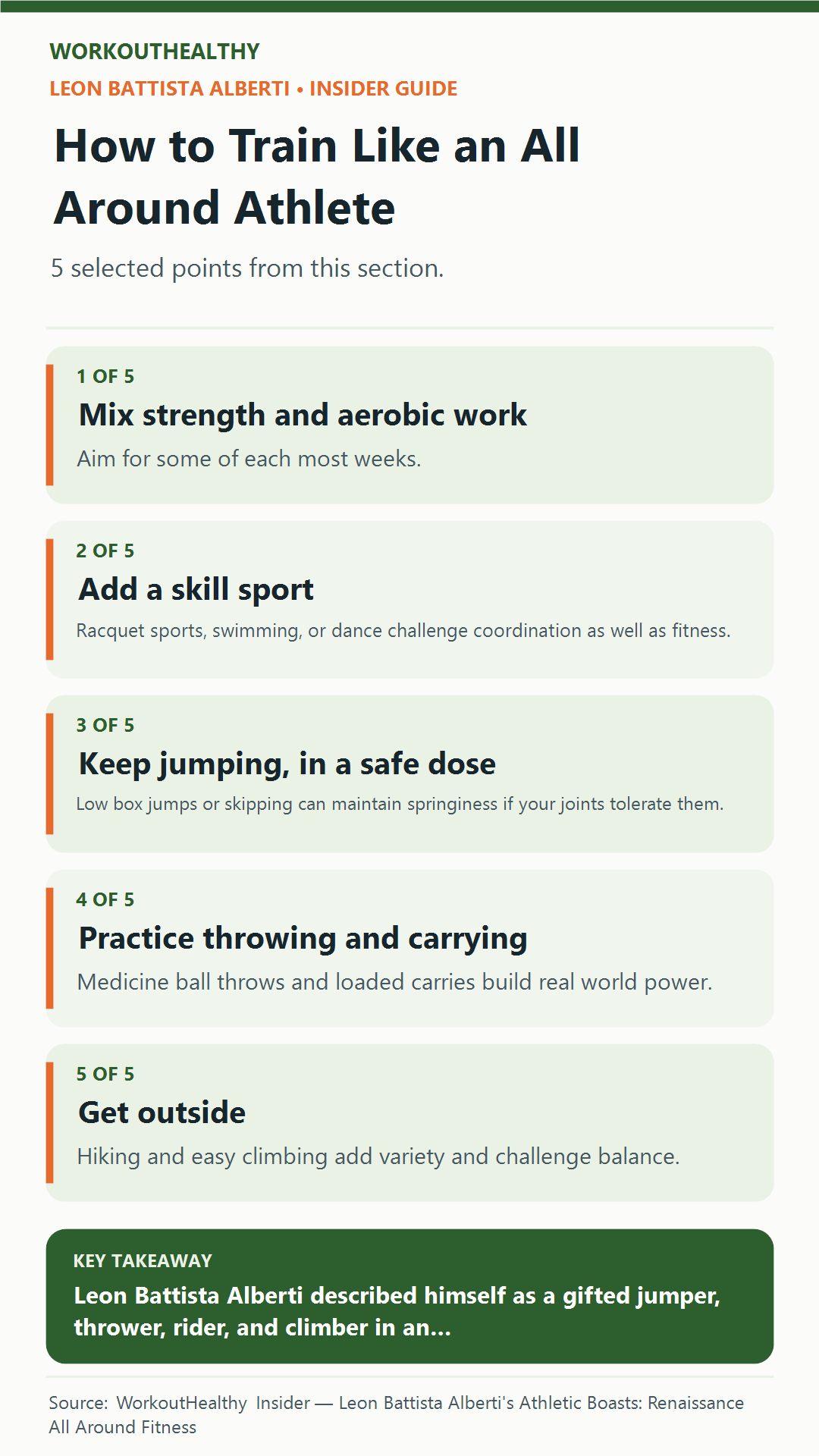
How to Train Like an All Around Athlete
- Mix strength and aerobic work. Aim for some of each most weeks.
- Add a skill sport. Racquet sports, swimming, or dance challenge coordination as well as fitness.
- Keep jumping, in a safe dose. Low box jumps or skipping can maintain springiness if your joints tolerate them.
- Practice throwing and carrying. Medicine ball throws and loaded carries build real world power.
- Get outside. Hiking and easy climbing add variety and challenge balance.
- Keep strength work short and steady. Around 30 to 60 minutes a week was where many benefits peaked.
For a modern example of varied physical skill, see how Ryan Gosling trained like a stuntman for The Fall Guy.
Jumping skills take more preparation than they look, as shown in our look at Benson Boone’s backflip training.
For a lifelong view of staying active, read what a 104 year old woman says keeps her healthy.
Who Should Be Careful
Jumping, climbing, and horse riding all carry injury risk.
Older adults, and anyone with joint, bone, or heart problems, should get medical advice before adding high impact moves.
Riding and climbing should be learned with qualified instruction and proper safety gear.
The Bottom Line
Leon Battista Alberti described himself as a gifted jumper, thrower, rider, and climber in an autobiography written around 1438.
Those feats are self reported, wrestling was not confirmed, and there is no clear record of his abilities late in life.
His broader idea still fits modern evidence.
A mix of strength, aerobic work, and skill based sports is linked to better long term health.
Want more stories like this? Subscribe to WorkoutHealthy Insider for practical explanations behind popular fitness claims.
References
- Momma, H., Kawakami, R., Honda, T., & Sawada, S. S. (2022). Muscle-strengthening activities are associated with lower risk and mortality in major non-communicable diseases: A systematic review and meta-analysis of cohort studies. British Journal of Sports Medicine, 56(13), 755 to 763. https://doi.org/10.1136/bjsports-2021-105061
- Oja, P., Kelly, P., Pedisic, Z., Titze, S., Bauman, A., Foster, C., Hamer, M., Hillsdon, M., & Stamatakis, E. (2017). Associations of specific types of sports and exercise with all-cause and cardiovascular-disease mortality: A cohort study of 80 306 British adults. British Journal of Sports Medicine, 51(10), 812 to 817. https://doi.org/10.1136/bjsports-2016-096822
- University of St Andrews, MacTutor History of Mathematics. Leone Battista Alberti biography, including the athletic claims in his Vita. Read the biography.
- Massimo Riva, On Leon Baptista Alberti, MIT Press. Scholarly analysis of Alberti’s autobiographical self-presentation. Read the analysis.
This article is for general information only and is not medical advice. If you have an injury, ongoing pain, or a medical condition, talk to a doctor or physical therapist before you change how you train or eat.