
Kourtney Kardashian Barker’s wellness story is often packaged as a list of rules: a restrictive food plan, a supplement, an expensive treatment, or a perfectly timed workout. That packaging misses the question behind today’s Facebook post: which parts of her public routine are ordinary habits someone could sustain, and which parts are too individual or untested to copy?
Nobody outside her care team can verify a complete day-by-day record of her food, exercise, sleep, symptoms, and health outcomes. We can examine her published accounts and compare the general habits with independent guidance. That gives the idea of “quiet consistency” a fair test without treating celebrity wellness marketing as medical advice.
What Kourtney Has Actually Described
In a first-person Poosh account about preparing for the Met Gala, Kardashian Barker said she already worked out regularly and kept roughly an hour of morning exercise in her routine. The important word is already. She described continuity, not a sudden crash plan. A single event week, however, cannot establish her exact training or food intake throughout the year.
Her account of returning to exercise after having children reveals change over time. She said she had not been drawn to intense workouts during one pregnancy, and later worked with a trainer who varied sessions. That is not a universal postpartum protocol. It is evidence that her own approach has shifted with circumstances, rather than following one immutable formula.
Poosh, the wellness publication she founded, says its team tries workouts, recipes, and products. It is a useful window into the brand’s preferences, but it is not an independent clinical trial. The commercial context matters whenever a piece recommends a product: a person may find a practice enjoyable without its associated purchase being necessary or effective for everybody.
Consistency Is Different From Rigidity
Repeating a workable pattern for months is different from performing every task perfectly every day. A morning workout can be a convenient anchor for one person and an impossible schedule for a shift worker or a parent. The health-relevant question is whether activity recurs often enough to meet a realistic goal, not whether the clock says 6 a.m.
The World Health Organization recommends that adults accumulate at least 150 minutes of moderate-intensity aerobic activity each week, or 75 minutes of vigorous activity, with more activity offering additional benefits. Its broader guidance also recommends muscle-strengthening activity. A celebrity’s hour-long routine is not the minimum standard. Walking, cycling, shorter sessions, and strength work can be combined to suit a person’s health and schedule.
For example, three 30-minute walks and two 30-minute bike rides total 150 minutes. That is simple arithmetic, not a prescription for everyone and not a claim about Kardashian Barker’s schedule. It shows that the public-health target has several routes. Someone starting from inactivity can begin with less and build gradually.
This distinction avoids a hidden trap. Consistency means returning after interruptions. It does not mean training through injury, illness, severe fatigue, or a major life change to protect a streak. A routine that only survives ideal circumstances is fragile, even if it looks disciplined on social media.
“Clean Eating” Needs a Clearer Definition
The post uses “clean, minimally processed eating” as shorthand. The phrase has no single scientific definition. It can mean more vegetables and home-cooked meals, but it can also become a moral label that turns ordinary foods into failures. To make the idea testable, look at the overall food pattern rather than the adjective.
The WHO’s 2026 healthy-diet guidance names adequacy, balance, moderation, and diversity as core principles. It emphasizes a variety of fruits, vegetables, whole grains, pulses, nuts, seeds, and other nutrient-dense foods while limiting excess free sugar, sodium, and unhealthy fats. That is a broad pattern, not a celebrity-approved menu. Frozen vegetables, canned beans, and practical packaged foods can help someone eat well; “processed” is not automatically a nutritional verdict.
Kardashian Barker has discussed more restrictive food plans at different times. Those choices do not prove that cutting fruit, grains, or entire food groups is required for health. The relevant question is whether a diet meets a person’s nutritional needs and is sustainable, not whether it resembles a temporary celebrity experiment. People with diabetes, pregnancy-related needs, allergies, eating-disorder history, or other medical concerns should individualize food choices with qualified care.
Sleep and Stress Belong in the Picture
Sleep and stress management are often bundled with food and exercise in wellness stories. They are not a secret fourth workout, but they can shape whether a routine is tolerable. Someone who sleeps poorly may struggle with a demanding training plan. Someone facing an overloaded schedule may find a short walk far more realistic than an elaborate gym session.
The CDC recommends that adults ages 18 to 60 generally get at least seven hours of sleep per night. That population recommendation does not reveal Kardashian Barker’s sleep duration or prove that a specific bedtime ritual works. It gives readers a stronger benchmark than copying a celebrity supplement, pillowcase, or evening schedule.
Stress-management advice deserves the same context. Time off, social support, and manageable routines can help people cope, but a celebrity’s access to staff, childcare, trainers, and flexible time is not a neutral comparison with an ordinary household. The practical lesson is to reduce friction where possible, not to assume everyone can buy the same conditions.
Where Wellness Claims Need More Evidence
Today’s post correctly warns that some specific wellness claims deserve scrutiny. A testimonial, before-and-after photo, or influencer routine cannot isolate cause and effect. An apparent improvement may coincide with changes in sleep, food intake, exercise, medical care, or simply time. The more specific a promise—better hormones, lower inflammation, a faster metabolism—the more direct evidence it should require.
Products are separate from habits. The U.S. Food and Drug Administration explains that dietary supplements are not approved for safety and effectiveness before sale in the way drugs are. That does not mean every supplement is useless or unsafe; it means a product’s presence in a wellness routine is not proof of benefit. Anyone taking medication, managing a condition, or considering a supplement for a health problem should speak with a clinician.
Similarly, “natural” does not specify a benefit size, an effective dose, a risk, or the quality of supporting evidence. Ask what precise outcome is claimed, whether it was measured in people like you, what the comparison was, whether independent studies found a meaningful result, and whether a lower-cost habit can achieve the goal.
The WorkoutHealthy Three-Bucket Test
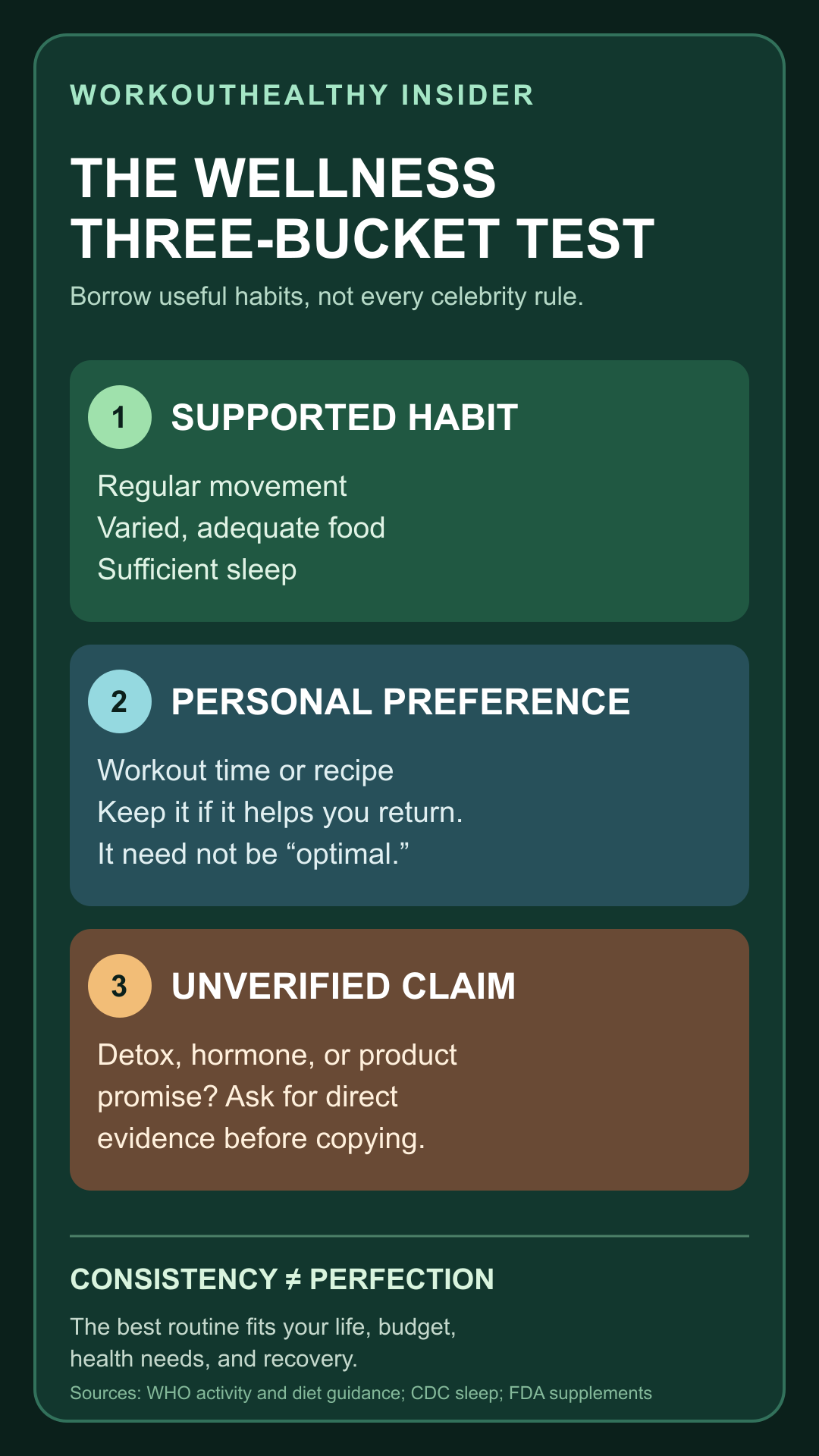
Here is a way to translate a celebrity routine without copying it wholesale. Sort each element into three buckets: broadly supported habit, personal preference, or unverified claim. This is an editorial framework for deciding what deserves attention, not a medical scoring system.
Bucket one: supported habit. Regular movement, a varied nutritious eating pattern, and sufficient sleep have independent guidance behind them. You can build them with your own schedule and budget. The arithmetic above shows how five ordinary activity sessions could add up to the WHO’s 150-minute threshold without resembling a celebrity routine.
Bucket two: personal preference. A workout time, recipe, clothing choice, or low-impact activity may be enjoyable without being superior. Keep it if it helps you repeat a supported habit. Drop it if it adds expense or friction without a clear benefit.
Bucket three: unverified claim. Treat a supplement or sweeping detox, hormone, inflammation, or body-composition promise as a question needing direct evidence. Do not give it the same credibility as movement or sleep simply because it appears in the same post.
Build a Routine That Survives Real Life
To use the good part of this story, start with one repeatable movement slot and one food improvement. The movement could be a 20-minute walk after work three days a week or two strength sessions. The food improvement could be adding a fruit or vegetable to lunch, not deleting an entire food group. Keep the plan small enough that a busy week does not erase it.
Then plan a fallback. If the full workout is impossible, a shorter session still counts as activity. If cooking falls through, a convenient balanced meal is preferable to an all-or-nothing rule. If sleep remains poor, address the schedule or seek care rather than assuming a celebrity’s supplement is the answer. This is an adaptable framework, not individualized treatment.
Review the plan after several weeks. Ask whether it improves capacity and day-to-day functioning without excessive strain, guilt, or expense. If not, adjust the plan instead of deciding that you lack discipline. A good routine is one you can repeat, recover from, and modify as life changes.
The Takeaway
Kourtney Kardashian Barker’s public accounts show recurring attention to movement and food choices, while also showing that her approach has changed across life stages. The Facebook post is strongest when it praises repeatable basics, and weakest if read as a claim that every product or restrictive rule has equally strong support.
Quiet consistency is worth discussing not because a celebrity practices it perfectly, but because regular activity, varied food, and sufficient sleep have stronger evidence and more flexibility than a dramatic reset. Borrow the principle; do not inherit every rule or purchase.
This article is for general information only and is not medical advice. If you have an injury, ongoing pain, a medical condition, or concerns about eating patterns, consult an appropriate healthcare professional before changing how you train or eat.