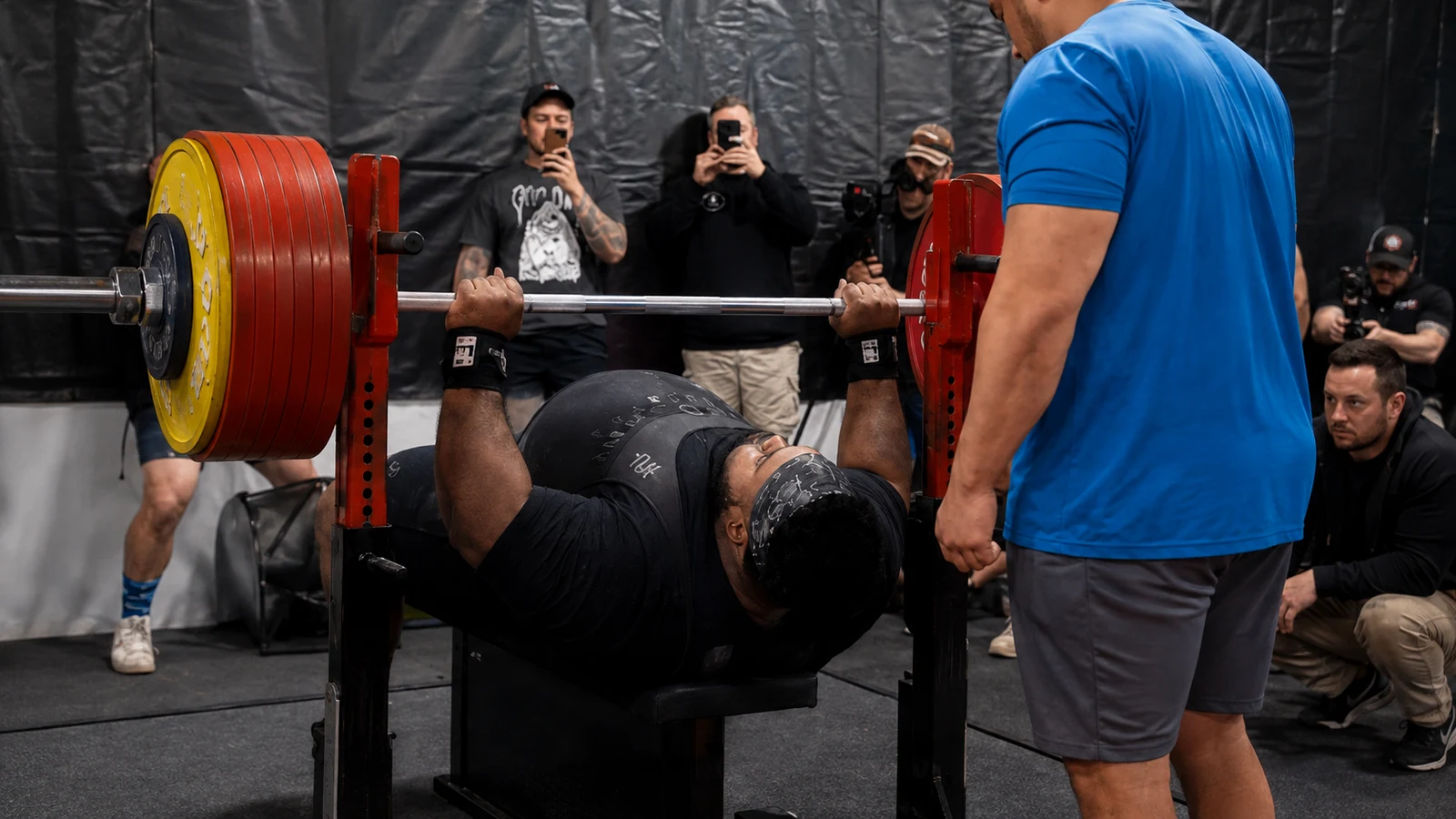

Julius Maddox pressed 355 kilograms off his own chest in February 2021, wearing nothing but wrist wraps and a lifting belt.
That converts to 782.64 pounds.
It stands as the heaviest raw bench press ever recorded by a human being, at any bodyweight, in a sanctioned competition.
Not a weight class record.
Not an age group or gender record.
The single heaviest number anyone has ever pressed off their own chest without a supportive bench shirt.
Numbers like that travel fast online, usually stripped of the context that makes them checkable.
This article verifies the lift against the actual meet record, explains what “raw” really means at this weight, and checks whether anyone has topped it since 2021.
What Happened at Hybrid Showdown III
The meet was the WRPF Hybrid Showdown III, held in Miami, Florida, in February 2021.
WRPF stands for the World Raw Powerlifting Federation, an international federation dedicated specifically to raw (unequipped) competition.
OpenPowerlifting, the independent public database that mirrors verified results across dozens of federations, lists the meet date as February 20, 2021, though most contemporary press coverage cites February 21, the day the lift went public.
Maddox opened that day with 330 kilograms, about 727 pounds, and it reportedly moved easily.
His second attempt was the record: 355 kilograms, locked out under a referee’s watch.
Reports on his bodyweight that day vary slightly by source, landing between roughly 441 and 447 pounds.
Even at the low end of that range, Maddox pressed close to twice his own bodyweight.
What “Raw” Actually Means at This Weight
In powerlifting, “raw” does not mean equipment-free.
Under WRPF rules, and most other federations’ rules, a raw lifter can still use a belt and wrist wraps.
What raw excludes is the bench shirt, a rigid, multi-ply supportive garment that equipped lifters wear specifically to add stored energy to the press.
Equipped world records sit far above raw ones for exactly that reason.
The all-time equipped bench press record is well north of 600 kilograms, more than 1,300 pounds, a number that owes as much to the shirt’s mechanics as to the lifter’s own strength.
A raw lift, by contrast, is close to a direct measure of what a person’s own chest, shoulders, and triceps can produce.
It is not an equipment record.
It is closer to a ceiling on unassisted human pressing strength, at least among lifters who have stepped onto a judged platform.
The Long Climb to 782.64 Pounds
Nobody presses 355 kilograms on a first attempt at anything.
Maddox broke the raw bench world record for the first time in August 2019, at 335.5 kilograms (739.6 pounds), passing a mark previously held by Russian lifter Kirill Sarychev.
He broke his own record again three months later, in November 2019, at 337.5 kilograms (744.1 pounds).
In March 2020, he became the first man to raw bench both 750 pounds and 350 kilograms in competition, a 350-kilogram lift that worked out to 770 pounds.
Eleven months after that, at Hybrid Showdown III, he added another 12 pounds and pushed the record to 782.64.
Along the way there were real failures, not just steady progress, including a controversial weight misload on an 800-pound attempt in June 2020 and another failed 800-pound attempt in August 2021.
A number this heavy is never really set in a single lockout. It is set across years of smaller jumps, most of them a few kilograms at a time, with real misses mixed in between the record-setting attempts.
The 782.64-pound record was not a sudden breakthrough.
It was the fourth step in a documented, multi-year progression, built one small increase at a time, with public failures along the way to prove it was never easy.
Who Actually Verifies a Number Like This
Powerlifting has no single global authority the way a sport like track and field has World Athletics.
Different federations run their own meets, keep their own record books, and recognize their own champions.
WRPF ran Hybrid Showdown III, judged the lift with its own referee panel, and is the federation whose record book credits Maddox with the mark.
OpenPowerlifting independently confirms the result happened, at that weight, on that platform, under WRPF’s sanctioning.
That database is a useful cross-check precisely because it aggregates verified meet data rather than relying on a single federation’s own self-reporting.
There is a real, honest limit to how “all-time” this record can be called, and it is worth stating plainly rather than glossing over.
A raw federation’s record only covers lifts made at meets it sanctions.
A lifter who presses more weight outside a sanctioned competition, in a gym or an exhibition event, is not automatically entered into any record book, no matter how much the number gets shared online.
That is not a hypothetical caveat in this exact case.
Fellow raw bench specialist Danial Zamani has reportedly pressed more than Maddox’s number at points, but not inside a sanctioned meet, which is exactly why it does not count as the official record.
“World record” in raw powerlifting means a specific, verifiable thing: a judged lift, at a sanctioned meet, under one federation’s rulebook, not simply the heaviest number anyone has ever moved anywhere.
Has Anyone Beaten It Since 2021
This is the question worth checking hardest with a claim this large, since raw bench specialists push these numbers aggressively every year.
The short answer, as of the most recent verifiable coverage, is no.
Maddox himself came closest to adding to his own mark.
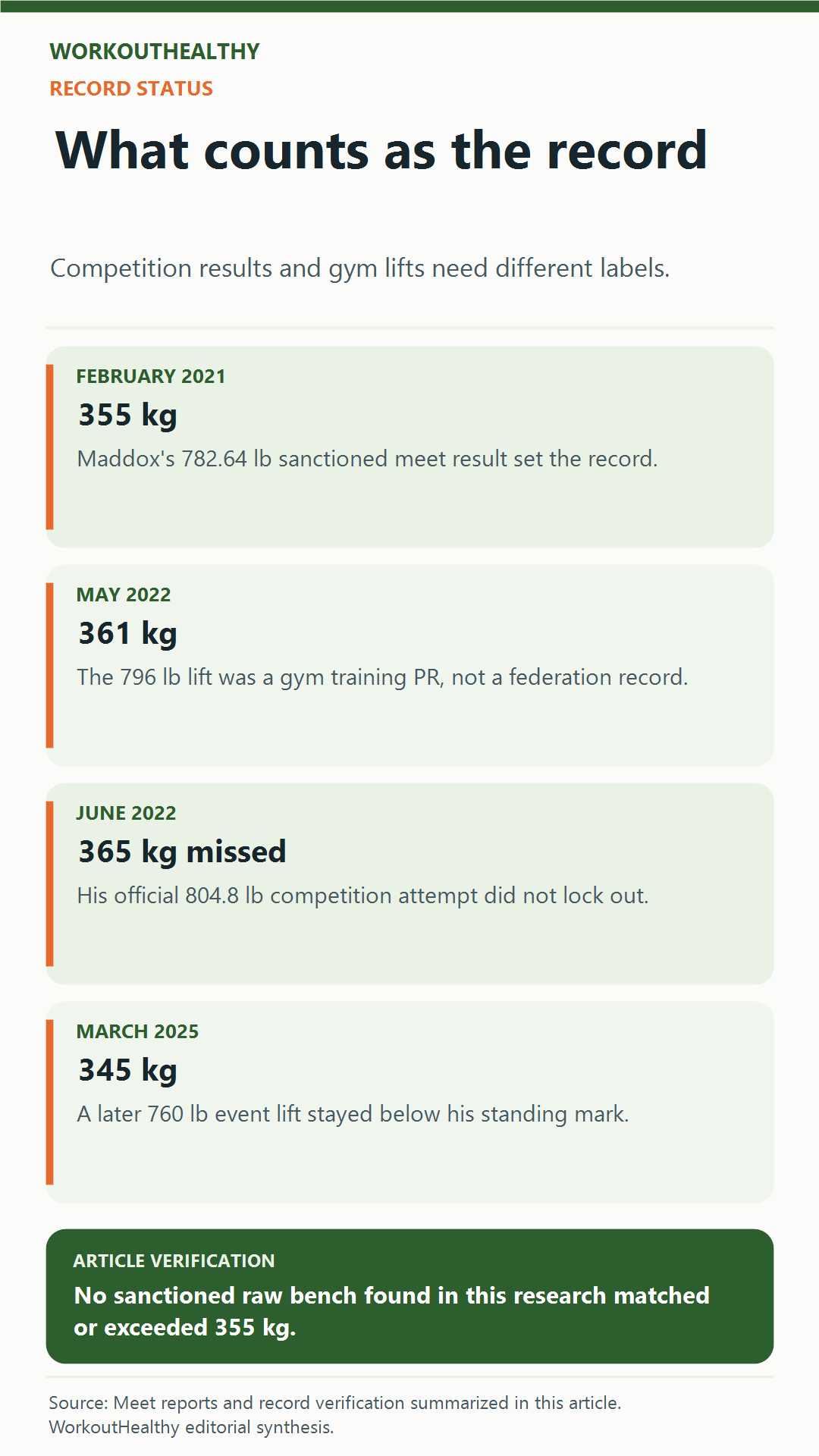
In May 2022, he hit 361 kilograms (796 pounds) in a training session, a number that circulated widely online.
That lift was explicitly a gym training PR, not a competition result, so it never entered any federation’s record book.
The following month, at the June 2022 RPS Redcon1 Rage Wars in Nashville, Maddox made his third official competition attempt at 800 pounds, this time at 365 kilograms (804.8 pounds), and missed the lockout.
That was his most recent official attempt at a heavier official record, and it did not succeed.
As recently as March 2025, at the Arnold Sports Festival, Maddox locked out a smooth 345-kilogram (760-pound) raw bench in front of a crowd, a lift well short of his own standing record, reported at the time as confirmation that his 782.64-pound mark remains the current all-time raw bench press world record.
Nothing found in the course of researching this article shows any other lifter, at any bodyweight, matching or exceeding 355 kilograms raw in a sanctioned meet since February 2021.
The claim, in other words, checks out as still current, with the honest caveat above about exactly what “verified” means in a sport with more than one federation and no single unifying record book.
The Mechanics Behind Pressing Nearly 800 Pounds
A raw bench press this heavy is decided long before the bar comes off the chest.
Grip width changes which part of the lift feels hardest, a phenomenon researchers call the sticking region, the point in the press where the bar tends to slow down or stall.
A 2016 study in the Journal of Sports Sciences measured how grip width shifted the location and severity of that sticking region in trained lifters, confirming it is a real, measurable mechanical effect and not just a coaching preference (Gomo & Van Den Tillaar, 2016).
Elite bench pressers spend years finding the exact grip width that moves their own sticking region to the spot where they are mechanically strongest.
The shoulders and elbows do not work in isolation either.
A 2025 biomechanics study modeled how shoulder and elbow joint mechanics interact to produce the bar’s path and its sticking region during heavy pressing, treating the arm as a linked chain rather than a set of separate joints (Evangelista et al., 2025).
That linked-chain framing helps explain why elite lifters obsess over their setup, their arch, and their bar path as one connected system, rather than training the chest, shoulders, and triceps as separate problems.
Leg drive plays a real role too.
Despite the name, a heavy raw bench is not an arms-only lift.
Pushing the feet hard into the floor helps stabilize the torso against the bench, giving the upper body a more solid base to press from rather than absorbing the whole load alone.
Training this kind of lift also takes real structure, not just heavy singles every week.
A 2020 study on elite powerlifters compared linear and undulating periodization models, tracking stress hormone response and competition performance across a training cycle, and found that structured, planned variation in training load produced better competition-day results than unplanned heavy training (Landram, Koch, & Mayhew, 2020).
That is part of why a record like this takes years, not weeks, even for a genetically gifted, full-time athlete.
What This Record Does Not Prove
This number does not mean Maddox is the strongest human being alive in some general sense.
It is a single-lift record in one exercise, not a total-body strength ranking.
It also does not transfer directly to how much a much smaller lifter could ever press.
Absolute strength numbers like this one favor lifters with more mass and longer levers to work with, which is part of why powerlifting also tracks separate records by weight class rather than only by the single heaviest number on the bar.
The record describes a specific lift on a specific day, not a permanent, unbreakable ceiling.
Raw bench numbers in actively contested divisions have moved before and can move again, even though nobody has done it yet.
Finally, this is a competition record, not a training number, and the two get blurred constantly online.
Maddox’s own 796-pound gym PR from 2022 is proof of exactly that gap: real, filmed, and still not an official record, because it never happened under a referee’s watch at a sanctioned meet.
Common Mistakes Lifters Make Chasing a Bigger Bench
Most lifters trying to add real weight to their bench run into the same handful of problems.
Flaring the elbows too wide on the way down adds strain to the shoulder joint and often shortens the range where the chest and triceps can produce their best force.
Letting the bar drift up toward the face instead of staying over the chest turns a mechanically strong pressing angle into a weak one.
Skipping leg drive, by letting the feet go loose or flat, removes a real, usable source of total-body stability.
Chasing heavier weight before the setup and arch are consistent tends to bake bad habits in at exactly the loads where they matter most.
Training the bench in isolation, without direct work for the triceps and upper back, caps progress even when the lift itself gets plenty of practice.
Who Should Be Cautious Before Loading Up
A record like this comes from a specific combination: years of structured training, expert coaching, and a sanctioned meet with judged standards behind every attempt.
It is not a realistic near-term target for someone newer to lifting, and it was never meant to be read as one.
Anyone with a history of shoulder impingement, rotator cuff issues, wrist pain, or a recent upper-body surgery should talk to a doctor or physical therapist before loading a heavy bench press.
People managing high blood pressure should also be cautious with true maximal-effort lifts, since a max attempt briefly spikes blood pressure more than lighter, higher-repetition work does.
A qualified coach can catch setup and bar path problems far earlier than trial and error alone, which is part of what our own guide on deciding whether you need a personal trainer covers in more detail.
A spotter is not optional at heavy training weights, regardless of experience level.
How to Build Toward a Heavier, Safer Bench Press
Nobody needs to chase 782 pounds to benefit from how a record like this gets built.
Start by locking in one consistent setup, the same grip width, the same shoulder position, and the same foot placement, on every working set, well before adding meaningful weight.
Add paused reps into a training week, holding the bar briefly on the chest, since that pause mirrors exactly what a judged meet attempt requires.
Film the bar path from the side occasionally and check whether it moves in a straight vertical line or curves slightly, since a controlled curved path tends to keep the bar closer to the body’s strongest line of leverage.
Practice pushing the feet into the floor on every rep, not only the heaviest ones, so leg drive becomes automatic rather than an afterthought under a heavy weight.
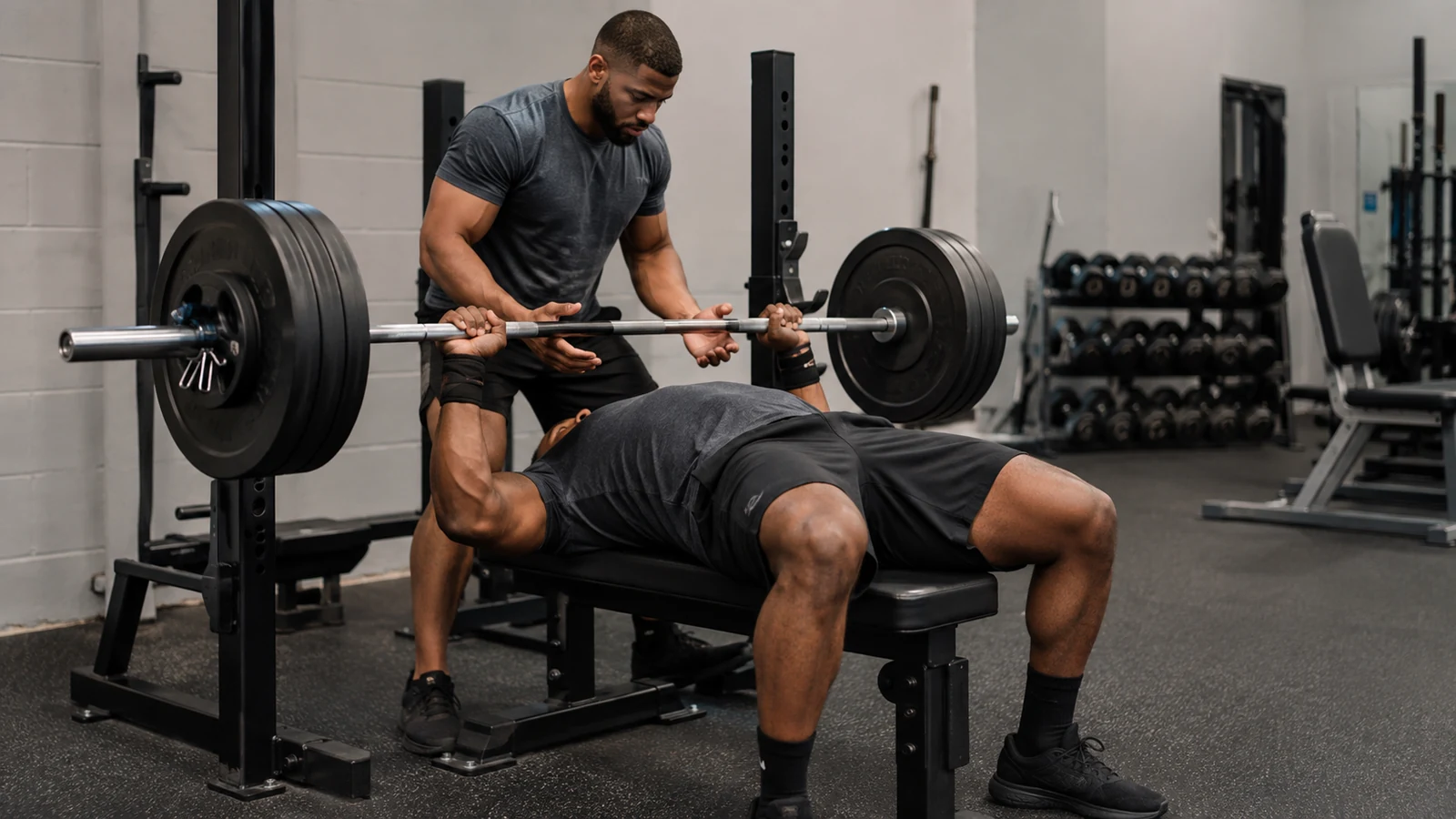
Layer in direct work for the triceps and upper back, since most stalled bench presses stall either off the chest or at lockout, and both weak points respond to targeted assistance training.
Readers curious how a bench press changes once leg drive is removed entirely can see that tradeoff explained in our floor press versus bench press comparison.
Progress the top working weight slowly, in small increments measured across months, not single sessions.
That same pattern, small, well-earned jumps rather than sudden leaps, shows up across other verified world records too, including the pacing behind DonnaJean Wilde’s push-up world record, a very different lift built on the same kind of disciplined, repeatable process.
It also shows up in less famous record holders, like the one behind Edith Connor’s Guinness record for oldest competitive female bodybuilder, a record built on the same kind of years-long consistency rather than a single lucky day.
Watch the Original Video
Enjoy stories like this one? Subscribe to WorkoutHealthy Insider for practical explanations behind popular fitness claims.
References
Evangelista, P., Rum, L., Picerno, P., & Biscarini, A. (2025). Decoding the contribution of shoulder and elbow mechanics to barbell kinematics and the sticking region in bench and overhead press exercises: A link-chain model with single- and two-joint muscles. Journal of Functional Morphology and Kinesiology, 10(3), 322. https://doi.org/10.3390/jfmk10030322
Gomo, O., & Van Den Tillaar, R. (2016). The effects of grip width on sticking region in bench press. Journal of Sports Sciences, 34(3), 232 to 238. https://doi.org/10.1080/02640414.2015.1046395
Landram, M. J., Koch, A. J., & Mayhew, J. L. (2020). Salivary stress hormone response and performance in full competition after linear or undulating periodization training in elite powerlifters. The Journal of Sports Medicine and Physical Fitness, 60(1). https://doi.org/10.23736/S0022-4707.19.09977-8
This article is for general information only and is not medical advice. If you have an injury, ongoing pain, or a medical condition, talk to a doctor or physical therapist before you change how you train or eat.