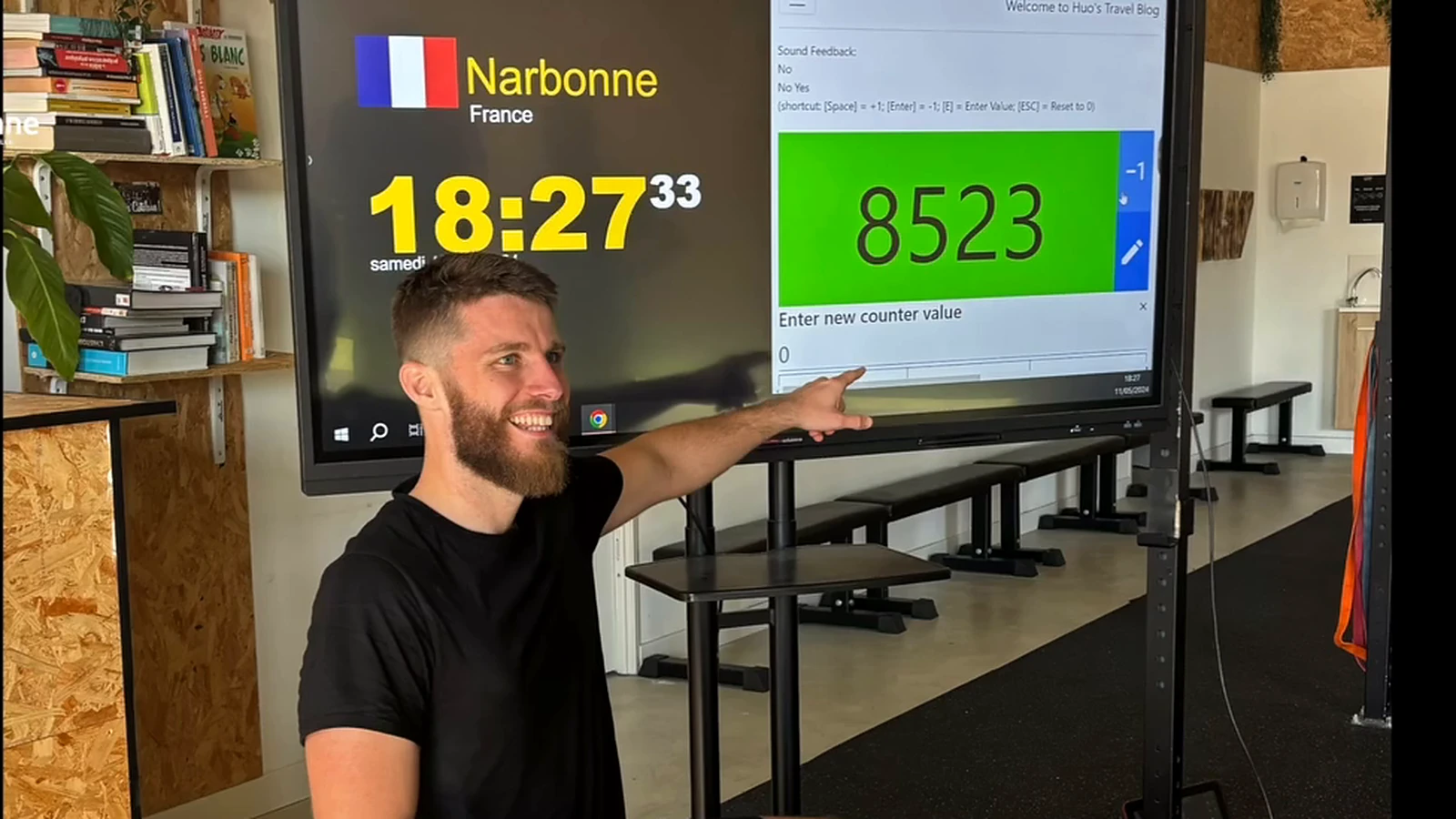

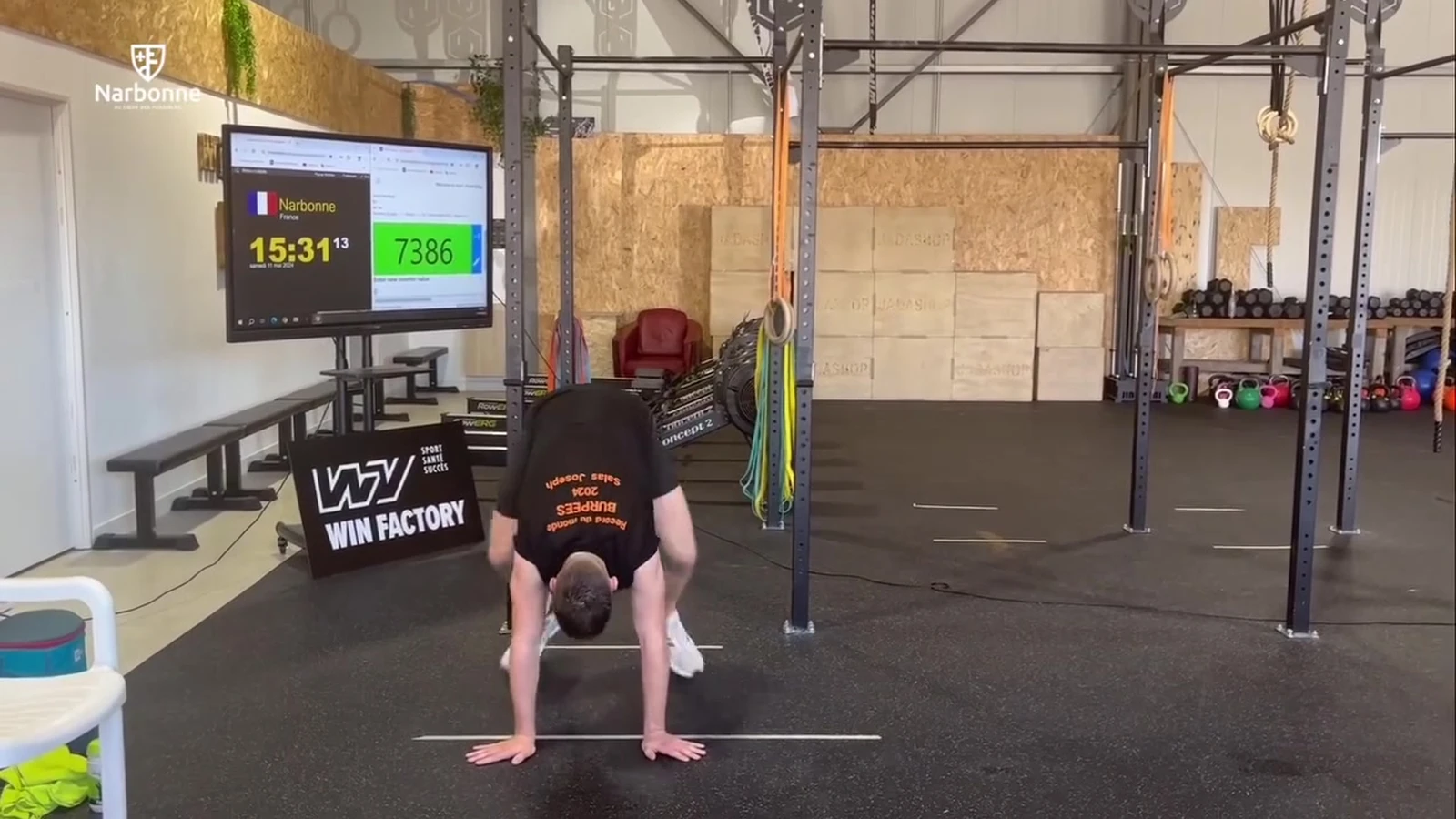
On 11 May 2024, a man named Joseph Salas walked into WIN FACTORY, a gym in Narbonne, France.
He did not really leave for the next 12 hours.
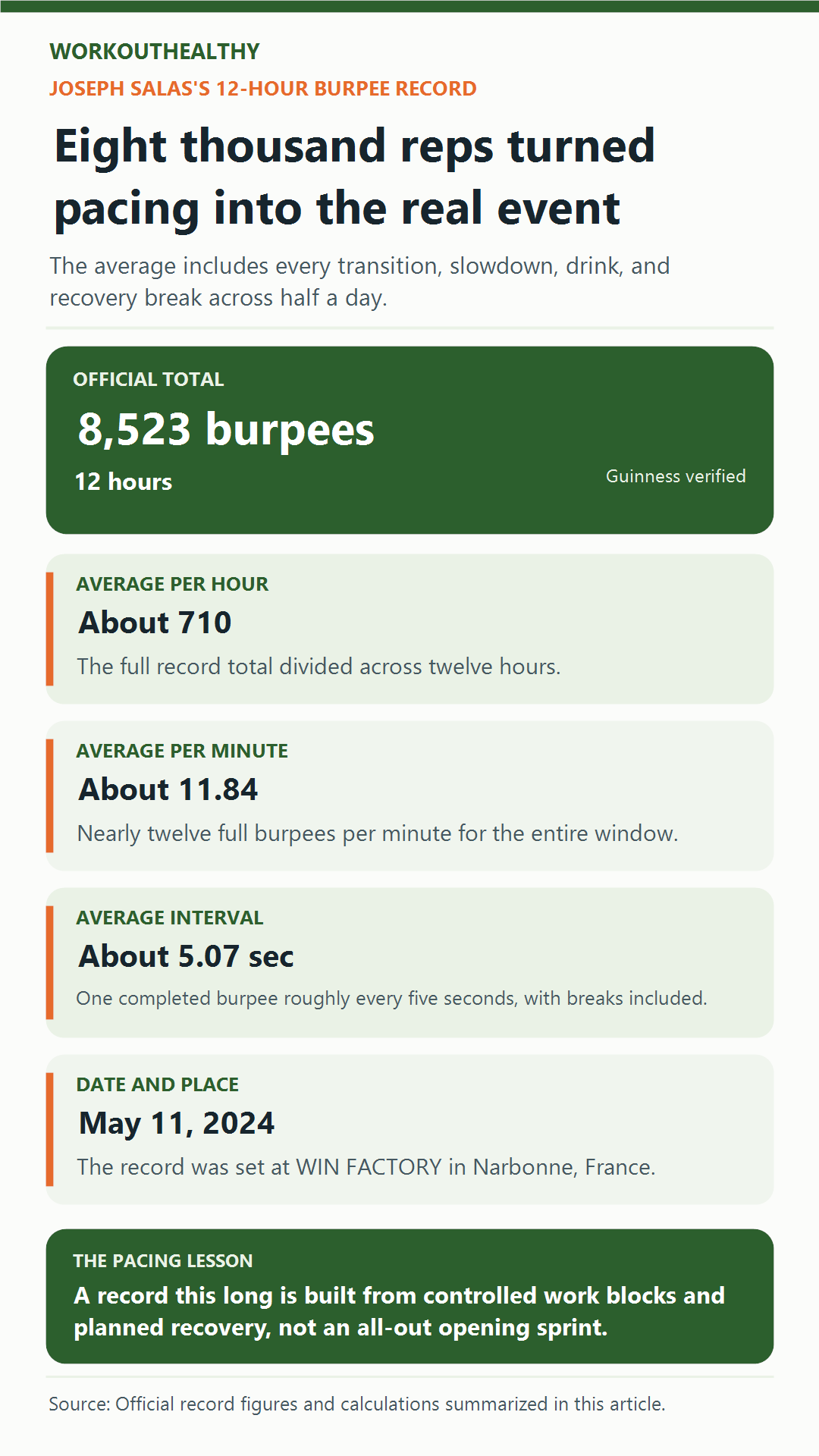
By the time the clock ran out, he had completed 8,523 burpees, a total Guinness World Records now lists as the current record for most burpees in 12 hours by a male.
Guinness’s own record page confirms the athlete’s name, the rep count, the date, and the location, all matching the details in the source workbook this article started from.
Do the math on 8,523 reps across 12 hours and the average pace works out to roughly one burpee every 5 seconds, for half a day, rest breaks included.
That pace, sustained for that long, is the real story here.
The Record: 8,523 Burpees in 12 Hours, Verified
Guinness defines the movement precisely for this category.
Its own record page states that “a burpee may be regarded as a squat thrust with a vertical jump,” which rules out shortened or half-rep versions some gyms use.
Guinness lists the record under ID 15-114434, titled “Most burpees in 12 hours (male),” with Salas credited as the current holder.
French regional outlets covered the attempt at the time, including France 3 Occitanie and L’Echo du Languedoc, both reporting the same 8,523 figure, the same date, and the same city.
One regional headline quoted Salas saying he was still having a hard time truly grasping what he had done, a reaction that tracks with the scale of the number.
The date, location, and rep count across every source line up with the claim this article set out to check, so there is no discrepancy to flag.
What a Burpee Actually Demands From the Body
A burpee is really three hard movements stacked into one.
The first phase drops the body into a squat and thrusts the legs back into a plank, loading the shoulders, chest, and core the way the top of a push-up does.
Some versions add a full push-up at the bottom, and Guinness’s own definition leaves room for that variation as long as the squat thrust and jump are both present.
The second phase reverses that, snapping the legs back underneath the hips.
The third phase drives straight up into a vertical jump, which is the part of the movement most people skip first when fatigue sets in.
Every one of those phases uses a different muscle group at a different joint angle.
That is part of why a burpee is often used as a single-exercise stand-in for a full-body workout.
Doing it 8,523 times in a row is a different problem entirely from doing it well ten times in a row.
This Is Not a Sprint. It Is a 12-Hour Pacing Problem
It is tempting to read 8,523 reps and imagine someone moving at top speed the entire time.
That is almost certainly not what happened.
A 2025 study in Frontiers in Physiology compared two ways of structuring high-intensity functional training with identical total volume: a continuous “rounds for time” format and an interval-based format with fixed rest built in (Smith et al., 2025).
The continuous format produced a mean oxygen consumption of 38.1 mL/kg/min and an average heart rate of 171 beats per minute.
The interval format, doing the same total work, produced a lower mean oxygen consumption of 30.8 mL/kg/min and a lower average heart rate of 153 beats per minute.
Blood lactate told a similar story, at 11.2 mmol/L after the continuous format compared with 6.5 mmol/L after the interval format.
The researchers concluded that built-in rest meaningfully changes how hard a body has to work to finish the same total volume of movement.
Nobody completes 8,523 burpees in 12 hours by working at the continuous, all-out pace that study measured over a few minutes.
A sustainable 12-hour attempt almost certainly looks closer to the interval side of that comparison, spread across hundreds of short work blocks with brief recovery windows built in throughout the day.
A record like this one is not one exhausting workout. It is hundreds of small, repeatable workouts, spread across a day and disguised as a single number.
What Sustains a Body Through Hours of Repeated Effort
Modern exercise science treats pacing as something closer to a skill than a personality trait.
A 2013 review in Sports Medicine described pacing as the deliberate use of the body’s energy resources so they last for the length of the task at hand, guided by both advance planning and real-time feedback from the body (Roelands et al., 2013).
The researchers describe two systems working together during long efforts.
One is anticipatory, setting an initial pace based on how long the task is expected to take.
The other is reactive, adjusting that plan moment to moment based on signals like rising core temperature, fatigue, and perceived effort.
Over a few minutes, that mostly plays out as a runner’s kick at the end of a race.
Over 12 hours, it likely plays out very differently, shaped by hundreds of small pacing decisions strung together across the whole day.
An athlete who burns too hot in the first hour risks not having enough left for hour ten.
An athlete who paces too conservatively risks running out the clock without reaching a competitive total.
Both mistakes are common in long-duration attempts, which is why elite endurance athletes rehearse pacing specifically, not just the movement itself.
What a Real 12-Hour Effort Looks Like, Based on Similar Events
Nobody has published a physiological breakdown of Salas’s specific 12-hour attempt, so the closest evidence comes from other events of similar length.
A 2015 study in PLOS ONE followed 15 experienced runners through a 106-kilometer mountain ultramarathon lasting roughly 18 hours (Kerhervé et al., 2015).
The runners did not hold one steady speed.
They gradually slowed across roughly the first 90 percent of the race, then unexpectedly picked the pace back up in the final stretch.
Heart rate actually drifted downward through most of the event relative to how hard the runners were working, a pattern the researchers linked to deliberate effort conservation rather than simple exhaustion.
Perceived effort climbed steadily the whole time, but never hit the runners’ reported maximum, even near the finish.
The researchers described this as active regulation of both physical and mental load, aimed specifically at avoiding premature exhaustion.
The faster finishers in that study took fewer rest breaks and were also willing to accept a bigger overall slowdown across the middle of the race.
A 12-hour burpee attempt is a different sport entirely, but the underlying pacing problem, spend just enough now to still have something left for the end, looks remarkably similar.
What This Record Does Not Prove
A verified world record proves that Joseph Salas, on that specific day, completed 8,523 burpees in 12 hours under Guinness’s rules.
It does not prove exactly how he trained to get there, since Guinness’s public record page does not publish an athlete’s training history.
It also does not prove that 8,523 is some fixed ceiling for a well-trained human body.
It only shows that 8,523 is the highest verified total on record as of this article.
Records like this one get broken, and Guinness itself notes that listings are not always updated the moment a new attempt is confirmed.
It is worth holding the exact number loosely rather than treating it as a hard physiological limit.
This record also says nothing about whether an average reader should attempt anything close to this volume.
Elite record attempts happen under supervision, typically with official witnesses and strict rules designed to keep the standard consistent and the attempt safe.
Common Mistakes People Make Chasing Big Rep Numbers
The most common mistake in any long-duration bodyweight challenge is starting too fast.
An early pace that feels easy in the first hour can quietly borrow against the ninth or tenth hour.
The second common mistake is ignoring form under fatigue, especially skipping the vertical jump portion of the burpee once the legs get tired.
Guinness’s own definition requires that jump, so a fatigued shortcut is not just risky, it can disqualify individual reps in an official attempt.
The third mistake is treating hydration and fueling as optional over a multi-hour event.
A 12-hour effort is closer to an endurance event than a strength workout, and endurance events fail as often from fueling mistakes as from muscular fatigue.
The fourth mistake is skipping planned rest.
The research above suggests rest built into a long effort actually lowers the physiological cost of the same total volume, not just the discomfort.
Who Should Be Extra Cautious With This Kind of Volume
Anyone with a current knee, shoulder, wrist, or lower back injury should not attempt high-volume burpee training without medical clearance first.
The repeated ground contact and jump landing in a burpee load the knees and lower back thousands of times over a long attempt.
Anyone with a heart condition, uncontrolled high blood pressure, or a history of exercise-related cardiac symptoms should treat any multi-hour exertion event as something to discuss with a doctor first, not something to try casually.
Older adults and anyone newer to structured exercise should build volume gradually across months, not attempt a single long session as a test of fitness.
Building Long-Duration Bodyweight Endurance Safely: A Step-by-Step Path

Nobody needs to chase thousands of reps to benefit from this kind of training.
Most people can build meaningful full-body conditioning with a small, structured fraction of that volume.
Our breakdown of how pacing changes total output across a full hour of jump rope covers a related steady-versus-sprint tradeoff in a different cardio movement, and the same lesson applies here.
Step 1: Master the standard burpee first.
Before adding volume, the squat thrust, plank, and jump should all look clean and controlled, one rep at a time.
Step 2: Build in sets, not one long unbroken effort.
Start with short work blocks of 30 to 60 seconds, followed by real rest, rather than testing a single long unbroken set early on.
Step 3: Track pace, not just total reps.
Our look at the pacing math behind DonnaJean Wilde’s one-hour push-up world record shows how elite record attempts are built around a steady, sustainable rate rather than raw effort.
Step 4: Extend total session length gradually.
Add duration in small increments over weeks, letting the body adapt to repeated impact and fatigue rather than jumping straight from minutes to hours.
Step 5: Practice fueling and hydration during longer sessions.
Anything approaching an hour or more of continuous training benefits from the same fueling planning used in other endurance sports, not an afterthought.
Step 6: Rehearse rest timing on purpose.
Decide in advance how long work blocks and rest blocks will be, rather than improvising once fatigue sets in.
Progress toward this kind of volume is slow by design. Rushing it is the most common way an ambitious exerciser strains a knee or a lower back chasing a bigger number.
Jumping from a few hundred burpees in a session to several thousand does not happen safely over a few weeks.
Building toward real long-duration bodyweight endurance is closer to training for an ultramarathon than chasing a single hard workout.
Guinness verifies plenty of records built on exactly this kind of patient, structured progression, including Edith Connor’s record for oldest female competitive bodybuilder, another feat WorkoutHealthy checked directly against Guinness’s own listing before writing about it.
Watch the Record
Curious how far real training science actually stretches behind a viral feat. Subscribe to WorkoutHealthy Insider for practical explanations behind popular fitness claims.
References
Kerhervé, H. A., Millet, G. Y., & Solomon, C. (2015). The dynamics of speed selection and psycho-physiological load during a mountain ultramarathon. PLOS ONE, 10(12), e0145482. https://doi.org/10.1371/journal.pone.0145482
Roelands, B., de Koning, J., Foster, C., Hettinga, F., & Meeusen, R. (2013). Neurophysiological determinants of theoretical concepts and mechanisms involved in pacing. Sports Medicine, 43(5), 301–311. https://doi.org/10.1007/s40279-013-0030-4
Smith, J. S., Bellissimo, G. F., & Amorim, F. T. (2025). The physiological responses to volume-matched high-intensity functional training protocols with varied time domains. Frontiers in Physiology, 15, Article 1511961. https://doi.org/10.3389/fphys.2024.1511961
This article is for general information only and is not medical advice. If you have an injury, ongoing pain, or a medical condition, talk to a doctor or physical therapist before you change how you train or eat.