

Joe Rogan and Mike Israetel agree that deliberate training beats random effort, but they disagree on how to build strength, choose foods, and think about testosterone. Their video debate is useful because neither side is entirely right or entirely wrong.
Rogan’s scheduled week and varied activity can make fitness sustainable. Israetel’s emphasis on progressive resistance, full controlled motion, and measurable results better explains how to target specific adaptations.
Watch Mike Israetel Review Joe Rogan’s Routine
The embedded video comes from the verified Renaissance Periodization channel. It covers kettlebells, Turkish get-ups, testosterone replacement therapy, Rogan’s weekly schedule, seed oils, and his meat-heavy diet.
The Short Answer
Rogan gets credit for planning exercise before the week begins and mixing resistance work with conditioning and mobility. A routine a person enjoys and repeats is more valuable than a theoretically perfect plan that stays on paper.
Israetel is stronger on the principles that drive measurable strength and muscle gain. Progressive loading, adequate volume, controlled range of motion, and exercises that can be tracked make adaptation easier to direct.
The nutrition and hormone discussion needs more caution than either a podcast clip or reaction video can provide. Carnivore eating has little long-term evidence, seed oils are not automatically inflammatory, and TRT is medical treatment rather than a general recovery habit.
Rogan’s Weekly Plan Is a Real Strength
Rogan has described deciding on Sunday how many yoga, lifting, and running sessions he intends to complete. That approach converts a vague wish to exercise into appointments with a number and a place in the calendar.
Planning does not guarantee adherence, but it removes a daily decision. It also makes a missed session visible enough to reschedule instead of quietly abandoning the week.
The limitation is that a list of sessions is not yet a complete program. A productive plan also specifies the movements, sets, repetitions, effort, and method of progression that serve the person’s goal.
Are Kettlebells Functional or Overrated?
Kettlebells are legitimate training tools for swings, carries, presses, squats, and conditioning circuits. A clinical scoping review found possible benefits across strength, power, and physical function, but it also judged the evidence base limited and often low quality.
A small trial comparing kettlebell and traditional weightlifting found that both improved strength, while the heavier traditional program produced larger gains in some maximal strength measures. That result supports Israetel’s point that loadable barbell work is often more efficient when maximal strength is the priority.
It does not make kettlebells useless. They are compact, versatile, and well suited to explosive hip work or training where space and equipment are limited, as seen in Taz Skylar’s kettlebell based fight preparation.
Calling any implement inherently functional misses the real question. An exercise is functional when its demands transfer to the goal, fit the trainee, and can be progressed without unacceptable risk or irritation.
What the Turkish Get-Up Actually Trains
The Turkish get-up asks a person to move from the floor to standing while stabilizing a weight overhead. It combines shoulder control, trunk tension, hip motion, coordination, and transitions through several positions.
A laboratory study measured shoulder muscle activity during the movement in 12 experienced participants. That tells us which muscles were active in one session, but it does not prove the exercise builds more strength or muscle than simpler presses, rows, or carries.
Use the get-up if coordinated overhead control is a goal and the positions feel comfortable. Do not make it the main muscle-building exercise merely because the movement looks complex.
Heavy Compound Lifts and Full Range of Motion
Israetel favors compound exercises that are stable, progressively loadable, and performed through a controlled range. Research broadly supports heavier loading for maximizing one-repetition strength, while hypertrophy can occur across light and heavy loads when sets are sufficiently challenging.
Systematic reviews also generally favor full range of motion over partial repetitions for strength and muscle outcomes. Full range should mean the largest controlled, pain-free range a person can own, not forcing every joint to match someone else’s depth.
Compound lifts are efficient because they train several joints and muscle groups at once. Isolation work still has value when a muscle needs more volume, a joint tolerates it better, or fatigue from another compound lift would be excessive.
Do You Need to Train to Failure?
Working close to failure can make a set stimulating, especially with lighter loads. Reaching absolute failure on every set is not required for strength or muscle growth and can add fatigue that reduces the quality of later work.
A practical approach is to finish most working sets with roughly one to three good repetitions in reserve. Technique, load progression, and recovery over several weeks matter more than turning each set into a test of will.
The Carnivore Diet Claim Needs Context
Rogan has described a diet centered heavily on meat and wild game. Protein-rich foods can support muscle repair and provide iron, zinc, vitamin B12, and other nutrients, but those benefits do not prove that excluding plant foods improves health.
A 2026 scoping review found only nine human studies of carnivore diets and concluded that the evidence is very limited. The authors raised concerns about low fiber, possible micronutrient gaps, and higher LDL cholesterol in some people.
That uncertainty is important because long-term outcomes cannot be inferred from short anecdotes. Our examination of the Liver King’s carnivore pivot reaches the same practical lesson: personal experience is not a substitute for controlled evidence.
A less restrictive pattern can still center protein while including vegetables, fruit, legumes, whole grains, nuts, and seeds. Arnold Schwarzenegger’s plant-forward approach is one example of combining performance goals with a broader food base.
Fiber Is More Than a Digestion Detail
Fiber supports stool regularity and feeds gut microbes, but its relevance extends further. Meta-analyses associate higher dietary fiber intake with lower cardiovascular and all-cause mortality, although observational findings cannot prove that fiber alone caused the difference.
Removing nearly every fiber source therefore creates a tradeoff that should be acknowledged. Someone who experiments with a restrictive diet should discuss symptoms, nutrient coverage, lipids, and duration with a qualified clinician.
Is Sugar Really Terrible?
High intake of free sugars can increase energy intake and contribute to dental decay. The World Health Organization recommends reducing free sugars, especially those added to foods and drinks or naturally concentrated in honey, syrups, and juice.
That guidance does not classify intact fruit, beans, oats, or other carbohydrate-rich whole foods as equivalent to soda. Food form, fiber, total diet, and dose matter more than using the word sugar as a verdict on every carbohydrate.
Seed Oils Are Not Automatically Inflammatory
The common argument says seed oils are dangerous because their linoleic acid content drives chronic inflammation. A systematic review of randomized trials found virtually no evidence that increasing linoleic acid raised common inflammatory markers in healthy adults.
A later meta-analysis of 40 randomized trials found that linoleic acid intake reduced LDL cholesterol without clear adverse changes in several other cardiometabolic markers. The American Heart Association likewise supports replacing saturated fats with polyunsaturated fats to reduce cardiovascular risk.
This does not turn every fried snack into a health food. Ultra-processed foods can combine refined starch, fat, salt, and high energy density, so the whole food and eating pattern matter more than blaming one extracted oil.
TRT Is Treatment, Not a Training Principle
Rogan has openly discussed using testosterone replacement therapy. The Endocrine Society recommends diagnosing hypogonadism only when a person has relevant symptoms and unequivocally, consistently low testosterone concentrations confirmed with repeat morning testing.
Clinical evaluation should also investigate why testosterone is low and whether treatment is appropriate. Monitoring matters because therapy can affect red blood cell concentration, fertility, prostate evaluation, and other health considerations.
A podcast guest’s experience cannot establish the right age, dose, or risk profile for another person. Anyone concerned about fatigue, libido, recovery, or testosterone should start with a medical assessment rather than a gym protocol.
Where Rogan Is Right
Rogan’s biggest strength is behavioral: he schedules training, chooses activities he enjoys, and keeps several forms of movement in his life. Variety can preserve motivation and distribute stress when the weekly workload is sensible.
He is also right that resistance training, conditioning, mobility practice, and adequate protein can coexist. A person does not need to identify as a powerlifter or bodybuilder to benefit from structured strength work.
Where Israetel Is Right
Israetel correctly separates liking an exercise from proving it is optimal for a specific outcome. If the goal is more muscle or maximal strength, stable exercises, progressive loading, adequate volume, and controlled full motion are easier to measure than a collection of impressive skills.
He is also right to challenge sweeping food labels and the idea that hormone therapy belongs in the same category as sleep, protein, or smart programming. Those claims require evidence and medical context, not confidence alone.
A Practical Weekly Framework
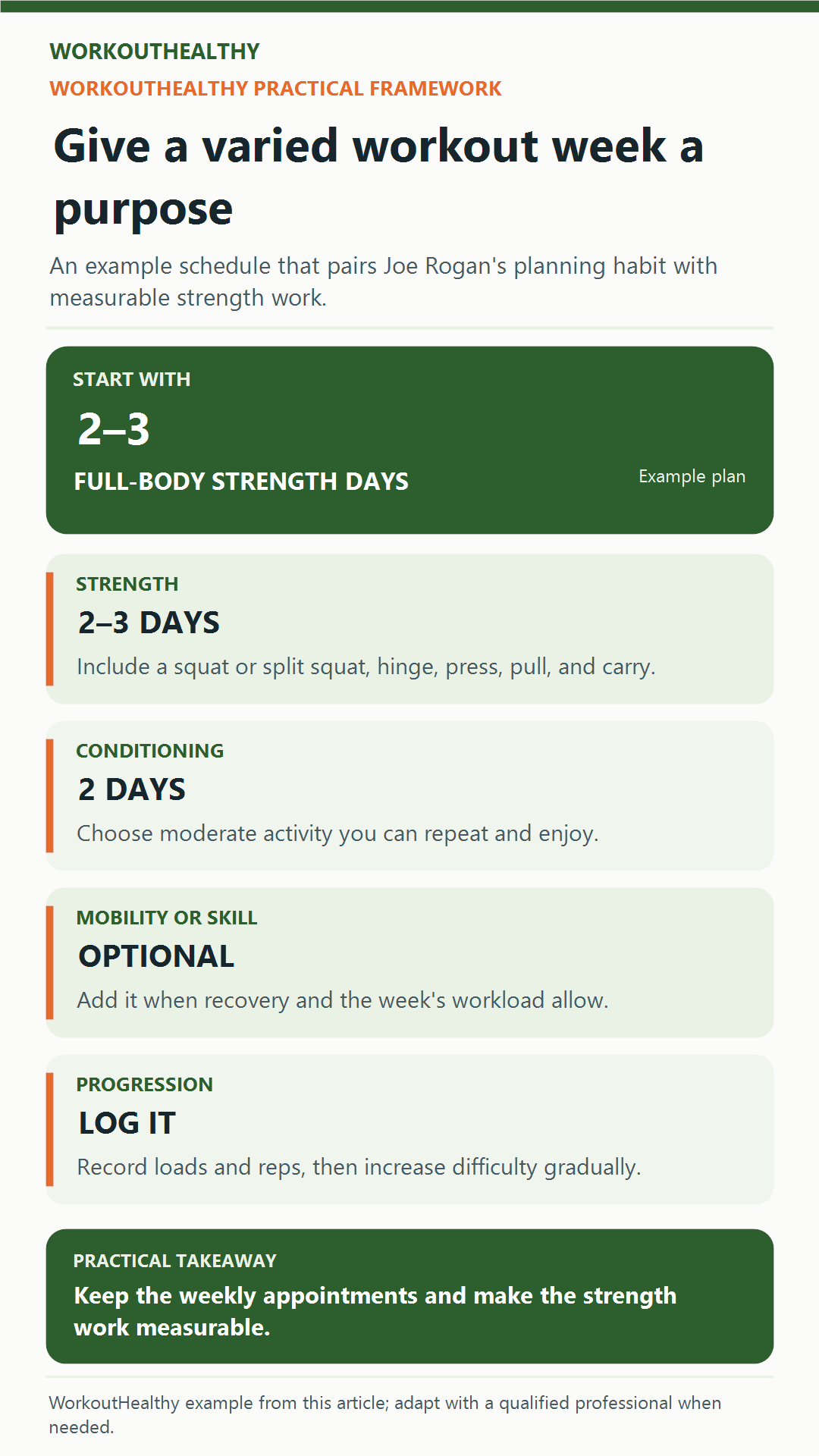
A general trainee could keep Rogan’s Sunday planning habit while applying clearer progression. Schedule two or three full-body strength sessions, two moderate conditioning sessions, and optional mobility or skill work around recovery and personal preference.
Each strength session can include a squat or split squat, a hinge, a press, a pull, and a carry. Record loads and repetitions, add difficulty gradually, and stop or modify movements that produce persistent pain.
Nutrition can be similarly practical: build meals around adequate protein, include a variety of minimally processed plant foods, and limit free sugars without fearing whole-food carbohydrates. Seek individualized medical advice before making restrictive dietary changes or considering hormones.
The Bottom Line
The Joe Rogan and Mike Israetel comparison is most useful when it is not treated as a winner-take-all argument. Rogan demonstrates commitment and variety, while Israetel supplies the clearer framework for targeted progression.
Keep the calendar, enjoyable movement, and consistency. Add measurable resistance training, reject unsupported seed-oil fear, treat carnivore claims cautiously, and keep TRT inside a real medical relationship.
Get the next evidence check.
Five practical fitness stories worth your time, every Friday.
One email a week. No product pitches. Unsubscribe in one click.
References
- Renaissance Periodization. (2024). Exercise Scientist Critiques Joe Rogan’s Training, Diet, and Drug Use.
- Meigh, N. J., et al. (2019). Kettlebell training in clinical practice: a scoping review. PubMed.
- Otto, W. H., et al. (2012). Effects of weightlifting versus kettlebell training on vertical jump, strength, and body composition. PubMed.
- St-Onge, E., et al. (2019). Shoulder muscle activity during the Turkish get-up. PubMed.
- Schoenfeld, B. J., et al. (2017). Strength and hypertrophy adaptations between low- versus high-load resistance training. PubMed.
- Currier, B. S., et al. (2023). Resistance training prescription for muscle strength and hypertrophy in healthy adults. PubMed.
- Pallarés, J. G., et al. (2021). Full versus partial range of motion in resistance training. PubMed.
- O’Hearn, L. A., et al. (2026). Carnivore diet: a scoping review. PubMed.
- Johnson, G. H., & Fritsche, K. (2012). Effect of dietary linoleic acid on markers of inflammation. PubMed.
- Vega-López, S., et al. (2023). Linoleic acid intake and cardiometabolic outcomes in randomized trials. PubMed.
- American Heart Association. (2017). Dietary Fats and Cardiovascular Disease.
- Endocrine Society. (2018). Testosterone Therapy in Men With Hypogonadism.
- World Health Organization. (2015). Guideline: Sugars intake for adults and children.
Medical disclaimer: This article is for general information only and is not medical advice. If you have an injury, ongoing pain, or a medical condition, talk to a doctor or physical therapist before you change how you train or eat.