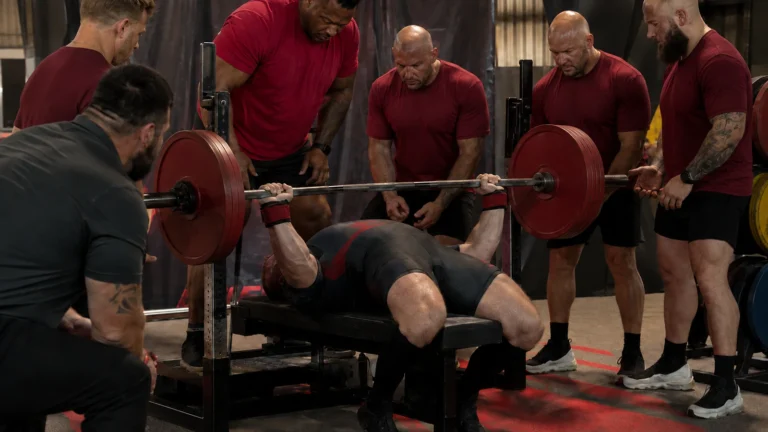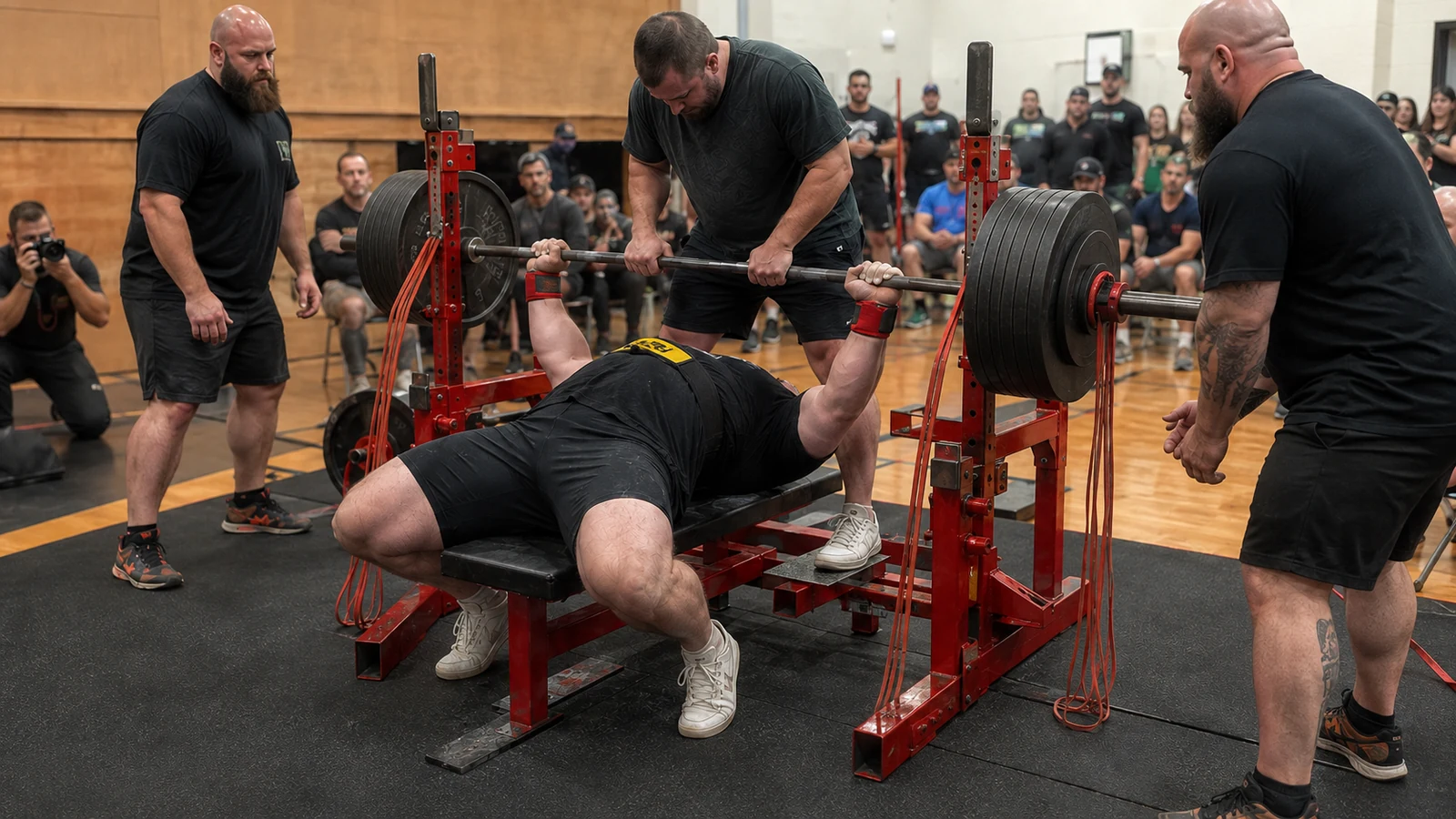

Jeremy Hoornstra pressed a barbell loaded to 306.1 kilograms off his chest and locked it out at the elbows.
That converts to 674.83 pounds, close enough to 675 that almost every retelling of the lift just rounds up.
He did it without a bench shirt, the stiff supportive garment that can add well over 100 pounds to a max bench press on its own.
A YouTube video of the lift, titled “Jeremy Hoornstra – 675 RAW Bench Press – World Record at 266 Body Weight,” has circulated among strength fans for years.
This article checks what can actually be confirmed about that lift, and where it fits inside the real history of raw bench pressing.
What Actually Happened at Kings of the Bench X
The workbook behind this article gave almost nothing to work with beyond the number itself, no date, no meet name, and no governing body.
Cross checking OpenPowerlifting’s public results database against the video’s own title closed that gap.
On June 12, 2014, Hoornstra competed at an event called Kings of the Bench X, held in Texas by a bench press specialty federation called Hardcore Powerlifting.
He weighed in at 120.7 kilograms, which is 266.1 pounds, the same “266 body weight” figure named directly in the video’s title.
On his best attempt that day he pressed 306.1 kilograms, or 674.83 pounds, competing raw and taking first place in his division.
Three independent details, the bodyweight figure, the bench figure, and the video’s own title, all line up with each other.
That agreement is what makes this lift verifiable, even though no dedicated news article about this specific meet could be located.
Records from Hardcore Powerlifting’s era of Kings of the Bench meets rarely got mainstream sports coverage the way major national federation meets do today.
Most of what survives from that circuit lives inside results databases and the footage lifters and spectators uploaded themselves, which is exactly the kind of record this video represents.
The Federation Behind the Record, and Why That Matters
Hardcore Powerlifting is a real, documented federation, not an invented one.
Its meet history shows a run of bench only events between 2006 and roughly 2015, mostly in Texas and Nevada, under names like Kings of the Bench and Clash of the Titans.
That history matters because it is not one of the larger sanctioning bodies most readers would recognize, such as the IPF, USAPL, or USPA.
A record inside a smaller specialty federation is still a real, judged, competitive result.
It is not automatically the same thing as an all time world record recognized across the entire sport.
Calling this a “world record” without that context, the way the original video’s title does, overstates what one specialty federation’s own bench meet can actually certify.
WorkoutHealthy has run into this same gap before, including a Guinness certified bodybuilding record that needed its own separate verification process before it counted as official.
A heavy raw bench press like this never comes from one skill alone, since it takes grip, arch, leg drive, and a rehearsed setup working together on the same lift.
Where 674.8 Pounds Sits in Raw Bench Press History
Raw bench press numbers grew slowly for decades, then accelerated once specialty bench meets and dedicated bench specialists became common.
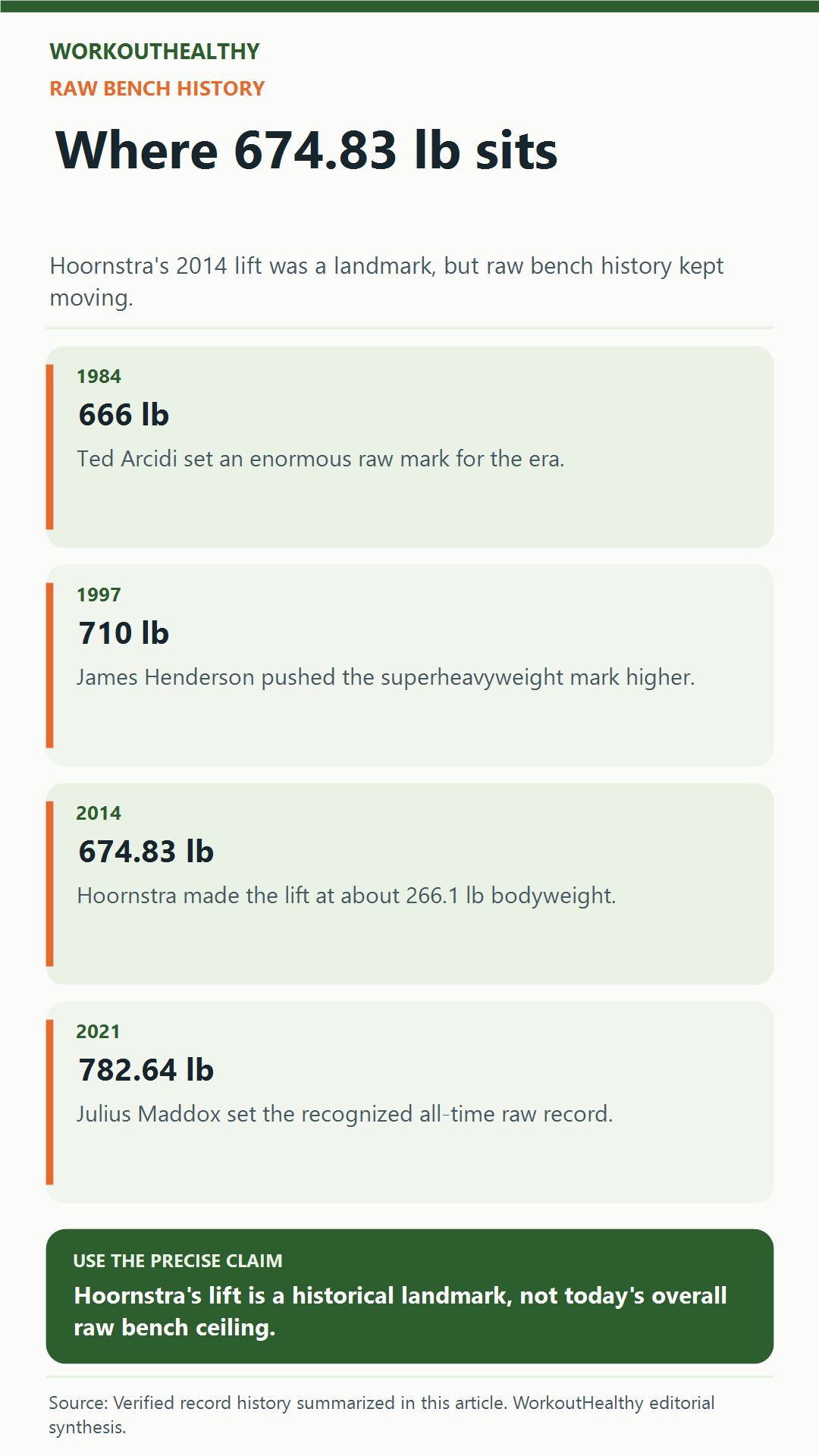
Ted Arcidi is credited with a 666 pound raw bench in 1984, an enormous number for its era.
James Henderson pushed a raw super heavyweight mark to 710 pounds in 1997.
Hoornstra’s 674.83 pound press at 266 pounds bodyweight in 2014 sits well inside that same climbing curve, heavy for a lifter far below super heavyweight.
He kept competing after that meet, and in 2018 he set a separate, IPL recognized raw bench world record of 650 pounds in the 242 pound weight class.
That second record came from a mainstream federation, which is useful context even though it is a different lift in a lighter weight class than the 2014 press this article covers.
The sport’s outer limit has since moved much further.
Julius Maddox holds the current recognized all time raw bench press world record at 355 kilograms, or 783 pounds, set in 2021.
The “Historical / superseded” label on this record fits that broader pattern more than it fits any single named lifter beating this exact mark.
Raw bench pressing as a whole has simply kept moving well past where it stood in 2014.
Why Raw Numbers Hit Different Than Equipped Numbers
Equipped powerlifting allows a bench shirt, a rigid, multi ply garment that stores elastic energy at the bottom of the lift and helps drive the bar back up.
A well fitted bench shirt can add well over 100 pounds to a lifter’s best raw number, sometimes far more at the elite level.
Raw competition strips that assistance away, leaving a belt as the only supportive gear most federations allow.
That single rule is why raw and equipped bench numbers are almost never compared directly in serious powerlifting discussion.
A raw press of 674.83 pounds and an equipped press of the same number represent very different feats of strength.
Readers curious about how even small setup changes affect a press can see this play out clearly in a comparison of the floor press and the standard bench press, where removing leg drive alone changes the numbers a lifter can move.
The Technique Behind a Bench Press This Heavy
Powerlifting research on the bench press consistently points to the same handful of technical factors separating a made lift from a missed one.
A 2009 study that compared successful and unsuccessful maximal bench press attempts found that bar path and the timing of the sticking point, the hardest point in the lift’s range of motion, predicted whether a heavy attempt would go up or stall (van den Tillaar & Ettema, 2009).
A stable arch, thick upper back muscle to press against, and a tight shoulder blade position all shorten the bar’s travel distance and reduce time spent in that vulnerable middle range.
A 2017 study on competitive bench press variations found that grip width and setup changes measurably shift both muscle activation and the amount of weight a lifter can move (Saeterbakken et al., 2017).
Leg drive, pushing hard through the floor to help transfer force up through a braced torso, is significant enough that some adaptive bench press divisions have removed it entirely to keep competition fair for lifters who cannot generate lower body force.
A 2023 paper on that specific rule change treated leg drive as a real, measurable contributor to bench press output, not a minor detail (D’Isanto et al., 2023).
None of that technique appears in a single viral video clip, which is part of why a number like 674.83 pounds looks almost effortless on screen and rarely is in real life.
What This Number Does Not Prove
A single heavy competition lift, captured on video, does not prove a full training history, a supplement stack, or a specific program.
It does not by itself prove that this was ever an all time world record across the entire sport, only that it happened, was judged, and was recorded inside one specialty federation’s meet.
It does not prove that the number would hold up unchanged if attempted again today, since bodyweight, health, and equipment rules all shift over a lifter’s career.
Even fully certified, sanctioned world records get revised constantly as more lifters compete and more meets get held.
WorkoutHealthy has fact checked plenty of claimed records that turned out to be real but more complicated than a headline number suggested, including a Guinness backed push up world record that still required careful math to understand.
Common Mistakes Lifters Make Chasing a Number Like This
The most common mistake is treating a viral bench number as a training template instead of a competition result years in the making.
A close second is loading the bar heavy before the setup, the arch, the grip, and the leg drive are actually consistent under lighter weight.
Many lifters also chase maximum singles too often, which leaves little room for the volume that actually builds pressing strength over time.
Skipping a spotter on true maximal attempts is a mistake that has ended training careers, not just single workouts.
Ignoring shoulder and elbow warning signs because a number on social media feels urgent is another frequent one.
Comparing a raw number straight across bodyweight classes is a smaller but very common mistake too, since a big press at 266 pounds bodyweight and the same number at super heavyweight represent different levels of relative strength.
Who Should Be Extra Careful With Max Effort Bench Training
Anyone with an existing shoulder impingement, a prior pectoral strain or tear, or ongoing elbow pain should not chase a bench press max without a coach or physical therapist involved first.
People with uncontrolled high blood pressure should talk to a doctor before any true one rep max attempt, since maximal lifts briefly spike blood pressure well above resting levels.
Lifters newer to barbell training benefit far more from technique work at moderate weight than from testing a true max early on.
Anyone training alone at home, without a spotter or safety bars, should treat a heavy single as unnecessary risk rather than a badge of progress.
A Practical Way to Build Toward a Bigger Raw Bench
Real raw bench progress starts with consistent technique work, not maximal attempts.
Set the same tight arch, the same foot position, and the same grip width every single working set, so the pattern becomes automatic under fatigue.
Train in the 70 to 85 percent of one rep max range for most heavy sessions, saving true maximal singles for a handful of times a year.
Add dedicated upper back work, rows, face pulls, and rear delt work, since a thicker upper back gives the bar a more stable surface to press against.
Practice leg drive deliberately at lighter loads first, pushing through the floor without letting the hips rise off the bench.
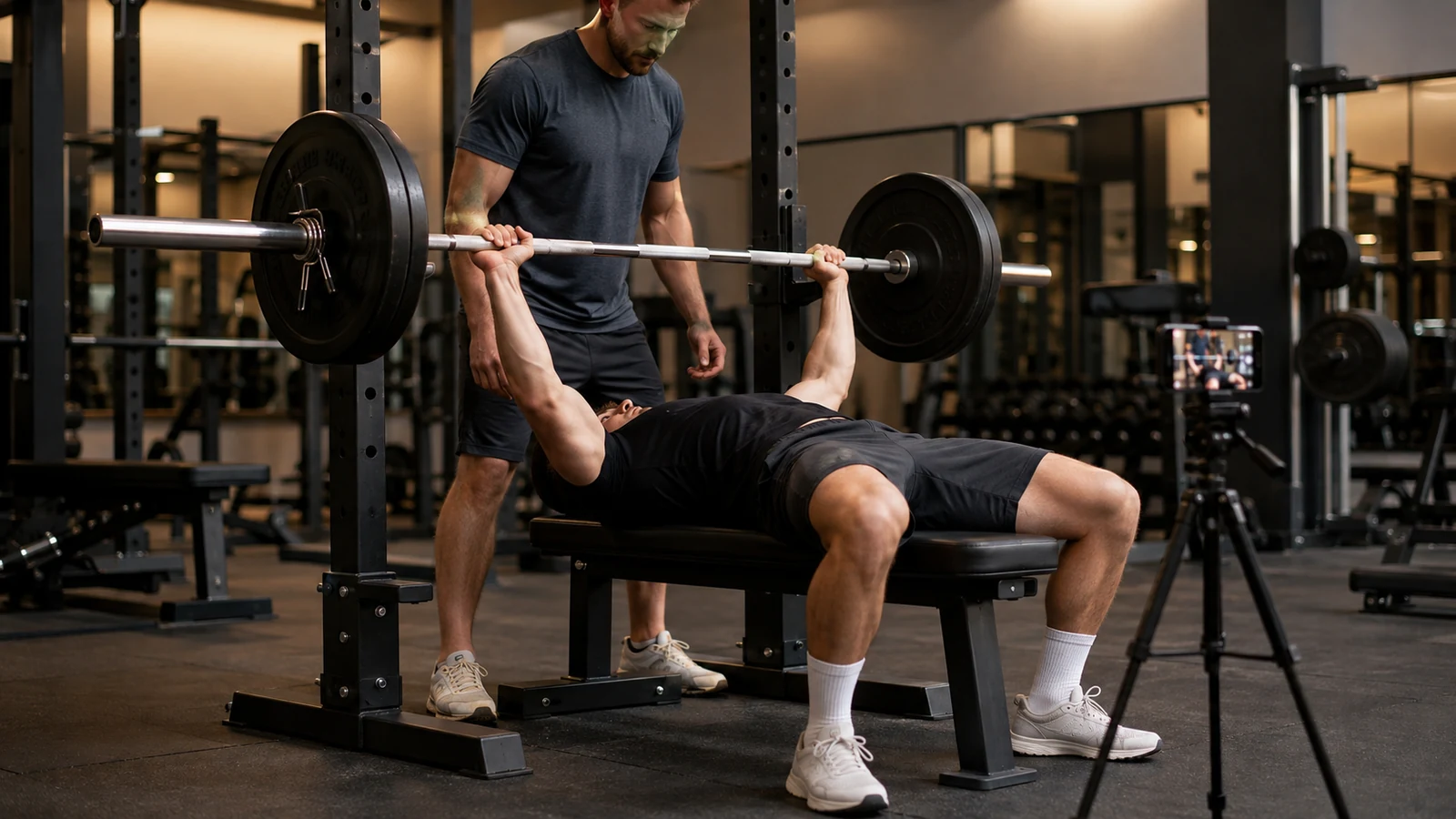
Film every heavy set from the side, since a camera angle catches bar path drift and hip movement long before it becomes obvious in the moment.
Not every strength approach agrees on how much volume that takes.
A very different, lower volume philosophy is covered in WorkoutHealthy’s look at Mike Mentzer’s Heavy Duty training system, which argues brief, intense sessions can build serious strength without the high set counts most powerlifting programs use.
Track the actual number on the bar every session, since strength built this specifically tends to come from small, boring, repeatable progress rather than a single dramatic jump.
The number that made this bench press famous already sits well behind today’s raw world record, though that does not erase what it took to press it back in 2014.
Watch the Original Video
Want more verified breakdowns like this one? Subscribe to WorkoutHealthy Insider for practical explanations behind popular fitness claims.
References
D’Isanto, T., D’Elia, F., Aliberti, S., Di Domenico, F., & Esposito, G. (2023). Unified bench press through the elimination of leg-drive to promote sports inclusion. Physical Education of Students, 27(6), 319 to 324. https://doi.org/10.15561/20755279.2023.0603
Saeterbakken, A. H., Mo, D. A., Scott, S., & Andersen, V. (2017). The effects of bench press variations in competitive athletes on muscle activity and performance. Journal of Human Kinetics, 57(1), 61 to 71. https://doi.org/10.1515/hukin-2017-0047
van den Tillaar, R., & Ettema, G. (2009). A comparison of successful and unsuccessful attempts in maximal bench pressing. Medicine & Science in Sports & Exercise, 41(11), 2056 to 2063. https://doi.org/10.1249/MSS.0b013e3181a8c360
This article is for general information only and is not medical advice. If you have an injury, ongoing pain, or a medical condition, talk to a doctor or physical therapist before you change how you train or eat.